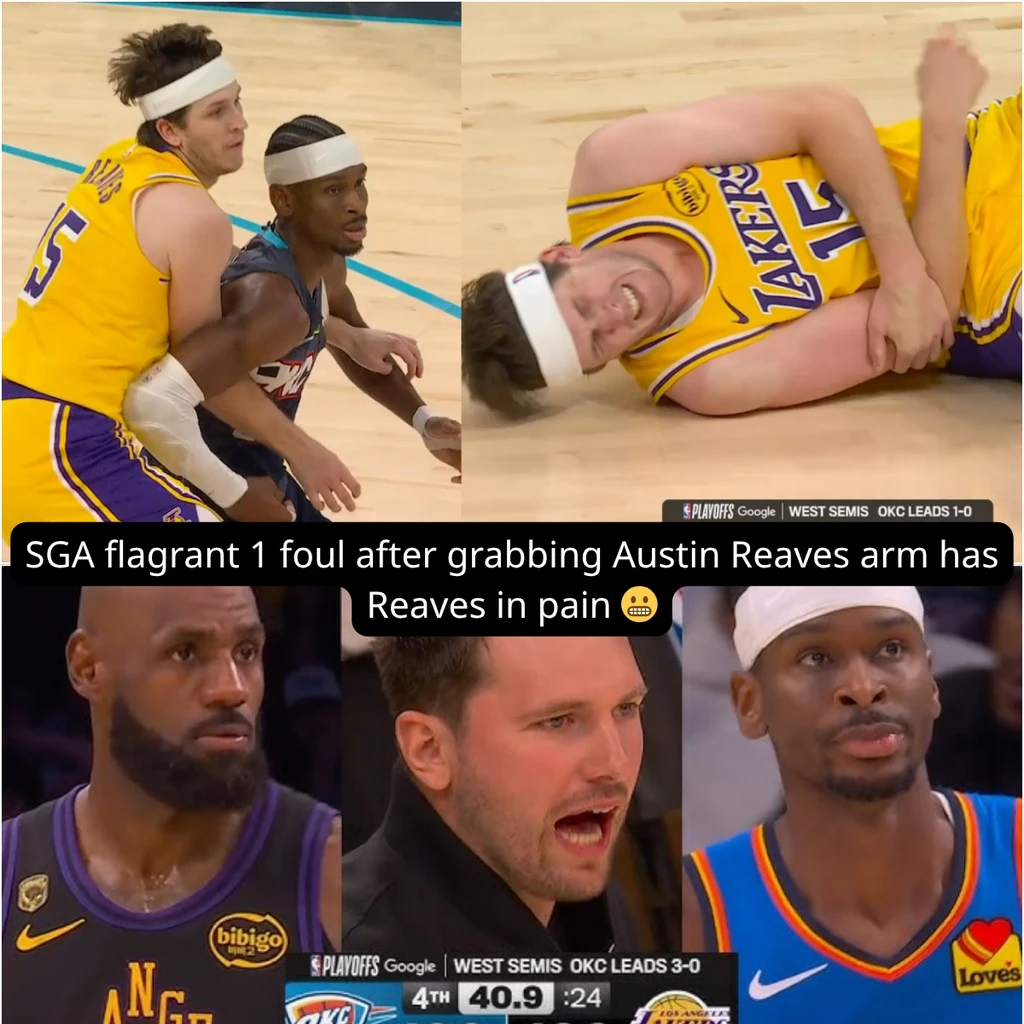
SGA flagrant 1 foul after grabbing Austin Reaves arm has Reaves in pain 😬
SGA flagrant 1 foul after grabbing Austin Reaves arm has Reaves in pain 😬
The atmosphere inside the Paycom Center didn’t just shift; it curdled. In a high-stakes matchup between the Los Angeles Lakers and the Oklahoma City Thunder, a single sequence of play managed to encapsulate the modern NBA’s struggle with officiating, the intensity of playoff-caliber defense, and the sheer volatility of professional basketball.
What began as a routine drive to the basket ended in a flurry of whistles, a star player on the hardwood, and a coaching staff in an absolute frenzy.
The Moment of Impact: Reeves Hits the Deck
The play was fast—blink-and-you-miss-it fast—until it wasn’t. As Austin Reeves moved through the lane, he became entangled with the Thunder’s cornerstone, Shai Gilgeous-Alexander (SGA). In the theater of the NBA, “entanglement” is often a polite word for a wrestling match.
As the whistle blew, Reeves didn’t just fall; he went down with the kind of thud that makes a home crowd go silent. The initial call was a personal foul on Gilgeous-Alexander—his fourth of the night. For OKC, that alone was a disaster. Losing your MVP candidate to foul trouble in a tight game is a nightmare scenario. But the drama was only beginning.
The “Clamp” and the Review
As Reeves remained on the floor, the officiating crew, led by the veteran crew chief, signaled for a video review. The criteria? A Possible Flagrant Foul.
The replay monitors told a story of “the clamp.” In slow motion, the world watched as SGA’s arm appeared to lock in with Reeves’. In the heat of the moment, it’s a chess match of limbs. Who initiated the hook? Who held on longer?
“Yeah, so that arm was locked in there,” noted the broadcast team. “It’s hard… those to me are really tough calls. Who’s wrapping who up there?”
The officials, however, saw intent—or at least, “unnecessary contact.” They ruled it a Flagrant 1. The justification was two-fold: the initial clamp and the “extra” follow-through that sent Reeves spiraling to the floor.
The Sideline Explosion: Alex Caruso and the Technical
While the refs hovered over the monitors, the Thunder sideline was a powder keg. Alex Caruso, known for his high basketball IQ and generally composed demeanor, reached his breaking point.
Arguing that Reeves had actually committed the initial foul by hooking SGA’s arm to draw the whistle, Caruso crossed the invisible line onto the court. The result was instantaneous: a Technical Foul.
The sequence of events created a rare “statistical windfall” for the Lakers:
Technical Free Throw: One shot for the Caruso outburst.
Flagrant Free Throws: Two shots for the foul on SGA.
Possession: The Lakers retained the ball.
The Strategy of the Challenge
Oklahoma City didn’t take the ruling lying down. Mark Daigneault burned his challenge, betting that the overhead cameras would show Reeves as the instigator. The Thunder’s argument was simple: The foul happened before the clamp.
If Reeves fouled SGA first, the subsequent “Flagrant” action might have been nullified or at least mitigated. However, the referees stood their ground. The challenge was unsuccessful, the ruling on the floor was upheld, and the Thunder found themselves in a massive hole—both in points and in the foul column.
The Hartenstein Factor
Isaiah Hartenstein, the Thunder’s vocal big man, was seen persistently pleading the case to the refs. His argument likely centered on the “natural shooting motion” or the “marginal contact” that occurs when two elite athletes collide at 15 mph. But in the modern NBA, the “clamp and rip” is a point of emphasis. If you wrap the arm, you’re going to pay the price.
The Fallout: A “Bunch of Free Throws”
The sequence resulted in what the announcers described as a “bunch of free throws.” Austin Reeves, shaking off the hit, stepped to the line to capitalize on the chaos.
The Technical: Swish.
The Flagrant Pairs: Swish, Swish.
In a matter of seconds, the Lakers turned a physical defensive stand by OKC into a multi-point possession without the clock even running.
Analysis: Why This Matters
This wasn’t just about one game in mid-May. This was a microcosm of the tension between physicality and officiating.
SGA’s Foul Trouble: With four fouls, Gilgeous-Alexander is forced to play “hand-off” defense for the remainder of the game. The Lakers’ scouting report just became very simple: attack Shai.
The Caruso Factor: Caruso is the emotional heartbeat of the Thunder’s defense. A technical foul limits his ability to be aggressive and vocal without risking an ejection.
The Lakers’ Momentum: For a team like Los Angeles, these “free” points are oxygen. In a league where margins are razor-thin, a 4-point swing and possession of the ball can be the difference between a win and a plane ride home.
As Reeves made his way back on defense, the boos in Oklahoma City were deafening. The Thunder felt robbed; the Lakers felt vindicated. But as the dust settled, one thing was clear: the officials had drawn a line in the sand. In the battle of the “clamp,” the aggressor—real or perceived—will always be the one to pay.