Scientists Were WRONG About Pompeii’s Children | The DNA Evidence Changes Everything
Scientists Were WRONG About Pompeii’s Children | The DNA Evidence Changes Everything
The boy lay on his right side, his knees drawn up toward his torso in a tight, defensive fetal curve. His small hands were folded neatly against his chest, right over the center of his sternum, as if he were trying to protect a fragile secret hidden beneath his woolen tunic. His eyelids were smoothly closed, unmarred by the terror that had consumed the final hours of his world. To the untrained eye, he looked exactly like a child who had grown tired of playing in the sun-drenched vineyards of the Italian coast and had simply curled up to sleep in the deep clover.
He was not sleeping. He was dying.
Nearly two thousand years ago, on a catastrophic morning that transformed the vibrant Roman city of Pompeii into a landscape of ash and bone, Mount Vesuvius detonated with the force of a hundred thousand atomic bombs. The second phase of the eruption unleashed a succession of ground-hugging pyroclastic surges—avalanches of superheated gas and dense volcanic debris traveling at over a hundred kilometers per hour. When the third surge breached the southern ramparts of the city wall, the internal temperature of every structure and open courtyard spiked to two hundred and fifty degrees Celsius in a fraction of a second.
Death did not wait for a breath. The thermal shock killed the city’s remaining two thousand inhabitants long before their lungs could register the toxic, sulfurous air or their nervous systems could process the pain of a burn.
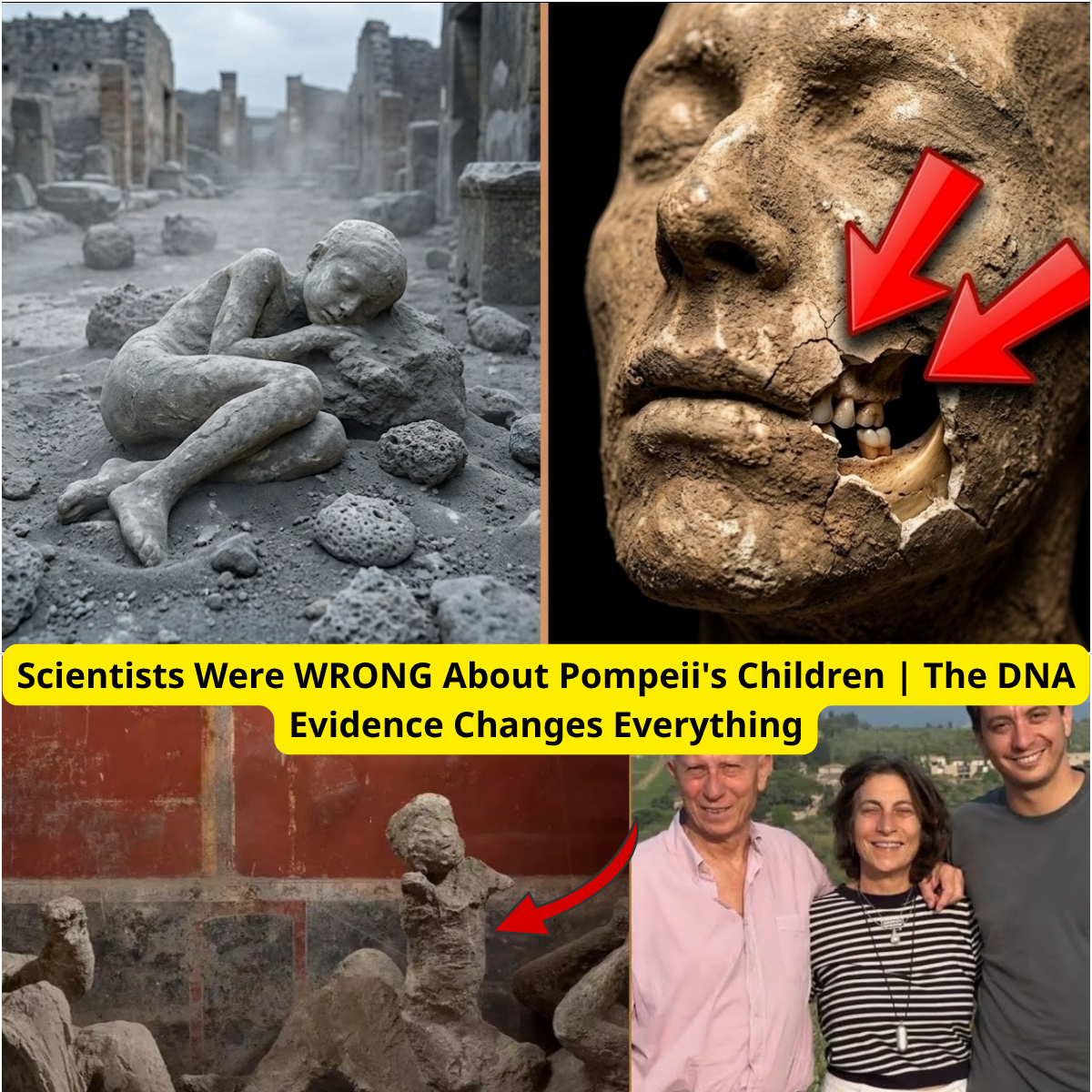
The bodies were instantly enveloped by an incredibly fine, dense blanket of gray volcanic ash. Over the following centuries, as rain compacted the debris into solid stone and the organic tissue of the dead slowly decomposed, it left behind a series of hollow cavities within the subterranean strata. These voids formed a perfect, high-resolution negative imprint of the exact moment life ceased. Every line of a knuckle, every fold of a heavy linen mantle, and every soft curve of a child’s lip remained suspended in the rock.
When nineteenth-century excavators began injecting liquid plaster into these hollow spaces, they didn’t just find bones. They resurrected the ghosts of the Roman Empire.
For more than a hundred and fifty years, the curators of the Pompeii archaeological site provided visitors with an emotionally devastating, easily digestible narrative for the small casts. They spoke of parental devotion frozen in stone. They pointed to the groups of adults and children clustered together in corridors and public gardens, describing them as nuclear families who had chosen to perish in each other’s arms. A brave father shielding his young son from the falling pumice; a terrified mother cradling her infant against her breast in a final, futile act of maternal sanctuary.
The stories were heartbreaking. They were also entirely manufactured.
In November 2024, a landmark international study published in the journal Current Biology completely shattered the sentimental folklore that had been sold to millions of museum visitors. An advanced research consortium comprising geneticists from Harvard University, the Max Planck Institute, and the University of Florence succeeded in extracting ancient DNA from the highly degraded bone fragments still trapped deep inside the plaster shells.
The process was an archaeological minefield. During early twentieth-century restorations, the fragile skeletons within the casts had been cracked, shifted, and inadvertently contaminated with modern additives. Reaching the petrified marrow required the team to utilize ultra-thin, surgical drills, boring through hairline fractures in the plaster that were barely wider than a standard pencil.
Out of fourteen distinct plaster casts selected for testing, six yielded highly preserved, authentic ancient DNA. Five produced complete, indisputable genomic profiles. And when the data was fully sequenced, the romanticized mythology of the Roman family collapsed into the dust.
The House of the Bracelet
Dr. Marcus Vance leaned over the illuminated light table in the temporary laboratory facility set up just outside the Porta Nocera. On his high-resolution monitor, the chromosomal mapping of four specific casts recovered from an elite Pompeian villa—the House of the Golden Bracelet—was laid out in parallel columns.
For half a century, this specific group had been the crown jewel of Pompeii’s human exhibitions. Discovered beneath a collapsed masonry staircase near a luxurious sunken garden, the configuration of the bodies seemed to tell an unmistakable story. An adult lay on their back, cradling a tiny four-year-old child directly on their lap. A second adult lay just a few feet away, their arm extended toward a slightly older youth who was huddled against the wall.
Because one of the adults wore an extraordinarily heavy, intricately worked cuff of solid gold on their wrist, early excavators immediately labeled the individual as a wealthy matriarch. The exhibit was officially captioned as a tragic upper-class family: a mother, a father, and their two beloved children, trapped together while attempting to flee through the service exit of their mansion.
Marcus pointed a gloved finger at the genetic breakdown of the “mother” wearing the gold jewelry.
“Look at the sex chromosomes on specimen 58A,” Marcus said, his voice flat with clinical certainty. “It’s a clear X and Y profile. The individual wearing the heavy golden bracelet wasn’t a woman. He was a biological male.”
His research assistant, Chloe, shifted her gaze to the adjacent data column. “And the child on his lap? Is it his son?”
“Not even remotely,” Marcus replied, scrolling down to the maternal and paternal lineage markers. “There is zero genetic continuity between the adult male and the toddler. In fact, none of the four individuals found huddled beneath that staircase shared any close biological relationship whatsoever. They weren’t a family. They were a random assortment of human beings who happened to seek shelter in the exact same dead-end corridor while the sky was falling.”
Chloe stared at the plaster photograph of the four-year-old child, whose features had been preserved by the ash with harrowing clarity. “So the wealthy mother cradling her baby was a total fiction.”
“An absolute invention,” Marcus nodded. “We projected our modern, middle-class Western ideals of the nuclear family backward onto a ancient society that operated under a completely different social blueprint. That child wasn’t being held by a parent. He was being held by a domestic servant, a neighbor, or perhaps a desperate house slave who simply grabbed the nearest mobile body when the villa’s roof began to cave in under thirty centimeters of falling pumice.”
The DNA profile of the toddler revealed something even more complex: his genetic ancestry was rooted deeply in the eastern Mediterranean—likely the Levant or western Anatolia. His family line had crossed the sea generations earlier, swallowed up by the immense, chaotic machinery of the Roman Empire, which constantly pulled millions of bodies from the provinces into the Italian heartland as traders, laborers, and slaves.
The study revealed that this dislocation of children from their biological parents was not an isolated anomaly; it was the definitive rule of the disaster. Across every major cast group tested, the adults found accompanying young children were genetically unrelated to them. The intense physical proximity that historical novelists had interpreted as parental love was actually the result of social proximity—the complex, multi-tiered hierarchy of the Roman familia.
Left Behind
To understand why the children of Pompeii died in the arms of strangers, Marcus knew he had to look past the romance of the ruins and confront the brutal socio-economic realities of a Roman imperial port city.
The eruption of Vesuvius was not an instantaneous explosion that caught the population entirely unawares. The disaster unfolded in distinct, agonizing phases. The initial phase lasted for roughly eighteen hours, during which a colossal plinian column of white and gray pumice shot thirty kilometers into the stratosphere, blocking out the sun and raining millions of sharp, glassy stones down upon the bay.
As the pumice piled up on the flat roofs of Pompeii at a rate of fifteen centimeters per hour, the timber beams began to creak and shatter. The air became thick with white dust, and the streets grew progressively impassable. During those eighteen hours, anyone who possessed the economic means, physical mobility, or social freedom to leave the city did so.
“The elite families didn’t sit in their dining rooms waiting for the mountain to clear its throat,” Marcus explained during a site briefing with the local conservation directors. “They packed their silver, harnessed their mules, and used their connections to flee south toward Salerno or east into the Campanian countryside. They had the resources to escape the initial warning signs.”
“But they didn’t take everyone with them,” Chloe noted, looking over the demographic mapping of the skeletons found in the upper ash layers.
“No,” Marcus said grimly. “They left behind the property. They left behind the old, the infirm, the heavily pregnant, and the very young. A wealthy Roman household wasn’t just a mom, a dad, and a couple of kids. It was a massive corporate entity housed under one roof. It contained freed technicians, hired seasonal laborers, wet nurses, and dozens of domestic slaves who performed every physical task from cooking to childcare.”
When an elite family fled the city on the first afternoon of the eruption, they left a skeleton crew behind to guard the real estate and protect the heavy valuables from looters. If a young child was deemed too fragile or difficult to transport through a rain of falling rocks, or if the parents assumed the eruption would blow over in a few days, the child was left behind in the care of the household staff.
The DNA evidence demonstrated that the individuals who perished with the children were the household members who simply did not have the legal or financial agency to run. They were the people at the absolute absolute bottom of the imperial social pyramid—enslaved nursemaids, tutors, and stable hands—trapped in dark rooms with someone else’s offspring while the sky turned to fire.
In 2018, confirmation of this terrifying isolation was uncovered in the Central Baths, a massive public complex near the intersection of the Via di Nola. Deep within a corner of the vaulted frigidarium, excavators uncovered the isolated skeleton of a single child, aged roughly seven or eight years old.
The child was completely alone.
The skeletal remains were found crouched in a tight corner behind a marble basin, the legs drawn up tightly against the rib cage, the arms wrapped around the shins. The pyroclastic surge had blasted through the high clerestory windows of the bathhouse, instantly sealing the room in a thick layer of liquid mud and fine ash. There was no adult cast within fifty meters of the body. No mother. No protective father. No loyal servant.
This child had been abandoned to navigate the screaming chaos of a dying city entirely on their own, seeking shelter inside a dark, echoing public monument while the roofs of the surrounding residential neighborhoods collapsed into the street.
The Value of Property
The cold reality of Roman childhood was that a young life was viewed through the lens of utility and legal ownership, rather than inherent human rights.
Under the foundational statutes of Roman law, a child was classified under the absolute executive authority of the oldest living male patriarch—the paterfamilias. This legal concept, known as patria potestas, granted a father absolute power of life and death over every member of his household. A father could legally sell his children into chattel slavery if the family fell into debt. He could legally execute an adult son for treason against the family honor.
Most famously, a Roman father possessed the right of exposure (expositio). When a child was born, it was placed on the bare earth at the father’s feet. If the paterfamilias stooped to pick the infant up, it was officially accepted into the household. If the child was female, deformed, sickly, or simply an unwanted financial burden, the father could order it to be carried out to the local town dump or a public crossroads and abandoned to die of exposure or be collected by local slave-traders.
“We have to stop looking at these casts through a post-Victorian lens,” Marcus told his students as they walked through the Garden of the Fugitives, where the plaster figures lay arranged beneath protective glass canopies. “A child in this society was not an inherently protected individual. Until a child reached adolescence and entered the legal fabric of the state, they were essentially private property.”
In elite Roman homes, the physical and emotional labor of raising children was systematically delegated downward to the enslaved population. Within days of birth, a child was handed over to a nutrix—an enslaved wet nurse whose own newborn child had often been taken away or exposed so that her milk could be utilized by her masters. The wet nurse was the person who fed the child, carried it through the loud markets, and sang it to sleep in the small rooms at the back of the atrium.
As the child grew older, it was transferred to the custody of a paedagogus—a slave who served as a personal chaperone and tutor. These men, frequently educated captives from the Greek-speaking provinces of the East, accompanied the child everywhere, protecting them from the chaotic traffic of the streets, sitting with them at school, and enforcing discipline with a leather strap.
To a Roman child of high status, the biological mother and father were often distant, majestic figures who managed the family’s political alliances and financial portfolios. The face that a child reached for when the earth began to tremor was almost certainly the face of an enslaved caretaker who had been bought and paid for at the local slave auction.
And for the children of the slaves themselves, life was even more precarious. Born into automatic bondage, they were integrated into the household workforce from the moment their bones were strong enough to lift a bucket.
In 2021, forensic examinations of the human skeletons recovered from the ancient commercial bakeries near the Insula of the Chaste Lovers revealed a horrific subtext to the city’s economic life. Deep within the windowless, cramped mill-rooms where massive basalt stones were turned by blinded donkeys and weary men, archaeologists found the distinct, thin bones of children aged six and seven.
Their skeletons did not bear the sudden, violent trauma of the eruption. Instead, their joints showed the unmistakable, permanent distortions of chronic, repetitive labor—spinal compressions from carrying heavy sacks of grain and malformed shoulder blades caused by pulling the heavy levers of the flour hoppers. They had died long before the volcano erupted, their small lives consumed by the industrial machinery of the empire.
The Unwritten Record
Near the edge of the Vineyard of the Fugitives lay the smallest plaster cast ever produced in the history of Mediterranean archaeology. It was an infant, estimated by forensic anthropologists to be less than nine months old.
The cast was a miniature masterpiece of ancient tragedy. The tiny indentation of the child’s cranium was visible against the rock, the miniature fingers clenched into tiny, tight fists, the legs drawn inward in a defensive spasm that mirrored the larger bodies around it. It had been carried in the arms of an adult whose cast had been badly damaged during the early excavations of 1961.
For generations, tourists had stood before this tiny glass display case and wept openly, convinced they were witnessing a mother’s final, desperate attempt to carry her baby through the city gates to the safety of the sea.
“The truth is, we don’t even know the biological sex of the adult who was carrying that infant,” Chloe said, adjusting her camera as she documented the cast’s current state of preservation. “It could have been a young male stable hand. It could have been an elder sister who was a kitchen slave. It could have been a neighbor who found the baby crying in an empty atrium after the villa had been abandoned.”
“And that’s the real tragedy of the DNA revolution,” Marcus said, turning off his monitor as the sun began to set behind the jagged purple peak of Vesuvius. “The science can dismantle the convenient lies we’ve been telling ourselves for a century. It can tell us who these children were not with. It can prove with absolute mathematical certainty that they did not die in the arms of their biological families.”
He looked out over the empty, excavated streets of the ancient city, where the shadows of the broken columns were stretching toward the sea.
“But the DNA cannot tell us what those final moments actually felt like,” he continued softly. “It cannot tell us if that enslaved tutor held that child out of genuine, deep-seated human affection, or if he held him simply because the terror of the dark was too immense to face alone. The ash preserved the physical architecture of their loneliness, but it left the human connection unwritten.”
Of the one hundred and four original plaster casts created by the pioneering archaeologist Giuseppe Fiorelli in the nineteenth century, only a small fraction have undergone modern genetic analysis. The vast majority of the children of Pompeii remain locked inside their gray plaster carapaces, stored in climate-controlled museum vaults and dark holding rooms beneath the ruins, their true identities and relationships hidden behind the convenient assumptions of modern historians.
As the new forensic tools of the twenty-first century are systematically applied to the remaining dead, the romanticized, comfortable myths of the ancient world will continue to dissolve. The image that emerges from the data is not a portrait of domestic bliss frozen in time, but a stark, uncompromising look at an empire where children were often expendable, where families were fractured by the boundaries of legal status, and where the final, desperate embrace of a dying child was given not by a mother, but by a stranger who had been left behind to burn.