Scary Videos and Disturbing Footage That People Still Talk About
Scary Videos and Disturbing Footage That People Still Talk About
In an era defined by high-definition smartphone cameras and omnipresent home surveillance, the ancient human obsession with the supernatural has not withered; instead, it has digitized, transforming the grainy ghost stories of the past into viral, terrifyingly immediate video clips that haunt our feeds and disrupt our sleep.
The New Age of Apparitions
For generations, the classic American ghost story required a campfire, a creaky Victorian mansion, or a seasoned orator spinning yarns from a forgotten local history book. The terror was abstract, built entirely in the theater of the mind. Today, however, the campfire has been replaced by the glowing screen of a smartphone, and the orator is an everyday person who happened to hit “record” at the exact moment their reality fractured.
The modern internet is flooded with a highly specific genre of content: brief, unedited, and deeply unsettling video clips that capture the precisely timed collision of the mundane and the inexplicable. These are not Hollywood productions backed by million-dollar special effects budgets. They are raw, shaky, and often captured in the dead of night by ordinary people—homeowners loading their cars, teenagers exploring local woods, or grandchildren caring for aging relatives.
What makes these digital artifacts so uniquely compelling to an American audience is their proximity to the everyday. They suggest that the barrier between our highly organized, technologically advanced society and the primal, shadowy unknown is far thinner than we care to admit. When an anomaly occurs on a Nest cam or a TikTok live stream, it brings the supernatural directly into the modern American living room, forcing a skeptical public to ask: what if?
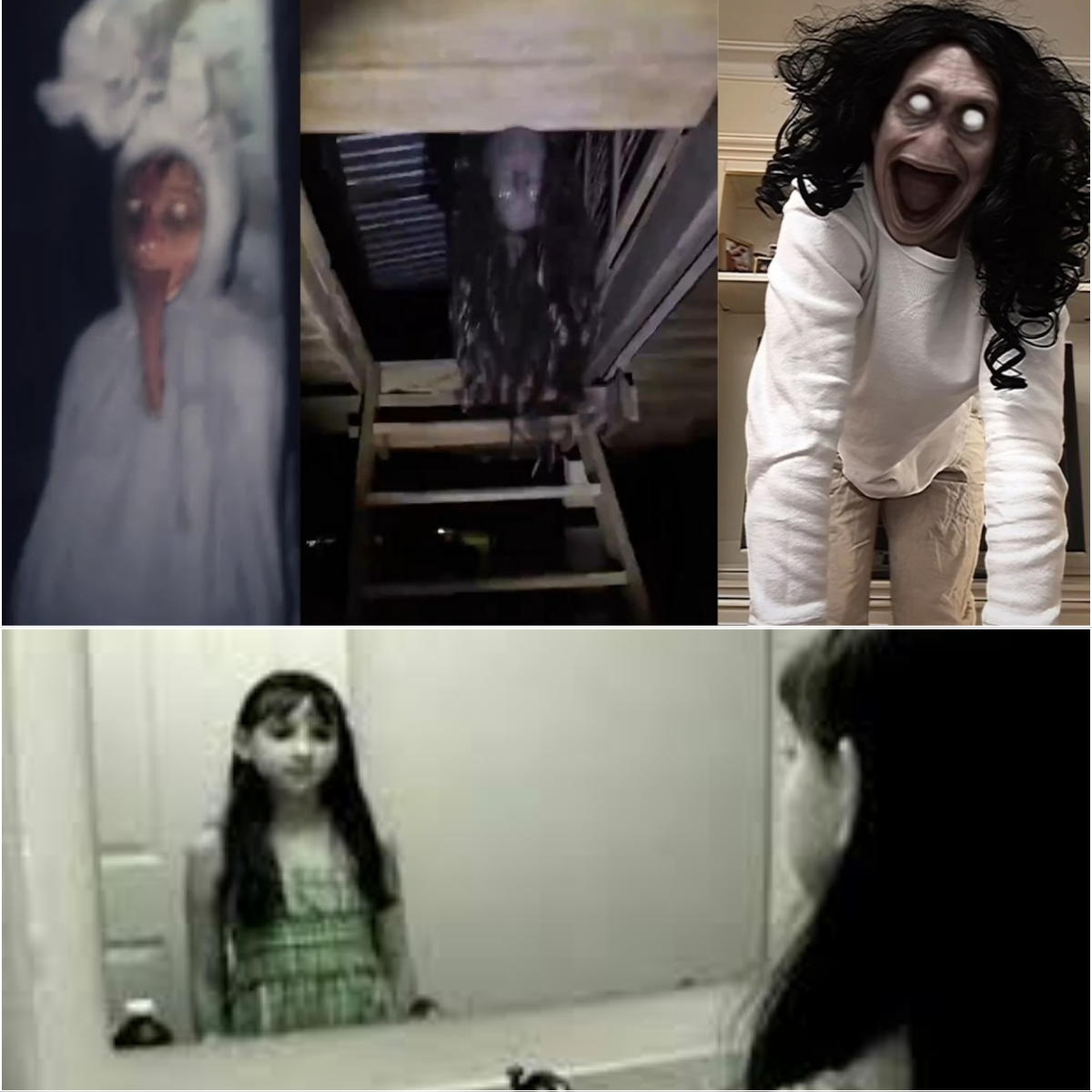
Shadows in the Woods: The Forest Boundary
One of the most recurring themes in contemporary paranormal media is the terror of the forest edge. In the vast suburban and rural expanses of the United States, the backyard often ends where a dense, unmanaged tree line begins. It is a boundary line between human civilization and the lawless natural world—a perfect canvas for the projection of our deepest anxieties.
Consider a common scenario circulating in digital folklore: a father and his young daughter are spending a quiet afternoon outside their suburban home. The atmosphere is completely normal until the child notices a distortion near the wood line. She points, her voice shifting from playful innocence to sharp panic as she tries to guide her father’s eyes toward a shape that defies normal human anatomy.
When the father approaches, the figure vanishes into the brush, leaving behind only a brief, ambiguous silhouette captured on a smartphone lens.
Psychologists often note that children are uniquely attuned to anomalies in their environment, unburdened by the cognitive filters that adults use to rationalize away the bizarre. For the parent, the terror of this moment is twofold: the physical threat of an intruder lurking on their property, and the deeply unsettling realization that their child witnessed something fundamentally wrong. The forest edge remains a powerful archetype in the American psyche—a place where the rules of the grid no longer apply, and where things can watch us from the safety of the dark.
The Shoreline Encounter: When Curiosity Turns to Panic
If the forest represents a hidden danger, the open beach at night represents an absolute, terrifying isolation. The vast emptiness of an ocean shoreline after dark offers a different kind of vulnerability, where the soothing sounds of breaking waves can instantly mask the approach of something malicious.
In a highly discussed piece of footage that has circulated across various internet forums, a woman walking along a desolate beach late at night spots a lone figure sitting directly on the shoreline. The area is entirely empty, shrouded in pitch blackness. Driven by a mix of natural curiosity and genuine concern that the person might be in distress, she begins filming as she slowly approaches the figure.
The tension in such recordings relies on a slow, agonizing buildup. The figure remains completely motionless, head lowered, entirely unresponsive to verbal greetings. The silence of the beach becomes suffocating. Then, without warning, the social contract breaks entirely. The figure abruptly snaps to life, rising with terrifying speed and aggressively chasing the recorder into the dark.
This style of video taps into a profound urban anxiety: the vulnerability of isolation. In the dark, our willingness to help a stranger can easily be weaponized against us. The sudden transition from a welfare check to a desperate, panicked flight for survival is a narrative arc that leaves viewers breathless, serving as a stark reminder of why we fear the empty spaces of the world after the sun goes down.
Exploits in the Abandoned: The Haunting of the Far East
The thirst for paranormal validation is a global phenomenon, and American audiences have increasingly turned their attention to international creators who push the boundaries of urban exploration. In Southeast Asia, particularly in Thailand, paranormal investigation has evolved into a high-stakes digital spectator sport, blending deep-seated animistic traditions with modern streaming culture.
In these international dispatches, investigators frequently seek out locations carrying heavy local stigmas—such as abandoned wooden estates located far from residential areas. These houses, left to rot in the tropical humidity, are treated by locals as forbidden territory after dark. Armed with nothing more than a flashlight and a camera, creators navigate these oppressive environments, where every creaking floorboard sounds like a threat.
The climax of these explorations often involves a fleeting, heart-stopping visual anomaly. In one renowned broadcast, as the investigator’s camera panned across a dilapidated doorway, it briefly captured what appeared to be an upside-down, darkened face peeking directly at the lens from the ceiling. The reaction is instantaneous: a lung-shattering scream, a frantic retreat, and the chaotic bounce of a dropped flashlight.
For Western viewers, these videos provide a fascinating, cross-cultural window into horror. The architecture is unfamiliar, the spiritual lore is rooted in centuries-old regional traditions, but the physiological response to terror—the spike in adrenaline, the instinctual urge to flee—is entirely universal. It proves that regardless of geographic borders, a sudden, inexplicable disruption of space triggers the exact same primal panic.
The Plantation Specter: The Stillness of the Dark
Closer to the traditional roots of rural gothic horror are the videos captured within agricultural plantations and deep orchards. In many parts of the American South and global agricultural regions, fields of crops create vast, labyrinthine grids of shadow where lines of sight are severely restricted. Walking through these areas at night is an exercise in sensory deprivation.
A notable video documenting this specific environment features two men navigating a dense plantation at night, their paths illuminated only by the narrow beams of their flashlights. The atmosphere is heavy and quiet until their lights catch a surreal sight: a lone woman standing perfectly still among the crops, entirely out of place in both time and geography.
As the men cautiously advance, attempting to discern whether they are encountering a trespasser or someone in need of medical attention, the woman slowly turns toward the light. The revelation of her countenance—distorted, vacant, or aggressively unnatural—instantly breaks the men’s composure, sending them sprinting blindly back through the dark rows of vegetation.
The horror of the plantation specter lies in its absolute stillness. In nature, living things move, breathe, and react. When a entity stands completely rigid in a desolate field, it violates our basic understanding of living biology. It acts as a scarecrow of flesh and bone, a visual anomaly that warns the subconscious that whatever is standing before us does not belong to the world of the living.
Forbidden Trails: The Cost of Ignoring Warnings
There is a subset of the online paranormal community that approaches the unknown not as casual observers, but as aggressive investigators. These groups actively seek out remote, heavily restricted territories, often documenting their journeys onto land that explicitly wishes to remain unvisited.
One such documented excursion occurred on a freezing December night, when an exploration group traveled to a remote forest known for bizarre local activity. Upon arrival, the environment immediately signaled deterrence: dogs howling in the distance, a massive fallen tree deliberately blocking the trail, and freshly posted signs warning outsiders to stay away.
Ignoring the clear societal boundaries, the group pressed forward into the silent woods. The auditory landscape quickly shifted, throwing strange, metallic creaking sounds through the trees that resembled heavy doors opening in an empty house. Realizing they might be trespassing on highly hostile private property, they attempted to reroute, only to find a secondary perimeter marked by trees wrapped in ominous red-and-white ribbons and explicit warnings of camera surveillance.
The true danger of these explorations often manifests not as a ghost, but as a terrifyingly real human threat. While adjusting their equipment in a small clearing, the group was suddenly ambushed by a woman emerging from the pitch blackness, brandishing a full-sized axe and charging at them without a single word.
The ensuing chaos—the frantic screaming, the dropped gear, the desperate sprint back to their vehicle—recontextualizes the entire genre of paranormal exploration. Sometimes, the warnings posted at the edge of the woods are not there to protect a supernatural secret; they are there to protect the public from a volatile, dangerous reality. The subsequent news that local law enforcement had to detain the individual underscores a sobering truth: the most terrifying monsters we encounter in the woods are often entirely human.
Possessed Belongings: The Intimacy of the Bedroom
While the wilderness offers expansive terror, the true psychological breaking point for most people occurs when the haunting invades the sanctity of the home—specifically, the bedroom. The bedroom is our ultimate sanctuary, the place where we strip away our defenses and allow ourselves to sleep. When an entity corrupts this space, there is nowhere left to hide.
A viral video that perfectly encapsulates this domestic terror begins innocently enough: a young woman is sitting on her bed, recording a casual video with a vintage doll from her collection. The lighting is warm, the mood is light, and the environment is thoroughly familiar.
The shift occurs in an instant. While the woman is looking directly at her camera, the doll’s arm, resting against the wall, distinctly lifts and moves on its own without any physical intervention. The woman catches the movement in her peripheral vision, freezes in absolute, primal terror, and bolts from the room, leaving the camera running in the empty space.
The internet frequently debates the validity of “haunted doll” footage, with skeptics pointing to invisible fishing lines, clever editing cuts, or off-camera assistance. Yet, the emotional resonance of the video doesn’t rely on scientific proof; it relies on the authenticity of the reaction. The sudden transformation of a beloved, inanimate childhood toy into an active, autonomous agent is a deeply rooted trope in American horror, tapping into our fear that the objects we own can secretly turn against us.
The Unseen Knocker: Terror at the Window
Parallel to the fear of the possessed object is the fear of the external entity attempting to gain entry. Windows are designed to let light in and allow us to look out, but at night, they turn into black mirrors, reflecting our own terrified faces back at us while completely obscuring whatever might be standing on the other side of the glass.
In a gripping home recording that plays like a sequence from a suspense film, a homeowner is awakened in the middle of the night by heavy, rhythmic pounding against his window pane. His dog is in a state of aggressive panic, barking wildly at the glass. The homeowner approaches with his camera, demanding that the unseen visitor leave his property.
In the dim light, a pair of pale hands can be seen actively slamming against the glass. Hoping to identify the intruder and de-escalate the situation, the man flips on the exterior floodlights. The moment the darkness vanishes, the physical hands disappear—yet the heavy, rhythmic knocking continues unabated against the structure.
The psychological weight of an invisible force actively hammering on a window is immense. It strips away the physical protection of the home, suggesting that a simple lock and a sheet of glass are entirely useless against an entity that operates outside the laws of physics. The continuation of the knocking into the bright morning hours creates an uncomfortable, lingering dread, leaving both the homeowner and the audience completely defenseless against an unresolved mystery.
The Canopy Apparition: What Lurks Above
When we walk through the dark, our survival instincts naturally train our eyes to scan the path directly ahead of us or look to our immediate left and right. We rarely think to look up. It is this evolutionary blind spot that makes the concept of a canopy-dwelling entity so uniquely terrifying.
This fear was vividly captured by two men exploring a rural wooded area rumored to be the historic site of a tragic discovery. While filming the dark, oppressive landscape, their flashlight beams accidentally swept across the upper branches of a massive tree, revealing a stark, impossible sight.
Nestled high within the dark foliage was a distinct, crimson-colored figure with long, hanging dark hair, sitting completely motionless on a branch. The figure didn’t scream, rustle the leaves, or attempt to climb down; it simply existed in the upper canopy, partially obscured by the shifting shadows, before slowly fading back into the deep blackness of the night.
The image of a humanoid figure perched silently in the high branches strikes at an ancient, ancestral fear of arboreal predators. It forces the viewer to realize that danger can approach from three dimensions, transforming an ordinary walk through the woods into a claustrophobic trap where the sky itself feels hostile.
The Caregiver’s Camera: Alzheimer’s and the Unseen
Perhaps the most emotionally complex and chilling paranormal videos are those that occur within the context of severe illness and elder care. These recordings move away from the sensationalism of haunted houses and look closely at the fragile nature of human consciousness and perception.
A deeply moving and unsettling series of clips shared by a digital creator named Nick documents his daily life caring for his grandmother, who suffers from advanced Alzheimer’s disease. Nick noted a heartbreaking habits common in dementia patients: his grandmother would frequently stand completely still in corners, staring blankly into empty spaces of the kitchen or living room as if engaged in a silent dialogue with someone invisible to the rest of the family.
For months, Nick rationalized this behavior as a standard symptom of her neurological decline. However, the narrative shifted dramatically one evening when his camera captured a sudden, violent physical anomaly. While his grandmother stood staring into her usual corner, a heavy decorative angel figurine—positioned securely on top of the refrigerator—abruptly launched off the appliance and slammed onto the floor without any physical contact. Simultaneously, the family dog began growling aggressively at the empty space.
These videos challenge our clinical understanding of reality. They evoke an ancient folk belief that those transitioning out of this life—whether through age, illness, or cognitive decline—gain a heightened sensitivity to a spiritual dimension that healthy, rational minds are locked out of. It is a deeply uncomfortable concept for a modern audience, suggesting that what we easily dismiss as medical hallucination might occasionally be an accurate perception of an unseen world.
The Yard Phantom: The Everyday Glitch
The final frontier of modern paranormal media is the automated CCTV camera. Across the United States, millions of homes are monitored by static, motion-activated security systems that record the mundane realities of suburban life—deliveries, stray animals, and changing weather patterns. But occasionally, these cameras catch a glitch in the matrix.
In one such piece of security footage, a homeowner named Berlin is outside his house late at night, casually loading items into the trunk of his vehicle before a trip. The driveway is well-lit, and the neighborhood is quiet. As Berlin works, the camera clearly captures a faint, transparent, human-shaped silhouette quickly gliding across the yard, passing mere feet behind his back.
The most compelling aspect of the footage is not the specter itself, but Berlin’s delayed physical reaction. A fraction of a second after the entity passes, he abruptly stops what he is doing, straightens up, and slowly turns around, scanning the empty yard with a look of profound confusion. He didn’t see the phantom with his eyes, but his body clearly registered a sudden, inexplicable shift in the air pressure or temperature.
This is the essence of the modern digital haunting. It does not require a dramatic, cinematic confrontation. It is a quiet, passing anomaly caught on a hard drive—a fleeting suggestion that as we go about the routine tasks of our daily lives, something else is moving alongside us, completely indifferent to our schedules, our security systems, and our skepticism.
The Enduring Appeal of the Digital Macabre
Why do millions of Americans continue to watch, share, and debate these brief, often terrifying video clips? In a world that feels increasingly mapped, measured, and explained by science and data, these digital mysteries offer a strange kind of comfort. They represent the survival of wonder.
Whether these videos are the product of elaborate hoaxes, technological glitches, optical illusions, or genuine encounters with an unmapped reality, their cultural impact remains undeniable. They serve as modern digital folklore, passed from user to user across the vast networks of the internet. They remind us of the age-old lesson our ancestors learned around the very first campfires: the world is incredibly large, our sight is incredibly limited, and it is always wiser to keep a watchful eye on the dark.