Protestants Are Finally Admitting Catholics Were Right About Saints
Protestants Are Finally Admitting Catholics Were Right About Saints
The rain had stopped by midnight, leaving the pavement of the seminary courtyard gleaming like polished obsidian under the yellow streetlamps. Inside the archive room, the air had cooled, but the intellectual intensity between the two men had only deepened. The leather-bound books remained open on the oak table, their pages casting long, angular shadows under the desk lamp.
Ethan sat back in his chair, staring intently at the small wooden rosary his uncle had placed on the table. He picked it up, letting the smooth olive-wood beads slide slowly through his fingers.
“I can see the logic of an intermediate state, Uncle Tom,” Ethan said, his voice dropping into a quieter, more reflective register. “I really can. The scriptural and historical data you showed me about Sheol and the righteous dead makes sense of things I used to skim right past. But transitioning from that to actually living as though the Catholic faith is a reality? There’s an even bigger hurdle for me. It’s the Communion of Saints.”
Thomas leaned back, laced his fingers together over his sweater, and listened intently. He knew that for someone steeped in the modern American Protestant tradition, this wasn’t just a theological puzzle; it was an entirely different way of viewing the cosmos.
“Tell me what pinches you the most about it,” Thomas invited gently.
“It’s the sheer scale of the claim,” Ethan said, looking up, his eyes wide with a mix of awe and frustration. “The idea that Christ’s Body is so radically one that this oneness actually transcends life, physical death, time, and space. The claim that people who died centuries ago are somehow actively aware of my life, praying for me, and actively helping me along my journey to heaven. Coming from my background, the hardest thing to accept isn’t just the mechanics of it—it’s trying to grasp the unfathomable humility and generosity of God.”
“How so?”
“Because in my theological upbringing,” Ethan explained, leaning forward, “salvation is something God does for us while we remain entirely passive recipients. We’re broken sinners; He saves us. Case closed. But the Catholic view implies that God doesn’t just offer salvation to sinners; He actually raises us up to participate directly in His divine life. He invites human beings to participate in the actual management and salvation of the world. It feels… incredibly risky. It feels like it takes the spotlight off Jesus.”
Thomas nodded slowly, his expression full of deep pastoral warmth. “Ethan, you’ve just articulated the exact dividing line between the Reformation and the ancient Church. You’re realizing that the Catholic universe is far more cooperative and interconnected than the Protestant one. But let’s address the most common roadblock first, before we get into that beautiful mystery of God’s humility.”
Thomas pulled a fresh notepad toward himself and drew a large, thick line down the center of the page. On one side, he wrote Worship (Latria), and on the other, he wrote Honor/Intercession (Dulia).
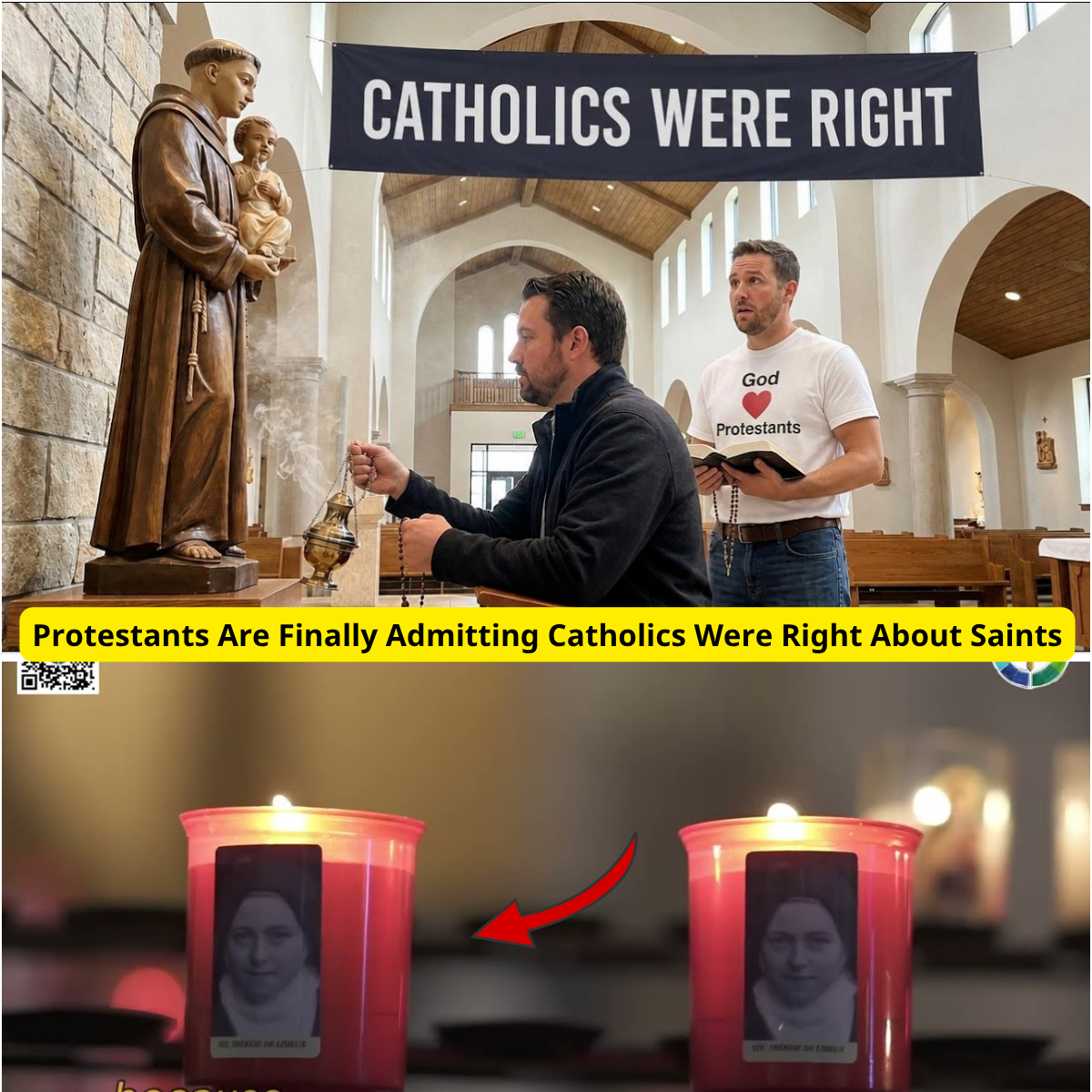
“For years, American Protestants have hurled one accusation at the Church over and over again,” Thomas said. “You’ve heard it a thousand times in your seminary circles: ‘Catholics worship saints. Why are they praying to dead people? Why not just go directly to Jesus? The Bible says worship God alone.’ And honestly, Ethan, if you grow up without much explanation, that sounds like an open-and-shut case. You walk into a historic parish, you see marble statues, flickering votive candles, names on stained glass, and you hear everyday Catholics chanting, ‘St. Anthony, pray for us.’ On the surface, to a modern eye, it looks like we’ve built a pagan pantheon and slapped Christian names on it.”
“Can you blame us for thinking that?” Ethan asked candidly. “It looks like a distraction from the sufficiency of Christ.”
“I don’t blame you at all,” Thomas said. “Many Catholics explain it poorly, making the saints sound like magical wish-granters or minor deities. But let’s lay down the absolute, unshakeable law of the Catholic Church right now: Catholics worship God alone. Father, Son, and Holy Spirit. Only God receives adoration. Only God saves, only God forgives sins, and only God possesses inherent divine power. The saints have zero power of their own. None.”
“Then what is the point of speaking to them?” Ethan pushed. “The Epistle to the Hebrews explicitly teaches that we have direct access to the throne of grace. Because of Christ’s high priestly work, we have a six-lane highway straight to the Father. Why deviate from the highway to talk to someone else?”
“We don’t deviate,” Thomas countered smoothly. “Catholics agree one hundred percent that we can go directly to Jesus. The disagreement isn’t about whether we can go to Him; it’s about whether asking others to assist us along the way somehow insults Him. Let me ask you a practical question, Ethan. When you were going through your difficult final exams last semester, did you ask anyone to pray for you?”
“Of course,” Ethan said. “I asked my parents, my roommates, and the leadership team at my campus ministry.”
“Why?” Thomas asked, his eyes flashing with a sharp, academic wit. “Why didn’t you tell them, ‘No, don’t pray for me, that’s an insult to the six-lane highway of Hebrews! Go to Jesus only!’? Why did you involve your friends?”
“Because the Bible tells us to pray for one another,” Ethan replied automatically. “Intercessory prayer among believers is biblical.”
“Exactly!” Thomas said, striking the table lightly with his hand. “Because Christians intuitively understand that asking a brother or sister to pray for them doesn’t replace Christ’s mediation—it participates in it. Jesus is the one Mediator between God and man, as First Timothy 2:5 states. But He invites His Body to share in that work. If asking your mortal, sinful roommate to pray for you doesn’t obscure the sufficiency of Jesus, why on earth would asking a perfected, glorified Christian in heaven obscure Him?”
Ethan paused, looking down at his notes. “But there’s a massive biological difference there, Uncle Tom. My roommate is sitting right across the room from me. He’s breathing. He can hear me. The saints are… well, they’re dead. The Bible strictly forbids necromancy—communicating with the dead.”
“And that,” Thomas said, leaning forward, “is the fundamental misunderstanding of the afterlife that traps so many modern Christians. Many people—both Catholic and Protestant—secretly believe that when a Christian dies, their soul goes into a deep freeze, a kind of ‘soul sleep’ or a spiritual purgatory of absolute isolation where they are completely blacked out until the final judgment at the end of time. They think the saints are dead as a doornail.”
Thomas flipped the pages of his Bible back to the Gospels. “But what does Jesus say about this? Turn to Luke chapter 20, verse 38. When debating the Sadducees about the resurrection, Christ explicitly states: ‘He is not God of the dead, but of the living, for all live to him.’ Think about the Transfiguration on the mountain. When Jesus is revealed in His glory, who appears next to Him, actively conversing with Him about His upcoming passion in Jerusalem?”
“Moses and Elijah,” Ethan murmured.
“Right. Moses had been physically dead for over a thousand years. Elijah had been taken up centuries prior. Yet there they are, completely conscious, intensely aware of salvation history as it folds out on earth, and deeply involved in the conversation. Look at the data we have from people who undergo profound near-death experiences—when the heart stops and the brain flatlines, their consciousness doesn’t vanish; if anything, it expands. Death is not the extinction of consciousness; it is merely the separation of the soul from the physical vessel. If a Christian is alive in Christ right now on earth, they are even more alive the moment they drop the heavy cloak of the flesh.”
Thomas turned to the final book of the New Testament, flattening the pages of Revelation with his palm.
“If you want to see what the saints are doing right now, look at Revelation chapter 5, verse 8. The Apostle John describes the heavenly liturgy. He sees the twenty-four elders holding golden bowls full of incense. And what does the text explicitly say that incense is?”
Ethan leaned over to read the passage. “‘Which are the prayers of the saints.’“
“And again in Revelation chapter 8, verses 3 and 4,” Thomas pointed out, “an angel stands at the altar with a golden censer, offering the prayers of all the saints on the golden altar before the throne. The inhabitants of heaven are not sealed off in soundproof rooms, completely oblivious to their family members fighting the war on earth. They are part of the great ‘cloud of witnesses’ that Hebrews 12 talks about, cheering us on from the stadium seats. If Christians on earth are commanded to care for one another and pray for one another, why would they suddenly stop caring the second they enter the realm of perfect love? Does entering heaven turn you into an egoist who forgets his own children and grandchildren?”
Ethan remained silent for a long moment, the rhythmic sound of the building’s old radiator hissing in the background. He could see how the scriptural pieces locked together. If the soul is alive, and if the Body of Christ cannot be severed by physical death, then communication within that Body was a logical necessity.
“It changes the way you look at a statue,” Ethan admitted softly, glancing toward a small plaster depiction of St. Francis sitting on a nearby bookshelf.
“Of course it does,” Thomas said. “When someone keeps a framed photograph of their deceased grandmother on their mantelpiece in an American home, does anyone accuse them of worshiping Grandma? If they look at the photo during a hard day and say, ‘I miss you, Grandma, I hope you’re proud of me,’ is that idolatry? No. It’s affection. It’s memory. The physical object is simply a visual anchor pointing to a living reality. The saints inspire us because they were real, broken sinners who walked through the same mud we walk through, yet were entirely transformed by the grace of God. They show us that holiness is actually possible for ordinary people.”
“But what about that original point I made?” Ethan asked, his voice tinged with a deeper theological longing. “The humility of God. Why would an almighty, all-powerful Sovereign want to share His platform with human beings? Why not just do it all Himself and keep the glory perfectly clean?”
Thomas’s face lit up with the expression of a teacher whose student had finally asked the golden question. He turned to the Gospel of John, chapter 17—the High Priestly Prayer of Christ on the night before He died.
“This is where the breathtaking beauty of the Catholic cosmos opens up, Ethan,” Thomas said, his voice rich with emotion. “Look at John 17, verse 22. Jesus is praying to the Father about His disciples, and by extension, all who will believe through their word. He says: ‘The glory that you have given me I have given to them, that they may be one even as we are one.’“
Thomas tapped the verse with his finger. “Think about that. Jesus doesn’t hoard His glory like a jealous worldly monarch. He shares it. He invites us into the inner ring of the Trinity. Because we are baptized into His mystical body, the Church is quite literally a continuation of the Incarnation here on earth. We are His hands, His feet, His eyes, and His mouthpiece to a broken world. When you meet a profoundly holy person on earth—someone radiant with charity and peace—don’t you feel like you’ve just had an encounter with Jesus Himself?”
“Yes,” Ethan admitted. “You see Christ in them.”
“Exactly. Because Christ is living in them. The saints are simply an extension of Jesus. When we honor a saint, we are honoring the Master Craftsman who sculpted them. If I walk into an art gallery and praise a masterpiece painting, the artist doesn’t get jealous and say, ‘Hey, stop looking at that canvas, look at me instead!’ No! The beauty of the canvas is the direct manifestation of the artist’s genius. The holiness of Mary, the courage of Peter, the brilliance of Augustine—it is all just the reflected light of the Sun of Justice, Jesus Christ.”
Thomas stood up, walked to a small kitchenette in the corner of the archive room, and poured two fresh cups of tea. He brought one back and placed it in front of Ethan, who was staring down at the open pages of Revelation, his mind clearly working through a massive paradigm shift.
“It demands a total re-evaluation of church history,” Ethan said, looking up as he accepted the mug. “If this is what the Communion of Saints really means, then this isn’t some medieval corruption. It means the early Christians closest to the apostles must have believed it too.”
“They absolutely did,” Thomas said, taking a sip of his tea. “If you visit the Roman catacombs today—the subterranean burial chambers where the early Christians hid from imperial persecution—the walls are literally covered in graffiti from the second and third centuries. And what does that ancient graffiti say? It says things like, ‘Peter and Paul, pray for us.’ ‘Atticus, sleep in peace, and pray for your parents.’ These were generations of believers who lived under the threat of being torn apart by wild beasts in the Colosseum. They didn’t have time for invented, unbiblical philosophies. They practiced intercession because they knew, with absolute, first-hand certainty, that the boundary between earth and heaven was paper-thin.”
Thomas leaned back, his eyes steady and calm. “For over fifteen hundred years, this was just standard, everyday, universal Christianity. It was the air the global Church breathed. It was only during the fracture of the Reformation that a hyper-individualistic view of salvation took root—one that isolated the believer from the historic family of God and treated the dead as though they had dropped out of existence entirely.”
He reached over and turned the notepad around so Ethan could see the summary points he had written.
Stop viewing prayer to the saints as an alternative to Jesus. When you invoke a saint, you are asking a living elder brother or sister to stand before the throne of grace with you, reinforcing your own prayers through Christ.
Read the biographies of historic holy men and women (like St. Augustine, St. Teresa of Avila, or St. Francis). Identify the specific virtues Christ cultivated in them, recognizing that honoring their transformation is a direct praise of the Divine Sculptor.
Begin treating deceased Christian loved ones and the historic saints not as historical memories, but as living, conscious members of your immediate family. Integrate a simple request for their intercession into your daily struggles.
The archive room fell into a long, tranquil silence. The heavy, systemic objections that Ethan had carried into the basement hours earlier had been dismantled, replaced by a vast, interconnected landscape of grace that stretched across centuries and continents.
“It’s a lot more beautiful than the universe I was living in,” Ethan admitted quietly, his fingers tracing the edge of his open Bible. “It makes the Christian life feel less like a lonely solo march and more like being part of an immense, triumphant army.”
“That’s because it is an army, Ethan,” Thomas said, his voice full of a deep, resonant conviction. “It’s the Church Militant here on earth, joined at the hip with the Church Triumphant in heaven. We are all bound together by the same supernatural bloodstream of grace. You are never alone when you pray. You are never fighting in isolation.”
He pointed to the small wooden rosary still resting between them. “When you’re ready to clean up the old misconceptions, the family is waiting for you. And they’ve been praying for you to join them for a very long time.”