Pro Palestinian CHARGES at Jews With His Dog, Then This Happens!
Pro Palestinian CHARGES at Jews With His Dog, Then This Happens!
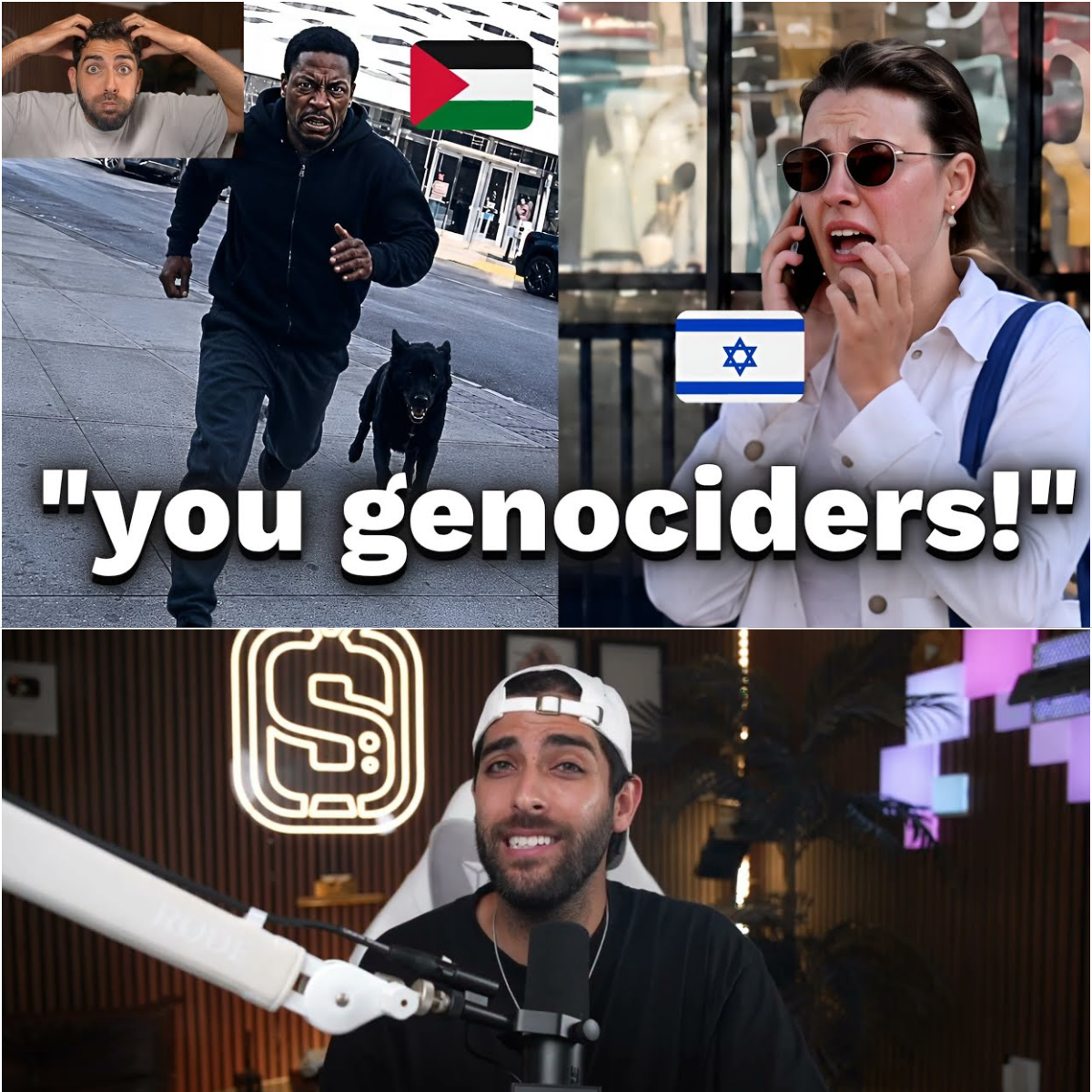
A woman in a simulated military uniform paces a New York City subway car, shouting at passengers that Jewish people are “eating children” before violently lunging to tear at a bystander’s hair. Halfway across the world in Barcelona, a trans activist and high school biology teacher bars a young couple from entering a public spa, screaming “Free Palestine” simply because one of them is wearing a visible Star of David necklace. In Los Angeles, a van stalks a man walking home from a synagogue before an occupant leaps out to assault him, while up the coast in Santa Monica, an enraged driver screeches to a halt to unleash a dog onto a Jewish couple, screaming that they are “genociders.” These are not isolated fragments of historical fiction; they are captured on high-definition smartphone cameras, revealing a terrifying reality: in 2026, the boundaries separating geopolitical protest from raw, unadulterated antisemitism have completely collapsed.
What the world is witnessing is a hyper-accelerated, algorithmic mutation of the world’s oldest hatred. For decades, the post-Holocaust global consensus maintained a fragile but vital barrier against overt anti-Jewish bigotry in public spaces. Today, that barrier has been utterly pulverized. By tethering ancient blood libels to contemporary Middle Eastern geopolitics, radical actors across the political spectrum have successfully mainstreamed a brand of harassment that targets Jewish individuals regardless of their nationality, their personal politics, or their geographic distance from the Gaza Strip. From public transit networks and European hospitality venues to international airports and mixed martial arts gyms, being visibly Jewish has once again become a catalyst for public hostility, sanctioned by a digital culture that treats bigotry as counter-cultural activism.
From Geopolitics to Blood Libel: The Collapse of the “Zionist” Distinction
For years, academic defenders and political activists on the international left have insisted upon a strict intellectual boundary: criticism of the State of Israel or the political ideology of Zionism is fundamentally distinct from antisemitism. In the sterile environments of university lecture halls, this distinction remains a fiercely guarded rhetorical shield. On the streets of Western cities, however, the video evidence demonstrates that this intellectual boundary has ceased to exist.
The confrontation in Barcelona serves as an alarming case study. The victims were not Israeli diplomats, soldiers, or political operatives; they were tourists attempting to patronize a local business. They did not initiate a political debate, nor were they carrying flags or chanting slogans. Their sole “offense” was the possession of a small piece of jewelry—the Star of David—an emblem that predates modern political Zionism by millennia.
When confronted by the spa’s management and local activists, the victims were explicitly told they were unwelcome because of the symbol on their necks, met with demands to state their positions on a foreign conflict as a prerequisite for entry. When the victims pointed out the absurdity of being profiled purely for being Jewish, the aggressors immediately hid behind the mantra of “Free Palestine” and accusations of “condoning genocide.”
This is the mechanical core of modern antisemitism: the weaponization of geopolitical grief to justify local discrimination. By establishing a standard where any Jewish person anywhere in the world is held personally accountable for the actions of the Israeli government, activists have effectively stripped Jewish people of their individuality. A religious symbol is treated as a uniform; a secular ethnicity is treated as a political combatant.
When this standard is normalized, the descent into ancient conspiracy theories is instantaneous. The New York subway incident—where an assailant openly accused Jewish people of consuming children—is directly descended from the medieval “blood libel,” the superstitious belief that Jews murdered Christian children to use their blood in religious rituals. In 2026, this delusion has been seamlessly retrofitted for the internet age. The language of human rights and anti-imperialism is systematically peeled away, revealing the jagged, familiar contours of classical European bigotry underneath.
The Digital Echo Chamber and the Validation of Prejudice
The rapid mainstreaming of this behavior cannot be understood without examining the architecture of modern social media platforms. In the past, individuals harboring extreme conspiratorial views about minority groups were largely isolated, restricted to the dark corners of fringe publications or radical pamphlets. In the contemporary media landscape, however, algorithms prioritize conflict, outrage, and emotional volatility over factual accuracy and civil discourse.
When an influencer, an athlete, or a political commentator engages in anti-Jewish rhetoric, the digital ecosystem does not suppress the infection; it monetizes it. High-profile figures, such as former UFC champion Sean Strickland, demonstrate how easily antisemitic tropes can be packaged as edgy, anti-establishment truth-telling. In public interviews, Strickland openly questioned the physical toughness of Jewish men, mockingly stating that he had never met a “tough” Jew because “maybe they’re just so used to bombing kids.”
When the corporate structures governing professional sports reacted to the backlash—with the UFC leadership reportedly revoking his participation in international promotional events—Strickland did not recede. Instead, he filmed a satirical, defensive video mocking the concept of accountability, framing himself as a victim of a shadowy network involving the White House, political donors, and international conspiratorial forces.
To a young, digitally native audience, this performance is highly intoxicating. It reframes crude bigotry as an act of heroic rebellion against an oppressive, sanitizing corporate elite. Supporters do not see an athlete engaging in ethnic stereotyping; they see a working-class hero being punished by an invisible cabal for “speaking truth to power.” The metrics validate the strategy: videos featuring these confrontations regularly rack up tens of thousands of views, likes, and shares within hours, creating a perverse incentive structure where the social reward for public bigotry vastly outweighs the cultural penalty.
The Double Standard of Corporate and State Protection
Perhaps the most demoralizing aspect of the current crisis for global Jewish communities is the perception of an institutional double standard regarding public safety and civil rights enforcement. Throughout the Western world, public institutions, corporate HR departments, and law enforcement agencies have spent the last decade building robust, highly sensitive protocols designed to detect and eradicate Islamophobia, racism, and transphobia.
Yet, when the victims of discrimination are Jewish, the institutional apparatus often appears paralyzed, hesitant, or indifferent. In Germany—a nation legally bound by its constitution to aggressively combat antisemitism—reports surfaced of a hospitality group sending explicit digital messages to prospective guests stating that “no Jews are allowed in our hotel.” In London, passengers arriving on flights from Tel Aviv have faced targeted verbal harassment from airport contractors within the terminal facilities, with minimal immediate intervention from security personnel.
This disparity in institutional urgency has not escaped the notice of the public. If a retail business or a public service provider in a major Western metropolis explicitly barred a Muslim or Christian individual based entirely on their visible religious attire, the corporate and political fallout would be immediate, total, and catastrophic for the perpetrators. The story would dominate national news broadcasts for days; executives would be terminated, and civil rights investigations would be launched within hours.
When the victims are Jewish, however, the response from legacy media organizations and state authorities is frequently characterized by a search for nuance or political context. The crime is often framed not as an act of unprovoked hatred, but as an unfortunate byproduct of a “complicated” international situation. By treating antisemitic hate crimes as understandable expressions of political frustration rather than violations of fundamental civil rights, the establishment has created a permissive environment where perpetrators feel insulated from legal and social consequences.
The Resurgence of the Radical Fringe
This institutional vacuum has allowed older, more explicit forms of white nationalist bigotry to re-emerge into the public square, completely unburdened by the shame that once kept them contained. At local government levels across the United States, municipal school board meetings and town halls—the traditional bedrock of American civic life—have increasingly been disrupted by individuals openly performing Nazi salutes and shouting “Heil Hitler” at elected officials and community members.
The danger of this resurgence lies in its dual-pronged nature. The Jewish community finds itself caught in an ideological pincer movement. On one side, a radicalized progressive faction uses the language of social justice to de-platform, isolate, and harass Jewish individuals under the guise of anti-Zionism. On the other side, an emboldened far-right movement capitalizes on the general breakdown of civic order to reintroduce classical, Hitlerian white supremacy into the mainstream dialogue.
Both sides of this ideological divide utilize the exact same underlying premise: that the Jewish people possess a disproportionate, malevolent amount of global influence that must be aggressively dismantled. Whether the rhetoric originates from a trans activist in Spain, a street assailant in Los Angeles, or a neo-Nazi at an American school board meeting, the target remains identical.
The Anatomy of an Unchecked Crisis
The events of 2026 present a stark warning to Western democracies about the fragility of civil peace. When a society permits a single minority group to be hunted in public spaces, denied service at commercial establishments, and subjected to ancient conspiracy theories on public transit, the rot cannot be contained to that group alone. The erosion of the social contract is systemic.
For the American audience, the footage coming out of Southern California, New York, and Western Europe should serve as an urgent call to action. The safety of a democracy can be measured by the safety of its most historically targeted minority. If the public continues to treat public displays of antisemitism as mere performance art, political theater, or a distant consequence of a foreign war, the infrastructure of mutual tolerance will collapse entirely.
The solution requires an immediate return to moral clarity. The international community must decouple its varying opinions on Middle Eastern state policy from its treatment of the Jewish human beings living within its own borders. Law enforcement agencies must prosecute hate crimes disguised as protests with the exact same rigor applied to any other civil rights violation. Most importantly, digital platforms must confront the reality that their algorithms are currently serving as the primary distribution network for an ancient social toxin. Until the cost of public bigotry is rendered unpayable once again, the images of violence on our subways, our streets, and our screens will continue to multiply, reminding us that the horrors of the 20th century are never truly buried—they are merely waiting for a society complacent enough to let them return.