Pilate and the Empty Tomb: The Report to Rome No One Was Supposed to Read
Pilate and the Empty Tomb: The Report to Rome No One Was Supposed to Read
The oil lamps flickered against the cold limestone walls of the Antonia Fortress, casting long, distorted shadows that looked like grasping hands. Outside, Jerusalem slept under a heavy, suffocating silence—the kind of silence that precedes a desert storm. Inside, Pontius Pilate sat at his heavy cedar desk, staring at a blank scroll of Egyptian parchment.
His hands, usually steady enough to sign a dozen death warrants without a tremor, were uncharacteristically cold.
Three days. It had been only three days since the execution. To a Roman Procurator, a crucifixion was standard bureaucratic maintenance—a routine chore to keep the peace in a province that bred fanatics like flies. He had washed his hands of the Galilean philosopher, quite literally, delivering him to the fury of the Sanhedrin just to prevent a riot. It should have been over. The man should have been rotting in a sealed tomb, another forgotten statistic of Roman pacification.
Instead, the world was fracturing at the seams.
A sudden, sharp knock shattered the silence of the chamber. Pilate flinched, his hand instinctively dropping to the hilt of his gladius. “Enter,” he commanded, his voice raspy from lack of sleep.
The heavy oak door groaned open. Centurion Marcus stepped into the room. Marcus was a veteran of the Germanic campaigns, a man whose face was a roadmap of scars and whose loyalty to the eagle was absolute. He had seen men disemboweled, seen entire villages burned to ash, and had never once blinked.
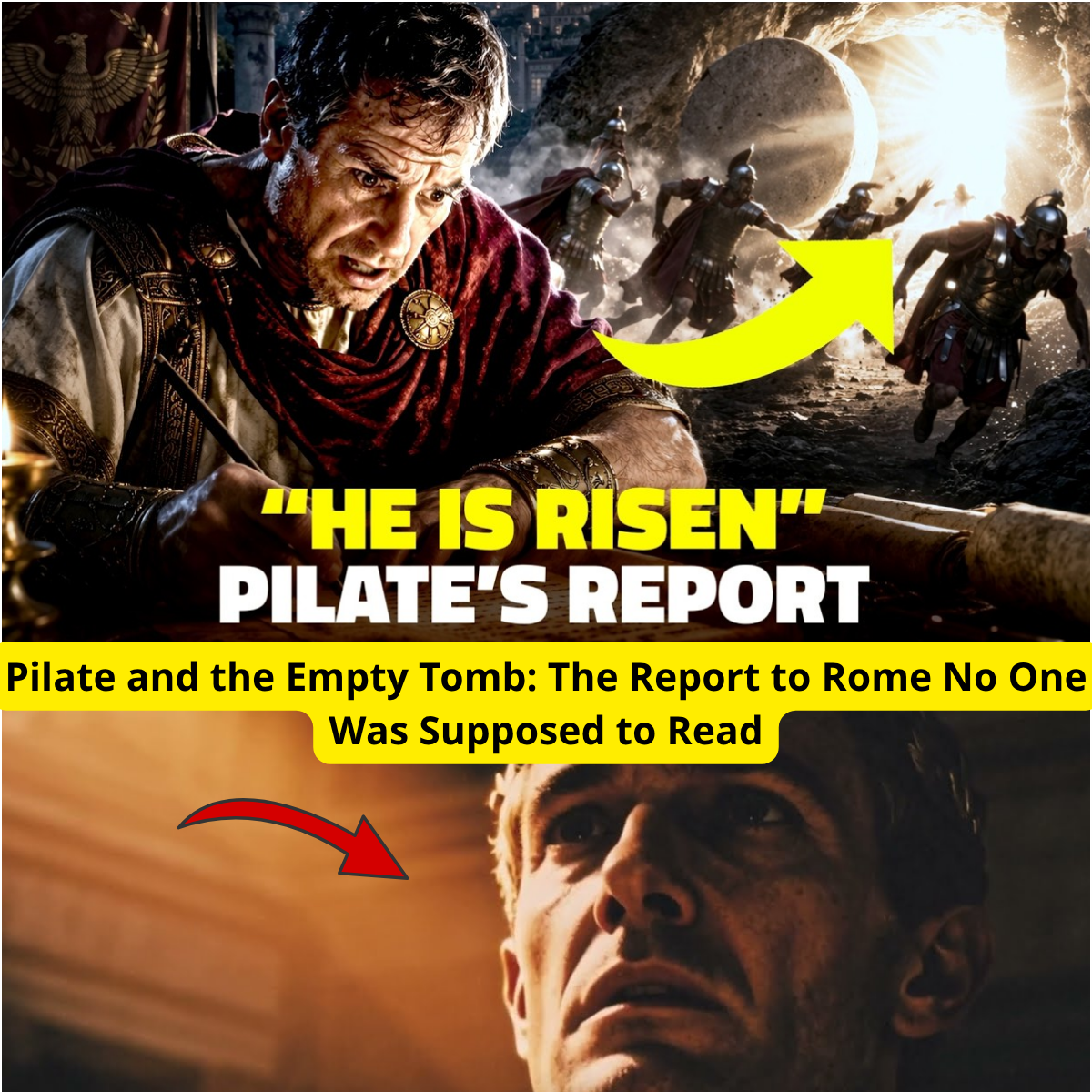
But tonight, Marcus looked like a ghost. His eyes were wide, bloodshot, and hollowed out by an emotion Pilate had never seen in him: absolute, paralyzing terror.
“Report,” Pilate said, leaning forward, his cynical facade slipping for a fraction of a second. “Where are the guards from the tomb? Why have they not been brought to the courtyard for execution?”
According to the custodia militaris—the unyielding bedrock of Roman military law—the penalty for allowing a prisoner’s body to be stolen under a watch was death. No exceptions. No appeals. A Roman soldier who slept on duty paid with his blood.
Marcus swallowed hard, his armor clanking softly as his knees trembled. “My Lord… I cannot execute them. Not for this.”
“You defy a direct imperial decree?” Pilate’s voice dropped to a dangerous, low hiss. “They let the disciples steal the corpse. The High Priest Caiaphas is already outside, demanding their heads to cover their incompetence. If I do not execute them, the Sanhedrin will report my weakness to Rome.”
“It was not the disciples, Governor,” Marcus whispered, his voice cracking. “I interrogated the men myself. Separate rooms. Separate guards holding the swords to their throats. Their stories do not waver by a single word. They did not sleep. They did not fail.”
Pilate stood up, the heavy wood of his chair scraping loudly against the stone floor. “Then what happened at that tomb, Marcus?”
The Centurion looked down at his own trembling hands. “They say it was not taken away, Governor. They say… it came out.”
Act II: The Anatomy of a Lie
The tension in the room grew thick enough to choke on. Pilate walked slowly toward the high balcony, looking out over the dark silhouette of the city. He could hear the faint, distant sounds of Jerusalem waking up—the early calls of street vendors, the shuffling of sandals on cobblestones. But beneath it, there was an undercurrent of panic. The Sanhedrin was in a frenzy.
“Bring the watch leader in,” Pilate ordered. “Secretly. Through the servant’s entrance. If Caiaphas sees him alive, we will have a holy war on our hands.”
Minutes later, a young legionnaire named Quintus was brought into the study. He had lost his helmet; his uniform was torn, and his face was the color of curdled milk. The moment he saw Pilate, he collapsed to his knees, not out of respect, but because his legs could no longer support his weight.
“Tell me everything,” Pilate commanded, his eyes boring into the young man. “And if I catch a single lie, I will personally throw you to the crosses outside the walls.”
“We were awake, Excellency,” Quintus stammered, his eyes darting around the room as if the shadows themselves might strike him down. “The imperial seal was intact. We had four men on active perimeter, four on reserve. At the third watch, the ground… it didn’t just shake. It screamed. An earthquake from deep within the rock. And then, the dark vanished.”
“A storm?” Pilate asked, trying to find a rational, Roman explanation. “A lightning strike?”
“No, Governor. A light brighter than the midday sun, but it didn’t burn. It descended from above, tearing through the night. The air tasted like iron. We saw a figure… a being of blinding glory. He touched the stone. The great stone, which required twenty men to roll into place, was tossed aside like a pebble. And then…” Quintus choked back a sob, burying his face in his hands.
“And then what?” Pilate pressed, stepping closer, his heart hammering against his ribs.
“He walked out,” Quintus wept. “The man you crucified. He was walking among us. His wounds were glowing like embers, but he wasn’t bleeding. He was alive, Governor. He looked at us, and the sheer majesty of his gaze… it didn’t just terrify the body. It broke our souls. We fell like dead men.”
Pilate sat back down at his desk, his mind racing. He had spent his entire career dealing with political agitators, rebels, and self-proclaimed prophets. They all bled. They all died. They all stayed in the dirt. But this…
“Caiaphas claims your men took gold,” Pilate said coldly. “He claims you fell asleep and allowed the Galilean’s followers to carry him off.”
Quintus looked up, a flash of desperate indignation breaking through his fear. “The High Priest offered us a fortune, My Lord! A bag of gold that could buy a villa in Capri for every man on the watch. All we had to do was say we slept. But think of it, Governor! If we were asleep, how could we know it was the disciples who came? A sleeping witness has no legal value in Rome or Judea! It is an absurd lie! We took their money because to refuse would mean they would knife us in our beds, but we came straight to Marcus. We cannot hide this light with a handful of Jewish coins.”
Pilate waved his hand, dismissing the soldier. Marcus led the weeping legionnaire out, leaving the Governor alone with his thoughts.
The lie was indeed absurd. If the body had truly been stolen, the Sanhedrin wouldn’t be offering bribes; they would be screaming for blood, demanding an investigation, searching every house in the city. Their sudden generosity was the ultimate confession of their guilt. They were terrified. They were trying to blot out the sun with a handful of dirt.
Act III: The Voice in the Courtyard
The door to the inner chambers opened quietly, and a soft rustle of silk announced a new presence. Claudia Procula, Pilate’s wife, stepped into the candlelit room. Her pale face was framed by dark curls, her eyes heavy with a profound, sorrowful wisdom.
“You haven’t slept,” she said softly, placing a gentle hand on his tense shoulder.
“I am the Governor of Judea, Claudia. Sleep is a luxury for men without provinces to govern,” Pilate replied, his voice defensive, though he did not pull away from her touch.
“You are running from the truth, Pontius,” she said, her voice dropping to a whisper. “Three days ago, I sent you a warning. I told you to have nothing to do with that righteous man. I told you of the torment I suffered in my dreams because of him. You ignored me to please a mob.”
“I did what was politically expedient!” Pilate snapped, turning to face her. “If I had released him, the city would have burned. Tiberius Caesar does not tolerate governors who start riots.”
“And look at you now,” Claudia said, her eyes shining with unshed tears. “The city is quiet, yet you are trembling. The empire’s seal has been broken, not by swords, but by something beyond this world. I was there, Pontius. I stood in the shadows of the courtyard when the guards returned. I saw their faces. I heard what they muttered when they thought no one was listening.”
Pilate looked away, unable to hold her gaze. “They are superstitious peasants. They saw an earthquake and let their imaginations run wild.”
“No,” Claudia insisted, grabbing his hand. Her touch was warm, contrasting sharply with his icy skin. “They saw the dawn of something new. Even non-Christian chronicles—the records of the pagans in the East—are talking about the darkness that covered the earth on Friday. The sun was eclipsed at Passover, Pontius! You know as well as I do that a solar eclipse is scientifically impossible during a full moon. Nature itself refused to look upon what you did. And now, the dead are walking. People are claiming to have seen ancient prophets roaming the streets of Jerusalem.”
Pilate felt a cold sweat break out across his brow. He remembered the Galilean’s words during the interrogation. Everyone who is of the truth listens to my voice. Pilate had responded with a cynical, worldly question: What is truth?
Now, it seemed, the truth had broken out of a sealed tomb to give him his answer.
“What would you have me do, Claudia?” Pilate asked, his voice suddenly sounding old, stripped of all imperial authority. “Go to the temple and bow before the fishermen? Confess to Caesar that I executed a god?”
“Listen to the inner voice, Pontius,” she pleaded softly. “The same voice that told you he was innocent when he stood before your judgment seat. Do not let your pride destroy you. Write the truth. If you must write to Rome, do not send a bureaucratic lie. Give Caesar the chronicle of what actually happened.”
Act IV: The Letter to Tiberius
Claudia left him alone with the parchment. The first rays of dawn were beginning to bleed through the window, painting the limestone walls in hues of deep crimson and gold.
Pilate picked up his reed pen. His hand was no longer shaking, replaced by a grim, heavy resolve. He was a Roman. He was a realist. If his career was to end, if his life was to be forfeit, he would at least leave a record that would haunt the halls of Rome for generations.
He dipped the pen in ink and began to write, addressing the most powerful man in the ancient world.
To Tiberius Caesar, Emperor of Rome,
From Pontius Pilate, Procurator of Judea.
A matter has transpired in this province which it is my duty to report to the throne, an event so contrary to the laws of nature and the order of Rome that it threatens to redefine the very nature of our empire…
He wrote with an honesty he hadn’t used in decades. He described the man Jesus, not as a political agitator or a rebel leader, but as a being who possessed a power never before seen on earth. He detailed the malice of the Sanhedrin, their blind hatred, and his own moral cowardice in handing the man over to be crucified.
Then, his pen hesitated before he wrote of the resurrection.
On the morning of the third day, a thunder was heard from heaven that shook the foundations of the Antonia Fortress. My elite guards, men trained never to feel fear, were paralyzed by a light that outshone the sun. The imperial seal was shattered. The stone was rolled away, not from the outside by human hands, but from within.
The one whom we crucified was seen walking among us, surrounded by a glory that does not belong to this world. He did not escape, Caesar. He overcame.
Pilate paused, looking at the wet ink. He knew what this letter could mean. It could be viewed as the madness of a broken governor who had lost control of his territory. It could lead to his recall, his disgrace, or his execution. To report heavenly signs was to admit his own utter inability to control a man whom nature itself seemed to obey.
But as he looked out at the morning sun rising over Jerusalem, he realized something profound. The stone hadn’t been rolled away to let Jesus out. A being who could conquer death itself didn’t need an open door. The stone had been rolled away to let the world look inside—to show that the tomb was empty, that the power of Rome’s legions, the weight of the imperial seal, and the finality of the grave were all completely meaningless against the author of life.
With a final, decisive stroke, Pilate wrote the concluding line of his report—the phrase that would stand at the summit of his lifelong search for truth:
Having weighed the evidence of my own soldiers, the panic of the authorities, and the signs in the heavens, I am compelled to write what my soul can no longer deny:
He truly was the Son of God.
Act V: The Echo of the Light
Years passed, and the empire did what empires do. It moved on. Pilate was eventually recalled to Rome, fading into the murky margins of history. Some chronicles claimed he fell into disgrace; others whispered that he and Claudia sought a quiet, radical redemption far from the corridors of power, driven by the memory of that impossible morning.
But the report he wrote—the echo of that broken seal—could never be truly erased. It traveled through the centuries, whispered in the catacombs by early Christians, cited by jurists like Tertullian, and used by martyrs like Justin to challenge the pagan emperors of the second century. It became a voice crying out from antiquity, proving that truth cannot be buried, budgeted, or bribed into silence.
The story of Pontius Pilate stands as a timeless lesson for every soul that has ever struggled with doubt. You can try to wash your hands of the truth. You can try to hide it behind political convenience, rationalizations, or the busy noise of everyday life. But if the truth is divine, it will always find its way back to you.
The tomb remains empty. The guards fled. The report was written. And the light that tore through the darkness of Jerusalem two thousand years ago still shines today, demanding an answer from every heart.
Like Claudia Procula, we are called to listen to that inner voice whispering that He is the righteous one. Like the terrified soldiers, we are forced to confront a reality that shatters our fragile illusions of control. The stone was rolled away so that we could look inside, see the empty linen clothes, and understand the ultimate victory.
The dawn has broken, the seal is gone, and the truth is alive.