NBA Players FEAR Nikola Jokic After This UNBELIEVABLE Performance
NBA Players FEAR Nikola Jokic After This UNBELIEVABLE Performance
In the hallowed, hyper-masculine halls of NBA history, there are certain “untouchables.” These are the giants whose legacies are fortified by the sheer weight of their physical destruction. At the summit of that mountain sits Shaquille O’Neal—the “Most Dominant Ever.” For two decades, the consensus was simple: nobody, in any era, could stop the Diesel in his prime. It wasn’t just a basketball opinion; it was a law of physics.
But laws are being rewritten in Denver, Colorado.
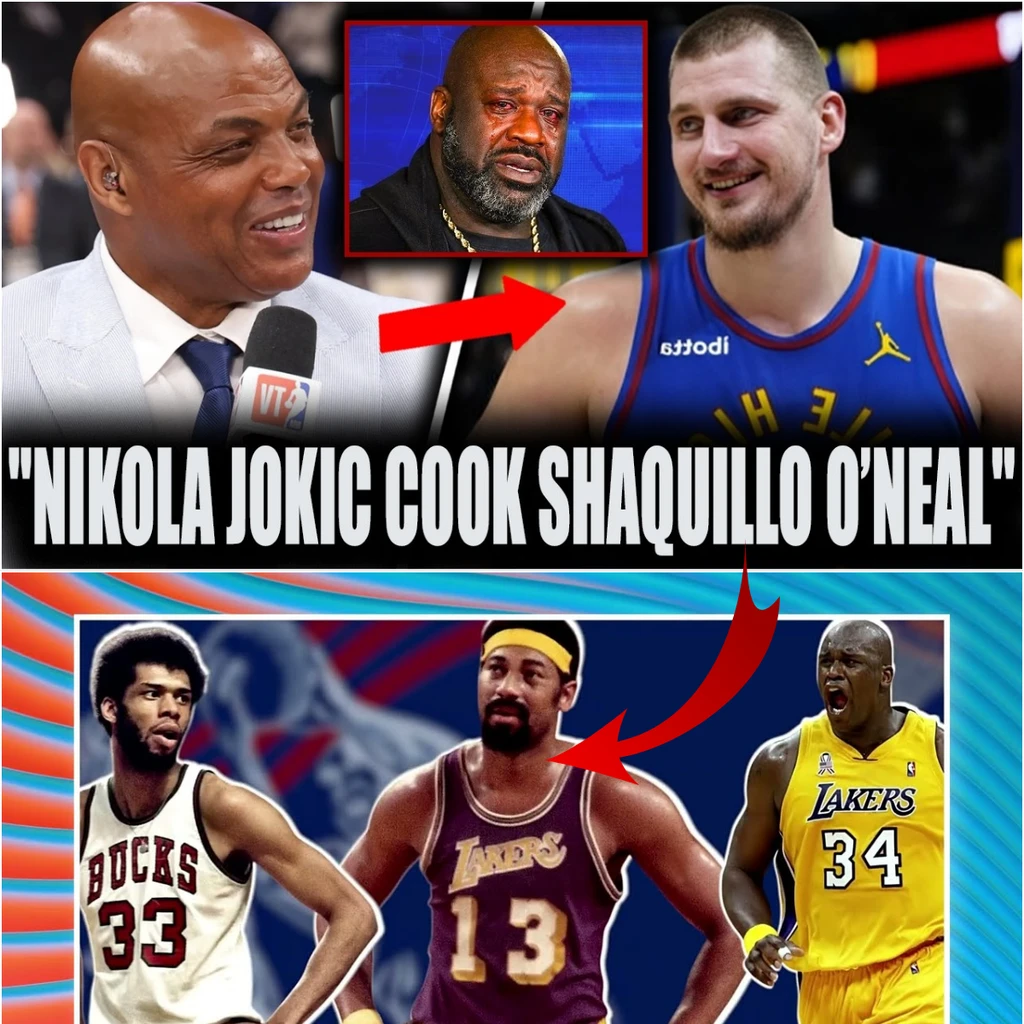
When Charles Barkley recently looked into a camera and declared that Nikola Jokic—a man often teased for his “doughy” physique and lack of vertical leap—would “cook” Shaquille O’Neal, the collective gasp of the basketball world was audible. To the old guard, it sounded like heresy. To Shaq, it sounded like a personal insult. But as the dust settles and the analytics emerge, we are forced to confront an uncomfortable reality: Barkley might not be crazy. He might just be ahead of the curve.
I. The Death of the Traditional Giant
To understand why a Jokic vs. Shaq matchup is so polarizing, you first have to understand what Shaq represented. Shaq was a sledgehammer. In the early 2000s, he didn’t just score; he demolished the infrastructure of the game. He broke backboards, altered the geometry of the paint, and forced every team in the league to carry three “stiffs” on their roster just to provide six fouls each against him.
However, the game Shaq played is nearly unrecognizable compared to the one Jokic dominates today. In Shaq’s era, the game was played from the inside out. You dumped the ball into the post, the world stopped, and you watched two titans wrestle for real estate.
Nikola Jokic has turned that model upside down. He is a “Point Center”—a playmaker trapped in a 7-foot, 280-pound body. He doesn’t want to wrestle you; he wants to solve you. While Shaq’s dominance was loud, physical, and overwhelming, Jokic’s dominance is silent, cerebral, and inevitable.
II. The Hakeem Blueprint: A Warning from History
The most compelling argument for “The Joker” cooking “The Diesel” isn’t found in modern spreadsheets, but in the 1995 NBA Finals.
Shaquille O’Neal famously claims that only one man ever “beat” him: Hakeem “The Dream” Olajuwon. Hakeem didn’t outmuscle Shaq; he outmaneuvered him. He used a “scientific” arsenal of footwork, mid-range jumpers, and up-and-under fakes that left Shaq jumping at shadows.
Now, fast-forward to 2026. Nikola Jokic has taken the Hakeem blueprint and digitized it for the modern era. Consider these staggering statistics:
Efficiency: Jokic is hitting over 50% from mid-range on high volume—a territory Shaq famously hated defending.
Touch: He finishes over 70% at the rim, not by dunking through people, but by using “soft touch” floaters and angles that defy the laws of gravity.
The Spacer: Jokic is a legitimate threat from the three-point line, a place Shaq wouldn’t visit unless there was a buffet nearby.
As Barkley pointed out, if Hakeem, David Robinson, and Patrick Ewing could give Shaq fits by forcing him to move his feet and defend the perimeter, what happens when he has to guard a man who is arguably the greatest passer in the history of the sport?
III. The Geography of the Nightmare
The “uncomfortable reality” of this matchup lies in the geography of the court. In 2001, Shaq lived in the paint. He was the king of a five-foot radius. If you entered his kingdom, you paid a price.
But Jokic doesn’t meet you at the rim. He drags you 25 feet away from it.
Imagine a 2001 Shaquille O’Neal being forced to defend a high pick-and-roll involving Jokic and Jamal Murray. Shaq is faced with a “Decision Tree” of nightmares:
Drop Back: Jokic hits a wide-open three or a 15-foot “sombor shuffle” jumper.
Step Up: Jokic delivers a no-look, behind-the-back laser to a cutting teammate.
Switch: Shaq is left on an island, 30 feet from the basket, trying to contain the most efficient offensive engine the game has ever seen.
In this scenario, Shaq’s greatest strength—his size—becomes a liability. He is a battleship being asked to chase a jet ski in the open ocean.
IV. The Admission: Even Shaq Knows
Perhaps the most telling moment in this entire debate came from Shaq himself. Known for his legendary ego and “ring counting” as a defense mechanism, Shaq recently softened his stance. During a broadcast, after watching Jokic dismantle yet another elite defense, Shaq admitted, “I probably wouldn’t have stopped him either.”
This wasn’t just humility; it was an acknowledgment of the evolution of the species. Shaq realized that Jokic isn’t just “good for a big man.” Jokic is a “cheat code.”
When you lead the league in triple-doubles, rebounds, and assists over a 30-game stretch, you aren’t just playing basketball; you are orchestrating a symphony. Shaq’s dominance was a monologue—one guy shouting louder than everyone else. Jokic’s dominance is a dialogue—he makes the four people around him twice as dangerous.
V. Conclusion: A New Definition of Greatness
We are witnessing a “clash of eras” where brute force meets surgical control. The reason the basketball world “isn’t ready” for this conversation is that it forces us to admit that the game has passed its idols by.
Shaq will always be the most physically imposing human to ever lace up sneakers. But “The Joker” represents a perfected version of the formula that historically gave Shaq the most trouble. He is the scientific counter-argument to the sledgehammer.
Is Jokic better than Shaq? That’s a conversation for the barbershops. But would he “cook” him in a modern game? When you look at the spacing, the skill, and the unprecedented control Jokic exerts over 48 minutes, the answer is no longer a joke. It’s an unavoidable reality.
The Joker isn’t just playing in Shaq’s league anymore; he’s building a new one entirely.