Mysterious notes led to a horror show
Mysterious notes led to a horror show
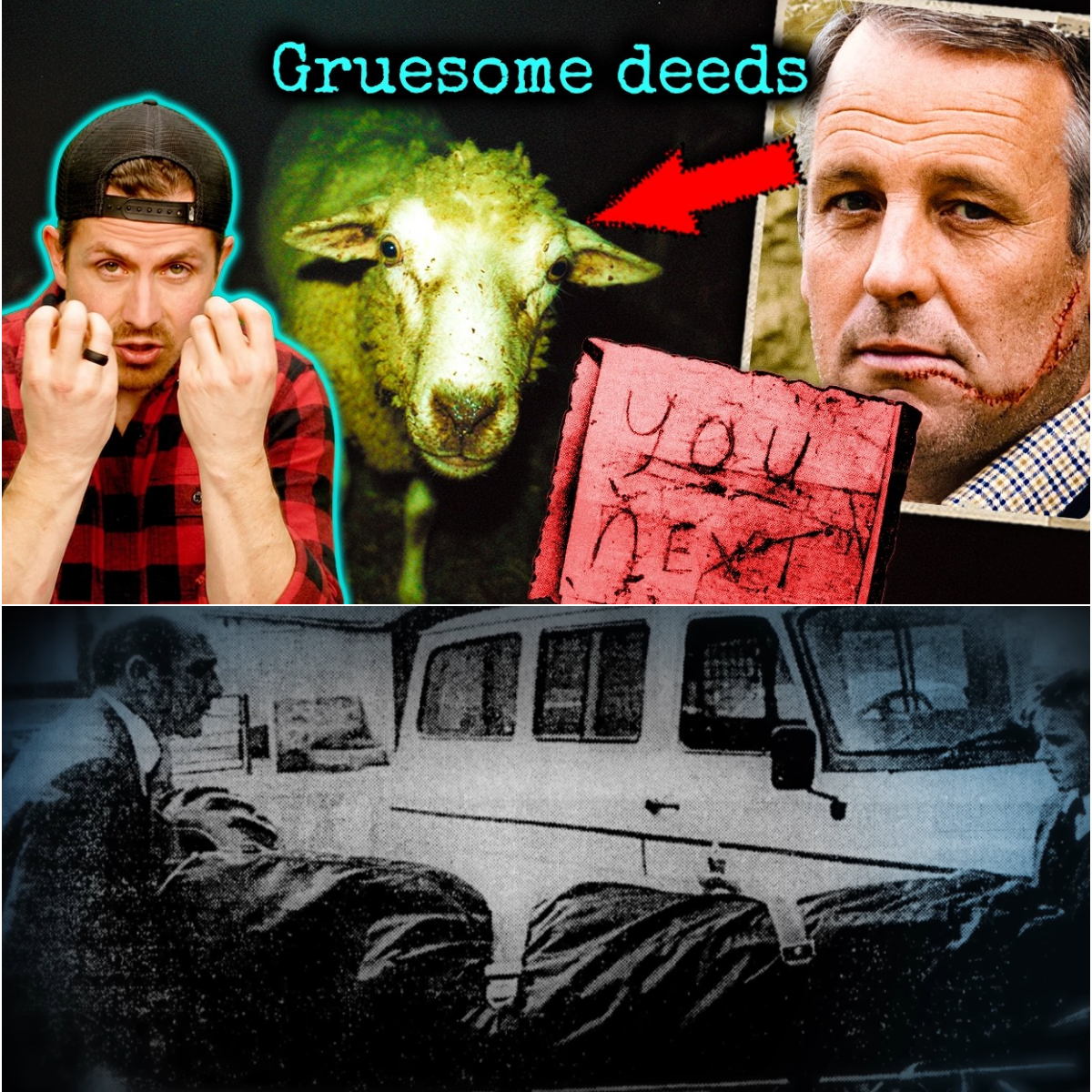
Graham Backhouse always dreamed of writing the ultimate detective thriller, but his masterpiece wasn’t meant for bookstore shelves—it was written in blood, pipe bombs, and a notebook found in his own farmhouse.
When a late-night panic button alert sent police charging toward a remote country home, they prepared themselves for the climax of a weeks-long terror campaign that had already hospitalized a woman. Instead, they stepped into a butcher shop. A neighbor lay dead in the hallway, a knife still clenched in his fist; in the kitchen, a severely slashed farmer cradled a shotgun, groaning in agony. It looked like a textbook case of life-or-death self-defense against a madman. But as investigators began to peel back the layers of the bloody scene, a single, mundane household object revealed that the entire narrative was a calculated lie.
The farmer wasn’t the victim. He was the author of the nightmare.
Part I: The Silhouette of a Suspect
The Poisoned Fence Line
To the quiet village community, Graham Backhouse was a man under siege. For weeks, an invisible tormentor had been waging a psychological war against his household. Threatening letters had arrived in the mail, a severed lamb’s head had been left as a grotesque marker on his land, and finally, a devastating car bomb had torn through the family vehicle, nearly claiming the life of his wife, Margaret.
With his wife fighting for her life in a hospital bed and his children sent away to his mother’s house for their own protection, Graham sat alone in his farmhouse, consumed by a desperate question: Who would want to destroy his life?
[The Architecture of a Feud]

   GRAHAM'S FARMHOUSE ◄─── Property Line Dispute ───► COLIN'S HOME
   (Financial Distress)                             (The Intended Fall Guy)
The more Graham stared at the empty spaces of his home, the more his mind fixated on a single name: Colin.
Colin was Graham’s immediate neighbor, and it was common knowledge in the village that the two men detested each other. Their relationship had been corroded by years of bitter, petty bickering over property lines. While their arguments had never spilled over into physical altercations, they frequently reached a fever pitch. To a man looking for an enemy, Colin fit the profile perfectly. He was local, he was angry, and he possessed the proximity to execute a campaign of terror.
The Driveway Intercept
Driven by a mix of paranoia and calculated curiosity, Graham decided to confront the elephant on his border. He walked down his gravel driveway, turned the corner of the country lane, and marched up toward Colin’s house.
Colin was working in his front yard when Graham approached. He didn’t offer a greeting; he simply stood his ground, watching his rival’s advance with a cold, displeased glare.
[The Stilted Dialogue Matrix]

   GRAHAM'S STRATEGY:  Deploy mundane small talk ──► Observe Colin's anxiety parameters.
   COLIN'S RESPONSE:   Total emotional silence ───► Fails to mention the car bombing.
   THE INSIGHT:        Graham interprets the silence not as dislike, but as guilt.
What followed was a deeply bizarre, stilted conversation. Neither man truly wished to look the other in the eye, yet they exchanged empty pleasantries about the weather and the land. Graham intentionally withheld any mention of the ongoing police investigation, the bomb, or his wife’s critical condition. He wanted to see if Colin would crack, if he would betray himself through nervous glances or unprompted defenses.
When Graham finally turned and walked back to his property, his suspicion had hardened into absolute certainty. It wasn’t what Colin had said; it was what he hadn’t said. In a small village shattered by a car bombing, Colin had not asked why Graham was visiting. He hadn’t asked about Margaret’s recovery. He had treated the interaction with an unnatural, hyper-neutral indifference.
To Graham, this was the behavior of a guilty man keeping his mouth shut.
Part II: The Midnight Pounding
The Blank Notepad
By the night of April 30th, the atmosphere inside the Backhouse farm was suffocating. Graham sat at his desk, staring down at a clean, white spiral notepad. He had always harbored literary ambitions, finding solace in the mechanics of storytelling. But tonight, his creativity was blocked by a wall of real-world dread.
The police had recently interviewed Colin, but the interrogation had yielded no breakthroughs. The investigation was stalling, no arrests had been made, and the threat felt just as imminent as it had weeks ago.
+--------------------------------------------------------------------------+
|                     TIMELINE OF THE APRIL 30TH ASSAULT                   |
+--------------------------+-----------------------+-----------------------+
| Time Marker              | Auditory / Visual     | Tactical Response     |
+--------------------------+-----------------------+-----------------------+
| 11:42 PM                 | Aggressive Knocking   | Graham approaches door|
| 11:43 PM                 | Second Door Pounding  | Door opens; confrontation|
| 11:45 PM                 | Panic Alarm Tripped   | Police dispatch units |
+--------------------------+-----------------------+-----------------------+
Then, splitting the midnight silence of the house, came a sudden, violent pounding on the front door.
Graham’s heart locked in his chest. He wasn’t expecting visitors, and no one in the valley traveled to this isolated farmstead so late without warning. Given the context of the bombs and the death threats, the aggressive knocking felt like a death knell. He rose from his chair, his pulse hammering against his ribs, and crept down the darkened hallway.
The Breach
As his fingers brushed the brass door handle, a second, even more frantic barrage of blows rattled the wood on its hinges. Whoever was standing on the porch wasn’t just waiting; they were demanding entry.
Graham turned the knob and pulled the door open. The silhouette standing in the porch light caused his survival instincts to take over instantly.
[The Hallway Collision]

  [Door Opens] ───► Colin stands with an exposed blade ───► Graham retreats to kitchen
                                                                   │
                                                                   ▼
  [The Fatal Shot] ◄─── Graham unslings double-barrel ◄────────────┘
Before he could utter a word of greeting or defense, the intruder lunged across the threshold. It was Colin. But he wasn’t there to discuss property lines. In his right hand, a long knife caught the dim light of the hallway.
Graham bolted backward, screaming as he fled down the corridor toward the kitchen where his hunting shotgun was kept. The chase was short, loud, and bloody.
Part III: The Crime Scene at the Farmhouse
The Discovery in the Hallway
When Detective Superintendent Tom Evans and his tactical team breached the front door of the Backhouse farm minutes later, they were operating under maximum adrenaline. The dedicated panic button installed by the department had been triggered, signaling that the valley’s phantom bomber had finally come back to finish the job.
The house was dead silent when the officers crossed the threshold, their service weapons drawn. The scent of copper and burnt cordite hung heavy in the narrow hallway.
          [ Forensic Anatomy of the Entry Corridor ]

   Victim Alpha:     Colin (Neighbor, mid-60s). Found lying flat on his back.
   Trauma Profile:   Massive close-range shotgun blast centered on the torso.
   Weapon Clench:    Right hand locked in a post-mortem cadaveric spasm around a knife.
   Blood Pool:       Static, heavy pooling underneath the lumbar spine.
As Detective Evans advanced down the corridor, his flashlight beam illuminated a grim sight. A man was lying flat on his back in the center of the floor, his shirt saturated by a catastrophic volume of dark blood.
Kneeling down, Evans realized with a shock that this was not the homeowner. It was Colin, the neighbor they had questioned just days prior. He was dead, killed by a devastating blast to the chest. Curiously, even in death, his right hand remained locked in a tight, rigid grip around the handle of a heavy kitchen knife.
The Kitchen Carnage
A faint, low moaning sound echoed from the kitchen, drawing the officers away from the corpse. Pushing past the threshold, Evans stepped into a scene of absolute chaos. Chairs had been violently upended, tables were thrown sideways, and blood was smeared across the linoleum floor, cabinets, and countertops.
In the center of the wreckage sat Graham Backhouse, propped up against a cabinet base, cradling a double-barrel shotgun.
   [ Graham's Traumatic Presentation ]

   Facial Gash:      Deep, linear laceration slicing from the cheek down to the jawline.
   Torso Wounds:     Multiple horizontal slices across the chest and upper abdomen.
   Vitals Status:    Profuse bleeding, conscious, exhibiting signs of hypovolemic shock.
Gritting his teeth against the pain, Graham laid out the sequence of events for the detective. He claimed Colin had forced his way into the house, cornered him, and bizarrely boasted that he was the mastermind behind the car bomb and the threatening notes.
According to Graham, when he reached for the panic button, Colin pulled the knife and began slashing at him like a possessed man. Graham managed to break away, grab his shotgun from the corner, and fire one desperate shot in self-defense before collapsing from blood loss.
It was an ironclad story of survival. Paramedics loaded Graham into an ambulance, and investigators began the routine process of documenting what appeared to be a closed case of justifiable homicide.
Part IV: The Anatomy of a Flawed Script
The Planted Pipe
The initial search of Colin’s neighboring property seemed to validate Graham’s account completely. Hidden beneath a pile of damp autumn leaves near a tool shed, search teams uncovered a length of threaded iron pipe and matching end caps.
Forensic analysis verified that the metal’s metallurgical composition and threading pattern were identical to the fragments recovered from the car bomb that had nearly killed Margaret Backhouse.
+--------------------------------------------------------------------------+
|                     THE FORENSIC INCONSISTENCY MATRIX                    |
+--------------------------+-----------------------+-----------------------+
| Graham's Narrative       | Physical Evidence     | Forensic Reality      |
+--------------------------+-----------------------+-----------------------+
| High-velocity knife fight| Pure pooling, no spray| Zero arterial splatter|
| Defending his life       | Linear, shallow cuts  | Self-inflicted gashes |
| Ambushed at the door     | Doodles on pad layer  | Pre-planned manuscript|
+--------------------------+-----------------------+-----------------------+
To a casual observer, the evidence was definitive: Colin was the bomber, and his anger had driven him to a final, fatal confrontation. But Detective Evans was a veteran of three decades in law enforcement, and something about the geometry of the kitchen crime scene began to trouble him.
The blood spatter on the walls didn’t tell the same story that Graham had told. In a high-velocity, frantic knife fight where a man is being slashed across the face and chest, blood behaves dynamically—it sprays, arcs, and drops in directional droplets ($d_x/d_y$) as the body moves through space.
The kitchen walls, however, showed no signs of cast-off or arterial spurting. Instead, Graham’s blood had fallen straight down, forming neat, static pools on the floor where he had clearly been standing completely still.
The Self-Inflicted Signature
When forensic pathologists examined Graham’s wounds at the hospital, the narrative suffered another devastating blow. The deep cuts on his chest and stomach were perfectly horizontal, remarkably uniform in depth, and conspicuously avoided any vital organs or major blood vessels.
More damningly, Graham possessed absolutely no defensive wounds on his hands, forearms, or wrists—the universal hallmark of a person trying to fend off an active knife attack.
       [ The Mechanics of Fake Wounds ]

   Hesitation Marks: Shallow entry points that deepen once the brain overrides pain limits.
   Symmetry:         Cuts track the natural arm movement of a right-handed individual.
   Lack of Defense:  Hands remain pristine; no blade grasping marks found on the palms.
The medical evidence pointed to a single conclusion: Graham had sliced his own flesh. He had stood in front of his kitchen mirror, methodically drawing the blade across his chest and face to simulate a frantic struggle, unaware that the physics of blood flow would betray him to the technicians analyzing the room.
Colin hadn’t attacked Graham. Colin had been lured to the house under false pretenses and executed the moment he stepped through the door, his hand manually forced around the knife handle after his heart had stopped beating.
Part V: The Indented Impression
The Spiral Notebook
The final, definitive piece of evidence didn’t come from a ballistics lab or a blood-spatter matrix. It was found sitting quietly on a desk in Graham’s home office: an ordinary, cardboard-backed spiral notepad.
[The Indentation Blueprint]

   [TOP SHEET: Lost Layer] ───► Graham draws a unique, circular geometric doodle.
                                           │
                                           ▼ (Pen pressure transfers downward)
                                           │
   [SUB-SHEET: Note Layer] ───► Imprint of doodle embeds into the paper texture.
                                           │
                                           ▼ (Graham tears sheet to write threat note)
                                           │
   [THE EVIDENCE LINK]     ───► Forensic light matches note imprint to the notepad core.
During the preliminary phase of the investigation, Graham had turned over several of the anonymous, typed and handwritten death threats to the police, playing the part of the harassed victim.
Document examiners analyzing those original threatening notes had noted a peculiar anomaly under specialized oblique lighting: a faint, colorless, indented impression pressed into the fibers of the paper, shaped like a unique, geometric circular doodle. It had no relation to the written threats; it was a sub-surface distortion created by someone pressuring a pen on a sheet above it.
When Evans flipped through the pages of the farmhouse notepad, he stopped dead on a mid-section page. There, drawn in blue ink, was the exact, highly specific circular design.
The Fiction that Bleed Through
Graham, desperate to clear the mounting, catastrophic debts of his failing farm operation, had devised what he thought was the perfect white-collar execution. He had taken out a massive, premium life insurance policy on his wife, Margaret. To ensure he would never be suspected when she died, he decided to write a thriller in real life.
He authored the death threats, mailed them to himself, slaughtered one of his own lambs to use its head as a prop, and finally built a pipe bomb designed to vaporize his wife when she turned the car key.
                 ┌────────────────────────────────────────┐
                 │     THE ANATOMY OF A FAILED PLOT       │
                 └───────────────────┬────────────────────┘
                                     │
        ┌────────────────────────────┴────────────────────────────┐
        │                                                         │
        ▼                                                         ▼
   The Insurance Strategy                                    The Fall-Guy Audible
   * Target: Margaret Backhouse                              * Target: Colin (Neighbor)
   * Tool: Under-car Pipe Bomb                               * Tool: Lure, Shotgun, and Self-Harm
   * Result: Survival / Plot Failure                         * Result: Forensic Detection / Arrest
But Margaret survived the blast. Panicked that the police would eventually trace the bomb components back to his workshop, Graham realized his story needed a twist—a villain to take the fall. He chose Colin, using their public property feud as the perfect motive. He planted the leftover bomb pipe on Colin’s property, invited him over under a neighborly pretext, and shot him point-blank in the chest before mutilating his own face to sell the lie.
He had accounted for the police, the neighbor, and the gun. But the amateur writer had forgotten the basic physics of paper. He had sketched his casual doodles on his notepad, torn off the top pages, and then used the underlying, pre-indented sheets to construct the “anonymous” threats he handed to the police. He had literally pressed his own signature into the evidence.
Part VI: The Verdict of the Page
The trial of Graham Backhouse stripped away any remaining illusions of his innocence. Presented with the flawless convergence of blood-spatter analysis, the lack of defensive wounds, and the undeniable forensic match of the indented notepad sheets, the jury required very little time to deliberate.
In a courtroom context, his elaborate detective story was picked apart like a poorly written high school essay.
[The Final Disposition of Graham Backhouse]

  1984 Criminal Trial ───► Convicted: Murder & Attempted Murder ───► Two Life Sentences
                                                                           │
                                                                           ▼
  1994 Prison Status   ───► Death via Myocardial Infarction     ◄──────────┘
Graham Backhouse was found guilty on all counts of first-degree murder and the attempted murder of his wife. The judge handed down two consecutive life sentences, ensuring the failed author would spend the remainder of his days behind concrete walls.
He never achieved his dream of becoming a celebrated true-crime writer. Instead, he became the subject of one, dying of a sudden heart attack in his prison cell in 1994. He left behind a legacy not of literary brilliance, but of a man who tried to write a perfect murder—only to find his own pen had signed his arrest warrant.