Muslim Woman Thought She Can Take on Ayaan Hirsi Ali, Then This Happens!
Muslim Woman Thought She Can Take on Ayaan Hirsi Ali, Then This Happens!
“Any public relations person will tell you never open your remarks with statistics,” Ayaan Hirsi Ali announced to a crowded, tense auditorium. A brief ripple of uneasy laughter swept through the room. “And I’m famous for being disobedient. So, I am going to do just that.”
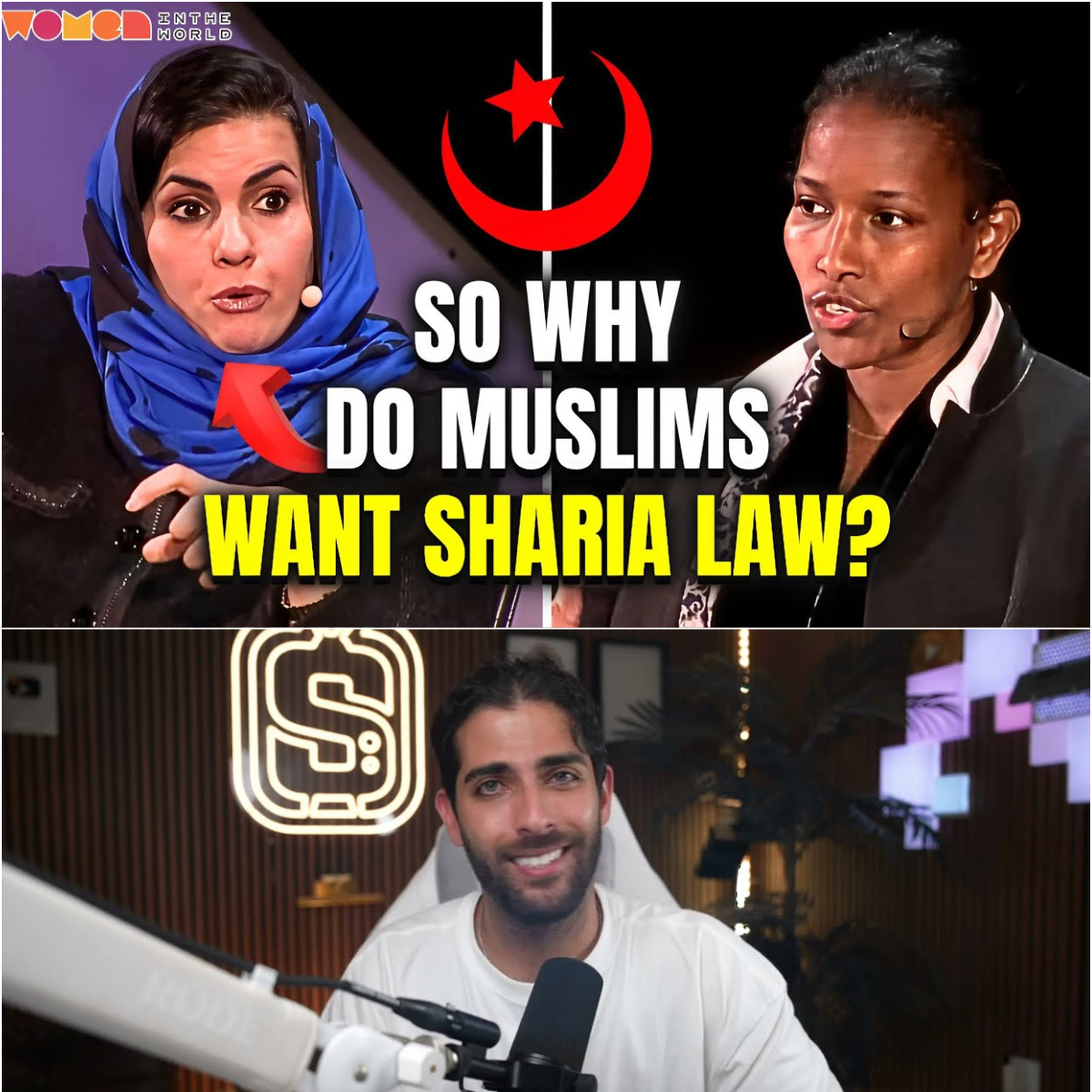
In a cultural moment defined by hypersensitivity and the careful curation of rhetoric, Hirsi Ali remains a profoundly disruptive force. The Somali-born Dutch-American activist, author, and former politician has spent decades at the epicenter of one of the world’s most volatile debates: the intersection of Islamic doctrine, women’s rights, and Western secularism. During a recent panel discussion on the status of women in Islam, the friction between Hirsi Ali and her critics was on full display, capturing a microcosm of the global ideological struggle over the future of the world’s second-largest religion.
The debate, which has since gained renewed traction across digital platforms and social media commentary, laid bare the deeply entrenched divisions between institutional defenders of religious contextualization and those, like Hirsi Ali, who demand a harsh, unblinking confrontation with the fundamental texts of Islam. It is a battle not just over theology, but over human rights, the limits of cultural relativism, and the very definition of progress in the twenty-first century.
The Statistics of Disobedience
True to her warning, Hirsi Ali bypassed pleasantries and launched directly into empirical data, specifically citing a landmark 2013 study by the Pew Research Center. The study, which remains a touchstone in geopolitical sociology, posed a straightforward but explosive question to populations across the Islamic world: Do you favor or oppose making Sharia, or Islamic law, the official law of the land in our country?
The numbers Hirsi Ali recited are staggering, painting a picture of overwhelming majorities favoring theocratic governance. According to the data she highlighted, the implementation of Sharia is supported by 72 percent of Indonesians, 74 percent of Egyptians, 82 percent of Bangladeshis, 84 percent of Pakistanis, 89 percent of Palestinians, 91 percent of Iraqis, and 99 percent of Afghans.
By leading with these statistics, Hirsi Ali committed a calculated rhetorical strike. In Western academic and progressive circles, there is often a concerted effort to frame radical or fundamentalist interpretations of Islam as extreme fringe anomalies—a microscopic minority entirely divorced from the broader global Muslim population. The Pew statistics violently disrupt this comforting narrative. They suggest that the desire for a theocratic legal framework is not an aberration isolated to militant factions, but rather a mainstream aspiration across vast swaths of the globe.
For Hirsi Ali, this data is the unavoidable starting point for any honest conversation about women’s rights. If the overwhelming majority of a population desires the implementation of Islamic law, one must critically examine what that law actually dictates.
The Crucial Distinction: Doctrine vs. People
Anticipating the inevitable accusations of bigotry that trail her public appearances, Hirsi Ali drew a sharp, non-negotiable line in the sand—a distinction that serves as the bedrock of her entire philosophy.
“Let’s make a distinction between Islam as a doctrine and Muslims as fellow human beings who are incredibly diverse,” she urged the panel and the audience. “I embrace Muslims, but I reject Islamic law.”
This bifurcation is crucial. To her critics, an attack on Islam is inextricably an attack on Muslims. But Hirsi Ali insists on treating Islam the way one would treat any other political, economic, or philosophical system: as a set of ideas subject to rigorous, even merciless, scrutiny.
She rejects Sharia not out of xenophobia, but because, in her view, it is fundamentally totalitarian and explicitly bigoted against women. When Islamic doctrine transitions from a private spiritual compass to the official law of the land, the consequences for women are codified and catastrophic. Hirsi Ali meticulously listed the legal realities of Sharia: the reinstatement of child marriage, the mandate of male guardianship, unequal inheritance laws where a woman receives half the share of a man, and a draconian justice system where female rape victims are routinely blamed and, in the most extreme interpretations, stoned to death for adultery.
“We condemn all of these practices,” she stated, addressing the panel’s shared progressive values. “But we will not defeat, we will not eradicate these practices unless we talk about the principle. And the principle is enshrined in Islamic law, unreformed.”
The Whataboutism of Misogyny
The pushback from the panel was immediate, reflecting the standard academic defense against critiques of specific religious doctrines: the argument of universal patriarchal guilt.
One panelist challenged Hirsi Ali’s hyper-focus on Islam by pointing out that the orthodoxies of all major religions are inherently misogynistic. The moderator noted that in India, Hindu women are fighting for the right to enter certain temples, just as Muslim women are fighting for access to mosques. Furthermore, the moderator pointed to the United States, where conservative Christian theology aggressively informs the deeply polarizing political debate over abortion access.
“To me, coming from a so-called third-world country, I find it shocking that America debates abortion,” the panelist remarked. “Misogyny exists in every religion, in every culture, and in every geographical territory. Why are you picking only on Islam?”
It is a familiar rhetorical maneuver—a blend of whataboutism and cultural relativism intended to dilute the specific critiques of Islamic law by spreading the blame evenly across the spectrum of human faith. Hirsi Ali, however, refused to take the bait. While acknowledging that misogyny is indeed a global, cross-cultural disease, she maintained that the conversation required focus. To say “all religions have problems” is to avoid addressing the unique, state-sanctioned mechanisms of Sharia that currently subjugate millions of women.
The difference lies in the enforcement mechanism. While conservative Christians in the United States operate within a secular constitutional republic where their views on abortion are debated, voted upon, and challenged in independent courts, nations governed by strict Sharia do not offer such democratic recourse. The misogyny is not merely cultural; it is divine jurisprudence, heavily armed by the state.
To illustrate this, Hirsi Ali pointed to the texts themselves, specifically citing Surah 4:34 of the Quran. This verse is frequently translated as giving husbands the explicit authority to physically strike their wives if they fear disobedience or rebellion. In the digital age, as Hirsi Ali noted, ignorance is a choice. Anyone with an internet connection can access the Quran and the Hadiths (the recorded sayings and actions of the Prophet Muhammad) to read the foundational texts that inform these oppressive legal systems.
The Reality of Implementation: Iran and Saudi Arabia
To move the debate out of the realm of theoretical theology and into the harsh light of geopolitical reality, Hirsi Ali pointed to specific historical and contemporary examples of Sharia in action. She noted that one does not need to guess what Islamic law looks like when implemented; the world has vivid, ongoing case studies.
She invoked the 1979 Iranian Revolution. When Ayatollah Ruhollah Khomeini returned from exile to establish the Islamic Republic, it was done with a massive wave of popular approval. The secular laws of the preceding Pahlavi dynasty were swiftly dismantled and replaced with strict Islamic jurisprudence.
“You know one of the first things that he did?” Hirsi Ali asked the audience. “He reduced the age of marriage to nine.”
This is not a historical accident, she argued, but a direct reflection of doctrine. Defenders of Sharia, when pressed on the issue of child marriage, routinely look to the example of the Prophet Muhammad. According to widely accepted Sunni Islamic tradition, Muhammad contracted marriage with Aisha when she was six years old and consummated the marriage when she was nine. For those who view the Prophet as the perfect, timeless moral exemplar, his actions validate the practice for eternity.
Hirsi Ali expressed profound frustration with educated, emancipated Muslim women living in the West who continually defend Sharia by claiming it is merely “misunderstood” or requires “contextualization.” To her, this defense is a staggering betrayal of the millions of women living under the boot of these laws in places like Saudi Arabia, Iran, and Afghanistan. In these nations, women endure the daily humiliations of male guardianship systems, are forbidden from traveling without male permission, and find their legal testimonies mathematically reduced to half the value of a man’s.
To call Sharia a “dynamic process,” as one panelist attempted to do, rings hollow to the woman suffering under the lash for improper attire in Tehran or facing lashes for mingling with the opposite sex in Riyadh.
The Shift: From “War” to Internal Reform
The debate reached its most combative peak when a panelist confronted Hirsi Ali over her past rhetoric, specifically a controversial 2007 interview with Reason magazine in which she seemingly advocated for the military defeat of Islam. The panelist argued that by declaring “war on Islam,” Hirsi Ali had permanently surrendered her credibility and alienated the very Muslim women who are fighting for reform from within the faith.
“For someone who has actually asked for Islam to be defeated militarily, I am really surprised that you are still talking about saying the same things,” the panelist challenged, accusing her of backpedaling.
Hirsi Ali did not flinch, but used the confrontation to clarify the evolution of her stance, sparked heavily by the geopolitical seismic shifts of the Arab Spring. She reiterated her foundational premise: unreformed, political Islam is a “nihilistic cult of death” that prioritizes the afterlife over human flourishing in the present. However, her view on how to defeat this ideology has fundamentally shifted toward supporting internal reform.
The catalyst for this shift was the bravery of young, dissenting Muslims. With one-fifth of humanity identifying as Muslim—a billion of whom are under the age of thirty—the demographic reality is one of immense diversity.
“I am seeing a growing number of young Muslims who from the inside reject some of the most basic Islamic doctrine,” Hirsi Ali explained, referencing the inspiration for her book, Heretic. “They want a separation of religion from politics. They’re fighting for women’s rights.”
This is where the true battle lines of the 21st century are being drawn. The conflict is not inherently between the West and the Islamic world, but rather a civil war of ideas taking place within the Islamic world itself. And the frontlines of this war are incredibly dangerous.
Hirsi Ali brought a chilling immediacy to the debate by reminding the audience of a news story that had broken that very day: a secular Bangladeshi blogger had been hacked to death with machetes on the streets of Dhaka by religious extremists. This was not an isolated incident. Freethinkers, secularists, and reformist Muslims face routine assassinations, imprisonment, and mob violence in places like Cairo, Tunis, and Dhaka.
These reformers are refusing to blame their internal societal decay on convenient external scapegoats like American imperialism or Zionism. They recognize that the rot is ideological, and they are pushing back against the fundamentalists who seek to implement Sharia.
“I don’t mind arguing with the Islamists and the extremists. They want to kill me. I don’t want to kill them,” Hirsi Ali stated, capturing the asymmetrical nature of the conflict. “Ultimately, the power of the word is going to win. But we have to, with everything in us, protect that freedom of speech from allegations of Islamophobia, from all other kinds of fabricated ways of silencing people, and ultimately, from violence.”
The Western Observer and the Limits of Tolerance
The resonance of Hirsi Ali’s arguments extends far beyond academic panels, finding deeply rooted support among Western observers and digital commentators who are increasingly wary of political Islam. The YouTube commentary accompanying the debate footage highlights a growing sentiment among Western citizens: a willingness to embrace religious freedom, coupled with an absolute rejection of religious imposition.
In the digital sphere, commentators frequently echo Hirsi Ali’s distinction. The presence of peaceful Muslims—such as the “Quran-only” movements that reject the violent supplementary texts of the Hadiths—is welcomed. The friction occurs entirely at the boundary of political Islam.
For the average Western citizen rooted in the Enlightenment values of secularism and equal protection under the law, the core tenets of orthodox Sharia are entirely incompatible with a free society. The concept of Jizya (a historical subjugation tax levied on non-Muslims), the codification of unequal gender rights, and the outright criminalization of apostasy are not mere cultural differences; they are direct threats to the foundational architecture of liberal democracy.
When activists or religious leaders in the West advocate for the introduction of Sharia tribunals or claim that Islamic law is the perfect cure for society’s ills, they trigger a visceral, justifiable pushback. As one commentator noted, why should a secular society tolerate the creeping influence of a legal system that structurally categorizes non-believers and women as second-class citizens?
The Western left frequently finds itself tied in intellectual knots over this issue, paralyzed by the fear of being labeled “Islamophobic.” In their noble pursuit of protecting a minority group from Western prejudice, they often inadvertently run cover for a deeply conservative, patriarchal ideology that actively suppresses the rights of women, the LGBTQ+ community, and religious minorities in the Islamic world. Hirsi Ali’s presence serves as a constant, uncomfortable mirror held up to this hypocrisy.
The Enduring Power of the Word
Ayaan Hirsi Ali’s ongoing campaign against Sharia law is a testament to the enduring power of unapologetic truth-telling. In an era where complex geopolitical and religious issues are frequently smoothed over by diplomatic euphemisms and academic jargon, her bluntness is a necessary shock to the system.
By refusing to conflate the diverse, humanity of individual Muslims with the rigid, totalitarian dictates of Islamic law, she provides a clear intellectual framework for combating religious extremism. Her demands are simultaneously simple and revolutionary: separate mosque and state, protect the rights of women, and champion the brave dissidents fighting for reform from within.
The debate over the soul of Islam will not be settled in a single auditorium, nor will it be resolved in a single generation. But as the demographic wave of young, interconnected Muslims continues to rise, the demand for ideological reform will only grow louder. Until that internal revolution succeeds, voices like Ayaan Hirsi Ali’s remain vital—disobedient, relentless, and armed with the conviction that no cultural tradition is ever worth more than the freedom and dignity of a human being.