LeBron Superfan GETS ROASTED IN GOAT DEBATE
LeBron Superfan GETS ROASTED IN GOAT DEBATE
In the vaulted, neon-lit cathedrals of American sports talk, there is no debate more exhausted—yet more inexhaustible—than the quest to crown the NBA’s Greatest of All Time. For the better part of a decade, the argument has ceased to be about points or rebounds and has instead shifted into the realm of philosophy. On one side stands the ghost of Michael Jordan: a 6-0 specter of perfection, a man for whom the NBA Finals were not a series, but a coronation. On the other stands LeBron James: the relentless “Galactus” of the hardwood, a man whose career is defined by a staggering ten Finals appearances, but marred—in the eyes of his critics—by six silver medals.
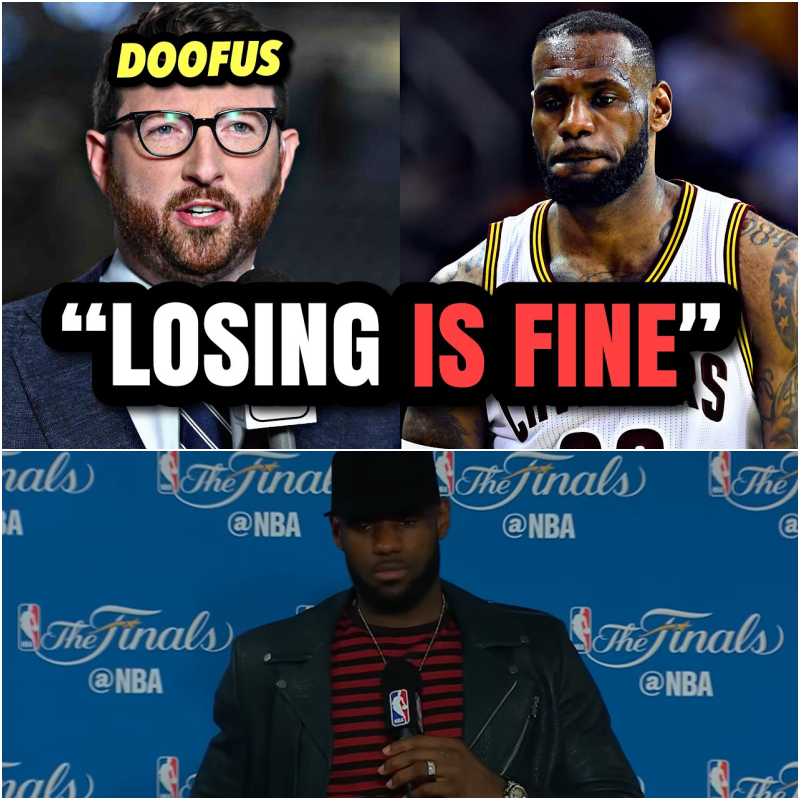
A recent media blitz, punctuated by comments from ESPN’s Dave McMenamin and veteran broadcaster Dan Patrick, has reignited this cold war. The narrative being pushed is one of “cumulative greatness”—the idea that simply reaching the mountain top ten times is a feat that eclipses the perfection of those who stayed there less often. But as the dust settles on this latest round of propaganda, a hard truth remains: in the American meritocracy of professional sports, we do not crown the man who “got there.” We crown the man who conquered.
The Cult of Participation
The centerpiece of the modern LeBron defense is a seductive piece of logic: It is better to lose in the Finals than to lose in the first round. At first glance, it is a statement so mathematically sound it feels unassailable. Why should Michael Jordan be rewarded for losing to the “Bad Boy” Pistons in the late ’80s, while LeBron James is penalized for losing to a dynasty like the Golden State Warriors in the 2010s?
However, this “vacuum logic” ignores the nuance of expectations and the reality of the competitive arc. Take, for example, the 1989 Chicago Bulls. Jordan, playing as a lone superstar with a sophomore Scottie Pippen and Horace Grant, dragged a sixth-seeded team to the Eastern Conference Finals. They weren’t supposed to be there. Their loss to Detroit was not a failure of character; it was a young team hitting a ceiling they had no business reaching yet.
Compare that to the expectations of a peak LeBron James squad. When you have the roster, the MVP trophies, and the hand-picked supporting cast, the “just getting there” participation trophy loses its luster. A loss in the Finals for a super-team isn’t a “better” result than a hard-fought early exit by an underdog; it is a spectacular collapse under the weight of championship expectations.
The Brady Fallacy
During a recent segment, Dan Patrick attempted to bridge the LeBron-Jordan gap by invoking the NFL’s gold standard: Tom Brady. Patrick argued that Brady’s greatness is tied to his ten Super Bowl appearances, suggesting that even the losses (three of them) didn’t diminish his status. “Brady got there,” Patrick noted. “Even if you lose, LeBron got there.”
But the comparison is fundamentally broken. The “Elephant in the Room” is the win-loss column. Tom Brady went 7-3 in Super Bowls. He didn’t just “get there” more than Joe Montana (who was a perfect 4-0); he won more than him. Brady surpassed the legend of Montana by taking the perfection of the 4-0 record and adding three more rings to it.
LeBron James has the appearances, but he lacks the hardware. He has ten appearances to Jordan’s six, yet he still trails by two championships. To use the Brady argument to defend LeBron is to ignore the very thing that made Brady the GOAT: the ability to finish the job more often than anyone else in history. In the history of the four major American sports, we have never rewarded a “negative” record on the biggest stage with the title of the greatest. Why start now?
The “Galactus” Strategy
The most damning indictment of LeBron’s ten Finals appearances is the manner in which they were achieved. Critics often point to his career trajectory as that of a “Galactus”—a cosmic entity that travels from planet to planet (or franchise to franchise), exhausting all local resources, draft picks, and cap space to create a window of immediate dominance, only to move on to the next “planet” once the atmosphere becomes toxic.
From the “Big Three” in Miami to the homecoming in Cleveland and the star-studded recruitment in Los Angeles, James has never had to endure the natural aging process of a single roster. Michael Jordan’s six titles were won with a single organization. He watched the Bulls grow from a scrappy underdog in 1991 to a weary, “Last Dance” veteran squad in 1998 that was running on fumes. Jordan didn’t leave when the resources were spent; he stayed and extracted every last drop of greatness from a declining roster.
LeBron’s eight consecutive Finals appearances are a testament to his individual brilliance, but they are also a product of his ability to hit the “reset” button and jump into a fresh Big Three every four years. It is an incredible feat of management and athleticism, but it lacks the grit of the dynasty-builder who wins through the thick and the thin.
The Golf Standard: Winners and Runners-Up
If we are to accept the “Finals appearance” as a primary metric of greatness, we must apply it to other sports. Consider the Masters. Tom Weiskopf, a legendary golfer, was a runner-up at Augusta four times in the late ’60s and early ’70s. He was consistently “there,” knocking on the door of history. Yet, in the annals of golf, Patrick Reed—who won the green jacket once—occupies a tier of champion that Weiskopf never reached.
Why? Because sports are binary. You win or you do not. There is no silver medal hanging in the rafters of the Staples Center or the United Center. The NBA does not hang banners for “Western Conference Champions” with the same pride it does for the Larry O’Brien Trophy. To suggest that we should give LeBron “extra credit” for being the runner-up six times is to ask the American public to change the very definition of success.
The Shifting Goalposts
Perhaps the most revealing moment of this recent media cycle came from Dave McMenamin, who suggested that LeBron’s Finals appearances are “as important as any stat he was able to accomplish.”
This is the ultimate shifting of the goalposts. For decades, the “Rings” argument was the gold standard. It was the metric used to elevate Magic over Bird, Jordan over Thomas, and Kobe over his contemporaries. Now that LeBron James has found himself on the trailing end of that specific metric, his proponents are attempting to devalue the ring in favor of the “journey.”
But the journey is only as good as the destination. We remember the 1996 Bulls not because they “got to the Finals,” but because they finished a 72-win season with a trophy. We remember the 2016 Cavaliers not because LeBron made his seventh Finals, but because he finally brought a championship to Ohio. The victory is the only thing that validates the struggle.
Conclusion: The Cost of Perfection
Ultimately, the LeBron vs. Jordan debate is a clash of values. It is a choice between Longevity and Lethality.
LeBron James is the greatest compiler the game has ever seen. His statistical totals in points, rebounds, and assists will likely never be touched. His ability to remain an elite force for two decades is a medical and athletic marvel. If the GOAT debate is about who played the most high-level basketball for the longest period of time, LeBron James wins in a landslide.
But if the GOAT debate is about who you want on the court when the world is on the line—who possessed the singular, terrifying ability to ensure victory at the highest level—the answer remains the man from Chicago. Michael Jordan’s 6-0 record isn’t just a stat; it’s a statement. It means that once he reached the summit, he never allowed himself to be knocked off. He never let a “lesser” team beat him. He never had a 2011-style meltdown.
LeBron’s motto, supported by a media machine eager to keep the debate alive, seems to be “Just Make It.” But for those who grew up watching the clinical, cold-blooded efficiency of the 1990s, the motto remains “Just Win It.”
In the end, you play to win the game. You don’t play to be the runner-up. And until LeBron James can bridge that two-ring gap, he will remain the greatest silver medalist in the history of the world—a king with a crowded court, but a throne that still sits one tier below the summit.