Klutch Sports STILL LYING FOR LEBRON
Klutch Sports STILL LYING FOR LEBRON
LOS ANGELES — In the pressurized cabin of NBA discourse, where the air is thin and the takes are incandescent, LeBron James has long existed in a state of quantum superposition. He is simultaneously the ageless titan carrying a franchise on his back and a 41-year-old elder statesman who must be shielded from the indignity of criticism.
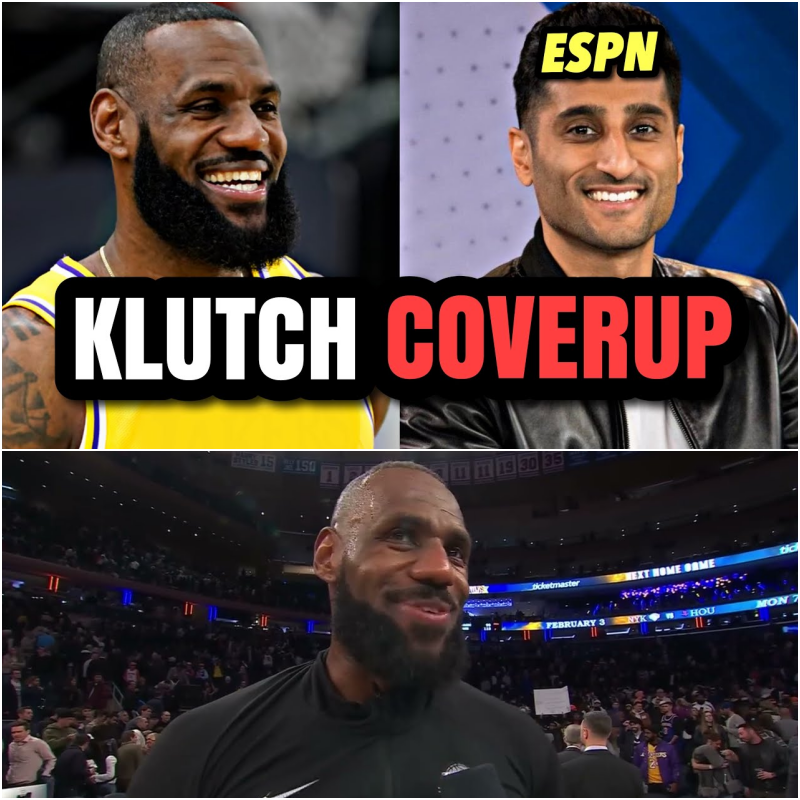
As the Los Angeles Lakers grapple with a tightening first-round series against the Houston Rockets—a matchup that has mutated from a potential sweep into a psychological quagmire—the machinery of the “LeBron Industrial Complex” has shifted into a familiar, high-gear overdrive. It is a masterclass in narrative elasticity: when the Lakers win, it is a testament to James’s singular greatness; when they falter, it is a failure of the supporting cast, a symptom of biological inevitability, or, most creatively, a form of “playoff load management.”
For the American sports consumer, the current spectacle is less about basketball and more about the curation of legacy. We are witnessing the final, frantic polishing of a monument, where any speck of dust is immediately blamed on the wind.
The Double-Edged Sword of Decades
The central tension of the current Laker campaign lies in how we define James’s 23rd season. To his most ardent defenders in the media—those often derided as “Klutch Sports assets”—James’s age is a “legacy enhancer” when he dunks and a “crushing excuse” when he commits a turnover.
Earlier this week, as the Lakers surged to a 3-0 lead, the airwaves were thick with proclamations that the “GOAT” (Greatest of All Time) conversation was effectively over. The narrative was seductive: a 41-year-old leading a “heavy underdog” to a dominant victory over a Houston team featuring Kevin Durant. In this version of reality, James was the sun around which all Laker success orbited.
However, the reality on the hardwood told a more nuanced story. The Lakers’ early dominance wasn’t merely a product of “King James” reaching into a fountain of youth; it was fueled by the “out-of-body experiences” of Marcus Smart and Luke Kennard. In the first two games, this duo combined for nearly 100 points, shooting the lights out of the Crypto.com Arena. Yet, in the post-game post-mortems on major networks like ESPN, these contributions were treated as footnotes—scaffolding for the grander architecture of LeBron’s brilliance.
“When things go well, it’s all about LeBron,” notes one skeptical analyst. “He’s the main storyline regardless of whether he played like an MVP or just a very good facilitator. But the moment the tide turns, the focus shifts to everyone else.”
The “Load Management” Mirage
The breaking point for many objective observers arrived during Game 4. With a chance to sweep the Rockets and send a message to the rest of the Western Conference, James turned in what can only be described as an “all-time stinker.”
The stat sheet was grim: 10 points, eight turnovers, and a 0-for-3 showing from beyond the arc. In any other era, for any other superstar, such a performance in a close-out game would be met with scathing critiques of focus and execution. Instead, the media apparatus pivoted toward a startling new defense: James wasn’t struggling; he was strategically “coasting.”
The suggestion that a player would engage in “load management” during a playoff game—effectively conceding a chance to rest for a week in exchange for an extra flight to Houston—is a bridge too far for many basketball purists. It represents a level of “stark-raving delusional” commentary that seeks to protect James from the very standards of excellence he spent two decades establishing.
When media figures like Sham Charania or Shannon Sharpe suggest that James “did everything he could” despite a turnover-laden fourth quarter, they aren’t just reporting on a game; they are participating in a PR campaign. It is a narrative where the 41-year-old is never the architect of his own defeat, but rather a victim of his teammates’ inadequacies or the simple passage of time.
The Scapegoat Shuffle
If James is the untouchable protagonist, then a supporting cast must be ready to play the role of the sacrificial lamb. Enter Marcus Smart and Luke Kennard.
The irony is thick enough to choke on. When the Lakers were winning, Smart and Kennard were the invisible engines. When they struggled in Game 5—combining for a dismal 12 points and seven turnovers—the narrative shifted instantly. They were no longer the reliable veterans; they were the “new scapegoats” responsible for the Lakers’ inability to close the series.
This cycle is the hallmark of the LeBron era. It creates a “heads I win, tails you lose” scenario for his teammates. If they play well, James is “elevating his squad.” If they play poorly, James is “carrying a lottery-level roster.” This selective memory ignores the fact that the Lakers’ 3-2 lead exists largely because those same role players played at an All-Star level during the series’ opening act.
As Chad Johnson (Ochocinco) recently pointed out in a televised spat with Shannon Sharpe, the inconsistency is glaring. You cannot use a player’s age to crown him as the greatest when he wins, and then use that same age as a “crutch” to absolve him of blame when he shoots 2-of-9.
The Pressure of the “House Money” Myth
As the series shifts back to Houston for Game 6, the psychological landscape has been fundamentally altered. The Lakers started this journey “playing with house money”—a team no one expected to win, led by an old man against the world.
But that shield has dissolved. With Kevin Durant sidelined by injury and the Lakers once holding a 3-0 lead, the pressure has shifted entirely onto the shoulders of the Purple and Gold. The Houston Rockets, fueled by youth and playing with nothing to lose, are no longer the ones under the microscope.
If the Lakers fail to close this out—if they become the first team in NBA history to blow a 3-0 lead—the narrative machine will face its greatest challenge yet. Will the “41-year-old” excuse hold up against the weight of a historic collapse? Or will we finally see a reckoning with the fact that James, like every great who preceded him, is subject to the same laws of physics and performance as everyone else?
The Legacy of the Playbook
The “LeBron Playbook” of media management is not a new phenomenon, but its current iteration is perhaps its most desperate. By setting the “GOAT” stakes so high for a first-round series, James’s advocates have backed themselves into a corner.
There has never been a point in NBA history where a first-round victory, regardless of the player’s age, dictated the terms of the greatest-of-all-time debate. To suggest so is “ludicrous” and “typical LeBron fan talk,” yet it has become the standard operating procedure for major sports networks.
This curated reality serves a specific purpose: it ensures that James’s brand remains pristine even as his athleticism wanes. It transforms a basketball player into a mythological figure who is beyond the reach of traditional criticism.
However, for the fans watching at home—those who see the eight turnovers, the missed rotations, and the “stat-padding” in the waning minutes of a blowout—the gap between the media’s portrayal and the on-court reality is becoming a canyon.
Conclusion: The End of the Cycle?
As the sun begins to set on one of the greatest careers in American sports history, we are left with a fundamental question: Can we appreciate LeBron James for what he is—a phenomenal, unprecedented talent navigating the twilight of his career—without the layer of protective lies?
The cycle of “all the credit, none of the blame” is exhausting for the average fan. It devalues the contributions of his teammates and insults the intelligence of the audience. James doesn’t need “Klutch Sports” to lie for him; his resume speaks for itself.
But as long as the media continues to treat his age as a convenient toggle switch—legacy enhancer today, excuse tomorrow—the “GOAT” conversation will remain mired in cynicism. The Lakers may still win this series, and James may still produce moments of magic. But if we want to truly honor his greatness, we must first be willing to see his flaws.
Until then, the circus continues. The flight to Houston is three-and-a-half hours. The pressure is mounting. And the narrative machine is already warming up its next set of excuses, just in case.