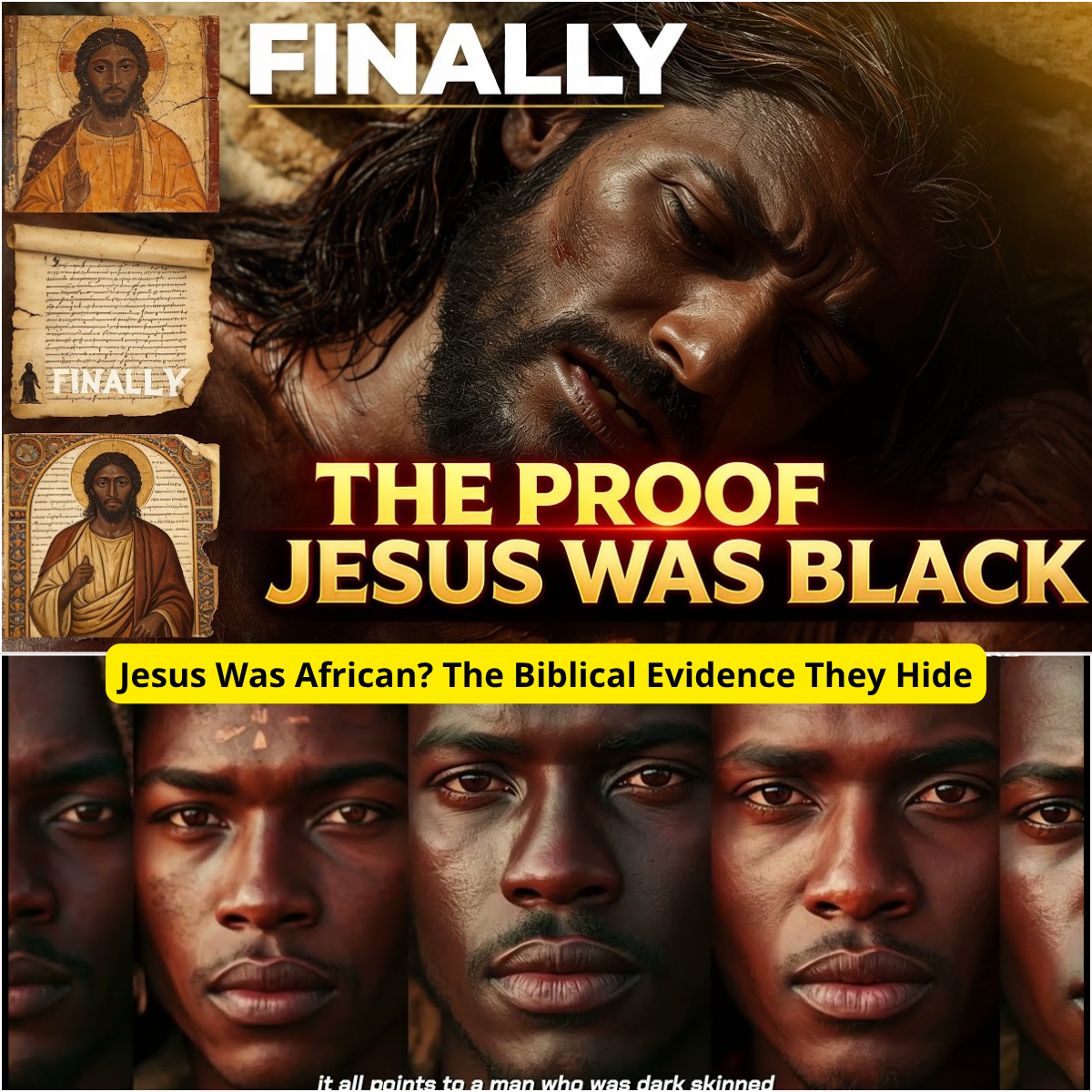
Jesus Was African? The Biblical Evidence They Hide
Jesus Was African? The Biblical Evidence They Hide
The dry autumn wind howled through the narrow, high-arched windows of St. Jude’s Theological Seminary, carrying with it the scent of damp earth and decaying leaves. Inside the mahogany-paneled lecture hall, the atmosphere was no less turbulent.
Marcus sat in the third row, his fingers tapping a rhythmic, nervous beat against the leather cover of his notebook. Across the room, the afternoon sun pierced through a stained-glass window, casting a brilliant crimson and sapphire fracture across the polished floorboards. The window depicted a serene, alabaster-skinned Christ with flowing, sun-kissed brown hair and piercing blue eyes—an image Marcus had seen in every Sunday school book, every Hollywood epic, and every church cathedral since he was a boy growing up in Chicago.
At the podium stood Professor Arthur Vance, a man whose reputation for rigid, traditionalist scholarship preceded him. Vance adjusted his spectacles, his voice echoing with seasoned authority.
“For centuries, Western iconography has provided us with a visual shorthand for the divine,” Vance said, gesturing toward the stained glass. “While these representations are culturally conditioned, they serve as a vital psychological anchor for Western Christendom. They give a face to the abstract.”
Marcus raised his hand. It wasn’t a hesitant gesture; it was deliberate.
Vance paused, his eyebrows knitting together. “Yes, Mr. Lincoln?”
Marcus stood up, holding a worn, heavily annotated Bible in his hands. “With all due respect, Professor, isn’t there a profound danger when a ‘cultural shorthand’ completely rewrites historical and geographical reality? We aren’t just talking about artistic license. We are talking about a deliberate erasure of the text itself.”
A low murmur rippled through the lecture hall. Several students turned around, some raising an eyebrow, others shifting uncomfortably in their seats.
Vance offered a patronizing smile. “Theology is a vast ocean, Marcus. Artistic interpretation does not dilute the core message of salvation.”
“But it dilutes the truth,” Marcus countered, his voice steady, carrying a conviction that demanded attention. “If we open this text without the filters that centuries of European paintings and movies have placed on our eyes, the reality is starkly different. The story of Scripture didn’t unfold in Europe. It unfolded in the Middle East and Africa. And the man at the center of it did not look like that window.”
Vance folded his hands over the podium. “If you are going to challenge centuries of church tradition, Mr. Lincoln, I trust you have more than just an opinion formed in your dormitory.”
“I do,” Marcus said, stepping into the aisle. “I have the text, history, geography, and the simple logic of how the world works. And if we truly believe in the authority of Scripture, we have no choice but to accept what it actually says.”
The lecture hall grew deathly quiet. Marcus looked around the room, sensing the collective tension. He knew he was standing on a theological landmine, but the fire inside him had been burning too long to be snuffed out by academic politeness.
“Let’s go back,” Marcus began, his voice taking on the cadence of a seasoned storyteller. “Way back before the New Testament, before David, before any king sat on a throne in Israel. Let’s look at the very root of the bloodline. The original Israelites were not a light-skinned, European people. They were a dark-skinned people living in a region surrounded by Egyptians, Ethiopians, Canaanites, and Arabs. In that part of the world, dark skin wasn’t an anomaly. It was the norm.”
He opened his Bible to Genesis. “Look at the tribe of Judah—the very line from which Jesus descends, the line that gives us the very word Jew. Genesis 38 explicitly records that Judah had children with Canaanite women, first Shua, then Tamar. The Canaanites were a dark, indigenous people of the Levant. The lineage of the Messiah was built on a foundation of mixed African and Middle Eastern ancestry. This isn’t reading between the lines; it’s basic genealogy.”
Vance cleared his throat, leaning forward. “An interesting genealogical footnote, Marcus, but skin color is notoriously difficult to determine from ancient texts.”
“Then let’s look at how the text uses contrast to define normalcy,” Marcus shot back. “When Moses married Zipporah, a Cushite woman from Africa, his siblings Aaron and Miriam opposed him because of her identity. And how did God respond to Miriam’s prejudice? The text says He struck her with a skin disease that turned her skin ‘white as snow.’ Why white? Because in a world where dark skin was the baseline of health and normalcy, being turned white was the ultimate visual marker of judgment and affliction. The text uses whiteness as the aberration, not the standard.”
A student in the front row, a traditionalist named Bradley, leaned back and scoffed. “You’re pulling isolated Old Testament verses to build a racial narrative, Marcus. What does that have to do with the historical Jesus?”
“Everything,” Marcus said, turning his gaze to Bradley. “Because you cannot separate Jesus from the line of David. The New Testament explicitly calls Him the Son of David. So, what did David look like?”
Marcus flipped to 1 Samuel 16. “When the prophet Samuel went to the house of Jesse to find the next king, he was introduced to David. The text describes David as ruddy—translated from the Hebrew word adommoni. Western translators, imagining their own reflection, interpreted this to mean a rosy-cheeked, fair-skinned boy. But in the context of ancient, dark-skinned Semitic and Afro-Asiatic peoples, adommoni refers to a deep, reddish-brown, bronze complexion. It’s the color of rich, sun-baked earth or burnt copper. It’s the exact skin tone you see today across the Horn of Africa and the Arabian Peninsula.”
Marcus pointed directly at the stained-glass window. “David was a shepherd who spent his youth under a brutal Middle Eastern sun. The pale, blond-haired, blue-eyed boy in our Sunday school books is a European invention. Renaissance artists painted what they knew; they painted their own image onto a story that belonged to a completely different continent. And it is through this exact, sun-weathered, dark-bronze bloodline of David that Mary of Nazareth conceived.”
Professor Vance stepped out from behind the podium, his expression hardening. The academic debate was shifting into a direct confrontation of worldviews.
“Even if we concede the regional climate and genetics of the ancient Near East,” Vance said, his voice dropping an octave, “the New Testament offers no physical description of Christ during His earthly ministry. It focuses entirely on His spiritual identity. Your argument lacks an eyewitness account.”
“During His earthly ministry, yes,” Marcus conceded, stepping closer to the front of the hall. “Because He looked like everyone else in Galilee. He didn’t stand out as a European foreigner; He was recognized as a Galilean Jew. But the New Testament does give us an eyewitness description of His glorified form. John sees Him in the Book of Revelation, and he isn’t using loose, poetic metaphors. He is describing a vivid, literal manifestation.”
Marcus turned the pages to Revelation chapter one, his eyes scanning the verses he knew by heart.
“John writes that the head and hair of Jesus were ‘white like wool.’ Not smooth like silk, not fine like European hair. Like wool. And then he describes His feet and legs: ‘like fine brass, as if they had been burned in a furnace.’ Let those words sink in. Woolen hair. Brass skin, intentionally specified as burned in a furnace—the deepest, darkest shade of bronze imaginable.”
Marcus looked around the room, making eye contact with his peers. “There is only one demographic of human beings on this planet whose hair naturally grows in tight, dense, coiled textures resembling wool. Straight hair doesn’t look like wool. Curly European hair doesn’t look like wool. It is a highly specific, undeniable description that points directly to African and African-descended peoples. Combined with skin the color of fired brass, the text is painting a picture that contradicts every piece of art hanging in this seminary.”
“That is apocalyptic imagery!” Bradley shouted from his desk. “It’s symbolic of purity and judgment, not a racial profile!”
“If it’s entirely symbolic, why use such hyper-specific, physical descriptors rooted in human anatomy?” Marcus replied, his voice rising to match Bradley’s energy. “Even if you want to retreat into symbolism, the symbols chosen are drawn from the physical realities of the authors’ world. They didn’t choose marble or ivory; they chose burnt brass and wool.”
The room was buzzing now. The comfortable, academic detachment had vanished, replaced by the raw friction of a truth that challenged deep-seated cultural comfort.
“But let’s leave the visions aside,” Marcus continued, his tone softening into an undeniable, practical logic. “Let’s talk about survival. Let’s talk about the flight to Egypt.”
He closed the Bible and held it against his chest. “When Jesus was a baby, King Herod ordered the slaughter of every male child two years old and under in the region of Bethlehem. Joseph was warned in a dream to take Mary and the child and flee. Where did they go? They didn’t flee to Rome. They didn’t hide in Athens. They went south, into Egypt. Into Africa.”
Marcus walked to the center of the room, tracking an imaginary map with his hand. “Think about the basic, real-world logic of a refugee family running for their lives. They needed to disappear. They needed to blend into a crowd so that Herod’s soldiers couldn’t track them down. At that time in history, the indigenous population of Egypt consisted of people of color—as evidenced by their own ancient tomb paintings, which depicted their skin in shades of deep reddish-brown and black.”
He stopped and faced Professor Vance directly. “If Jesus looked like the pale, blue-eyed figure in that stained-glass window, do you honestly believe he could have hidden in an ancient African village? A white baby in a first-century Egyptian community would have stuck out like a flare in the night sky. Informants would have spoken, and Herod’s soldiers would have found them within hours. But Jesus survived because His family blended in. They disappeared into the crowd because they looked exactly like the crowd. He possessed the skin, the hair, and the features of the region.”
Vance remained silent, his gaze fixed on the floor, processing the undeniable pragmatism of the historical context.
“And the narrative consistent with this reality continues all the way to the cross,” Marcus said, his voice carrying a solemn weight. “When Jesus was marching to Calvary, battered, bleeding, and collapsing under the weight of the crossbeam, the Roman soldiers grabbed a man out of the crowd to carry it for Him. Who did they pick? Simon of Cyrene. Cyrene was a city on the northern coast of Africa, in modern-day Libya. Simon was a black African man.”
Marcus paused, letting the silence fill the room. “Historians and theologians have often pondered why, out of thousands of onlookers in Jerusalem for Passover, the soldiers chose Simon. Some accounts suggest a cruel irony—that in the chaos and dust of the crowd, Simon bore such a striking physical resemblance to Jesus that the soldiers targeted him to mock the condemned man, or even momentarily confused the two. Whether through resemblance or proximity, the inclusion of an African man at the climax of the passion narrative reinforces the inescapable truth: the world Jesus occupied, the community He identified with, and the skin He lived in belonged to the Afro-Asiatic world.”
Marcus walked back to his desk, but he didn’t sit down. He looked up at the stained glass, then back at his professor.
“For hundreds of years, the image of a white Christ was exported across the globe,” Marcus said, his voice laced with a profound, quiet sorrow. “It was brought to Africa, to the Americas, to the Caribbean by colonizers and missionaries. They hung those false images in churches, placed them in family Bibles, and implicitly taught millions of people of color that God, in His human perfection, looked like a European conqueror. It became a tool of psychological and spiritual subjugation. The false image became more real to people than the text itself.”
The room was completely still. Even Bradley had stopped fidgeting.
“But the text never changed,” Marcus said, his voice ringing with absolute clarity. “The Book of Revelation still says wool and burnt brass. Genesis still records the dark ancestry of Judah. The geography still places the story firmly in the soil of the Middle East and Africa. The pictures lied, but the text kept the truth safe.”
Professor Vance looked up. The defensive, academic armor had dropped from his face, replaced by a vulnerability that Marcus had never seen in him before. He looked at the stained-glass window, then at Marcus, and finally down at his own notes.
“This isn’t about racial pride,” Marcus concluded, his eyes shining with conviction. “It’s not a black truth or a white truth. It’s just the truth. And if we claim to be scholars, if we claim to be believers who honor the integrity of Scripture, then we have to be brave enough to look at it without the filters. We have to be willing to accept the discomfort of unlearning a beautiful lie to embrace an authentic reality.”
Marcus sat down, placing his notebook on the desk.
The silence stretched for what felt like an eternity. The tension in the room had shifted from hostility to a profound, contemplative weight.
Professor Vance slowly walked back to the podium. He didn’t pick up his lecture notes. Instead, he looked out at the class, his eyes lingering on the stained-glass window before settling on Marcus.
“Thank you, Mr. Lincoln,” Vance said softly, his voice devoid of its earlier condescension. “I believe… you have given us all a great deal of truth to reckon with today.”
As the dismissal bell rang, no one rushed out. The students moved slowly, their eyes drifting between the text in their laps and the white image in the window, seeing the pages with fresh eyes for the very first time.