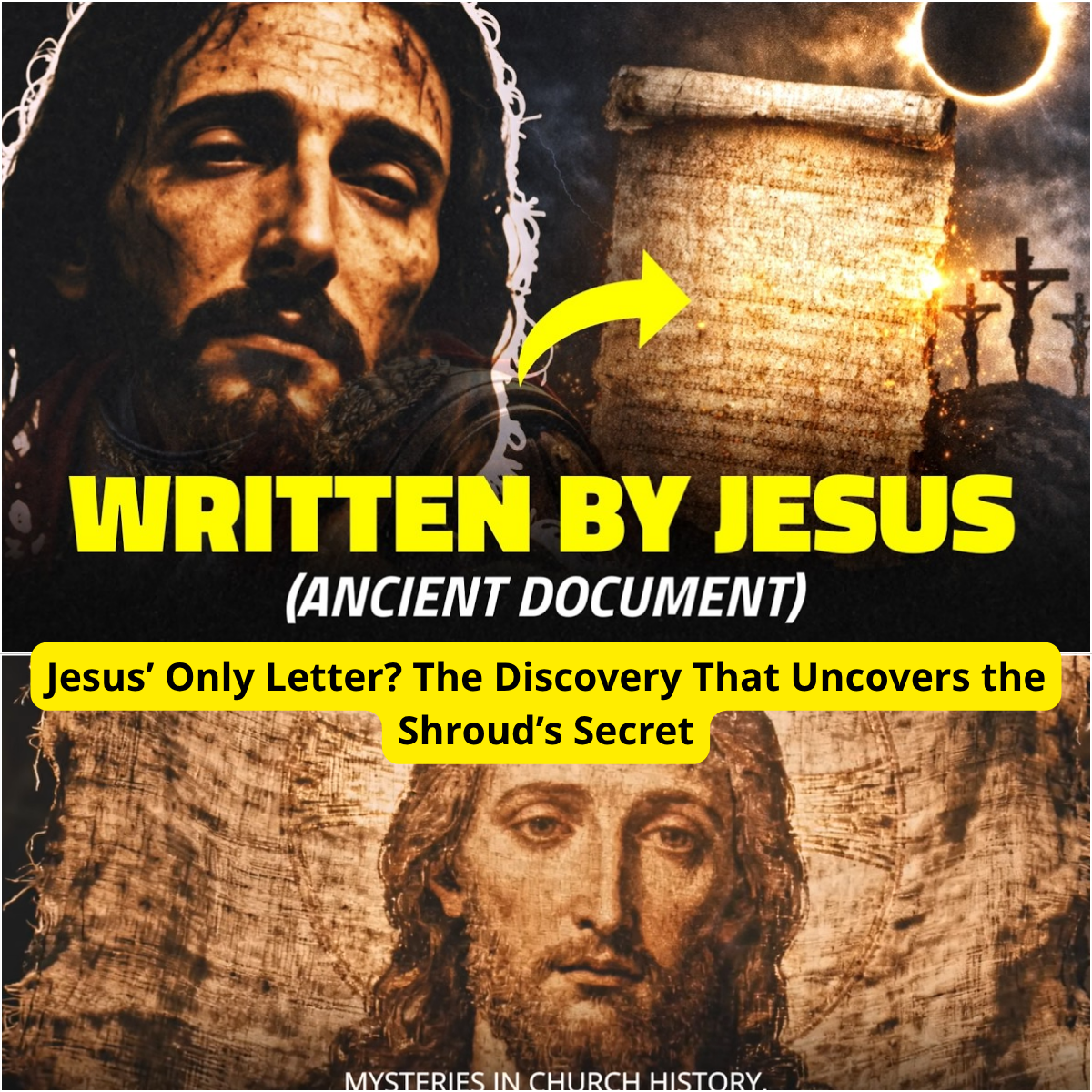
Jesus’ Only Letter? The Discovery That Uncovers the Shroud’s Secret
Jesus’ Only Letter? The Discovery That Uncovers the Shroud’s Secret
The afternoon sun over Edessa did not shine; it baked. Outside the heavy limestone walls of the royal palace, the air hummed with the dry, mechanical buzz of locusts and the distant, rhythmic clatter of blacksmiths shaping iron. Edessa, a powerful pagan city-state nestled in the fertile crescent of southeastern Turkey, was a jewel of wealth and trade. Its markets overflowed with purple dyes from Phoenicia, silks from the Far East, and spices that smelled of smoke and honey.
But inside the high-arched chambers of the inner palace, the atmosphere was suffocatingly still. Gold and marble could not buy breath, nor could they cool the burning torment of the flesh.
King Abgar V, known to his subjects as the Black, lay motionless beneath sheets of fine Egyptian linen. He was an immensely wealthy monarch, a man whose word could move armies and change the borders of empires. Yet, he was utterly helpless. An aggressive, relentless affliction—which the court chronicles described as a severe, devastating form of leprosy combined with a crippling gout—had eaten away at his strength. His skin was mapping the progress of his decay, and his joints felt as though they were being systematically crushed by iron vices.
Around his bed stood the finest minds in the region. There were Greek physicians smelling of vinegar and dried herbs, Babylonian astrologers who spoke of shifting planetary alignments, and local priests who had slaughtered dozens of white goats to the pagan gods of the sun and moon. They had all failed. The potions grew more bitter, the incantations louder, but the king only drew closer to the grave.
A soft knock interrupted the low murmuring of the doctors. Ananias, the king’s most trusted archivist and high-speed courier, stepped through the heavy velvet drapes. He had just returned from a long trade route that extended south into the Roman province of Judea. His sandals were caked with the white dust of the road, and his eyes carried the manic energy of a man who had seen something that defied the natural order.
“Leave us,” Abgar croaked, his voice raw, waving a heavily bandaged hand toward the physicians. The men bowed quickly and shuffled out, eager to escape the heavy stench of the sickroom.
Once the drapes fell shut, Ananias dropped to one knee. “Your Majesty, I have seen things in the south that the mind cannot easily hold. The marketplaces of Jerusalem and the villages of Galilee are in an uproar.”
Abgar sighed, a sound like dry parchment rubbing together. “I care nothing for Jewish politics, Ananias. Tell me of a cure, or let me sleep.”
“It is a cure, my King,” Ananias insisted, leaning closer. “But it comes from no physician. There is a man, a carpenter from Nazareth named Jesus. The merchants speak of him not as a doctor, but as life itself. He uses no medicines, no knives, and no charms. They say he needs only a single spoken word to make the lame leap like deer. A single touch from his fingers cleanses the skin of lepers as white as snow. I spoke with a centurion who swears this man looked at a dead girl, spoke to her, and she stood up to eat.”
The king remained silent for a long moment. He was a pragmatic ruler, a man trained to spot the exaggerations of travelers and the lies of religious zealots. Yet, as he looked down at his own decaying hands, something strange and logical clicked within his mind. If these reports were even half true, this man was working outside the laws of nature. He was not a sorcerer; he was operating with the authority of the Creator.
“Ananias,” the king commanded, his voice suddenly gaining a thread of its old steel. “Bring ink, reed pens, and the finest parchment from the archives. You will write exactly what I dictate.”
The courier moved swiftly, setting up a small wooden writing desk by the bedside. He dipped his reed pen into the dark ink, waiting with bated breath.
“To Jesus, the good Savior who has appeared in the city of Jerusalem,” Abgar dictated, his eyes fixed on the ceiling. “Abgar, ruler of Edessa, sends greeting unto you.”
The king paused, swallowing hard against the pain. “I have heard of you, and of the healings performed by your hands without drugs or herbs. For it is reported that you cause the blind to see, the lame to walk, and that you cleanse lepers. Hearing all these things concerning you, I have concluded one of two things: either that you are God descended from heaven to do these things, or that you are the Son of God.”
Ananias’s pen scratched furiously against the parchment.
“Therefore,” Abgar continued, “I write to beg you to take the trouble to come to me, and to heal the disease from which I suffer. Furthermore, I have heard that the Judeans murmur against you and seek to do you harm. My city, though small, is stately and honorable. It is sufficient for both of us. Come, live within my walls, share my throne, and you shall be safe.”
It was an astonishing proposal. A wealthy, sovereign pagan monarch was offering political asylum and an earthly kingdom to a penniless teacher from Nazareth, explicitly to save him from the threat of execution.
Ananias sealed the parchment with the royal wax of Edessa, placed it in a protective leather pouch, and left the city before the sun had fully set, riding toward Jerusalem with the speed of a man carrying the life of his king in his hands.
The Reply from Jerusalem
The journey to Jerusalem was grueling, but Ananias pressed his horses through the rocky terrain of the Jordan Valley, arriving during the chaotic weeks of the Passover festival. The holy city was a boiling cauldron of Roman soldiers, temple authorities, and massive crowds of pilgrims.
It did not take long to find the teacher. He was surrounded by a dense wall of humanity near the temple courts—men, women, and children pressing in just to touch the hem of his cloak. Ananias, using his status as a royal emissary, managed to navigate through the disciples and reached the inner circle.
When Jesus turned his gaze toward him, Ananias felt a physical sensation, as if his very soul were being weighed and understood in a fraction of a second. The courier dropped to his knee, retrieved the letter from his leather pouch, and presented it.
Jesus took the parchment. He did not read it with the slow, deliberate parsing of human scholars. He looked at it, smiled with a deep, sorrowful tenderness, and handed it to one of his closest followers, a man named Jude Thaddaeus, to read aloud to the others.
“Tell your master this,” Jesus said to Ananias, his voice carrying easily over the din of the marketplace. Then, he dictated a reply, which Ananias meticulously copied onto a fresh scroll.
“Blessed are you, Abgar, who have believed in me without having seen me. For it is written of me that those who have seen me will not believe, so that those who have not seen me may believe and have life.”
The text of the letter took a turn that made Ananias’s heart sink.
“As for your invitation to come to you, it is necessary that I fulfill here all things for which I was sent. When I have fulfilled them, I shall be taken up to Him who sent me. But after my ascension, I will send one of my disciples to you. He will heal your disease and bring life to you and to all who are with you.”
Jesus was refusing the safety of Edessa. He was turning down an earthly throne and a secure sanctuary because he knew his path led inevitably to a Roman cross outside the city walls. He would not run from Calvary; the salvation of the world, including that of King Abgar, depended on his willingness to stay and die.
The Portrait of Light
Ananias stood frozen, his mission only partially successful. He had a letter, but his king was still dying.
Seeing the deep distress on the courier’s face, Jesus paused. Traditional accounts within the archives suggest that Abgar had given Ananias a secondary, secret command: If the teacher cannot come, paint his portrait. Bring me his likeness so that I may look upon it and hold onto hope.
Ananias was an accomplished artist, trained in the classical traditions of capturing royal forms. He moved to the edge of the courtyard, pulled out a linen cloth, and began to study the features of Jesus, attempting to sketch the lines of his face, the shape of his eyes, and the drape of his beard.
But it was impossible.
Every time Ananias focused his eyes on the face of Christ, the features seemed to shift, radiating an intense, divine luminescence. It was a transfiguring glow that dazzled the artist’s eyes and made his hands tremble so violently that the charcoal snapped against the fabric. The heavy, uncreated light seemed to blur the boundary between the physical world and the divine, leaving the skilled painter completely blind to the lines he was trying to capture.
Jesus saw the man’s mounting frustration and his tears of desperation. With an act of immense compassion, he called out to his disciples. “Bring water,” he commanded.
A ceramic bowl was brought forward. Jesus washed his face, wiping away the sweat and dust of the Jerusalem heat. Then, he took a heavy piece of linen fabric—referred to in the ancient Greek texts as a Mandylion—and pressed it firmly against his wet face.
When he pulled the cloth away, he did not hand back a wet rag. He handed Ananias the linen.
The courier held it up to the light, and his breath caught in his throat. Imprinted directly into the very fibers of the fabric, without a single drop of ink, oil, or pigment, was a perfect, photographic likeness of the face of Jesus. It was his exact visage, his eyes, his hair, and his beard, captured in a monochrome, ghostly shadow. It was an image not made by human hands.
“Take this to your king,” Jesus whispered. “Tell him to endure.”
The Shadow in the Fabric
Ananias rode back to Edessa as if pursued by ghosts. He burst into the royal bedchamber, where King Abgar lay in what the doctors believed were his final hours. The king’s breathing was shallow, his eyes glassy with the approach of death.
“My King,” Ananias cried out, dropping the scroll of the letter onto the bed and carefully unfolding the linen Mandylion. “The teacher could not come. But he sent his word, and he sent this.”
The dying monarch forced his head up, his eyes focusing on the cloth. The moment his gaze locked onto the serene, mysterious face imprinted on the linen, a violent tremor ran through his body.
It was not a tremor of pain, but of life.
Before the eyes of the terrified court physicians, the gray, necrotic tint of Abgar’s skin began to flush with healthy, red blood. The deep, weeping lesions of his leprosy vanished, leaving skin as smooth as a child’s. His swollen, gout-ridden joints straightened without a sound. With a great cry, the king swung his legs out of bed, stood upright on his own feet for the first time in years, and wept.
Edessa was transformed. The king threw down the pagan idols of his ancestors and declared that the God of Jesus of Nazareth was the only true God of the kingdom. The Mandylion was framed in gold and jewels, placed in a prominent niche above the main gates of the city, becoming the most fiercely guarded treasure of Eastern Christendom.
But history is a cruel master. Decades passed, Abgar died, and his grandson eventually ascended the throne. The young ruler rejected the Christian faith of his grandfather, returning to the ancient, violent pagan rites. He ordered the immediate execution of the city’s bishop and the systematic destruction of all Christian symbols.
To save the sacred cloth from being burned, the faithful acted in secret. In the dead of night, the bishop’s remaining priests climbed the high city walls. They placed the Mandylion inside a deep, hollow niche above the public gate. They lit a small clay oil lamp, placed it directly in front of the holy face, and then sealed the opening with thick bricks and heavy mortar, blending it perfectly into the rest of the stone wall.
The city changed hands. Wars raged. The secret of the sealed wall died with the priests who built it. For five hundred years, the face of Christ remained walled up in total, absolute darkness, forgotten by the world.
The Reversal of the Shroud
The year was 544 AD. The massive imperial armies of the Persian Empire had surrounded Edessa, building massive wooden siege towers and digging tunnels beneath the foundations to collapse the walls. The city was on the brink of total annihilation.
During an emergency project to reinforce the inner defenses near the main gate, a mason’s iron crowbar struck a hollow section of the old brickwork. The stone shattered, revealing a hidden chamber.
The workmen dropped their tools in disbelief. Inside the dark, five-hundred-year-old niche, the linen cloth was completely intact, free from rot or mold. And standing before it, the ancient clay oil lamp was miraculously still burning, its flame dancing in the draft after half a millennium of isolation.
The rediscovery of the Mandylion rallied the defenders; the city was saved from the siege, and the cloth was eventually moved to the imperial capital of Constantinople with grand, royal honors.
Yet, as the centuries moved forward, modern historians and textual scholars began to notice a profound, logical problem within this beautiful narrative. If Jesus had impressed his face onto a towel while he was alive and walking the roads of Galilee, why did the earliest copies and descriptions of the Mandylion show a face that had clearly undergone horrific trauma? The image showed a bruised nose, swelling around the cheeks, and distinct, unmistakable traces of blood on the forehead. It was the face of a man who had been brutally beaten and executed.
The answer to this riddle was proposed by modern historians who re-examined the original Syriac texts found by the early church historian Eusebius.
Eusebius had been right about the promise of Jesus: After my ascension, I will send one of my disciples. Following the crucifixion and resurrection, the apostle Jude Thaddaeus truly did travel to Edessa to complete the mission. But he didn’t bring a simple face towel from Jesus’s earthly ministry. He carried something far more explosive: the clean linen burial shroud that had wrapped the broken body of Christ inside the tomb of Joseph of Arimathea.
But Jude Thaddaeus faced a massive cultural barrier. To present an ancient pagan king with a four-meter-long burial shroud covered in the bodily fluids and blood of an executed criminal would have been an unspeakable insult, violating every custom of cleanliness and royalty. The king would have rejected it instantly in horror.
So, the apostle made a brilliant, strategic adjustment. He took the massive burial sheet and folded it carefully.
The ancient Greek records use a highly specific, rare term to describe how the Mandylion was displayed: Tetradiplon, which literally translates to “folded in four doubles”—meaning it was folded into exactly eight distinct layers.
If you take the Holy Shroud—the very same cloth kept today in Turin, Italy—and fold it precisely according to the Tetradiplon pattern, a fascinating geometric phenomenon occurs. The long, graphic images of the scourged back disappear completely. The nail-pierced hands and the spear wound in the side are hidden inside the inner folds. The only section that remains perfectly visible, framed precisely within a small rectangle of fabric, is the majestic, serene, and haunting face of Jesus Christ.
The legendary Mandylion of Edessa was not a separate artifact; it was the Shroud of Turin, folded to hide the horror of the crucifixion from a pagan king, showing him only the face of the man who had conquered death. When the knights of the Fourth Crusade sacked Constantinople in 1204, they recorded their astonishment at finding a cloth that, when unfolded, revealed the entire length of the Savior’s body.
Whether the exchange of letters between Abgar and Jesus was a literal diplomatic event or a deep tradition of the earliest martyrs, it underscores a core reality of the Christian faith. The history does not point to a distant, abstract deity hidden away in an unapproachable sky. It speaks of a God who stepped into the dirt, who bled, who wrote his intentions not just in spoken words, but in the physical evidence of his love.
The face on the fabric is not a portrait of a dead man. It is a snapshot of infinite love captured a fraction of a second before the light of the resurrection shattered the darkness of the tomb forever.