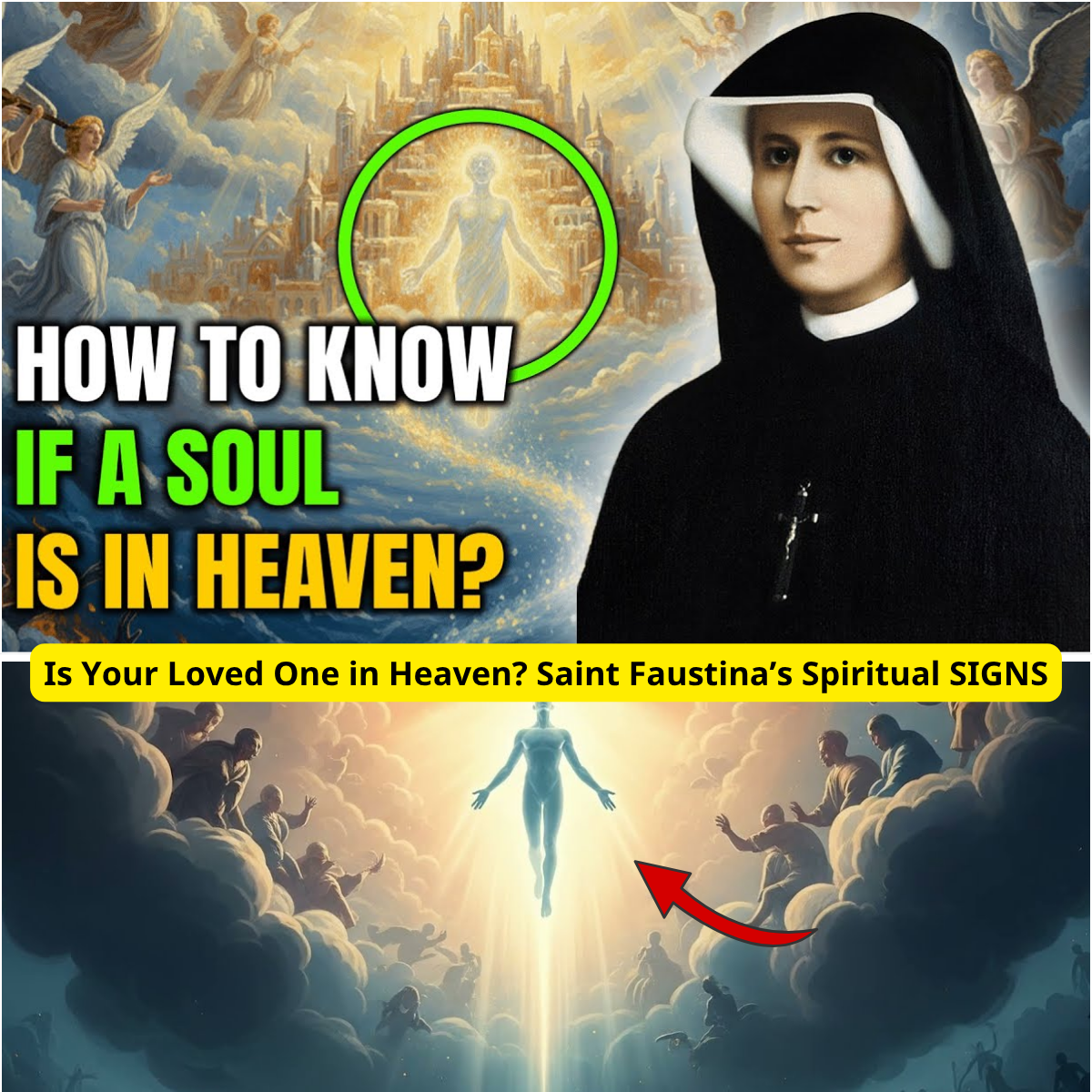
Is Your Loved One in Heaven? Saint Faustina’s Spiritual SIGNS
Is Your Loved One in Heaven? Saint Faustina’s Spiritual SIGNS
The engine of Julian’s Volvo station wagon hummed a low, vibrating note that seemed to match the dull ache behind his eyes. Outside, the mid-November rain of upstate New York blurred the skeletal trees into streaks of charcoal gray. On the passenger seat sat a cardboard box—the final, tangible remnants of his mother’s apartment.
Julian had spent the last three days sorting through seventy-six years of a life: faded photographs, recipe cards written in elegant, looping cursive, and a mountain of religious pamphlets. His mother, Elena, had been a woman of fierce, unyielding Catholic faith. Julian, an architectural engineer who dealt strictly in load-bearing beams and measurable physics, had long since abandoned the rituals of his youth. To him, death was a structural failure of the biology—nothing more.
Yet, as he reached over to steady the box against a sharp turn, a particular pamphlet caught his eye. It was worn at the edges, featuring a soft-focused painting of a young nun with deep, haunting eyes. The Revelations of St. Faustina: Mercy in the Deepest Night.
Julian scoffed softly, the sound swallowed by the rain. His mother had spent her final months terrified, not of death itself, but of what came immediately after. She had wept in her hospice bed, clutching her rosary, whispering about the “first seconds” of the soul’s release. She feared she wasn’t holy enough for paradise, terrified that she would be left to languish in the purifying fires of Purgatory, waiting for prayers her secular son would never offer.
“It’s just a comforting story, Mom,” Julian whispered to the empty car. “There is no courtroom. There is no accounting.”
Then, the world shattered.
It didn’t happen with a screech of brakes or a dramatic swerve. The oncoming semi-truck simply hydroplaned across the double yellow line on State Route 9. One moment there was the rhythmic click of the windshield wipers; the next, a wall of blinding chrome and a sound like a tearing continent.
There was no pain. That was the first realization that dawned on Julian.
The second realization was that the hum of the Volvo’s engine had been replaced by a silence so absolute it possessed its own weight. It was the silence left behind when a massive bell stops ringing—an expectant, vibrating hush.
Julian opened his eyes, but he didn’t look through physical pupils. He was standing on Route 9, but the asphalt was no longer wet. In fact, the rain seemed frozen in mid-air, thousands of translucent diamonds suspended in a gray sky. A few yards away, his Volvo was crushed like an aluminum soda can against the grille of the truck. He could see a figure slumped over the deflated airbag. The jacket was familiar—it was his own charcoal wool coat.
I am dead, Julian thought. The realization didn’t bring panic. Instead, it brought a strange, crystalline clarity. His consciousness felt weightless, completely unmoored from the biological machinery that had governed it for thirty-eight years.
Suddenly, the frozen landscape of upstate New York dissolved. The physical world didn’t vanish; it simply peeled back like a layer of old wallpaper, revealing a reality that had been humming underneath it all along.
Julian found himself in a space that was neither dark nor light, but a vibrant, living twilight. Time, as he had known it—the ticking of seconds, the progression of minutes—simply ceased to exist. He was caught in a profound, terrifying suspension.
Then came the Revelation.
It was exactly as his mother’s pamphlets had described, though his rational mind had always mocked it. It was not a courtroom with a bearded judge on a throne. It was far more devastating and beautiful than that. It was an encounter with absolute Truth.
Julian felt a Presence. It was a light that didn’t shine on him, but through him. In that light, his entire life was laid bare. It wasn’t a chronological movie of his years; it was an instantaneous, complete realization of every action, every thought, and every ripple of consequence he had ever caused.
He saw the structural blueprints he had designed, yes, but he didn’t see the steel—he saw the families who felt safe inside them. But then, the light shifted to his personal life. He saw the moments of raw, unadulterated selfishness. He remembered a girl in college whose heart he had broken out of sheer boredom; he felt her exact sorrow, taste for taste. He saw the times he had ignored a beggar on the streets of Manhattan, shielding his eyes behind expensive sunglasses.
Most painfully, he saw his mother. He saw her sitting alone in her kitchen, holding the phone, waiting for a call he was too busy to make. He saw the condescending smile he had given her when she talked about her saints. In the light of this absolute, unconditional Love that now surrounded him, Julian saw his own imperfections not as crimes, but as a tragic weight. He felt a profound, agonizing sorrow—not because he feared punishment, but because he realized how poorly he had loved.
The weight of his unaligned soul felt heavy, pulling him downward, away from the blindingly beautiful light that promised eternal joy. He knew, with absolute certainty, that he could not enter that light. Not like this. He was too stained, too distorted by his own earthly ego. He needed to be undone. He needed to be purified.
This is Purgatory, Julian realized, a silent cry echoing within his being. It isn’t a prison. It’s a hospital. And it hurts.
The suffering was a profound, aching longing—a spiritual homesickness so intense it felt like burning. He wanted to reach the light, but the gravity of his own unresolved life held him back. He was entirely helpless. He could do nothing to lift himself. He was out of time.
In the physical world, on Route 9, the first sirens began to wail through the autumn rain.
Two miles away, in a small, clapboard home, an elderly woman named Clara was kneeling by her bed. Clara had been Elena’s best friend for nearly fifty years. She didn’t know about the accident. She didn’t know that Julian’s car was currently being cut open by paramedics with the Jaws of Life.
But Clara felt a sudden, inexplicable tug in her chest. It was a spiritual pressure she had felt only a few times in her long life—a sudden, urgent command to pray.
Clara reached for her heavy wooden rosary, the beads smooth from decades of friction. She didn’t know who she was praying for, but she offered it up for “the soul most in need of mercy this hour.”
As her fingers moved to the first crucifix, she whispered, “Lord, remember them. Let your mercy fall upon them like rain.”
In the twilight of the suspended realm, Julian felt the first tremor.
The suffocating weight of his regrets suddenly shifted. It was as if an invisible shoulder had stepped beneath his burden, lifting a fraction of the crushing gravity. A wave of cool, soothing peace rippled through the burning longing of his soul.
He didn’t understand it. He had no merits of his own to claim. He had died with a heart full of skepticism and a life marred by standard, everyday indifference. Yet, the atmosphere of his purification was changing. The sharp, agonizing edge of his sorrow was softening into a profound, humble hope.
Then, another shift occurred. Far away, beyond the veil of the frozen physical world, a parish priest in a small town was elevating a silver chalice during a weekday morning Mass. He was uttering the ancient words of the Eucharist, offering the sacrifice for the living and the dead.
To Julian, this earthly ritual did not manifest as words or bread. It manifested as a cosmic tear in the fabric of his isolation. A blinding beam of pure, golden light pierced through the twilight of Purgatory. It was a bridge, forged from the pure, unconditional love of Christ and anchored by the faith of strangers on earth.
The light enveloped Julian. He felt the rough, jagged edges of his soul—the selfishness, the arrogance, the unexpressed love—being gently but firmly burned away. But it no longer felt like destruction; it felt like healing. It was the sensation of a broken bone being set correctly, or a deep wound being cleansed.
Through this bridge of prayer, Julian felt a sudden, profound connection to a vast network of souls. He realized he was not alone. He was being carried by the Communion of Saints—by the prayers of people he had never met, by the legacy of his mother’s faith, and by the mysterious, boundless mercy that St. Faustina had written about.
He saw, in a flash of divine understanding, that his mother was not suffering. She had passed through this same fire, lifted by her own lifetime of devotion and the prayers of her community, and she was already resting in the outer courts of the Dawn. And now, that same network of love was reaching down for him.
With a final, shattering surge of peace, Julian felt the last vestiges of his earthly weight dissolve. He was no longer pulling downward. The light above him grew larger, warmer, filling his entire existence until the twilight was completely swallowed by a brilliant, welcoming noon.
“Clear! Shocking again on three! One, two, three—”
A violent, agonizing surge of electricity tore through Julian’s chest.
His eyes flew open. The diamond rain was gone. The twilight was gone. Instead, there were the blinding, fluorescent lights of an emergency room, the smell of antiseptic and burnt flesh, and the chaotic, metallic clanging of medical instruments.
“We have a pulse!” a voice shouted above him. “He’s back! God almighty, he’s back.”
Julian gasped, the harsh, cold air of the physical world searing his lungs like liquid fire. He tried to speak, but a plastic tube was jammed down his throat. His body was a map of agonizing pain—broken ribs, a fractured collarbone, the deep, thumping ache of trauma.
Yet, as the doctors and nurses swarmed around him, adjusting IV lines and checking monitors, Julian lay perfectly still beneath the pain.
A nurse, noticing his wide, staring eyes, leaned over him, her face etched with exhaustion and relief. “It’s okay, Julian,” she said softly, reading his chart. “You’re at St. Luke’s Memorial. You were in a terrible accident. Your heart stopped for nearly four minutes. We almost lost you.”
Julian couldn’t nod, but a single tear slipped from the corner of his eye, tracking through the dried blood on his cheek.
Four minutes. To the doctors, it was a measurable span of biological oxygen deprivation. To Julian, it had been an eternity—a journey through the architecture of the afterlife, a firsthand viewing of the great, invisible bridge that connects the living with the dead.
Three weeks later, the snow had begun to fall, dusting the cemetery with a clean, white shroud.
Julian sat in a wheelchair, bundled in his heavy winter coat, his body still healing from the fractures. His friend drove him to the small Catholic cemetery where Elena had been laid to rest just a month prior.
The cemetery was quiet, the only sound the distant crows calling from the pines. Julian asked to be left alone for a few minutes. He rolled himself forward until the tires of his chair touched the edge of the fresh, gray granite headstone.
Elena Vance. Beloved Mother. ‘Jesus, I Trust in You.’
Julian looked at the inscription. For years, he had viewed those words as a psychological crutch for a woman afraid of the dark. Now, he looked at them with a profound, trembling reverence. He reached out with a gloved hand, brushing a layer of light snow off the top of the stone.
“I saw it, Mom,” Julian whispered, his voice cracking in the cold air. “I saw the light. And I felt the weight.”
He closed his eyes, and for the first time since he was a child, Julian didn’t look at the world through the lens of physics or engineering. He looked at it through the lens of the spirit. He remembered the absolute reality of that twilight realm, the agonizing longing of the souls who were so close to God but still held back by the stains of their earthly journey. He remembered how the prayer of a stranger, or the offering of a Mass, had manifested as a literal lifeline, lifting him out of the abyss.
He pulled a small, black object from his coat pocket. It was his mother’s old rosary, the one he had rescued from the cardboard box before the crash. The wooden beads felt solid and real against his scarred palms.
Julian didn’t know the proper sequence of the prayers anymore; he had forgotten the mysteries and the structure. But as he looked up at the gray sky, he realized that structure didn’t matter. The intention of the heart was the true currency of eternity.
“Jesus,” Julian prayed, his voice steadying, echoing softly across the silent graves. “Remember her. Keep her in your arms. And remember all the souls who are waiting in the dark right now, the ones who think nobody is looking for them.”
As the words left his lips, a strange thing happened. The biting, bitter wind that had been whipping across the cemetery suddenly died down. A profound, unnatural stillness settled over the rows of headstones.
Then, the heavy cloud cover directly above the cemetery parted. A single, brilliant shaft of afternoon sunlight broke through, illuminating Elena’s headstone and warming Julian’s face. A small, brown sparrow landed on the edge of the granite, chirped once, and flew up into the light.
It wasn’t a scientific proof. It wouldn’t hold up in a laboratory or a peer-reviewed journal. But Julian didn’t need a blueprint anymore. He felt a sudden, overwhelming wave of peace wash over his chest, identical to the relief he had felt when the invisible bridge had pierced his Purgatory.
He smiled, tears blurring his vision as he tightly gripped the wooden beads. He knew, with a certainty that surpassed all human logic, that his mother was listening. He knew that the connection between them had not been severed by the truck on Route 9, nor by the grave beneath his feet.
Love did not end with the final heartbeat. It was the only thing that crossed the threshold, and through the quiet, humble act of prayer, it possessed the power to move the very foundations of eternity.