Homeless Man Received a Rosary of the Virgin Mary from a Girl… Nobody Believed What Happened to Him
Homeless Man Received a Rosary of the Virgin Mary from a Girl… Nobody Believed What Happened to Him
The autumn wind carried a bitter chill through the city center, sweeping dry leaves across the cracked concrete of the public square. On a weathered green bench near the corner, a man sat frozen in place, a permanent fixture of a landscape most people went out of their way to ignore.
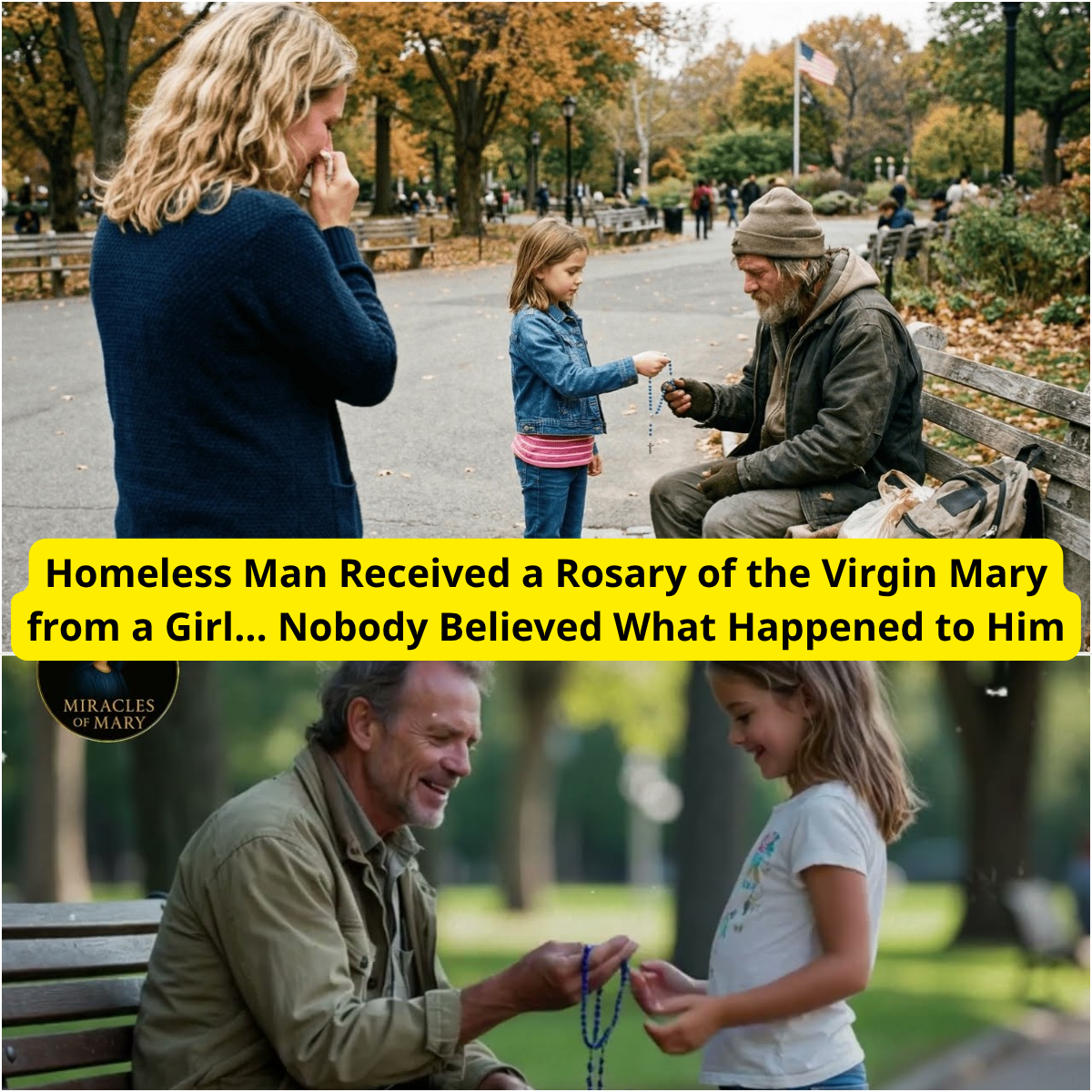
Joel was forty-three years old, though the deep, leathered lines etched around his eyes suggested a much harder mileage. His beard was long, tangled, and shot through with premature gray. His oversized coat—plucked from a church donation bin weeks earlier—had lost its original color to sun and grime a long time ago. His feet rested heavily on an old nylon backpack that contained every single thing he owned in the world.
Joel didn’t beg. He didn’t hold up cardboard signs or call out to the commuters rushing past. He simply existed there, quiet and still, watching the river of humanity flow around him as if he were observing a movie that no longer had anything to do with him.
To the bustling crowd, Joel was invisible. Passersby looked away not out of malice, but out of a profound, localized discomfort. Looking into the eyes of someone sitting on the cold ground hurts. It forces a recognition of shared fragility, and because most people don’t know what to do with that sudden ache, they choose the easiest defense mechanism available: they pretend they didn’t see.
But Joel hadn’t always been a ghost on a park bench. Two years prior, he had a life. It was simple, but it was his. He worked in construction, waking up before dawn to catch the city bus, spending his days hauling heavy materials, framing structures, and doing the grueling labor that keeps a city moving. He didn’t earn a fortune, but he paid his rent on time, bought groceries, and regularly sent a portion of his paycheck to his younger brother, Danny, who lived several hours away.
Then, the economic tides turned. The construction firm went under almost overnight. Joel pounded the pavement looking for work, but the market was dead. One month of unpaid rent bled into two, and then three. His landlord, running out of patience, handed him an eviction notice. Joel walked out of his apartment with nothing but a backpack and a shattering sense of failure.
A week on the streets became a month; a month became a year. When you spend that long sleeping on concrete, surrounded by ambient noise and constant vulnerability, a subtle, terrifying transformation occurs. It isn’t just your body that deteriorates under the elements—it’s your soul. Joel stopped believing that tomorrow could be any different from today. He stopped trying to claw his way back up. He swallowed his pride, wrapped himself in silence, and gave up without telling a soul. Existing without a purpose is the most exhausting labor a man can endure.
That particular Saturday morning in October began like any other. The sky was an unbroken sheet of slate gray, threatening rain that refused to fall. Joel sat on his bench, pulling his oversized coat tight against his chest.
Suddenly, the rhythmic clicking of heels and the light skip of sneakers broke the ambient noise of the sidewalk. Diane, a hardworking legal secretary and a lifelong, devout Catholic, was walking briskly toward the local market. Holding her hand was her nine-year-old daughter, Amanda.
Amanda was a bright-eyed girl with a mop of brown hair pulled tightly into a swinging ponytail. Wrapped securely around her small left wrist was her most prized possession: a delicate rosary made of vibrant, sky-blue glass beads, given to her by her grandmother for her birthday. “This is the most precious thing I own,” her grandmother had whispered, pressing it into her palms. “Now, it belongs to you.” Amanda had promised never to take it off.
As they neared the green park bench, Amanda abruptly stopped. Diane kept walking for two more paces before realizing her daughter’s hand had slipped from her grip.
“Amanda, honey, come on, we’re in a hurry,” Diane said, turning around.
But Amanda didn’t move. She was standing perfectly still, her gaze locked onto Joel. She wasn’t staring with the cruel curiosity of a child or the patronizing pity of an adult. She was looking at him with intense, pure attention, as if she were seeing a human being where everyone else saw an empty space.
Joel, feeling the weight of her stare, uncomfortably shifted his eyes to the ground. But Amanda took a step closer to the bench.
“Amanda,” Diane said, her voice tightening with protective instinct.
“Mom, wait just a second,” Amanda replied calmly. Before her mother could protest, the little girl walked straight up to the weathered man.
Joel raised his eyes, surprised to find the little girl standing directly in front of him. Her clear brown eyes met his gaze without a trace of fear.
“Sir,” Amanda said softly. She reached down, unlooping the sky-blue rosary from her wrist. The glass beads caught the dull morning light, dangling from her small fingers. She extended her hand, offering the heirloom to him. “This is from the Virgin Mary. She takes care of everyone.”
Joel stared at the blue beads, then at the girl’s face. His mind scrambled to process the gesture. When he finally spoke, his voice was a harsh, rusty croak—he hadn’t used his vocal cords in days. “I… I don’t need this, kid.”
“Yes, you do,” Amanda insisted. There was no hesitation in her voice, no doubt. She spoke with the absolute certainty of someone fulfilling a vital mission.
Diane stepped forward, her hand reaching for her daughter’s shoulder. “Amanda, sweetie, that’s your grandmother’s rosary. You promised to keep it safe.”
Amanda looked up at her mother, her expression steady and wise beyond her nine years. “I know, Mom. But Grandma would want me to give it to him. He needs it more than I do.”
Diane opened her mouth to argue, but as she looked from her daughter’s fiercely determined eyes to the hollow, exhausted face of the man on the bench, the words died in her throat. A profound silence fell over the sidewalk—a silence that lasted only a few seconds but felt like an eternity. Diane slowly stepped back and nodded.
Amanda turned back to Joel, took his large, calloused hand, and gently placed the cool glass beads into his palm. She gave him a bright, reassuring smile. “She’ll take care of you,” Amanda murmured.
Then, she turned around, took her mother’s hand, and the two continued walking down the sidewalk, blending into the crowd as if nothing extraordinary had just occurred.
Joel sat frozen, staring down at his open palm. The tiny metal crucifix at the end of the beads pressed into his skin. A strange sensation washed over him—a deep wave of discomfort. The rosary felt incredibly heavy, as if it possessed a physical mass that forced him to feel things he had spent two years burying.
Agitated, Joel clutched the rosary, his eyes darting to a public trash can just two meters away. His arm tensed. He almost threw it away. Almost. But as he looked back down at the vibrant blue beads, he pictured the little girl’s unblinking eyes. He couldn’t do it. With a frustrated sigh, he shoved the rosary deep into the inner pocket of his coat, buried his face in his collar, and let the day fade into night.
The next several days passed in their usual, agonizingly slow routine. Joel woke with the sun, washed his face in a grimy public restroom, and returned to his bench to watch the world spin. The blue rosary remained hidden in his coat pocket. He tried to completely ignore it, yet his fingers would occasionally brush against the smooth glass beads, reminding him of its presence.
Exactly one year to the day after his eviction, late on a Tuesday afternoon, the sky turned a brilliant, bruised orange as the sun dipped below the city skyline. The square was nearly empty.
Suddenly, a shadow fell across Joel’s boots. He looked up to find an older woman standing before him. She wore a pristine beige trench coat, her white hair neatly coiffed, a leather purse resting on her forearm. Joel had never seen her before in his life.
She looked down at him, her expression gentle but firm. “You don’t have to stay here forever, you know.”
Joel blinked, completely speechless. Strangers either ignored him or silently dropped a dollar bill or a half-eaten sandwich near his feet. They never spoke to him. They certainly never looked at him like this.
“There’s a shelter just two blocks past the iron bridge,” the woman continued, pointing eastward. “They have openings right now. They can help you.”
Joel frowned, his old, defensive pride flaring up. “I didn’t ask anyone for help.”
“I know,” the woman replied softly. She offered a small, knowing smile, turned on her heel, and walked away into the fading light.
Joel watched her disappear around the corner. He reached into his pocket, his thumb rolling over the glass beads of the rosary. “You don’t have to stay here forever.” The words repeated in his mind like a rhythmic chant. He tried to dismiss it as a random coincidence, but the phrase had already taken root in his mind.
That night, Joel slept terribly. A violent wind whipped through the square, making it impossible to find a comfortable position on the hard wooden slats of the bench. When he finally drifted into a fitful slumber in the pre-dawn hours, a dream claimed him.
He found himself standing in a vast, empty room. There were no doors, no windows, and no furniture, just a soft, radiant white light emanating from every direction. Standing in the center of the room was a woman. Joel knew instantly, without a shadow of a doubt, who she was. She wore a flowing blue mantle that matched the exact shade of Amanda’s rosary. Her face was a portrait of absolute, unearthly serenity, and her eyes held a depth of peace Joel had never encountered in the waking world.
She didn’t speak a single word. Instead, she locked her eyes onto his, slowly raised her right hand, and pointed to something directly behind him. Joel turned around in the dream and saw the old iron bridge that crossed the river just ten minutes away from his bench.
Joel gasped, sitting bolt upright as he woke. His heart was hammering against his ribs, his breath ragged in the cold morning air. But alongside the adrenaline, a profound, completely illogical sense of peace washed over him. It was a feeling of safety he hadn’t experienced since he was a child.
He sat on the bench until the sun broke over the horizon, casting long shadows across the square. Driven by an overwhelming intuition he couldn’t begin to explain, Joel stood up, slung his heavy backpack over his shoulders, and began to walk.
He marched down the empty streets, crossed the iron bridge, and followed the road on the other side. Halfway down the block, he stopped. There stood a modest, two-story brick building. A clean blue sign hung beside the entrance: St. Jude’s Emergency Shelter – Openings Available.
His hands trembled as he pushed the heavy glass door open and stepped inside. The air was warm, smelling faintly of floor wax and roasted coffee. A large, burly man with a kind face and a clipboard looked up from a desk. His name was Robert.
“Can I help you, brother? Need a place to stay?” Robert asked, his voice deep and welcoming.
Joel swallowed the lump in his throat. “I think I do.”
Robert smiled warmly, stepping out from behind the desk to offer a firm, grounding handshake. “Then you came to the right place.”
Robert led Joel to a clean, quiet dormitory at the back of the building, assigning him a single bed with a crisp white mattress, a fluffy pillow, and a thick wool blanket. Beside the bed was a small wooden nightstand with a working lamp.
Joel sat on the edge of the mattress, running his hand over the clean sheets. Slowly, he reached into his coat pocket, pulled out the blue rosary, and set it gently on the nightstand. It was the first time the beads had seen the light of day since Amanda had handed them to him. That night, Joel slept through the night without waking up once.
The next morning, he took his first hot shower in nearly a year, letting the steam wash away months of accumulated grime and despair. In the cafeteria, he ate a hot breakfast of eggs and toast, chewing slowly, savoring the simple dignity of eating off a real porcelain plate with proper silverware.
For the first week, Joel remained an island. He had forgotten how to interact with people, how to navigate the basic social cues of the living. When a friendly resident named Pete tried to strike up a conversation, Joel simply muttered a rejection and walked away. He wasn’t ready.
But Robert was patient. After a few more days, the shelter director sat across from Joel at lunchtime. “Robert tells me you used to work in construction, Joel. Is that true?”
“Yeah,” Joel murmured, keeping his eyes on his coffee. “Before everything went south.”
“Well, the second floor of this building is falling apart,” Robert said, leaning in. “The flooring is warped, and the wiring is a complete mess. I have some donated tools, but I don’t have anyone who knows how to use them. I’m offering you a chance to lead the project.”
Joel looked up, suspicious. “You’re offering me a job?”
“I’m offering you a purpose for your day, Joel. And a small stipend once the work is approved.”
The next morning, Joel stood on the dilapidated second floor. The loose tiles were a tripping hazard, and exposed copper wires dangled precariously from the ceiling. He rolled up his sleeves, a familiar spark igniting in his chest. He began with the electrical work, carefully isolating the live currents, rerouting the cables safely behind the drywall, and fixing the dead outlets.
By the third day, Pete walked up the stairs to watch. “Wow, man. You did all this wiring by yourself?”
“I’m working on it,” Joel said, not looking up from his toolbox.
“You… you need an extra pair of hands? I don’t know much, but I can carry things,” Pete offered hesitantly.
Joel paused. He looked at Pete, seeing a flash of the same desperation he had carried for two years. He pointed to a stack of lumber. “Hold this board flush against the wall while I nail it in.”
Within a week, Joel had a crew of three residents working under his direction. He taught them how to measure twice, how to level a floor, and how to safely handle a saw. He became their foreman. Three weeks later, the second floor was completely transformed. Robert was able to install ten additional beds, providing shelter for ten more soul-weary souls who had been sleeping in the cold.
When Robert came up to inspect the finished work, he gasped. “Joel, this is incredible. You’re exceptionally good at this.”
“It’s the only thing I know how to do,” Joel said softly.
That night, Joel stood in front of the bathroom mirror and truly looked at his reflection. He had trimmed his beard, and his skin had regained its color. For the first time in two years, he felt a flicker of something he thought had died forever: pride.
As the autumn turned to winter, Joel continued managing maintenance projects for the shelter, earning a steady, modest income. One afternoon, Robert called him into his administrative office.
“A close friend of mine owns a commercial maintenance company downtown,” Robert said, sliding a business card across the desk. “His name is Greg. He’s looking for a reliable supervisor. I already gave him your name and told him about the miracles you performed on our second floor.”
Joel stared at the card, his throat tightening. “Robert… I don’t have a resume. I don’t have references. My address is a homeless shelter.”
“You have me,” Robert said firmly. “I’ve seen what you can do. You’re a leader, Joel.”
The night before the interview, Joel lay awake, staring at the ceiling. He turned his head to look at the blue rosary resting on the nightstand, catching the moonlight. He reached out, his fingers wrapping around the glass beads. “If you’re really out there,” he whispered into the dark room, “please help me tomorrow. Just give me a chance.” It wasn’t a traditional prayer, but it was a desperate cry from a man who finally had something to lose again.
The interview was short. Greg, a no-nonsense man with a desk buried under blue prints, looked Joel up and down. “Robert says you ran a crew of amateurs and rebuilt his entire second floor from scratch.”
“We did good work, sir,” Joel said, his voice steady. “I do things right the first time.”
Greg studied him for a moment, then smiled. “Robert is a tough judge of character. If he vouches for you, that’s all the reference I need. Can you start tomorrow at 7:00 a.m.?”
Joel’s legs shook as he stood up to shake Greg’s hand. “I won’t be late.”
Walking out into the crisp winter sunshine, Joel stopped on the sidewalk. He closed his eyes, tilted his head toward the warmth of the sun, and wept silently. He was no longer invisible. He had a job.
Joel worked for Greg with a ferocious, unmatched work ethic. He arrived early, stayed late, and treated every plumbing repair and structural patch as if his life depended on it—because it did. Within three months, he had saved enough money to sign a lease on a tiny, one-room studio apartment overlooking a quiet parking lot.
The day he received the keys, he stood at the threshold for a full minute, staring at the brass handle before turning it. The room was sparse—just a twin bed, a small wardrobe, and a single wooden shelf on the far wall. But it was his. He dropped his backpack on the floor, sat on the edge of the mattress, and let out a long breath. He was finally home.
He placed Amanda’s blue rosary on the center of the wooden shelf. Right next to it, he stood an old, wrinkled photograph he had kept safely tucked in the deepest pocket of his backpack through his entire ordeal on the streets.
The photo was five years old, taken at a Fourth of July barbecue. It showed Joel standing shoulder-to-shoulder with his younger brother, Danny. Both of them were laughing, their arms slung around each other’s shoulders.
Joel hadn’t spoken to Danny in over two years. When he had first lost his apartment, shame and broken pride had paralyzed him. He had ignored Danny’s calls, letting his phone battery die until the service was disconnected entirely. He had disconnected himself from the world out of sheer embarrassment.
But now, with a roof over his head and his dignity restored, the silence between them felt like a heavy stone in his chest. Dozens of times, Joel would pull out his phone, dial Danny’s old number, and freeze before hitting the call button. The fear of rejection, of discovering that his brother had moved on or harbored deep resentment, was terrifying.
One Friday evening, as a gentle rain tapped against his window, Joel sat on the edge of his bed. He looked up at the wooden shelf—at the smiling faces in the old photo, and the bright blue glass beads resting beside it. He remembered Amanda’s clear, unshrinking voice: “She takes care of everyone.”
Taking a deep breath, Joel dialed the numbers and pressed call.
The phone rang once. Twice. Three times. Joel’s thumb hovered over the disconnect button, panic rising in his chest.
“Hello?” a voice answered.
Joel closed his eyes, a tear escaping down his cheek. “Danny… it’s Joel.”
A sharp intake of breath echoed through the receiver, followed by a choked sob. “Joel? Oh my God… Joel! Where have you been? I’ve been looking for you for two years! I called your old boss, I went to your old building… I thought you were dead, man!”
“I’m okay, Danny,” Joel wept, his voice breaking completely. “I’m so sorry. I’m okay now. I have an apartment. I have a job.”
“Give me your address,” Danny demanded, his voice thick with emotion. “I don’t care how far it is. I’m getting in my car right now.”
The following afternoon, a heavy knock echoed through the small studio apartment. Joel opened the door to find Danny standing in the dingy hallway. His brother looked a little older, his hair a bit thinner, but it was him.
Neither man spoke. Danny stepped forward and threw his arms around Joel, pulling him into a ferocious, crushing embrace. Both men sobbed openly in the hallway, holding onto each other as if to anchor themselves against the past two years of separation. The true miracle of Joel’s journey wasn’t found in the brick and mortar of his apartment; it was alive right there in that hallway, wrapped in the arms of the brother he thought he had lost forever.
They spent the weekend talking, bridging the gap of the missing years. Joel made fresh coffee and sat by the window, telling Danny everything. He didn’t leave out a single detail. He told him about the soul-crushing weight of the park bench, the little girl with the brown ponytail who refused to look away, the older woman in the beige coat, the dream of the blue mantle, Robert, Greg, and the shelter.
Danny listened in stunned silence. When Joel finished his story, Danny looked up at the blue rosary resting on the shelf. “What do you think it all was, Joel? How do you explain all those pieces fitting together perfectly?”
Joel looked at the photo of their family, then at the blue beads. “I spent a long time trying to explain it away with logic. But the truth is, I was a dead man sitting on a bench with no reason to ever get up. And now I’m a man with a future, a home, and my brother sitting across from me. I don’t need to explain it anymore. I just need to be grateful.”
One year later, the foliage in the city square had turned to vibrant shades of crimson and gold.
Joel’s life had continued its steady, beautiful upward trajectory. Greg had promoted him to a permanent foreman position, providing a comfortable raise. Joel had moved into a larger, sunlit one-bedroom apartment with a proper kitchen and a living room window that overlooked a tree-lined street.
Danny had brought his wife and his young son to visit for Sunday lunch. Joel had cooked a massive pot of spaghetti, laughing as his nephew ran around the living room, marveling at the shiny tools in Joel’s professional briefcase. Joel had even started attending the local parish on Sunday mornings, slipping quietly into the very last pew, not out of obligation, but out of a genuine desire to sit in the stillness and give thanks.
On an October evening, exactly one year to the day since his encounter with Amanda, Joel decided to take a walk. His steps, guided by a quiet nostalgia, led him back to the bustling public square.
He stopped in front of the old green park bench. It looked smaller now, weathered by another year of changing seasons. Joel walked over and sat down on the familiar wooden slats.
He closed his eyes, letting the memories rush back. He remembered the bone-chilling cold of the winter nights, the crushing weight of the absolute silence, and the agonizing pain of being entirely invisible to the world. He remembered how close he had come to tossing the blue beads into the trash can just a few feet away.
He pulled the sky-blue rosary from his jacket pocket, letting the glass beads pool in his calloused palm. He looked up at the autumn sky, a serene smile breaking through his beard.
“Thank you,” Joel whispered quietly into the evening air.
He was thanking the sky, the mysterious woman at dusk, Robert, Greg, and his brother. But most of all, he was thanking a brave nine-year-old girl who had dared to look into the eyes of a broken man and hand him a lifeline when he had completely given up on himself.
Joel stood up from the bench, tucked the rosary safely into his pocket, and walked out of the square. He wasn’t running away from the ghosts of his past anymore. He was simply walking home.