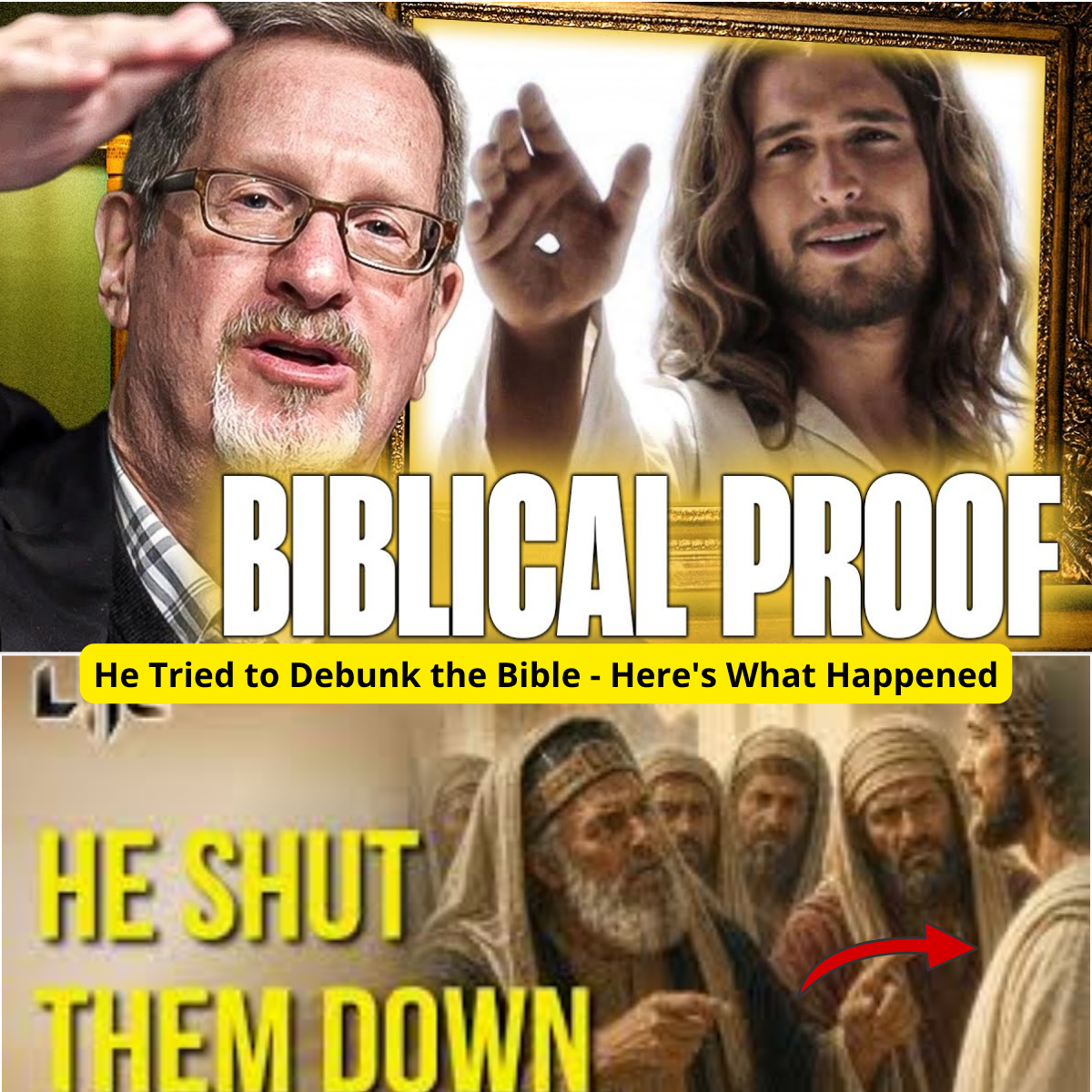
He Tried to Debunk the Bible – Here’s What Happened
He Tried to Debunk the Bible – Here’s What Happened
The autumn wind off Lake Michigan screamed through the concrete canyons of downtown Chicago, but inside the bustling, caffeine-fueled newsroom of the Chicago Tribune, the air was thick with the scent of cheap tobacco, fresh ink, and raw ambition.
Lee Strobel, the paper’s brilliant and notoriously aggressive legal editor, sat hunched over his cluttered desk. At just twenty-nine, Lee was a rising star in investigative journalism. Armed with a master’s degree from Yale Law School, he viewed the world through a lens of absolute, unyielding empiricism. To Lee, if a fact couldn’t be cross-examined, entered into evidence, or verified by two independent sources, it simply didn’t exist. He was a devout, adamant atheist, and he wore his skepticism like a badge of intellectual superiority.
His phone rattled on its cradle. He ignored it, his eyes locked on a galley proof of his latest front-page scoop—a meticulous exposé on the Ford Pinto design flaws. He knew how to build a case. He knew how to find the hairline fractures in a corporation’s defense and drive a wedge straight through them.
But three weeks ago, a crack had formed in his own life. A fracture he hadn’t seen coming, and one he had no idea how to fix.
Lee pulled a pack of cigarettes from his breast pocket, lit one, and let his mind drift back to the evening his world had tilted on its axis. He and his wife, Leslie, had been married young—he was twenty, she was nineteen, though they had been inseparable best friends since they were fourteen years old. They knew each other’s thoughts before they were spoken. Leslie had always been a gentle agnostic, floating comfortably in the same secular currents as Lee.
Then came the afternoon she walked into their suburban condo, her face illuminated by a quiet, radiant serenity that Lee had never seen before. She had looked at him, taken a deep breath, and delivered the single worst piece of news an atheist husband could ever receive.
“Lee,” she had said softly, “I’ve become a Christian.”
The words had hit him like a physical blow to the solar plexus. Oh, great, he had thought, his mind instantly racing down a track of worst-case scenarios. This is the end of everything. Now she’s going to start judging me. She’s going to stop me from hanging out with my friends. She’s going to fill our daughter’s head with fairy tales and make the kids think there’s something fundamentally wrong with their father because he doesn’t believe in ancient myths.
He had seen nothing but catastrophic trouble on the horizon, and trouble had arrived with breathtaking speed. Almost overnight, Leslie had transformed into a devout, practicing Christian. Lee’s defense mechanisms had kicked into high gear, transforming him into an even more combative, unyielding atheist.
For the first time in their lives, the childhood sweethearts were at total loggerheads. Every weekend became a tactical skirmish.
“I’m going to church this morning, Lee,” she would say, adjusting her coat.
“Oh, perfect,” Lee would snap back, leaning against the kitchen counter with a mug of coffee. “So am I supposed to just sit here and babysit the kids while you go get brainwashed by some guy in a robe? I’ve got actual work to do, Leslie.”
The lowest point had come just a week later. Leslie had approached him at the dining table, looking nervous but determined. “Lee, I’ve been thinking… I’d really like to start giving some of our money to the church. As a tithe.”
Lee had let out a sharp, mocking laugh that cut through the room like a razor. “I’ve got a better idea,” he had sneered, staring her down. “Why don’t you take that hard-earned cash, walk into the bathroom, and flush it straight down the toilet? Because I guarantee you it will have the exact same effect on the universe.”
The memory of the hurt in her eyes still pricked at his conscience, but his anger quickly surged to replace it. He couldn’t live like this. He loved his wife, and he wanted his marriage back. He needed to rescue her from what he perceived to be a bizarre, anti-intellectual cult.
He took a long drag from his cigarette, staring out the dirt-streaked newsroom window at the gray Chicago skyline. How do I fix this? he thought.
Then, the realization hit him. It was beautifully, elegantly simple.
All I have to do is disprove Christianity.
He smiled, a cold, confident expression spreading across his face. He had gone to Yale Law School. He understood the strict mechanics of legal evidence. He knew how to tear a witness statement to shreds. He figured it would take him a long weekend—maybe a three-day weekend at most. He would sit down with a few history books, poke enough logical holes in the New Testament narrative to make the whole fragile structure collapse, present the undeniable proof to Leslie, and they could finally get on with their lives.
The catalyst for Leslie’s sudden transformation had been entirely ordinary, which made it all the more infuriating to Lee. A few months prior, they had moved into a new condominium complex in the Chicago suburbs. One afternoon, their doorbell had rung.
When Leslie opened it, she found a woman standing on the welcome mat. Her name was Linda. She was a neighborhood nurse, and she had a six-month-old baby balanced on her hip. Since Lee and Leslie had a nine-month-old daughter of their own, the connection was instant. Linda had smiled warmly, held out a fresh plate of homemade cookies, and introduced herself.
Within weeks, Linda and Leslie became best friends. But Linda wasn’t just a friendly neighbor; she was an extraordinarily devout, articulate Christian. During their long afternoons together while the babies napped, the two women began having deep, sprawling conversations about faith, suffering, and the nature of God.
Unlike Lee, Leslie wasn’t inherently hostile to religion. She simply had questions—the normal, searching questions of anyone trying to make sense of a complicated world. Linda didn’t offer empty platitudes or defensive theological jargon; she had real, substantive answers. She eventually invited Leslie to attend a service at her church. Leslie went, checked it out for herself, and found a community and a truth that resonated deep within her soul.
And then, she had brought the news home to Lee.
The sheer caricature of religion that Lee carried in his mind made him recoil against her conversion. He viewed Christians as a uniform mass of judgmental, narrow-minded hypocrites who looked down their noses at anyone who didn’t subscribe to their precise brand of wishful thinking.
Moreover, on a purely subterranean, psychological level, Lee felt an intense wave of jealousy. He had always been the central man in Leslie’s life. He was her protector, her intellectual sounding board, her best friend. Now, suddenly, there was this third party in their marriage—this “Jesus” character—and Leslie was deferring to Him.
“I’m going to tear this thing down,” Lee muttered aloud to the empty newsroom, stubbing out his cigarette in a crowded tin ashtray.
But a three-day weekend quickly dissolved into a week. A week turned into a month. A month turned into six.
Lee’s investigative instincts completely took over. He realized very early on that he couldn’t waste time attacking trivial theological disagreements or denominational quirks. He needed to strike straight at the jugular of the entire Christian faith. Even as an atheist, Lee possessed enough analytical clarity to recognize that the entire global phenomenon of Christianity hung on a single, historical pivot point: the Resurrection.
If Jesus of Nazareth died on a Roman cross and remained in that tomb, then Christianity was nothing more than a historical footnote—a well-meaning but ultimately delusional myth. But if He actually walked out of that grave three days later, it changed everything.
Jesus hadn’t just claimed to be a good moral teacher; He had made explicitly transcendent, Messianic, and divine claims about His identity. Lee dug into the text, discovering that at one point in the gospels, Jesus stood before a crowd and declared, “I and the Father are one.”
Lee’s legal training forced him to look up the original Greek manuscripts. He found that the word used for “one” in that passage wasn’t masculine; it was neuter. Jesus wasn’t claiming that He and God the Father were the exact same person; He was claiming they were the exact same thing—one in nature, one in essence, co-equal in divine authority. The ancient audience had understood the radical implication instantly; they immediately picked up stones to kill Him for blasphemy, stating openly, “You, a mere man, claim to be God.”
“Anyone can claim to be God,” Lee reasoned, tapping his pencil against his legal pad. “I could stand up on my desk right now and claim to be divine. It doesn’t make it true. But if a man claims to be God, gets publicly executed by the most ruthless military machine in the ancient world, and then shows up three days later having conquered death? That is a definitive receipt. That means He’s telling the truth.”
The Resurrection was the ball game. If Lee could disprove the Resurrection, he would be home free. He could rescue Leslie from her delusion, dismantle her faith with clinical precision, and restore his family to the way it used to be.
The journey turned out to be an arduous, exhausting trek through the slow, analog world of 1980s research. There were no search engines, no digital databases, no instant downloads. Lee spent his nights and weekends sitting in the dim light of university libraries, staring until his eyes blurred into microfiche and microfilm readers. He waited months for inter-library loans to deliver obscure, ancient texts from distant academic repositories. He traveled to museums to examine photographs of early manuscripts.
But Lee possessed a weapon that standard historical researchers didn’t: he was a top-tier investigative reporter for one of the largest newspapers in America. He knew how to get people on the phone. He had spent years breaking major national stories, including the original, explosive reporting on the Ford Pinto safety cover-up. He knew exactly how to track down an expert, pick up a rotary telephone, and use his credentials to gain access.
“This is Lee Strobel from the Chicago Tribune,” he would say, his voice crisp and professional. “I’m working on an in-depth investigation regarding ancient first-century historical data, and I have a few specific questions for you.”
The world-class scholars on the other end of the line, assuming they were being interviewed for a major newspaper feature, were more than happy to open their archives and share their life’s work. Lee took exhaustive mental notes, treating his personal quest like a high-stakes homicide investigation.
Decades later, Lee would retrace these exact steps to write his bestselling book, The Case for Christ, conducting recorded, formal interviews to preserve the data. But during this intensive year-and-a-nine-month period, it was entirely personal. It was a private war waged for the soul of his marriage.
To his utter astonishment, every time he thought he had formulated a definitive, knockdown objection to the Christian narrative, the evidence refused to cooperate.
When he was a young boy, Lee’s parents had given him an inflated, three-foot-tall punching clown for Christmas. It was weighted with sand at the very bottom. You could strike that clown with a ferocious, full-force punch, and it would fly backward, nearly touching the carpet. But because of that hidden weight at the base, it would invariably snap right back up to an upright position, ready for the next hit.
That punching toy became the perfect metaphor for Lee’s investigation. He would uncover what he believed to be a devastating, unanswerable objection to the Resurrection, and he would hurl it at the text. Bang. The historical data would sway backward for a second, and then, to his intense frustration, it would snap right back into place with a thoroughly documented, logically sound counter-argument.
He hit it again with another skeptical theory. Bang. It bounced right back.
Lee was stunned. As an aggressive skeptic, he had entered the arena fully expecting to find a complete vacuum of historical validity. Instead, he found himself being systematically backed into a corner by a mountain of concrete data.
To organize his growing panic, Lee began summarizing his findings using four foundational words, each beginning with the letter E:
1. Execution
The first theory Lee tried to validate was the “Swoon Theory”—the idea that Jesus hadn’t actually died on the cross, but had merely fainted from blood loss, passed out in the cool, damp air of the tomb, and later revived to present himself to his disciples.
The historical and medical data blew that theory out of the water. Lee discovered that there was no record anywhere in the ancient world of anyone ever surviving a full, professional Roman crucifixion. Furthermore, Jesus’ death was verified not only by multiple independent documents within the New Testament but also by five highly reliable, non-Christian ancient sources outside the Bible: the Jewish historian Josephus, the Roman historian Tacitus, the Syrian philosopher Mara Bar-Serapion, the Greek satirist Lucian, and even the compiled writings of the Jewish Talmud, which explicitly admitted that Jesus was executed on the eve of Passover.
To solidify the point, Lee discovered a comprehensive peer-reviewed study published in the Journal of the American Medical Association (JAMA), a purely secular, scientific publication. After analyzing the historical accounts of the scourging and crucifixion from a clinical perspective, the medical journal concluded:
“Clearly, the weight of the historical and medical evidence indicates that Jesus was dead even before the wound to his side was inflicted.”
Even the highly critical, atheist New Testament scholar Gerd Lüdemann was forced to concede the point, stating openly that the death of Jesus on the cross by crucifixion was historically indisputable. The first E was solid: Jesus was undeniably dead.
2. Early Reports
Lee’s next line of defense was the “Legend Theory”—the argument that over the course of several generations, the story of a good teacher had gradually expanded through a game of historical telephone, eventually morphing into a myth about a resurrected god.
Lee knew from his legal background that it takes a significant amount of time for legend to develop in the ancient world and completely displace a known core of historical truth. The preeminent Oxford historian A.N. Sherwin-White had documented that the passage of two full generations was not nearly enough time for a myth to grow up and completely wipe out a solid foundation of historical fact.
Yet, when Lee examined the earliest Christian documents, he made a staggering discovery. In the book of 1 Corinthians, chapter 15, starting at verse 3, Paul records an ancient Christian Creed:
“That Christ died for our sins according to the Scriptures, that he was buried, that he was raised on the third day according to the Scriptures, and that he appeared to Cephas, and then to the Twelve…”
Lee traced the origin of this letter. Paul, a brilliant young Pharisee and a violent persecutor of the early church, had experienced a radical, life-altering encounter with the Risen Christ on the road to Damascus. He wrote this specific letter to the church in Corinth approximately twenty-two years after the crucifixion.
But where did Paul get the specific, rhythmic language of that Creed?
Lee dug deeper into the timeline. Historical scholars across the theological spectrum—including Dr. James D.G. Dunn, one of the most respected first-century historians in the United Kingdom—had meticulously analyzed the linguistic structure of that passage. They discovered that Paul had received this formal oral creed during his historic meeting in Jerusalem with Peter and James, just three years after his conversion. Paul used a specific Greek word to describe that meeting which implied a rigorous, investigative cross-examination—a journalistic fact-finding mission.
This meant that this formal report of the Resurrection, including specific named eyewitnesses, wasn’t a legend that developed over decades. It was a formalized, circulating document that existed within one to three years of the crucifixion itself, meaning the actual beliefs driving the creed went straight back to the immediate aftermath of the cross.
Dr. Dunn’s final historical conclusion left Lee entirely unnerved:
“We can be entirely confident that this report was written originally within months of the death of Jesus.”
It was a total news flash from antiquity. The time gap was completely non-existent. There was simply no room for a legend to form.
The final two words in Lee’s investigative framework were Empty Tomb and Eyewitnesses.
He discovered that the site of the grave was well-known to both Christians and Roman authorities alike. If the body had still been inside, the Roman government or the Jewish leadership could have easily marched to the tomb, dragged the decaying corpse of Jesus into the streets of Jerusalem, and crushed the entire Christian movement in thirty seconds. Yet, the tomb was empty, and the early church exploded with growth in the exact city where the execution had taken place.
Finally, the Eyewitnesses sealed the case. Jesus didn’t just appear to an isolated individual in a dark room; He appeared over a period of forty days to individuals, to groups of women, to the twelve apostles, and at one point, to more than five hundred people at a single time. Lee knew from his legal training that contemporary group hallucinations were a psychological impossibility.
It was a Sunday afternoon, precisely one year and nine months after he had set out on his long-weekend project to save his wife from a cult. Lee sat alone in his home study, surrounded by mountains of legal pads, photocopied manuscripts, and historical cross-references.
The punching clown had refused to stay down. The case was closed. The evidence for the Resurrection of Jesus was more robust than the evidence for almost any other event in ancient history.
Lee felt a profound, terrifying weight settle over his chest. He looked down at a verse he had recently encountered during his study of the Gospel of John, chapter 1, verse 12:
“But to all who did receive him, who believed in his name, he gave the right to become children of God.”
Lee realized that his entire life, he had misunderstood the nature of faith. He had assumed that Christianity was based on blind, wishful thinking, mythology, and emotional weakness. But his own investigation had proven that it was grounded in hard, verifiable historical data.
Yet, John 1:12 made it clear that merely believing the historical facts wasn’t enough. The Bible noted that even demons believe that Jesus is the Son of God, and they shudder because they understand the terrifying implications of that reality. It wasn’t enough to simply acknowledge the evidence; a person had to actively receive the free gift of God’s grace, forgiveness, and eternal life.
Lee closed his eyes. The pride of the young Yale law graduate, the cynicism of the hardcore Chicago Tribune investigative editor, fell away. He dropped to his knees on the study floor.
“Lord,” Lee whispered into the quiet room, his voice cracking with an emotion he hadn’t allowed himself to feel in decades. “I believe. I’ve looked at the evidence, and I can’t fight it anymore. I receive you. Please, forgive me, and take my life.”
When he opened his eyes, the heavy, suffocating anxiety that had plagued his marriage for nearly two years was gone, replaced by a deep, immovable peace.
He walked out into the living room where Leslie was sitting on the sofa, reading a book. She looked up, noticing something completely different in his eyes, in the softness of his posture.
“Leslie,” Lee said, his voice trembling slightly as a warm, genuine smile broke across his face. “Get your coat. We’re going to church. Together.”
Leslie stared at him for a long, breathless moment, her eyes welling with tears of sheer joy as she realized that the promise her friend Linda had spoken about all those months ago had finally come home to stay.
No matter where you are watching or listening to The Sean Ryan Show from today, if you got anything out of this incredible journey of transformation at all—if it challenged your perspective or gave you hope—please hit that like button right now, drop a comment below, and subscribe to the channel.
Most importantly, share this episode everywhere you possibly can with the skeptics and seekers in your own life. And if you’re feeling extra generous today, head over to Apple Podcasts and Spotify and leave us a five-star review. It helps us keep bringing these powerful, unfiltered stories straight to you. We’ll see you guys next time.