For centuries, the Shroud of Turin has stood at the center of one of history’s most enduring mysteries.
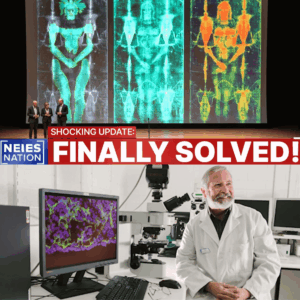
For centuries, the Shroud of Turin has stood at the center of one of history’s most enduring mysteries. Believed by many to be the burial cloth of Jesus Christ, the linen fabric bears the faint image of a man who appears to have suffered crucifixion. While faith has long upheld its authenticity, science has continuously tested its origins. In recent years, DNA analysis has added a surprising new layer to the debate—one that has both complicated and deepened our understanding.
The Shroud first gained widespread attention in the late Middle Ages, and since then it has been subjected to countless examinations. In 1988, radiocarbon dating suggested the cloth originated between 1260 and 1390, placing it firmly in the medieval period. For skeptics, this seemed to settle the matter. However, critics of the test argued that contamination, repairs, or environmental factors may have skewed the results.
Enter DNA analysis. Researchers were able to extract genetic material from dust particles and fibers collected from the Shroud. What they found was unexpected: DNA traces from multiple geographic regions, including Europe, the Middle East, North Africa, and even parts of Asia. This diversity suggests that the cloth may have traveled extensively over centuries, coming into contact with many individuals along the way.
Some proponents argue that the presence of Middle Eastern DNA supports the idea that the Shroud originated in the region where Jesus lived. Others counter that such DNA could have been transferred later, especially given the Shroud’s long history of public display, handling, and relocation. The evidence, rather than providing a definitive answer, has opened new avenues of interpretation.
Importantly, DNA findings cannot directly identify a specific individual—let alone confirm whether the Shroud once wrapped Jesus. Instead, they offer clues about the object’s journey through time. The genetic diversity found on the Shroud reflects centuries of human contact, environmental exposure, and historical movement.
So, has DNA evidence changed the debate forever? In a sense, yes—but not by resolving it. Instead, it has shifted the conversation from a simple question of authenticity to a more nuanced exploration of history, science, and belief. The Shroud of Turin remains a powerful symbol, one that continues to inspire both devotion and investigation.
In the end, the mystery endures. And perhaps that is precisely why the Shroud continues to captivate the world.
thêm
DNA Evidence on the Turin Shroud: The Discovery That Transformed the Debate Forever
For centuries, the Shroud of Turin has stood at the center of one of history’s most enduring mysteries. Believed by many to be the burial cloth of Jesus Christ, the linen fabric bears the faint image of a man who appears to have suffered crucifixion. While faith has long upheld its authenticity, science has continuously tested its origins. In recent years, DNA analysis has added a surprising new layer to the debate—one that has both complicated and deepened our understanding.
The Shroud first gained widespread attention in the late Middle Ages, and since then it has been subjected to countless examinations. In 1988, scientists used radiocarbon dating and concluded the cloth likely originated between 1260 and 1390, placing it in the medieval period. For skeptics, this seemed decisive. However, critics argued that contamination, fire damage, or later repairs could have affected the samples and distorted the results.
Enter modern genetic research. Scientists applied techniques from genetics and molecular biology to analyze microscopic particles collected from the cloth. The DNA they found revealed a strikingly complex picture: genetic traces from populations across Europe, the Middle East, North Africa, and parts of Asia.
This discovery sparked new interpretations. Some researchers suggest that the presence of Middle Eastern DNA aligns with the historical setting of Jesus’s life. Others caution that the Shroud has been handled by thousands of people over centuries—pilgrims, clergy, and scientists alike—making contamination almost unavoidable. In this view, the DNA evidence reflects not a single origin, but a long and eventful journey.
Additional scientific techniques have also been applied. Studies involving forensic analysis and spectroscopy have examined the image itself, suggesting it is not painted but formed through a still poorly understood process. Some hypotheses propose a chemical reaction involving body oils and linen fibers, while others explore more unusual possibilities.
Beyond the laboratory, the Shroud continues to influence culture, religion, and public imagination. It is housed in Cathedral of Saint John the Baptist, where it remains a focal point for pilgrims and researchers alike. Periodic public exhibitions draw millions of visitors, each bringing their own perspective—faith, curiosity, or skepticism.
So, has DNA evidence changed the debate forever? In a sense, yes—but not by settling it. Instead, it has transformed the discussion into a multidisciplinary puzzle involving history, science, and belief. The Shroud of Turin is no longer just a question of “real or fake,” but a complex artifact shaped by centuries of human interaction.
In the end, the mystery endures. Whether seen as a sacred relic, a historical object, or an unsolved scientific puzzle, the Shroud continues to captivate the world—and perhaps that enduring intrigue is its most powerful legacy.