Ex-Muslim Now Leading Thousands To JESUS (Here’s How!)
The Silent Revolution: How Faith and Disillusionment are Reshaping Iran
LOS ANGELES — In the heart of the Middle East, a demographic and spiritual transformation is occurring that defies nearly half a century of geopolitical expectations. For decades, the Islamic Republic of Iran has been defined by its clerical leadership, its “Death to America” rallies, and its role as a regional powerhouse of Islamic governance. However, beneath the surface of the state’s rigid exterior, a massive “silent revolution” is taking place—one fueled by deep disillusionment with the ruling theocracy and a surprising, rapid surge in conversions to Christianity.
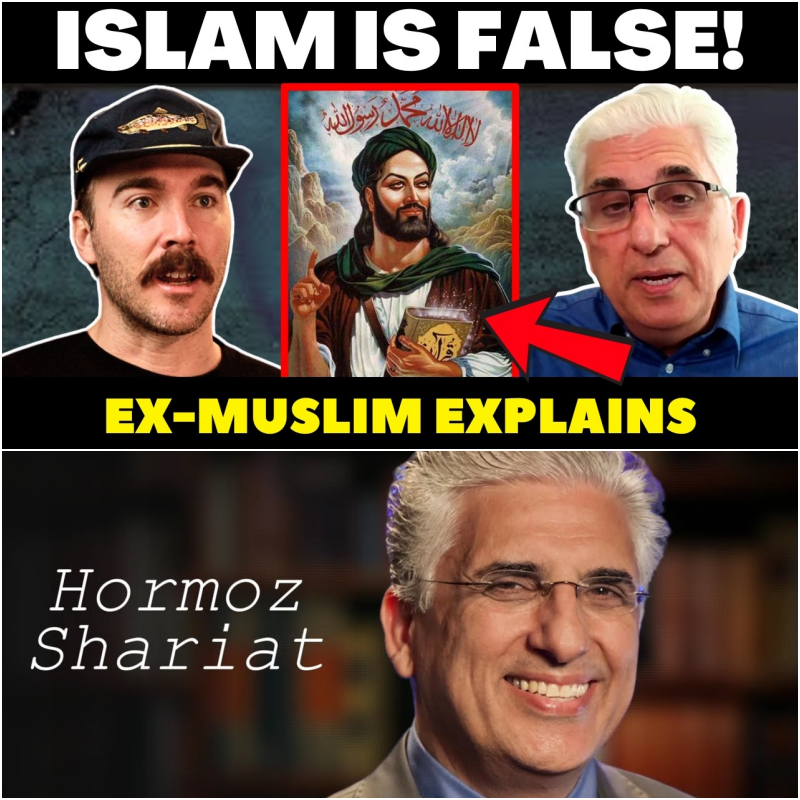
Dr. Hormoz Shariat, a former Muslim turned evangelist often referred to as the “Billy Graham of Iran,” suggests that the nation is currently at a breaking point. “Iran is the first Islamic nation that will turn to Christ,” Shariat stated in a recent interview. “It’s already happening. The rejection of Islam is so deep and so deliberate. It’s not an emotional, overnight decision. It took 45 years of living under a clerical government for the people to conclude that Islam, as implemented by the state, is the source of their problems, not the solution.”
The Great Disconnect: People vs. State
The narrative coming out of Tehran today is one of two Irans. There is the Iran of the official state media—the one that burns flags and issues threats of nuclear escalation—and the Iran of the kitchen tables and underground house churches.
Data from a landmark scientific survey conducted by European university professors supports Shariat’s observations. The study, which surveyed over 50,000 Iranians, revealed a startling fragmentation of belief:
Less than one-third of respondents identified as practicing Muslims.
One-third identified as secular, agnostic, or atheist, viewing religion as irrelevant to daily life.
One-third were actively seeking new spiritual paths, exploring everything from New Age philosophies and Eastern religions to Christianity.
This shift has created a unique geopolitical irony. While the Iranian government views the United States and Israel as its primary adversaries, many Iranians on the street hold the opposite view.
“The government of Iran is not the people,” Shariat explains. “The people of Iran love America. They love Israel. They look at Israel and ask, ‘Why can’t we be like that? Free, prosperous, and advanced in technology?’ When the government paints the American or Israeli flag on the sidewalk so people will trample on them, I have seen videos of citizens literally jumping over the flags or walking around them to show respect. They believe that if the government hates these nations, then those nations must be doing something right.”
The Rise of the Underground Church
Because of the severe penalties for apostasy—the act of leaving Islam—the growth of Christianity in Iran is largely invisible to the naked eye. There are no cathedrals or steeples. Instead, the “Underground Church” consists of thousands of house churches: small groups meeting in living rooms, basements, or remote locations.
The Iranian government’s response has been one of calculated intimidation. Recent reports indicate a surge in arrests, with over 70 Christians detained in just the last few weeks. The sentencing is often draconian; one young mother was recently sentenced to 17 years in prison simply for attending a house church.
“The persecution is a reaction of fear,” says Brandon, a journalist who has followed Shariat’s work. “The government knows they cannot convert these people back to Islam. They know there are millions of Christians now. They can’t arrest everyone, so they arrest a few and give them long sentences to put fear into the rest. They want Christians to stay behind closed doors and never speak of their faith.”
However, this strategy appears to be backfiring. Rather than retreating, many underground leaders are asking for “courage” rather than “protection.” The movement has moved beyond a mere ideological shift into what many describe as a supernatural phenomenon.
Beyond Intellect: Dreams, Visions, and Miracles
In the West, Christianity is often treated as a set of intellectual propositions or a cultural heritage. In Iran, the conversion stories often involve more dramatic, direct experiences. Research suggests that as many as 25% of Iranian converts claim to have come to Christ after having a direct vision or dream of Jesus.
Shariat notes that while many come to faith through intellectual study—as he did during his time as a PhD student at the University of Southern California—the majority are moved by seeing tangible change in their communities.
“About 50% come to Christ because they see a friend or family member transformed,” Shariat says. “They see a drug addict who couldn’t get clean through any program suddenly free. They see an angry, violent man become peaceful. They see the depressed become joyful. In a country under so much pressure, that kind of personal transformation is undeniable.”
One anecdote shared by an underground leader describes a taxi driver in Tehran who was arrested for sharing his faith. When interrogators asked why he wouldn’t stop, he simply told them, “I had terminal cancer and was going to die. Jesus appeared to me in my room and healed me. It’s not my fault He came to me. If you have a problem with it, talk to Him, not me.” The authorities, reportedly stunned by his bluntness and the medical evidence of his recovery, eventually released him.
The Message that Bridges the Gap
The core of this spiritual movement is surprisingly simple. For many Iranians raised in a system of complex religious laws and political mandates, the “simple gospel” offers a stark contrast.
“Islam, as it is practiced by the clerics, is a political system of control,” Shariat argues. “But the message that is changing Iran is three-fold: God loves you; you cannot reach Him on your own; and because He loves you, He reached out to you through Jesus. A child can understand it, yet it has the power to transform a society.”
This message creates a “Kingdom” that sits on top of the political friction between Washington and Tehran. While presidents and supreme leaders exchange threats, a different kind of unity is being forged between Iranian believers and the global Christian community.
A New Chapter for a Civilization
Iran is a nation with thousands of years of history, from the Persian Empire to the Islamic Revolution of 1979. For the first time in centuries, the very foundation of its religious identity is being questioned by its own citizens.
The “Hungry Minds” project, a recent best-selling educational initiative, highlights how civilizations are rebuilt not just through technology, but through the curiosity and spiritual renewal of their people. Iran seems to be at such a crossroads. The clerics may still hold the levers of power, the military, and the oil, but they appear to be losing the hearts of the next generation.
As the interview with Dr. Shariat concluded, he offered a perspective that bridges the temporal and the eternal: “We don’t promise that following Jesus means you won’t suffer. In fact, in Iran, it often means you will. But we offer an eternal perspective. Our lives are short, and we are here for a purpose. Even the suffering is being used to form the character of a new Iran.”
Whether this spiritual shift will eventually lead to a political “Persian Spring” remains to be seen. What is clear, however, is that the Iran of the future will look nothing like the Iran of the last 45 years. The flags may still burn in the squares of Tehran for now, but in the homes and hearts of its people, a different fire has been lit.
Analysis: The Geopolitics of Faith
To understand the weight of this shift, one must look at the historical context of the 1979 Revolution. At that time, Islam was seen as the revolutionary force that would topple Western-backed “puppets” and bring justice to the masses. Today, the roles have reversed. For the youth of Iran, the “establishment” is the clerical elite, and the “revolutionary” act is to seek a faith that the state forbids.
This internal pressure creates a volatile environment for the ruling regime. If the “one-third” seeking new religions continues to grow, the ideological basis for the Islamic Republic’s existence may evaporate before a single shot is fired in a foreign war.
Key Statistics at a Glance:
Category
Percentage of Population (Estimated)
Practicing Muslims
< 33%
Secular / Atheist / Agnostic
~ 33%
Spiritual Seekers (Christianity, New Age, etc.)
~ 33%
Estimated Number of Christians
2 – 3 Million (Growing)
“The thing about a living faith is that it doesn’t just change your ideas; it changes your reality. When people see miracles and transformed lives, the government’s propaganda loses its power.” — Dr. Hormoz Shariat
As we move further into 2026, the world continues to watch the Persian Gulf for signs of military conflict. But the real story might be the one the cameras can’t see: a nation of 85 million people quietly choosing a different path, one living room at a time.