Encontros de TERROR EXTREMO que Vão te Causar Calafrios
Encontros de TERROR EXTREMO que Vão te Causar Calafrios
The age of the smartphone and the ubiquitous security camera promised to demystify our world, shedding bright, empirical light onto the dark corners where superstition once thrived. Yet, as millions of lenses silently record the ordinary rhythms of daily life, they are increasingly capturing anomalies that defy easy explanation, breathing new life into old nightmares. Across the globe, from the isolated hollows of the Appalachian Mountains to urban high-rises in South America, a different kind of archive is being built: one of pixelated figures, impossible voices, and technological failures that occur in the immediate presence of the unexplained. These viral clips do not merely entertain; they introduce an unsettling modern tension, forcing viewers to wonder whether our machines are mapping the known world, or providing a clear view into a reality we are not yet prepared to understand.
The Auditory Trap of the Appalachian Hollows
In the ancient, heavily forested expanse of the Appalachian Mountains, isolation is a physical presence. The landscape is defined by deep valleys and dense canopies that swallow sound, creating a perfect acoustic environment for regional folklore to thrive. Among the most enduring rules passed down through generations of mountain residents is a simple, protective doctrine: if you hear a voice calling from the dark woods at night, do not answer, and never open the door.
A mother named Felícia recently experienced the visceral terror behind this old warning while home alone with her young daughter and the family’s dogs. The quiet of the evening was shattered by the distinct sound of activity originating from the back porch. As Felícia approached the area to investigate, she was struck by an impossibility: emanating from the darkness outside the closed back door were the unmistakable voices of her husband, Michael, and her daughter. They sounded clear, immediate, and desperate, repeatedly asking to be let inside.
The psychological dissonance was immediate and terrifying. Felícia knew with absolute certainty that her daughter was safely upstairs and that her husband was miles away, yet the auditory evidence outside the door was flawless. Recognizing the classic signs of an Appalachian auditory trap—where an unknown presence or localized anomaly mimics familiar voices to compromise a home’s perimeter—she refused to unlock the door.
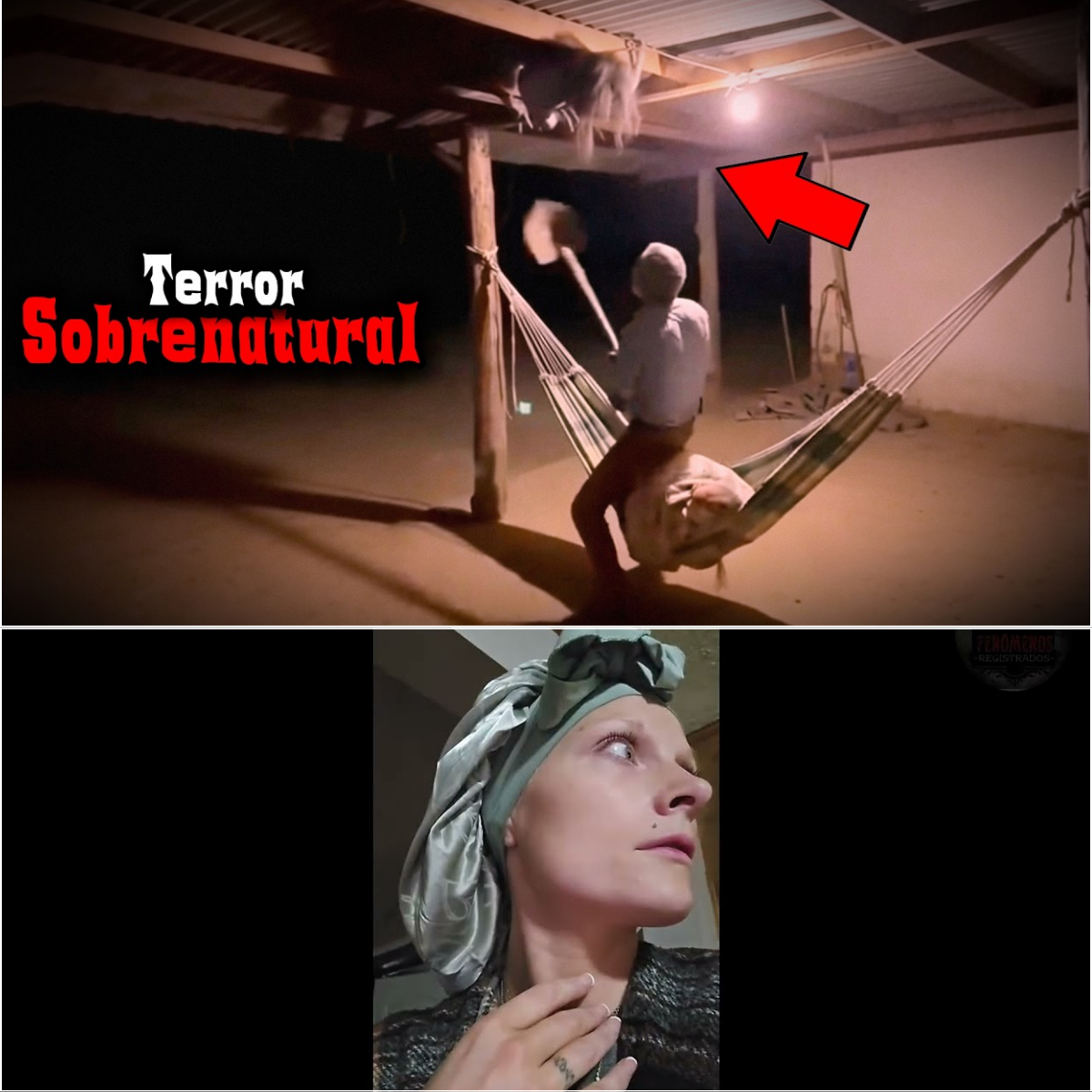
As the minutes ticked by, the situation grew progressively more hostile. The familiar voices dissolved into a chaotic chorus of multiple, distinct vocalizations shifting across the back porch. Terrified and seeking verification of her sanity, Felícia retreated upstairs, grabbed her mobile phone, and placed an urgent call to Michael. Over the line, she frantically explained that two entirely different voices were actively occupying the porch, begging him to return home.
While they awaited assistance, the domestic sanctuary began to unravel. Downstairs, the family dogs became intensely agitated, their bodies rigid as they locked their eyes onto the windowpanes. They were staring at something hidden in the pitch blackness, growling in deep, defensive intervals. Suddenly, without warning, a violent, heavy impact slammed against the glass, shaking the frame and causing the family to scramble for safety.
The incident, which fits seamlessly into the broader catalog of Appalachian acoustic phenomena, underscores an unsettling reality for those who choose to live on the fringes of the wilderness. Whether these mimicry events are the result of rare atmospheric anomalies, psychological phenomena, or something more predatory, the survival strategy remains entirely unchanged: maintain absolute silence, ignore the familiar voices, and keep the door firmly locked against the dark.
The Ghost in the Viking Ship
While remote forests provide a natural backdrop for the supernatural, urban and industrial environments possess their own distinct brand of haunting. The beginning of the 21st century saw a massive boom in affordable, consumer-grade digital cameras. These early devices, characterized by lower resolutions and rudimentary optical sensors, documented a transitional era of American life—and occasionally, they recorded things that bypassed human sight entirely.
One such recording involves a group of friends visiting a traveling, itinerant amusement park that had set up its temporary rides in a vacant lot on the outskirts of town. The group spent the evening navigating the bright lights, playing carnival games, and documenting their laughter with a standard compact digital camera, capturing the mundane joy of a summer night.
The tone of the footage shifted dramatically when the group decided to board the “Viking Ship”—a massive, pendulum-style ride that swings passengers high into the air in a sweeping arc. As the ride climbed to its apex, one member of the group aimed the camera across the rows of seats to film the reactions of the young women in their party. The passengers were smiling, screaming, and gripping the safety bars as the machine surged back and forth.
Centrally positioned among the riders was a woman wearing a plain white blouse. In the low-resolution digital footage, her face appeared strangely distorted, her features blurring and shifting in a manner that sat uncomfortably against the sharper, more defined faces of the surrounding teenagers. Despite the optical distortion, she appeared to be fully participating in the experience, her head moving in perfect synchronization with the rhythmic oscillations of the ride.
Then, at the highest point of the swing, the impossible occurred. Within the span of a single video frame, the woman in the white blouse vanished entirely. She did not slip beneath the safety bar, nor was there any indication of a physical fall or a sudden movement toward the exit platform. She simply ceased to exist on the digital sensor, leaving behind an empty seat where she had been sitting a fraction of a second prior.
In the years following the event, skeptics attempted to deconstruct the footage, suggesting that the woman may have slipped from the ride at that exact moment, creating the illusion of a spontaneous disappearance. However, the mystery deepened significantly when the group of friends reviewed the tape. None of them had any recollection of the woman boarding the ride with them, and a review of the passenger manifest and local park attendance revealed no record of her existence. The camera had documented a passenger who, by all physical accounts, had never been there at all, raising the chilling possibility that our earliest digital sensors were capable of catching residual entities caught in a loop of eternal recreation.
The Exorcism on the Corridors of Colombia
The boundary between an emotional breakdown and a supernatural event is often thin, but when an entire community and local law enforcement witness a domestic anomaly, the scale tips toward the extraordinary. In a residential apartment complex in Colombia, a young woman named Sara Vargas was resting in her home when she was disturbed by an undercurrent of sound filtering through the shared walls.
Initially, the noises resembled a standard, albeit heated, domestic dispute between neighbors. But as the night progressed, the character of the sound shifted into something far more desperate. The muffled arguments gave way to intense, unearthly shrieks and guttural roars that echoed down the concrete corridors of the building, carrying a quality of raw panic that alarmed the entire floor.
As multiple residents converged in the hallway, deeply concerned for the safety of the occupants, they contacted emergency services. When local police units arrived on the scene and forced entry into the apartment, the nature of the call transformed from a standard wellness check into an active spiritual crisis.
According to witness statements from neighbors and the responding officers, the apartment was occupied by two young women who had been experimenting with a classic Ouija board shortly before the atmospheric shift occurred. One of the women had succumbed to a state of extreme, hyper-violent agitation, displaying physical strength that defied her stature. The responding officers, visibly shaken by the scene inside the unit, stepped back into the hallway to make a series of unconventional requests, frantically asking waiting residents if anyone possessed a Catholic rosary.
The situation escalated further with the rapid arrival of a local priest, who rushed past the police barricade into the apartment. For the remainder of the night, the building was held in a state of suspended terror. Sara Vargas recorded the audio from her adjoining wall—a harrowing document of metallic crashes, continuous, desperate prayers, and high-pitched, agonizing screams that did not sound entirely human. At one point during the height of the intervention, the afflicted woman reportedly vomited a dense, dark substance resembling wet earth.
The auditory ordeal continued for hours, the volume fluctuating until the early morning hours when the apartment fell into an absolute, dead silence. While government and police officials never issued a formal, analytical statement regarding the operational details of that night, the audio captured by Vargas remains a viral artifact of modern digital demonology—a visceral recording of a community forced to listen to the raw mechanics of an active exorcism through their living room walls.
The Passenger in the Rearview Mirror
The gig economy has transformed our relationship with public transit, placing ordinary citizens in the roles of late-night drivers navigating empty city streets. This constant exposure to the nocturnal landscape has turned rideshare vehicles into a frequent setting for modern ghost stories, many of which are documented by internal cabin dashcams.
A driver named Jorge Nava was working a late-night shift in Mexico, executing a series of routine fares through the quiet grid of the city. After successfully hitting his financial target for the evening, Nava logged out of the rideshare application, turned off his passenger-seeking lights, and began the long drive back to his suburban home. The vehicle was empty, the streets were quiet, and the interior cabin was dark.
While navigating a stretch of highway, Nava glanced at the digital monitor connected to his internal safety camera—a tool installed to protect drivers from aggressive passengers. The screen revealed an impossibility: sitting calmly and silently in the center of the rear passenger seat was the distinct figure of an elderly woman.
Nava froze. He had not stopped the car, unlocked the doors, or accepted a fare since logging off the application. Gripped by fear, he executed a classic human reflex, turning his head completely around to look directly into the backseat with his own eyes. The space was entirely empty. The fabric of the seats was undisturbed, and the shadows were uniform.
Yet, when he looked back at the digital monitor, the elderly woman remained, her form clearly defined by the camera’s infrared night-vision sensor. She sat perfectly still, staring straight ahead, existing only within the digital reproduction of the cabin.
Nava managed to return home, attempting to rationalize the event as a trick of the light or a severe software malfunction. However, the true material cost of the encounter manifested the following morning. When Nava stepped out to his driveway to begin his morning shift, the vehicle refused to start. The battery, which was relatively new and had shown no signs of degradation, was completely and inexplicably drained to zero percent.
When Nava published the internal camera footage online, it sparked a fierce debate among digital forensic enthusiasts. Skeptics argued the image was the result of a double-exposure glitch, a reflection of a roadside billboard, or a coordinated hoax designed to generate social media traffic. Nava actively defended the validity of the recording, demonstrating that his own hand, when waved directly in front of the lens in similar lighting conditions, was occasionally obscured by the camera’s low-light compression algorithms. For Nava, the dead battery and the silent passenger were real artifacts of a night when his car became a vessel for a traveler who didn’t need a mobile app to hitch a ride.
The Sentinel of the Kentucky Highway
The phenomenon of the “glitch in the matrix” often involves wildlife acting in ways that violate their basic evolutionary instincts. Deers, by nature, are among the most skittish animals in the North American wilderness, programmed by millennia of predation to flee at the slightest vibration of an approaching engine or the glare of a high-beam headlight.
A driver navigating a remote, unlit state highway in Kentucky late at night was forced to slam on his brakes when a large white-tailed deer appeared in the middle of the asphalt. The animal was completely stationary, its legs locked, standing entirely perpendicular to the flow of traffic.
The driver expected the deer to bolt into the brush as the car slowed to a halt just feet from its flank. Instead, the animal remained utterly immobile, its eyes glassy and unfocused, showing no reaction to the hum of the engine, the blast of the horn, or the blinding intensity of the headlights. It was as if the animal’s biological programming had been suspended, frozen mid-frame in the center of the highway.
Intrigued and unsettled by the bizarre display, the driver shifted the car into park, rolled down his window, and retrieved his smartphone to document the encounter. He snapped a high-resolution photograph of the deer, hoping to capture the strangeness of its paralysis.
It was only later, when reviewing the image on the illuminated screen of his phone, that the true horror of the scene materialized. Standing directly adjacent to the frozen deer, its form semi-translucent and blending into the nocturnal background, was a deformed, elongated humanoid silhouette. The specter appeared to be leaning over the animal, its pale, indistinct upper extremity extended outward in a gesture that looked unmistakably like a gentle, reassuring caress.
The image quickly circulated through regional forums, where two distinct camps of interpretation formed. Secular skeptics asserted that the figure was nothing more than a trick of perspective—the complex geometry of a roadside tree trunk and low-hanging branches coming together in the dark to form a pareidolia-induced human shape. They argued that the deer was simply suffering from chronic wasting disease, a neurological affliction common in rural deer populations that induces lethargy and a lack of fear.
However, students of regional folklore offered a deeper, more unsettling explanation rooted in Native American and pioneer legends: the presence of a “Skinwalker” or a shape-shifting entity. In these traditions, these entities possess the capacity to influence, inhabit, or completely assume the physical forms of forest animals. If this interpretation holds weight, the driver’s camera did not merely capture a sick animal or a strange shadow; it documented the exact, terrifying moment a regional entity was holding a wild creature in a state of suspended animation, preparing to slip inside its skin.
The Unblinking Eye of the Digital Age
The common thread linking these diverse accounts is not merely the claim of the supernatural, but the specific role that technology plays in the validation of modern folklore. In previous generations, a strange voice on a porch or a missing passenger on a ride would exist only as a fleeting memory, an oral tale told to skeptical friends and destined to fade over time.
Today, our machines act as impartial, unblinking witnesses. A trail camera on an abandoned mining road, a security system outside an Appalachian home, or a rideshare dashcam in Mexico do not possess imagination, fear, or a desire for internet fame. They simply record data. And when that data includes physical anomalies, impossible acoustics, and unexplainable digital artifacts, it challenges the comforting boundary we have erected between the rational world and the ancient dark. The modern ghost story is no longer a matter of spoken words around a campfire; it is an archive of pixels, bytes, and frames, reminding us that the unknown is still out there, quietly waiting for its close-up.