Did LeBron Just Change the Series vs the Rockets?
Did LeBron Just Change the Series vs the Rockets?
In the high-stakes, hyper-analyzed world of the NBA playoffs, there is a term used by the more cynical corners of the internet to describe a matchup lacking elite, polished execution: a “Mid-Off.”
Going into Game 1 of the Western Conference first-round series between the Los Angeles Lakers and the Houston Rockets, that was exactly the expectation. On one side stood a Houston Rockets squad that, while talented, entered the arena missing their centerpiece, Kevin Durant. On the other, a Lakers team that resembled a walking infirmary, missing both Luka Dončić and Austin Reaves.
What the world expected was a grit-and-grind affair defined by who could make the fewest mistakes. What they got instead was a masterclass in psychological warfare and efficiency from a 41-year-old LeBron James—a performance that has flipped the betting markets on their head and left the Rockets staring into a 0-1 abyss they never saw coming.
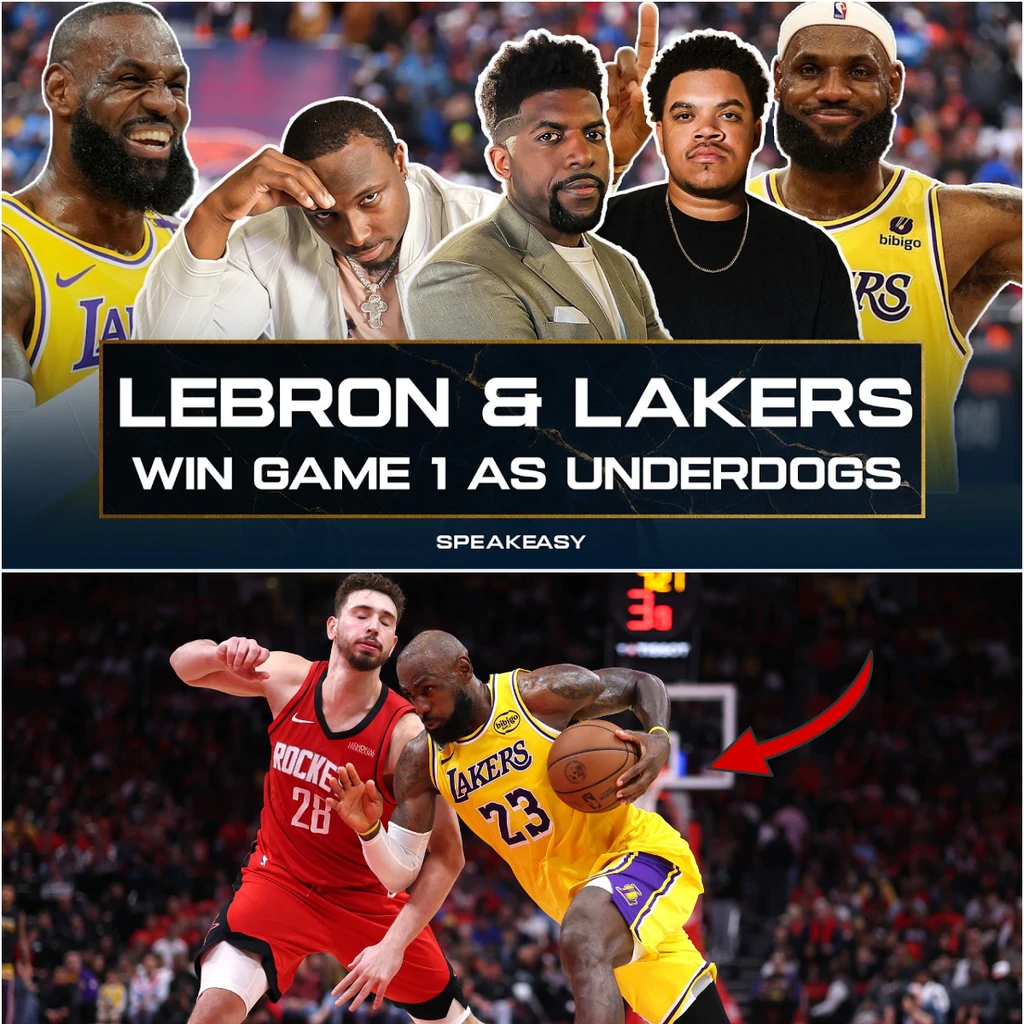
The “Everything” Effort Without the Energy
The lead-up to this series was defined by one word from LeBron James: Everything. With Dončić in Spain and Reaves in a hoodie, LeBron signaled that he was prepared to carry the entire weight of the Lakers’ franchise.
However, the genius of Game 1 wasn’t that LeBron did everything; it was how he did it. James finished the night with a playoff career-record 13 assists, orchestrating an offense that many believed would flatline without its primary creators.
“LeBron James just took a game without having to give you energy,” noted analyst Emmanuel Acho. “LeBron didn’t have to play 40 minutes. He didn’t have to put up 25 points. He got to be a distributor and a facilitator. He probably left this game like, ‘Oh, I’m chilling.’”
For the Rockets, this is the nightmare scenario. The traditional strategy for beating an aging LeBron James is the “Boxer’s Grind”—wearing him down through the first six rounds so that by the seventh or eighth, his hands are too heavy to defend the kill shot. By winning Game 1 through the heroics of role players like Luke Kennard (who dropped 27 points), LeBron effectively “stole” a victory while keeping his own gas tank at full.
The Luke Kennard Factor: Letting the Backups Believe
Perhaps the most dangerous byproduct of the Lakers’ Game 1 victory isn’t the 1-0 lead itself, but the psychological shift within the L.A. locker room. In professional sports, there is a clear line of demarcation between stars and backups. You aren’t supposed to win playoff games when your stars are sidelined.
But when a role player like Luke Kennard goes for 27, or Jake LaRavia starts finding his rhythm in the rotation, the hierarchy blurs.
“The worst thing you can do as a backup,” Shady McCoy explained, “is let a backup get confidence. The moment you give a backup confidence, they start thinking, ‘Hold on now, I deserve to be here.’ You just let Luke Kennard get busy. Now the Lakers actually think they can win this.”
The Rockets entered the series as massive -600 favorites. Following the Game 1 collapse, those odds have plummeted to Houston -25. The market isn’t just reacting to a loss; it’s reacting to the realization that the Lakers’ supporting cast is no longer afraid of the moment.
Houston’s Identity Crisis: Where is the Scoring?
While the Lakers are celebrating a found identity, the Rockets are searching for theirs. Despite their defensive prowess, Houston looked stagnant on the offensive end in Game 1.
The focus has turned toward Alperen Şengün, who many expected to take a leap into superstardom this post-season. Instead, Şengün looked “one-dimensional,” struggling to spread the floor and being neutralized by a Lakers defense that dared him to beat them from the perimeter.
“I watched Draymond Green at 6’6” give Şengün fits,” McCoy added. “When I watch the Rockets, they give you a lot of good defense, but they are inconsistent on offense. Where is the scoring coming from? KD is going to get his, but who else?”
The absence of Fred VanVleet has loomed large, leaving the offensive keys in the hands of Amen Thompson. While Thompson is a physical marvel, his lack of experience in high-leverage playoff environments was evident as the Lakers’ defense—anchored by the returning Marcus Smart—baited him into turnovers and contested looks.
The Kevin Durant Variable
The “aside” to Game 1 was the absence of Kevin Durant. While some believe his return for Game 2 will immediately level the playing field, others aren’t so sure. In the NBA playoffs, 36 hours is a lifetime, but it isn’t always enough time for a 37-year-old superstar to return to 100% health.
The stakes for Game 2 have now reached a fever pitch. LeBron James-led teams are a staggering 13-0 when winning Game 1 of the first round. If the Rockets cannot take Game 2 in Los Angeles, they return to Houston down 0-2, facing a Lakers team that might be on the verge of getting Luka Dončić back later in the series.
“The longer the Lakers can elongate this series, the better,” Acho argued. “Luca has a chance to potentially come back by the end of the series. If you’re telling me now it’s a five-game series after two games? Bet.”
The Verdict: Who Should Be the Favorite?
Despite the 1-0 lead, the debate continues to rage. On paper, a healthy Houston team with Kevin Durant and a deeper bench should be the favorites against a LeBron James “solo act.”
However, basketball isn’t played on paper. It’s played in the mind. And right now, LeBron James is playing chess while the Rockets are still trying to figure out how the pieces move.
The Lakers have done the impossible: they won a playoff game without their two best players, without their superstar exerting maximum energy, and they’ve forced the “better team” into a corner.
As the series shifts toward a pivotal Game 2, the question isn’t just whether Kevin Durant can save the Rockets—it’s whether anyone can stop a confident LeBron James when he’s playing in the “Catbird Seat.”