Black Single Dad Donated Blood for 3 Years — Then He Learned He Saved a Billionaire CEO
Black Single Dad Donated Blood for 3 Years — Then He Learned He Saved a Billionaire CEO
Chapter 1: The Weight of a Number
The small plastic card in Marcus’s hand bore the number 42. It was cheap, blue, and slightly bent at the corner, but he held it with the tight, protective grip of a man who possessed very little else. Around him, the waiting room of St. Jude’s Memorial Hospital hummed with the sterile anxiety of a Tuesday afternoon—coughing children, the sharp scent of antiseptic, and the low, rhythmic squeak of a nurse’s rubber-soled shoes on bleached linoleum.
Marcus leaned back into the hard plastic chair, pulling his worn canvas jacket tighter around his shoulders. The jacket was frayed at the cuffs, the dark green fabric permanently stained with the industrial grease of the commercial warehouse where he worked the graveyard shift. Exhaustion lived deep in his bones, settling like lead into the dark circles beneath his eyes. He had just finished a twelve-hour block stacking heavy pallets, his muscles aching for a bed he wouldn’t see for several more hours.
Yet, he was here. Just like he had been every single month for the last three years.
“Marcus,” a soft voice called out.
He looked up to see Sarah, a veteran phlebotomist with silver-streaked hair and a kind smile, leaning over the reception desk. She didn’t need to look at his chart. In a hospital that saw thousands of patients a week, Marcus was an unforgettable face. Not because of his quiet demeanor or his worn clothes, but because of what ran through his veins.
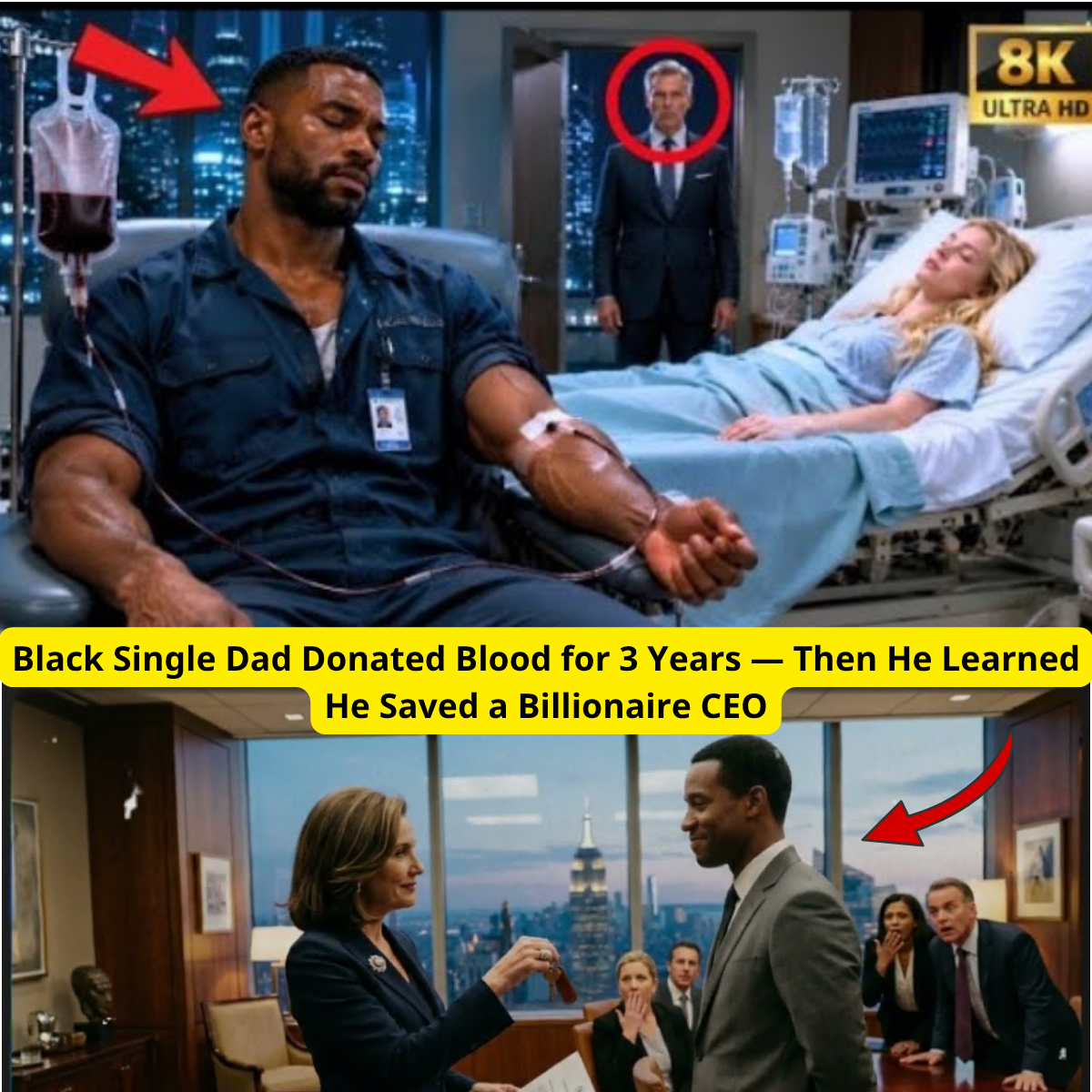
Marcus possessed an incredibly rare blood phenotype—a specific combination of antigens that made his blood a literal lifeline for a patient deep within the hospital’s restricted wards. Three years ago, an urgent, panicked directive had been sent through the state’s donor network. A patient was in critical condition, undergoing complex treatments that ravaged their system, and standard blood banks were empty of their specific match. Marcus had answered the call. He had never asked for the patient’s name, age, or gender. To Marcus, the specifics didn’t matter. The only math that made sense to him was simple: someone was dying, he had the means to keep them alive, and so he had to show up.
“Right this way, Marcus,” Sarah said, guiding him toward the familiar row of vinyl reclining chairs. “You look beat today, honey. Did you eat something before you came?”
“A piece of toast,” Marcus lied gently, offering a faint smile as he rolled up his sleeve, exposing a forearm patterned with the small, faded scars of a recurring donor.
The truth was harsher. Life outside the hospital walls was a relentless exercise in subtraction. Ever since a sudden illness had taken his wife four years ago, Marcus had been a man stranded on a crumbling island, raising their seven-year-old son, Leo, on a single warehouse wage. Their tiny, drafty apartment on the city’s east side was a landscape of pink past-due notices, flickering lightbulbs, and calculated sacrifices.
There were months when Marcus quietly bypassed his own dinner plate, claiming he had eaten a heavy lunch at the warehouse, just so Leo could have a second helping of mac and cheese or a fresh apple before school. There were mornings when he walked the five miles to his shift in the biting rain because the bus fare meant choosing between a transit pass or a new pack of asthma inhalers for his boy.
“Marcus, you’re running yourself ragged,” his coworker, Jeff, had told him just last week over a lukewarm vending machine coffee. “You look like a ghost, man. You’re giving away your own blood while you’re starving yourself. Let the hospital find someone else. You’ve got to take care of number one.”
Marcus had simply shaken his head, staring at his rough, calloused hands. “If you knew you were the only bridge keeping someone from falling off a cliff, Jeff, you wouldn’t tear the bridge down. You’d keep standing there. No matter how much it winded you.”
As the automated machine beside his chair began its familiar, low hum, drawing the dark crimson life from his arm, Marcus closed his eyes. The mild dizziness washed over him, a familiar companion by now. He focused his mind on Leo’s bright, gap-toothed laugh, using it as an anchor. He didn’t need a name or a face to justify the sting of the needle. He just needed to know that somewhere in this massive concrete building, a heartbeat was continuing because his hadn’t stopped.
Chapter 2: The Executive Floor
The phone call arrived on a Thursday evening, cutting through the quiet hum of Marcus’s small kitchen. Leo was at the table, furiously coloring a picture of a spaceship with a broken green crayon.
Marcus wiped his soapy hands on a dish towel and picked up the receiver. “Hello?”
“Is this Mr. Marcus Vance?” The voice on the other end was deep, meticulously polished, and carried a weight of authority that immediately made Marcus’s stomach drop.
“Yes, speaking.”
“Mr. Vance, my name is Dr. Harrison, the Executive Director of St. Jude’s Memorial. I’m calling to request your presence at the hospital tomorrow morning at nine o’clock. We have a private meeting scheduled for you on the penthouse floor.”
Marcus gripped the phone tighter, his mind instantly racing down a dark corridor of fear. “Is… is something wrong? The patient? Did something happen to the person receiving the blood?”
There was a brief, deliberate pause on the line. “The patient is stable, Mr. Vance. But it is of the utmost importance that you come. Please, report directly to the private elevators in the main lobby. Your name will be with security.”
Marcus barely slept that night. He tossed and turned on his sagging mattress, watching the shadows of passing cars stretch across the water-stained ceiling. Fear mutated into a thousand different scenarios. Had his blood caused a reaction? Had they discovered some latent illness in his system? Was he no longer able to help?
The next morning, Marcus stood before his small bathroom mirror, trying to tame his hair. He had borrowed a crisp, pale-blue button-down shirt from his neighbor, Mr. Henderson—a retired postman who lived across the hall. The shirt was slightly too large around the neck, emphasizing Marcus’s lean, hollowed collarbones, but it was clean and free of warehouse grease.
When he stepped out of the private elevator onto the twelfth floor of the hospital’s north tower, Marcus felt as though he had crossed an international border into a completely different country. The chaotic, fluorescent-lit world of the ground-floor clinic was gone, replaced by an atmosphere of hushed, intimidating luxury.
The floors were laid with thick, polished white marble that reflected the soft, recessed amber lighting above. The walls weren’t painted drywall; they were paneled in rich, dark walnut and hung with large, original oil paintings of pastoral landscapes. Two towering security guards in immaculate black suits stood beside a set of massive, frosted-glass double doors.
Marcus looked down at his worn, scuffed work boots, suddenly acutely aware of how out of place he was. He felt like an insect preserved in amber, an unpolished stone dropped into a pristine showroom.
One of the guards checked a tablet, nodded respectfully, and pressed a silent button. The glass doors swung open without a sound.
“Right this way, Mr. Vance,” a secretary murmured, her voice smooth and devoid of any clinical urgency.
She led him into a vast, sun-drenched private conference room. A massive mahogany table occupied the center of the space, surrounded by plush leather chairs. Several high-ranking doctors—men and women Marcus had only ever seen in hospital brochures—stood in a loose semi-circle near the floor-to-ceiling windows that looked out over the city skyline.
But Marcus’s eyes didn’t linger on the doctors. They were drawn instantly to a woman standing alone at the head of the table.
She was dressed in a tailored, charcoal-black designer suit that radiated power and immaculate precision. Her dark hair was pulled back into a severe, elegant twist, and her face was striking, defined by sharp cheekbones and piercing, intelligent eyes. Yet, as Marcus stepped fully into the room, the severe mask crumbled. Her hands began to tremble slightly, and her eyes, glittering under the soft light, filled instantly with a heavy, unvarnished wave of emotion.
Chapter 3: The Unveiling of the Ghost
Dr. Harrison stepped forward, his expression exceptionally grave yet profoundly respectful. “Marcus, thank you for coming on such short notice. There is someone here who has spent the last thirty-six months waiting for the medical clearance to look you in the eye.”
The doctor turned slightly toward the woman in black. “Marcus, for the past three years, the hospital has maintained strict anonymity protocols regarding your monthly directed donations due to the high profile of the recipient. But today, those protocols have been lifted. Marcus, this is Olivia Grant.”
The name struck Marcus like a physical blow. He froze, his breath catching in his throat.
Olivia Grant.
He had seen that face on the covers of national business magazines left behind in the warehouse breakroom. He had heard her name spoken on evening news broadcasts—the billionaire CEO of Grant Global Technologies, a logistical and tech empire that dictated trade across half the hemisphere. She was one of the most powerful, wealthy, and influential women in the country, a titan who moved millions of dollars with a single signature.
And she was standing before him, her bottom lip trembling, looking at his worn boots and neighbor’s oversized shirt as if he were an emperor.
Olivia stepped away from the mahogany table, her movements slow, almost fragile. When she spoke, her voice lacked the commanding edge of a boardroom executive; it was cracked, vulnerable, and thick with unshed tears.
“For three years,” Olivia whispered, stepping close enough that Marcus could smell the faint scent of jasmine and expensive linen. “I was a prisoner in a sterile room just two floors below this one. I was diagnosed with an aggressive, rare variant of bone marrow failure. The treatments required total systemic resets—procedures that wiped out my blood counts entirely. The doctors told my family that without a continuous, perfect phenotype match for transfusions, my body would reject the therapy within forty-eight hours. They said finding a match was like looking for a specific grain of sand on a coast.”
She paused, a single tear escaping and tracking down her sharp cheek. “And then, every month, like clockwork, the red cells arrived. The doctors told me it was a single donor. One man who never missed an appointment, never delayed, never made an excuse.”
Dr. Harrison cleared his throat, stepping in softly. “Marcus… we took the liberty of looking into your file recently, beyond the medical charts, to understand our donor profile. Olivia’s legal team discovered what you went through to keep those appointments. We know about the shifts you worked. We know about the meals you skipped so your son could have breakfast while you came here to give away the very fluid keeping you upright. We know you walked through a blizzard last January because the city transit line was frozen, just to sit in Sarah’s chair.”
Olivia looked at Marcus’s rough, calloused hands—hands that bore the scars of cheap warehouse cardboard and heavy wooden pallets.
“During those three years, Mr. Vance,” Olivia said, her voice dropping to a fierce, emotional whisper, “my boardroom split into factions. My wealthiest business partners tried to strip my voting shares while I lay unconscious. My closest social circles stopped calling when the prognosis turned terminal. The people I had showered with millions, the people who swore loyalty to my wealth, vanished like smoke.”
She reached out, her manicured fingers gently, hesitantly touching the rough fabric of Marcus’s sleeve. “But you… a man who didn’t know my name, a man who didn’t know if I was a saint or a sinner, a man who was struggling to put food on his own table… you walked through the cold to give me your life. You gave me three years of tomorrows.”
Marcus stood entirely speechless. The opulence of the room, the shining marble, the awe-world executives looking at him with absolute reverence—it all blurred into the background. In his mind, he wasn’t a hero. He was just Marcus, a father who knew what it felt like to look at an empty cupboard, a man who believed that human life was the only currency that truly mattered when the lights went out.
For the first time in his long, exhausting journey of grief and poverty, a profound warmth bloomed inside Marcus’s chest. The silent, invisible bruises of his daily life—the shame of the past-due notices, the bone-deep ache of the warehouse floor—suddenly felt redeemed. His struggle hadn’t been invisible. His small, quiet choices had held up a life.
Chapter 4: The Offer of the World
Olivia wiped her eyes with a lace handkerchief, her posture shifting back into that of a woman who was used to taking definitive action. She turned toward a young assistant standing near the door, who immediately stepped forward holding a thick, leather-bound portfolio.
“I am a woman of commerce, Marcus,” Olivia said, her eyes locked onto his. “I know that kindness cannot be bought, and I know that a debt of life can never truly be canceled. But I refuse to live in a world where the man who saved me has to choose between his son’s dinner and his own.”
She took the portfolio from her assistant and opened it, revealing several crisply printed documents bearing official corporate seals.
“First,” Olivia announced, her voice ringing clear through the silent room, “the deed to a four-bedroom home in the Oakridge district has been finalized in your name. The property taxes, insurance, and maintenance are fully paid in perpetuity by a private foundation. It has a yard for your son, Leo, and it is located three blocks from one of the best elementary schools in the state.”
Marcus’s jaw tightened, his mind struggling to process the words. A home. A safe neighborhood. No more drafty windows. No more landlord threats.
“Second,” Olivia continued, a small, genuine smile finally breaking through her tears, “a fully funded educational trust has been established for Leo. His tuition, housing, books, and living expenses are completely covered from this day forward, through whatever university or medical school he chooses to attend.”
The doctors in the room began to smile, a few of them nodding in quiet appreciation of the immense scale of the gift. But Olivia wasn’t finished.
“And finally, Marcus, I know you work at the logistics warehouse on the west side. Effective immediately, I am offering you the position of Director of Community Outreach Operations at Grant Global’s regional headquarters. It is a corporate management role. You will have a private office, full comprehensive medical care for you and your son, and a starting salary of two hundred and fifty thousand dollars a year. You will never stack a pallet again. You will never have to work a night shift to survive.”
The room erupted into sudden, warm applause. The executives smiled broadly, some of them clapping Marcus on the shoulder. It was the ultimate fairy-tale ending—the classic American dream realized in a single stroke of a billionaire’s pen. Destiny had finally turned its eyes toward the forgotten man, offering him a golden ladder out of the dark pit of poverty.
Everyone in the room watched Marcus, waiting for the tears of relief, the ecstatic nod of acceptance, the immediate surrender to a fortune he had so rightfully earned.
But Marcus didn’t move. He stood perfectly still, his eyes tracking the crisp, white edges of the contracts in Olivia’s hands. He looked at the sleek leather portfolio, then up at the expansive view of the city skyline, and finally back to Olivia’s expectant, hopeful face.
Slowly, deliberately, Marcus shook his head.
The applause died instantly, cutting off as if severed by a knife. The room plummeted into an uncomfortable, bewildered silence. Dr. Harrison’s smile vanished, and Olivia’s hand froze mid-air, the documents trembling slightly in her grip.
“Marcus?” Olivia asked, her voice filled with sudden, sharp confusion. “I… I don’t understand.”
Chapter 5: The Currency of Kindness
Marcus took a slow, deep breath, his hands sliding quietly into the pockets of his worn canvas jacket. His voice, when he spoke, was low, calm, and carried the steady, unshakeable resonance of a man who knew exactly who he was.
“Ms. Grant,” Marcus said softly, looking directly into her piercing eyes. “I thank you from the bottom of my heart for your incredible generosity. The things you’re offering… they are a miracle. They are more money and security than a man like me could see in three lifetimes.”
He paused, looking around the room at the expensive suits, the marble floors, and the mahogany table. “But I didn’t come to this hospital every month because I was looking for a lottery ticket. I didn’t give you my blood because I wanted a new house, or a fancy corporate title, or a giant salary.”
“Marcus,” Dr. Harrison interrupted, his tone incredulous. “This is a legitimate offer from the CEO. It’s entirely legal, and it’s yours. You don’t have to live in poverty anymore.”
“I know I don’t,” Marcus said, turning his gaze gently toward the doctor before looking back at Olivia. “But if I accept a house and a fortune in exchange for what I gave you, Ms. Grant, then my donations weren’t an act of humanity. They become a business transaction. They become a product I sold to a wealthy woman because she could afford the price tag.”
He stepped closer to the billionaire titan, his neighbor’s blue shirt shifting over his thin shoulders. “There are a lot of nights, Ms. Grant, when I sit in my kitchen and I feel completely broken. I look at the bills, I look at my wife’s empty chair, and I feel like the world doesn’t care if my son and I sink or swim. But when I came here, when I sat in that donation chair and felt the needle go in, I knew I was doing something that money couldn’t touch. I knew that a human life was hanging in the balance, and my poverty didn’t make my blood any less valuable than yours.”
Marcus offered a small, bittersweet smile. “Kindness shouldn’t have a price tag, Ms. Grant. If we only look out for each other when there’s a massive reward waiting at the end, then we aren’t a community anymore. We’re just merchants trading in survival. I can’t take the house, and I can’t take the corporate title. I am a warehouseman. I know how to move boxes, not run operations. I want to earn my living with my own two hands, the way I’ve always done.”
His calm, quiet words hung in the air like an unexploded shell.
Across the room, several of the high-ranking executives slowly lowered their eyes, their faces flushing with a sudden, deep embarrassment. These were men and women who spent fifty hours a week calculating profit margins, negotiating hostile takeovers, and assigning dollar values to human labor. They had built their entire lives on the belief that everything—loyalty, health, love, and life—had an ultimate purchase price. Yet, standing in front of them was a man who possessed literally nothing by their standards, who had just demonstrated a level of pure, uncorrupted dignity that made their millions look incredibly small.
Olivia Grant stood frozen, her eyes wide as Marcus’s words echoed through her mind. The tears she had been trying to hold back finally spilled over, flowing freely down her cheeks. In her world of wealth and cutthroat corporate politics, she had never encountered an unvetted heart. She had never met someone who truly valued another human being’s breath more than a mountain of gold.
Marcus wasn’t a hero because he had rare blood. He was a hero because his soul was entirely uncorrupted by the desperation of his circumstances.
Chapter 6: A New Type of Foundation
Olivia slowly closed the leather portfolio and handed it back to her assistant, her gaze never wavering from Marcus. She took a deep, steadying breath, her respect for the man before her mutating into something profound, something that would fundamentally alter the trajectory of her remaining years.
“You’re right, Marcus,” Olivia said, her voice shaking but resolute. “You are entirely right. I tried to answer your grace with a corporate contract, because that’s the only language I’ve spoken for twenty years. I apologize.”
She stepped even closer, extending her hand toward him—not as a billionaire offering a handout, but as an equal, a fellow human being who had been given a second chance at life.
“If you won’t let me change your life with money, Marcus, then please… let me use my money to change the lives of people who are exactly where you are right now.”
Marcus blinked, his hand coming out of his jacket pocket to meet hers. Her grip was warm and strong.
“What do you mean?” Marcus asked.
“Grant Global has the resources to build a new kind of legacy,” Olivia announced, turning to her executive team with a look of absolute command. “Starting today, we are redirecting fifty million dollars from our tech development surplus to establish the Vance Medical Solidarity Fund. It will be a comprehensive medical program designed specifically for low-income, single-parent families in this city. It will fully subsidize complex treatments, prescriptions, and emergency care for families who are currently slipping through the cracks—the families who are working night shifts and skipping meals just to stay alive.”
She looked back at Marcus, her eyes shining with determination. “And I am not offering you a corporate management position, Marcus. I am asking you to sit on the board of trustees as the chief consultant. I don’t need you to manage logistics software. I need your heart. I need you to guide these funds to the families who need them most, to ensure we never treat human suffering like a business transaction. We will pay you a standard, modest stipend for your time on the board—nothing that will make you feel like a merchant, but enough to ensure your bills are paid and Leo has his inhalers. Please. Tell me you won’t turn that down.”
Marcus looked at Olivia’s hand wrapped around his rough, calloused fingers. He looked at the doctors, who were no longer smiling corporate smiles, but looking at him with genuine, humbled hope.
He thought of the small apartment, of the pink notices, but then he thought of the hundreds of parents in his neighborhood who lay awake at night listening to their children cough, praying they wouldn’t have to choose between a doctor’s visit and the rent. He could help them. He could be their voice.
Slowly, a deep, beautiful smile spread across Marcus’s tired face. He gave Olivia’s hand a firm, appreciative squeeze.
“That,” Marcus whispered, his voice thick with emotion, “is a contract I would be proud to sign.”
Marcus never sought the spotlight, and he never became a wealthy man in the traditional sense. He kept his job at the warehouse for another year, eventually transitioning into full-time community work for the foundation he had inspired. But from that cold autumn morning forward, the weight he carried on his shoulders was no longer the heavy lead of despair; it was the light, buoyant strength of a man who had reminded a room full of titans that true greatness is never measured by the size of a bank account, but by the quiet, unyielding depth of human kindness.