Ben Shapiro Exposed to Jesus
The Intellectual Altar: When Ben Shapiro Was Confronted with the Ghost of Jesus
For a certain segment of the American intellectual public, there is no greater spectator sport than watching two hyper-articulate conservative titans sit across from one another and debate the architecture of the universe. It is a subculture where rapid-fire cadence meets centuries of theological dogma, usually broadcast in high-definition from a studio that smells faintly of mahogany and digital ambition.
But a fascinating dynamic occurs when the conversation shifts from mere political utility to the frighteningly specific question of cosmic truth.
This tension was on full display in a widely circulated dialogue between Ben Shapiro, the orthodox Jewish polemicist and cultural commentator, and William Lane Craig, one of Christendom’s most formidable living philosophers and apologists. The encounter, framed by commentators as a moment where Shapiro was “exposed to Jesus,” highlights a deeper, more profound fissure in the modern conservative coalition. It exposed the stark limits of political pragmatism when forced to confront the radical, historic claims of Christian theology.
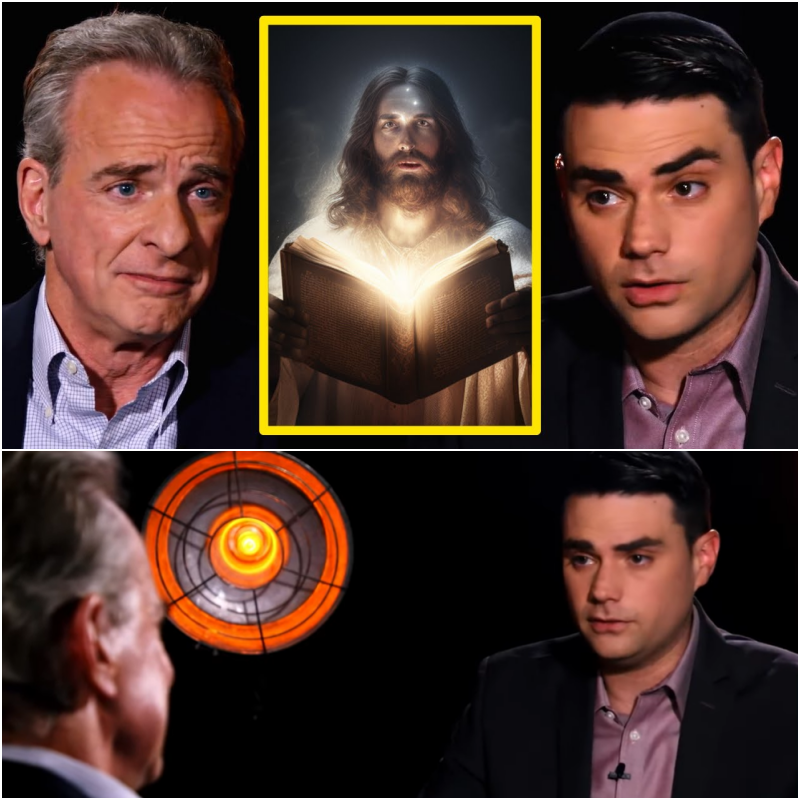
The Trap of Religious Utility
For years, the modern conservative movement has enjoyed a comfortable alliance with religious traditionalism. Figures like Shapiro, alongside secular or agnostic allies like Jordan Peterson, have argued forcefully that religious precepts are the bedrock of Western civilization. They argue that without the Judeo-Christian framework, society collapses into nihilism, moral relativism, and chaos.
In the opening salvo of the discussion, Shapiro pointed precisely to this phenomenon, noting how fascinating it is to watch the modern public broadly accept the efficacy of religious precepts without necessarily buying into the underlying truth of the religion itself.
Shapiro invoked Peterson as the prime example of this cultural trend. Peterson, a Jungian psychologist, has captured the imagination of millions of young men by telling them to clean their rooms, take up their moral crosses, and act as if God exists. Yet, as Shapiro rightly pointed out, Peterson rarely speaks in specifically religious or metaphysical terms. Instead, he speaks of archetypes embedded in myth, deeply rooted in the human psyche. It is an argument of pure utility: If you want to get ahead, if you want to be happy, you have to do this stuff.
This utilitarian approach has tremendous cultural appeal. It offers the comforting guardrails of traditional morality without demanding a signature on a theological dotted line. It allows the modern skeptic to enjoy the fruits of the kingdom while remaining agnostic about the King.
But as William Lane Craig gently yet firmly pointed out, this functional approach to faith is a house built on sand.
Floating in the Air: The Need for a Metaphysical Ground
Craig’s response to Shapiro’s observation cut straight to the heart of Christian apologetics. Recalling a previous dialogue he held with Jordan Peterson in Toronto, Craig explained that his approach was not to attack Peterson’s utilitarian view of morality, but to be “invitational.”
“You and I both affirm the objectivity of moral values and meaning in life,” Craig recalled telling Peterson. “I want to offer you a grounding for those values that we both hold dear.”
Without a metaphysical anchor rooted in an objective, supreme reality, the values that conservative commentators hold so dear are, in Craig’s words, “just sort of floating in the air.” They have no ontological foundation. If God is merely a useful psychological archetype or a cultural myth designed to keep society orderly, then morality becomes a evolutionary trick—a sophisticated survival mechanism rather than an absolute duty.
This is where the alliance between political conservatism and genuine theology begins to fray. For a political commentator, a religion that keeps citizens moral, law-abiding, and family-oriented is a successful religion. But for a theologian like Craig, a religion that is merely “good for society” but unconcerned with literal truth is an exercise in futility.
Craig lamented that while many people are increasingly open to the vague, quasi-pantheistic idea that there is a “moving force” behind the universe, the moment someone utters the specific word God, people run for the hills. They are chased away by memories of boring childhood Sunday school classes or simplistic, anti-intellectual versions of faith they outgrew in adolescence.
From the Cosmos to the Cross
How, then, does a Christian apologist bridge the gap for an intellectual like Shapiro, who is deeply steeped in the Old Testament but explicitly rejects the New?
Craig revealed his strategic playbook, one that deliberately avoids leading with the Bible. Instead, he leads with the universal language of philosophy.
The Creator of the Cosmos: Establishing that the universe had a beginning and therefore requires a transcendent cause.
The Designer of the Universe: Pointing to the exquisite fine-tuning of the laws of nature that allow for intelligent life.
The Absolute Moral Good: Arguing that objective moral duties require a divine lawgiver to furnish their basis.
This philosophical runway is comfortable terrain for Shapiro. As a traditional theist, Shapiro can enthusiastically agree with the concept of a cosmic creator and a divine moral law. But the runway inevitably ends, and the plane must take off into the turbulent skies of history and specificity.
“And then,” Craig continued, “I begin to ask: Well, who is Jesus of Nazareth? What did he claim? Why should we believe what he said?”
This is the precise moment where Shapiro is “exposed” to the central, unavoidable pivot of human history according to the Christian faith. It is no longer a debate about abstract cosmic architecture or the societal benefits of keeping the Sabbath. It becomes a deeply personal, historical confrontation with a specific first-century Jew who claimed to be the absolute revelation of the living God.
The Great Enchilada: The Word Made Flesh
To understand the radical nature of what Shapiro was being confronted with, one must look to the theological commentary that frames this very dialogue. Religion, in the grand scheme of human history, is structurally neutral. As theological analysts point out, history is littered with cannibalistic or deeply destructive religions that led to horrific human outcomes. Therefore, merely “having a religion” is not a virtue. Religion must be rooted in absolute truth.
Furthermore, human reason and philosophy are ultimately insufficient to bridge the gap between man and the divine. A philosophy can give you a “force” or a “prime mover,” but it cannot give you a relationship. It cannot give you salvation.
What humanity requires is not more philosophy, but revelation.
This revelation is articulated most beautifully and aggressively in the opening chapter of the Gospel of John, a text that stands as a direct theological challenge to the abstract, detached monotheism of traditional philosophy.
“In the beginning was the Word, and the Word was with God, and the Word was God.”
In the original Greek, this “Word” is Logos—the cosmic reason, the organizing principle of the universe that philosophers had debated for centuries. But the author of John does something that shattered both the Greek philosophical mind and the traditional Jewish expectation. In verse 14, he drops what theologians call the “big enchilada” of the Christian faith:
“And the Word became flesh and made its dwelling among us.”
This is the core of the Christian message that Ben Shapiro, despite all his intellectual brilliance, must grapple with. The abstract notion of God—the distant, terrifying Yahweh of Mount Sinai, the uncaused cause of Aristotle—made Himself known by walking among us. He entered history. He took on a human name. He experienced hunger, betrayal, and a brutal Roman execution.
Theologians often use a literary analogy to describe this staggering claim: It is as if William Shakespeare, looking at the tragedy of the human condition, chose to write himself into the play as a character in Hamlet in order to save the distraught prince. God did not merely shout instructions from the sky; He wrote Himself into our story. He became Emmanuel—God with us.
The Ultimate Fissure in Conservative Intellectualism
The dialogue between Craig and Shapiro exposes the ultimate limitation of the “intellectual dark web” and the broader conservative cultural renaissance. For years, these figures have successfully diagnosed the spiritual and moral decay of the modern West. They have rightly pointed out that a society that abandons its religious roots will quickly find itself adrift in a sea of meaningless materialism.
But diagnosing a disease is not the same as curing it.
You cannot save a civilization by asking its citizens to play-act a religion they do not believe is factually true. You cannot sustain a moral order on the back of a psychological archetype. Eventually, the human heart demands to know if the story is real.
When Ben Shapiro is confronted with Jesus, he is not just being confronted with a rival political theory or an alternative set of moral rules. He is being confronted with a historical claim that demands a verdict. If Jesus of Nazareth did not rise from the dead, then Christian apologetics is a delusion, and Craig’s philosophy is a waste of time. But if He did, then He is not merely a useful cultural asset to help stabilize Western civilization—He is the Lord of it.
As the cultural conversation continues to grapple with the collapse of meaning, the exchange between Craig and Shapiro serves as a stark reminder. Secular conservatism can argue for the utility of the altar. It can admire the beauty of the stained glass and praise the social cohesion of the parish. But eventually, the philosophy must end, the historical evidence must be weighed, and every intellectual must step inside the sanctuary to answer the ancient, haunting question that has echoes across two millennia: “Who do you say that I am?”