Atheist ACCIDENTALLY Makes A Case For JESUS (During Debate!)
Atheist ACCIDENTALLY Makes A Case For JESUS (During Debate!)
In the high-stakes theater of modern intellectual debate, the lines of engagement between skepticism and faith are usually drawn with rigid precision. The secular materialist relies on empirical gaps and the problem of suffering, while the religious apologist counters with cosmological symmetry and fine-tuning. It is a well-rehearsed dance where neither side expects to cede an inch of ground, let alone provide ammunition to their opponent.
Yet, during a remarkable public exchange between the prominent British atheist philosopher Michael Ruse and the renowned Oxford mathematician and Christian apologist John Lennox, the script was unexpectedly flipped.
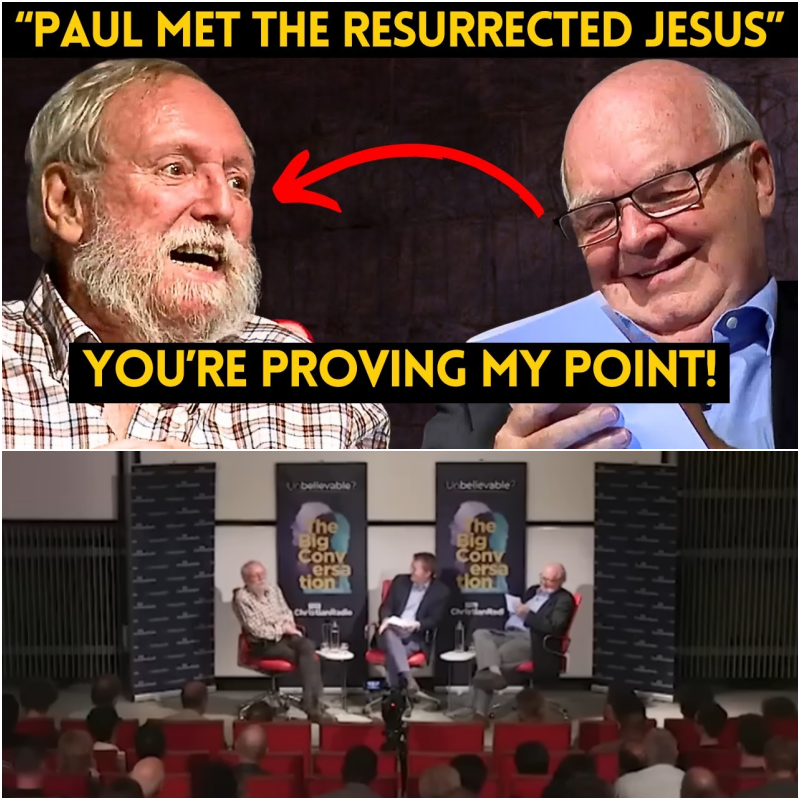
In a moment of profound candor, Ruse managed to do what generations of Sunday school preachers have labored to accomplish: he inadvertently built a compelling, multi-layered case for the validity of the Christian worldview. By examining the nature of morality and the historical mechanics of Christian conversion, the skeptic did more than just challenge his opponent—he unwittingly illuminated the structural integrity of the very faith he rejects.
The Anatomy of Evil: More Than a ‘Dangerous Dog’
The debate took an unexpected turn when the discussion shifted from abstract physics equations to the visceral reality of human history. Ruse, attempting to clarify how he perceives evidence versus how a believer perceives it, introduced a stark moral comparison: the harrowing dichotomy between Heinrich Himmler, one of the principal architects of the Nazi Holocaust, and Sophie Scholl, the courageous young German student guillotined for her non-violent resistance as part of the White Rose movement.
Ruse argued that a Christian looks out at the world and interprets these historical figures through a specific theological lens—namely, that human beings are uniquely made in the image of God.
“Yes, I see here a case of a person who is made in the image of God, and that’s what makes them evil,” Ruse said, describing the Christian perspective. He then added a crucial caveat: “If they were just a wild dog, they would be dangerous, but they wouldn’t be evil.”
While Ruse intended this as a demonstration of how subjective framework colors interpretation, he inadvertently tripped into a massive philosophical concession. He exposed the profound inadequacy of a purely materialistic worldview to account for true moral weight.
To the average observer—and certainly to an American audience steeped in a cultural consensus that fiercely defends objective human rights—the actions of Heinrich Himmler cannot be reduced to the mere biological misfiring of a “dangerous dog.” A rabid dog acts on instinct; it is a menace to be contained, but it carries no moral culpability. It cannot be “evil.”
By contrasting a dangerous animal with an evil man, Ruse implicitly admitted that a qualitative, ontological difference exists between human beings and the rest of the animal kingdom.
This is where the atheist’s argument accidentally builds the Christian’s case:
The Dilemma: If materialism is true, human beings are merely highly evolved primates—essentially sophisticated dogs. Their actions can be inconvenient, destructive, or biologically threatening, but they cannot transcend the categories of nature to become truly moral or immoral.
The Reality: Our collective human conscience utterly rejects this reductionism. We know, with deep moral certainty, that Himmler was not just a biological hazard; he was wicked. We know Sophie Scholl was not just acting on a counter-productive survival mechanism; she was transcendently good.
By acknowledging that Himmler possesses a unique category of “evil,” Ruse inadvertently validated the necessity of the Christian lens. The Christian worldview provides the only robust philosophical foundation for this distinction: humans possess an inherent moral framework because they are uniquely made in the Imago Dei (the Image of God). Without this framework, the skeptic is left trying to condemn genocide with a vocabulary that only allows them to call it “inconvenient.”
The Logic of Damascus: How Christianity Actually Started
The second, and perhaps most dramatic, accidental concession occurred when Ruse turned his attention to the historical origin of the Christian movement. In an effort to decouple faith from academic, natural theology, Ruse brought up the famous New Testament account of Saul of Tarsus on the road to Damascus.
“Saul was not met by somebody who says, ‘By the way, Saul, I’d like to introduce you to the ontological argument,'” Ruse noted with a touch of dry wit. “It didn’t work that way… It’s the gift of God; that’s the basis of it.”
Ruse’s rhetorical goal was to argue that Christian faith is an unprompted, mystical leap rather than a conclusion reached via intellectual design arguments. But John Lennox immediately seized upon the profound historical truth that Ruse had just brought to the surface.
“Hang on, Michael,” Lennox countered. “You see, Paul was convinced. What was the evidence? An appearance of the Risen Christ. That’s what started Christianity… and the fact that there was evidence of the other kind for his resurrection that launched Christianity on the world.”
                    [ THE GENESIS OF A MOVEMENT ]

     Traditional Skepticism              The Damascus Reality
   ┌────────────────────────┐         ┌────────────────────────┐
   │ Distant philosophical  │         │  A concrete historical │
   │ theories & abstractions│         │  encounter with Jesus  │
   └───────────┬────────────┘         └───────────┬────────────┘
               │                                  │
               ▼                                  ▼
     Fails to move a zealot            Transforms an assassin
By focusing on the Damascus road experience, Ruse inadvertently pointed to the single most disruptive catalyst in human history: the historical claim of the Resurrection.
Saul of Tarsus was not a seeker looking for a comfortable religious home; he was a brilliant, fiercely zealous Pharisee actively executing a campaign to systematically eradicate the early Christian church. He was intellectually hostile, culturally powerful, and ideologically committed to the destruction of this new Galilean heresy.
What could possibly transform a state-sanctioned religious executioner into the world’s most tireless champion of the very figure he persecuted?
As Ruse rightly pointed out, it wasn’t a dry lecture on the ontological argument or the fine-tuning of the universe. It was a concrete, historic encounter with a person. Paul’s life was upended because he became utterly convinced that he had looked upon the Risen Christ.
This recognition by an atheist debater strips away the common skeptical myth that Christianity began as a slow-evolving legend, cooked up over centuries by gullible peasants. Instead, it anchors the genesis of the global church exactly where the New Testament anchors it: in a sudden, explosive historical event driven by individuals who were entirely convinced they had witnessed a triumph over death.
The Cumulative Case: A Faith That Is Tested
The back-and-forth between Ruse and Lennox ultimately reframed the entire cultural conversation surrounding what “faith” actually means. In the modern secular imagination, faith is frequently defined as the act of believing something in the total absence of evidence—or, as Richard Dawkins famously suggested, in spite of it.
Yet, as Lennox masterfully articulated, stimulated by Ruse’s prompts, Christian faith operates far more like an evidence-based commitment.
To illustrate this, Lennox bridged the gap between historical data and personal experience by introducing the concept of empirical testability. While a scientist can test gravity by swinging a pendulum in a laboratory, the claims of Christianity are tested in the laboratory of human existence.
“Christ promises that those who trust him and receive him will receive peace with God and forgiveness and a new life and a new power,” Lennox argued. “I’ve seen that happen to me and to people endless times. And when you see two and two make four all the time, you begin to believe that two and two make four. I think it’s eminently testable.”
This cumulative approach directly challenges the rigid materialism that dominates contemporary intellectual circles. Science itself frequently relies on an “inference to the best explanation” for events in the deep past that cannot be recreated in a test tube—such as the unique origin of life or the Big Bang.
Similarly, the Christian case relies on a grand inference to the best explanation based on three massive pillars of evidence:
The Objective Intellectual Evidence: The undeniable mathematical elegance, intelligibility, and apparent design of the universe.
The Historical Evidence: The sudden, historically documented explosion of the early church, catalyzed by a group of fearful, scattered disciples who were suddenly willing to endure torture and execution because they claimed to have seen Jesus alive.
The Experiential Evidence: The ongoing, multi-generational testimony of millions of individuals across distinct cultures who report a radical, internal transformation—moving from spiritual blindness to sight, from moral brokenness to wholeness—upon encountering the living Christ.
The Fingerprint in the Mirror of History
When Michael Ruse stepped onto the debate stage, his goal was to expose the philosophical cracks in theism. Instead, his own illustrations served to highlight the profound explanatory power of the Christian story.
By raising the specter of Heinrich Himmler, he reminded the audience that without a divine anchor, our deep-seated convictions about human dignity and evil dissolve into mere matters of opinion. By invoking the road to Damascus, he highlighted the undeniable historical catalyst that launched a global movement: an encounter with a resurrected Savior that transformed absolute hostility into sacrificial love.
Ultimately, the debate revealed that the fingerprint of the Christian faith is not merely found in abstract philosophical proofs, but in the gritty reality of history and human nature. It is a worldview that does not ask its followers to take a blind leap into the dark, but rather to step decisively into the light of historical and existential reality.
And as one of the world’s most prominent atheists inadvertently demonstrated, even when you try to argue against that light, you often find yourself using its reflection to navigate the truth.