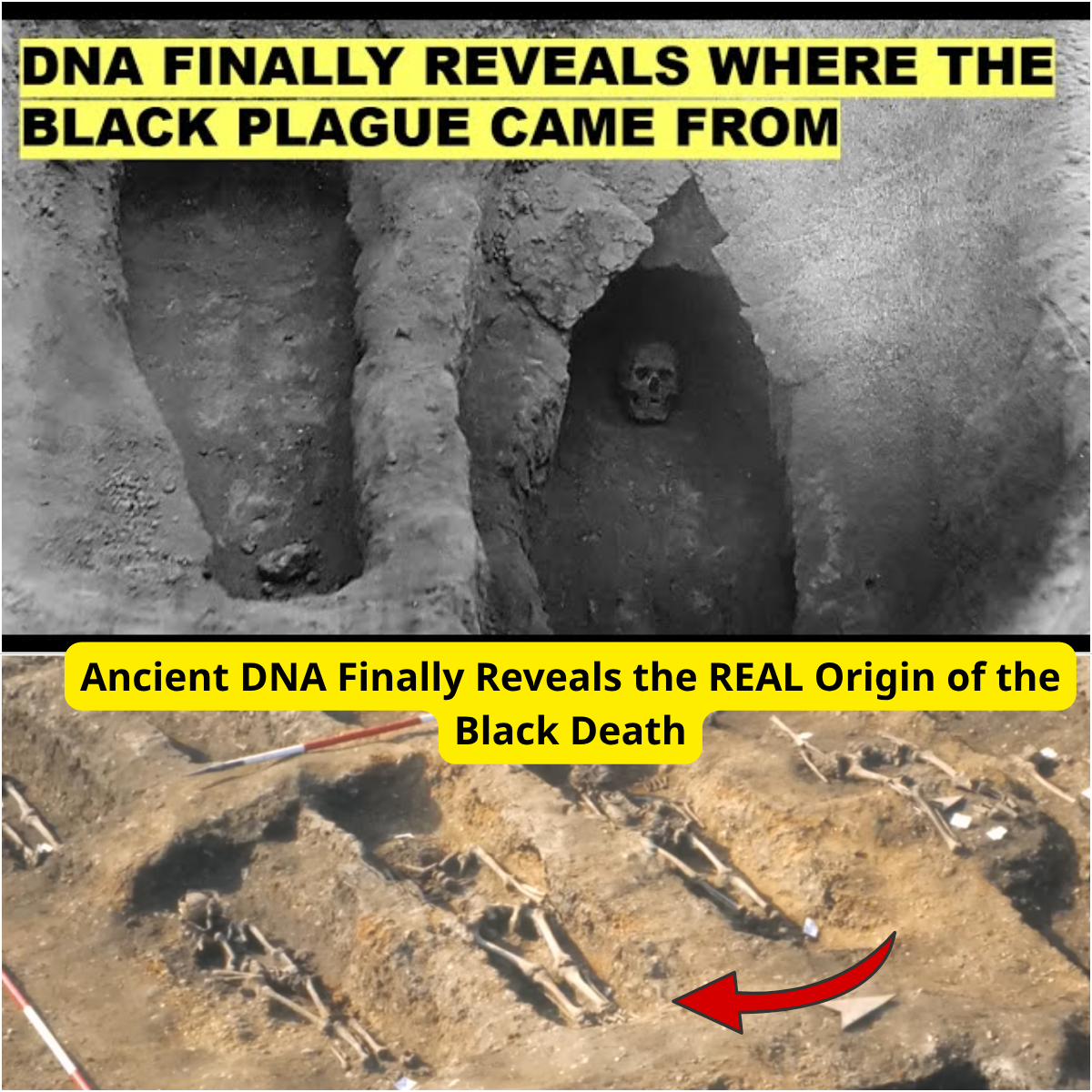
Ancient DNA Finally Reveals the REAL Origin of the Black Death
Ancient DNA Finally Reveals the REAL Origin of the Black Death
Chapter 1: The Gathering Shadow
The wind screaming down from the Tian Shan mountains carried the sharp, unforgiving bite of glacial ice and high-altitude solitude. It was the late summer of 1338. Below the jagged, snow-capped peaks lay the Chu Valley, a fertile corridor cradling the northern shores of Lake Issyk-Kul. For centuries, this deep basin in modern-day Kyrgyzstan had served as a vital sanctuary—a place where the thin air of the mountains gave way to green pastures, rushing rivers, and the bustling, polyglot energy of the Silk Road.
In the thriving trading settlement of Kara-Djigach, the world met in a vibrant tapestry of commerce and faith. Here, Nestorian Christian merchants—their lives governed by an ancient, far-reaching branch of the Eastern Church—rubbed shoulders with Persian diplomats, Mongol administrators, and Han silk traders. The air was usually filled with a rich cacophony: the guttural shouting of camel drivers, the metallic clink of silver coins from Tabriz, the rustle of raw silks, and the soft, rhythmic chanting of Syriac prayers drifting from the community’s stone church.
But by late August, a strange, heavy tension had settled over the valley, thicker and more suffocating than the dust stirred up by the caravans.
In a modest stone house near the center of the settlement, a merchant named Sanmach lay tangled in coarse woolen blankets. His skin was slick with a cold, greasy sweat, and his breath rattled in his chest like dry gravel. At his bedside sat his brother, a literate clerk who kept the community’s trade ledgers, his hand trembling as he pressed a damp cloth to Sanmach’s burning forehead.
“Drink, brother,” the clerk whispered, pressing a wooden bowl to Sanmach’s cracked lips.
Sanmach groaned, a sound of pure agony that seemed to tear from the very bottom of his lungs. He couldn’t swallow. His neck was swollen to twice its normal size, distorted by dark, bulbous lumps that had appeared overnight beneath his jawline and in the sensitive hollows of his armpits. They were hot to the touch, hard as stones, and throbbed with a cruel, rhythmic violence. As the clerk watched in horror, a dark, purple-black discoloration began to flower beneath Sanmach’s skin, spreading outward from the swellings like spilled ink on parchment.
By midnight, Sanmach’s delirium had turned to a violent, lung-tearing cough. He spat dark, frothy blood onto the dirt floor. The air in the room grew foul, heavy with the copper stench of hemorrhage and the sweet, sickening odor of internal decay.
Before the first pale light of dawn struck the peaks of the Tian Shan, Sanmach’s flailing limbs grew still. His eyes, wide and glassy with a final, unutterable terror, stared blankly at the timber ceiling.
He was the first, but he was far from the last.
Within days, the mysterious sickness tore through the stone houses of Kara-Djigach like a wildfire fed by a gale. It picked no favorites. It struck down the wealthy merchant who dealt in Indian Ocean pearls, the robust blacksmith who forged iron shoes for the caravan horses, and the young children who played along the irrigation ditches. The churchbell, which normally rang to celebrate the liturgy or welcome a rich caravan, now tolled a continuous, monotonous dirge.
The settlement’s small cemetery, located just outside the low mud-brick walls, quickly became a frantic scene of desperate labor. The living, pale-faced and exhausted, worked beneath the blazing sun and the cold mountain stars, hacking into the rocky earth to dig communal trenches. There was no time for elaborate shrouds, no time for long, tearful wakes.
By the time the snows of 1339 began to choke the mountain passes, blocking the valley from the outside world, over 118 individuals from this small, close-knit community had been lowered into the freezing dirt.
The settlement’s stonemasons, their hands stiff from grief and the biting cold, chiseled frantic inscriptions into simple slabs of gray river stone. On Sanmach’s marker, they cut neat, blocky Syriac characters into the rock, recording his name, his faith, and a final, desperate explanation for the catastrophe that had consumed their world.
The inscription read: This is the tomb of the believer Sanmach. He died of pestilence.
They filed the dead into the earth, covered them with stones, and prayed that the dark winter would freeze the invisible killer. They had no way of knowing that the agony of Kara-Djigach was not an isolated tragedy. It was the opening scene of an apocalyptic nightmare.
Chapter 2: The Six-Century Silence
The world beyond the Tian Shan mountains would eventually forget the small graveyard by Lake Issyk-Kul, but it would never forget what followed.
Nearly a decade after Sanmach drew his last breath, in the late autumn of 1347, a fleet of Genoese merchant ships slipped out of the Black Sea and docked in the panicked ports of Sicily and Italy. The sailors at the oars were dead or dying, their bodies covered in black, oozing swellings. Within months, the invisible killer stepped ashore, unleashed from the ships into a densely populated, highly urbanized European continent.
For the next six years, between 1347 and 1353, the cataclysm tore through Western civilization with a savagery never before recorded in human history. It was known by many terrifying names: the Great Mortality, the Great Pestilence, and most enduringly, the Black Death.
It moved with a terrifying, supernatural speed. In London, Paris, Florence, and Cologne, the infrastructure of society fractured entirely. Parents abandoned dying children; priests refused last rites; fields went unturned, and entire villages were wiped off the map, leaving empty stone houses to be reclaimed by the forest.
When the embers of the pandemic finally cooled, historians estimate that between 50% to 60% of Europe’s entire population had been reduced to rotting corpses in communal plague pits. It was a demographic disaster so severe that it reshaped the economic, religious, and psychological landscape of the Western world for centuries.
Yet, for over 600 years, an elite fraternity of scholars, epidemiologists, and historians remained gripped by a single, haunting historical mystery: Where did the fuse of this world-altering inferno begin? What was the original spark that ignited the Black Death?
For generations, the theories were as vast and shifting as the Asian steppes. Some historical texts blamed the sweltering, monsoonal river valleys of Central China. Others pointed to the vast grasslands of Mongolia, or the lowlands of India. The search was hindered by a lack of contemporary records and the vast passage of time. The origin of the world’s most devastating pandemic remained a ghost story, buried deep within the dark recesses of medieval history.
The first physical clue emerged not from a medical laboratory, but from a routine archaeological survey in the twilight of the 19th century.
In the sweltering summer of 1886, a team of Russian imperial archaeologists arrived in the Chu Valley, near the quiet village of Kara-Djigach. They were interested in the history of the Silk Road and the ancient Nestorian Christian communities that had once guarded its high-altitude passes.
As they cleared away centuries of windblown dust and mountain sediment, they uncovered two forgotten medieval cemeteries. Shovel by shovel, they unearthed dozens of gravestones intricately carved with Nestorian crosses and dated precisely to the late 1330s.
The archaeologists meticulously recorded the inscriptions, noting the strange, sudden spike in deaths between 1338 and 1339. They noted the frequent use of that single, ominous Syriac word: mawtānā—pestilence.
Recognizing the historical value of the site, the team carefully exhumed the skeletal remains, packed the skulls into wooden crates, and shipped them back across the Russian Empire to St. Petersburg for storage and future study.
But like so many monumental historical clues, the evidence was filed away in the bureaucratic belly of academia and largely forgotten. For more than 130 years, the skulls of Kara-Djigach sat in absolute silence on the dark, dust-covered shelves of the Peter the Great Museum of Anthropology and Ethnography, guarding a secret that the world was not yet technologically equipped to understand.
Chapter 3: The Archivist and the Family Tree
The silence was finally broken in the late 2010s, not by a biologist, but by an economic historian with a passion for old field diaries.
Dr. Philip Slavin, a medieval historian based at the University of Stirling in Scotland, was deep in the intellectual trenches of researching the environmental and economic triggers that preceded the Black Death. He was hunting for anomalies—unusual spikes in mortality, sudden drops in trade volume, or strange weather patterns in the decades leading up to 1347.
While combing through obscure, 19th-century Russian archaeological journals, Slavin’s eyes locked onto the field notes from the 1886 excavation near Lake Issyk-Kul. The sheer density of the burials in such a brief window caught his attention like a lightning bolt.
“One hundred and eighteen burials in two years,” Slavin murmured, tracing the old maps with his finger. “In a community that likely numbered only a few hundred people. That isn’t a bad winter. That is an execution.”
Intrigued, Slavin made the journey to St. Petersburg. Working alongside Russian researchers, he located the original, handwritten excavation diaries and the physical crates containing the human remains. He confirmed that out of the readable tombstones from that specific two-year window, a massive proportion explicitly blamed pestilence for the deaths.
Slavin was professionally convinced he was looking at the long-sought epicenter, the true Ground Zero of the Black Death. But a historian’s conviction, no matter how meticulously researched, is not scientific proof. To convince a skeptical scientific community, he needed to find a way to reach back across eight centuries and pull the invisible killer out of the bone.
He needed the paleogeneticists.
He found his allies at the Max Planck Institute for Evolutionary Anthropology in Leipzig, Germany—a world-renowned hub for the study of ancient DNA. When the geneticists heard Slavin present his historical and archival data, the reaction was immediate and electric.
For years, the Max Planck team had been locked in their own high-stakes hunt for the plague’s origin. They had been painstakingly constructing a massive, global genetic family tree for Yersinia pestis—the deadly bacterium responsible for the plague.
By collecting and sequencing over 1,300 genetic samples from both modern rodent reservoirs and the skeletal remains of plague victims excavated from historical sites across Europe, they had made a critical, paradigm-shifting discovery.
Their data revealed that sometime in the early 14th century, the Yersinia pestis genome had undergone what evolutionary biologists call a “Big Bang” of diversification. From a single, ancestral mother-strain, four brand-new, highly virulent lineages of the plague suddenly exploded into existence almost simultaneously.
One of those four lineages was the genetic monster that rode the Genoese ships into Europe in 1347, sustaining outbreaks across the continent for the next 400 years.
Crucially, the geneticists knew this mother-strain did not originate in Europe. The bacterial DNA pulled from the teeth of Black Death victims in London or Florence already contained one or two specific mutations. The European strains were clearly the modified descendants, the children of an older, unmutated ancestor. The original spark had to be locked in the soil of Asia.
A historic collaboration was forged. The Max Planck team traveled to St. Petersburg to meet Slavin and the museum curators. They approached the ancient skulls of Kara-Djigach not as historical artifacts, but as biological time capsules.
Chapter 4: The Smoking Gun in the Teeth
The paleogeneticists focused their attention on the teeth of seven individuals who had been buried in 1338 and 1339, including the remains found near the stone marking the death of Sanmach.
In the field of ancient DNA, teeth are gold mines. The hard, calcified enamel of a tooth acts as a natural armor, protecting the delicate dental pulp inside from environmental contamination, moisture, and time. When a person dies of a severe, bloodborne infection, the blood vessels inside the dental pulp often trap the genetic material of the pathogen, sealing it in a sterile chamber for centuries.
Using specialized, ultra-clean laboratory techniques designed to prevent any modern contamination, the scientists carefully drilled into the roots of the medieval teeth. They extracted the ancient, degraded powder from the pulp cavities and amplified the surviving DNA strands.
The laboratory in Leipzig was dead silent when the sequencing results flickered onto the computer monitors.
In the DNA profiles extracted from three of the seven Kara-Djigach individuals, the analysis software detected a massive, undeniable match. It was the unmistakable, distinct genetic signature of Yersinia pestis.
“We have it,” whispered the lead geneticist, staring at the screen. “The pestilence of 1338 wasn’t typhus. It wasn’t smallpox. It was the plague.”
The team had found their historical smoking gun. But the true, breathtaking revelation came when they mapped the full genome of the 1338 Kyrgyzstan bacterium and attempted to place it onto their global Yersinia pestis family tree.
The ancient strain did not fall onto one of the peripheral branches. It did not have the mutations seen in the victims of London, Marseille, or Germany. Instead, the computational model placed the Kara-Djigach strain precisely at the absolute root of the entire tree.
It sat perfectly at the exact point of origin for the “Big Bang” event. It was the ancestral mother-strain—the genetic Eve of the global pandemic. The strains that devastated Europe, North Africa, and the Middle East were all direct, mutated descendants of the microscopic killer that had choked the life out of Sanmach in the late summer of 1338.
They had officially found Ground Zero.
Chapter 5: The Spillover and the Caravan
With the geographic location and precise date of origin finally locked into the historical record, the scientific community faced the next logical question: How? How did a bacterium that lived quietly in the wilderness suddenly leap into a human trading outpost with such devastating, civilization-shattering force?
The answer lay in a natural ecological phenomenon known as zoonotic spillover.
The rugged terrain surrounding Lake Issyk-Kul, nestled within the Tian Shan mountains, is not just a beautiful landscape. It is a massive, ancient, and highly active natural plague reservoir. To this very day, Yersinia pestis circulates continuously and naturally within the vast populations of wild rodents that burrow into the mountain slopes—specifically gray marmots, great gerbils, and voles.
By combining climate science with historical data, the researchers reconstructed the perfect storm that brewed in the valley in the 1330s.
Evidence from tree-ring data suggested that Central Asia experienced a sudden, dramatic shift in climate during the early 14th century—unusually warm, wet springs followed by lush, hot summers. This ecological shift caused the vegetation along the mountain steps to flourish, providing an unprecedented bounty of food for the wild marmots.
The result was a massive, uncontrolled rodent population boom.
As the marmot burrows became overcrowded, the density of the fleas that lived in their fur skyrocketed. The Yersinia pestis bacterium thrived in this hyper-congested environment, amplifying its presence across the valley.
When the temporary climate boom inevitably collapsed into a period of drought, the wild rodents began to die off in massive numbers, forcing millions of hungry, infected fleas to abandon their furry hosts and look for alternative sources of blood.
The human settlement of Kara-Djigach sat directly in the path of this ecological crisis.
In the 14th century, gray marmots were heavily hunted by local populations for both their rich meat and their thick, luxurious fur, which was a prized commodity along the Silk Road. A single hunter, bringing a fresh, flea-ridden marmot carcass into the stone markets of Kara-Djigach to be skinned, would have been all it took to bridge the gap between the wilderness and civilization. The infected fleas slipped from the fur, bit the handlers, and injected the mother-strain directly into the human bloodstream.
The final piece of the historical puzzle was the journey—the lethal chain reaction that carried the virus from a quiet mountain graveyard across 3,500 kilometers of rugged terrain to the gates of Europe.
The graves of Kara-Djigach provided the answer. Dr. Slavin’s meticulous archival research noted that the individuals buried under the “pestilence” markers were interred with luxury items that had come from thousands of miles away: beautiful glass beads from the Mediterranean, precious pearls harvested from the warm waters of the Indian Ocean, and foreign coins minted in Iran.
These people were not isolated mountain villagers. They were international logistics experts. They were the drivers, protectors, and financiers of the Silk Road’s most active northern branch.
When the infected merchants packed their massive camel caravans with silks, spices, and furs to travel westward toward Europe, they did not travel alone. Hidden deep within the woven grain sacks, the heavy bundles of cloth, and the timber structures of the supply wagons were black rats (Rattus rattus)—a species that thrives in close proximity to human food storage.
As the caravans moved from one caravanserai to the next, traveling across the vast steppes of Central Asia, they functioned as slow-moving, invisible vessels of contagion. The infected fleas bit the rats, the rats multiplied within the cargo, and the plague marched steadily, inexorably westward, passing from settlement to settlement along the trade route.
By 1346, this slow march of death reached the shores of the Black Sea, arriving at the fortified, wealthy Genoese port city of Kaffa on the Crimean Peninsula.
Historical accounts from the period describe a terrifying scene: a besieging Mongol army, dying of the strange plague, began using massive wooden catapults to hurl the bloated, blackened corpses of their own victims over the stone walls of Kaffa, transforming the city into a trap of biological warfare.
When the panicked Genoese merchants fled Kaffa on their ships, sailing westward into the Mediterranean, they took the infected rats and fleas with them. The fuse that had been lit by a mountain marmot in Kyrgyzstan had finally reached the powder keg of Europe.
Chapter 6: The Legacy of Kara-Djigach
The discovery of the mother-strain in the Chu Valley fundamentally transforms our understanding of human history. It pulls a forgotten, dusty cemetery out of historical obscurity and places it at the absolute center of one of humanity’s darkest and most transformative chapters.
It serves as a stark, humbling reminder of the microscopic forces that dictate the rise and fall of empires. The medieval world of the 14th century was a world of grand ambitions, massive armies, and global trade networks that connected continents like never before. Yet, all of that human ingenuity was brought to its knees by a single, microscopic bacterium born in the dirt of a rugged mountain wilderness.
The genetic data and the archival detective work have finally allowed us to answer the question that haunted scholars for 600 years. The Black Death was not a supernatural curse, nor was it a sudden, random act of spontaneous generation. It was a tragedy born of environmental change, human connectivity, and the timeless, desperate struggle of life seeking new frontiers.
Today, the wind still screams down from the Tian Shan mountains, blowing over the quiet, empty valleys where the merchants of Kara-Djigach once lived, traded, and prayed. The stone buildings are gone, and the church has long since crumbled into dust. But the truth is no longer buried.
We now know that when Sanmach died in the heat of 1338, his family did not just bury a brother. They buried the first casualty of a global war between humanity and the plague—a war whose origin story is finally written in stone.