A Waitress Helped an Old Man Every Morning – But One Day, His Lawyers Walked In With 4 Bodyguards…
A Waitress Helped an Old Man Every Morning – But One Day, His Lawyers Walked In With 4 Bodyguards…
Chapter 1: The 7:10 Chime
The brass bell above the door of the Bluebird Diner didn’t just ring; it gave a sharp, metallic chirp that cut through the low hum of the morning rush. It was a comforting, predictable sound, as embedded in the rhythm of the place as the hiss of the espresso machine or the scrape of the spatula against the greasy flat-top grill.
Lena didn’t need to look up from her order pad. She knew the time without checking the grease-stained clock above the counter. It was exactly 7:10 a.m.
“Morning, Mr. Hail,” she said, her voice carrying a warmth that was entirely genuine, a rarity in a highway-adjacent diner at dawn.
The old man walked in with a deliberate, slow cadence. Every step seemed measured, a conscious effort against the pull of gravity and time. Yet, there was an unmistakable posture to him. He wore a faded, double-breasted brown wool coat that had seen better decades. The cuffs were slightly frayed, and the fabric was worn thin at the elbows, but it was meticulously brushed, free of lint or dust. His gray hair was parted with geometric precision, and despite the slushy autumn rain pooling on the linoleum floor, his black leather shoes shone with a fresh polish.
“And a very good morning to you, young lady,” he replied. His voice was a low, resonant baritone, rich and textured like old leather, though it carried the faint, breathless tremor of a man who was simply tired down to his bones.
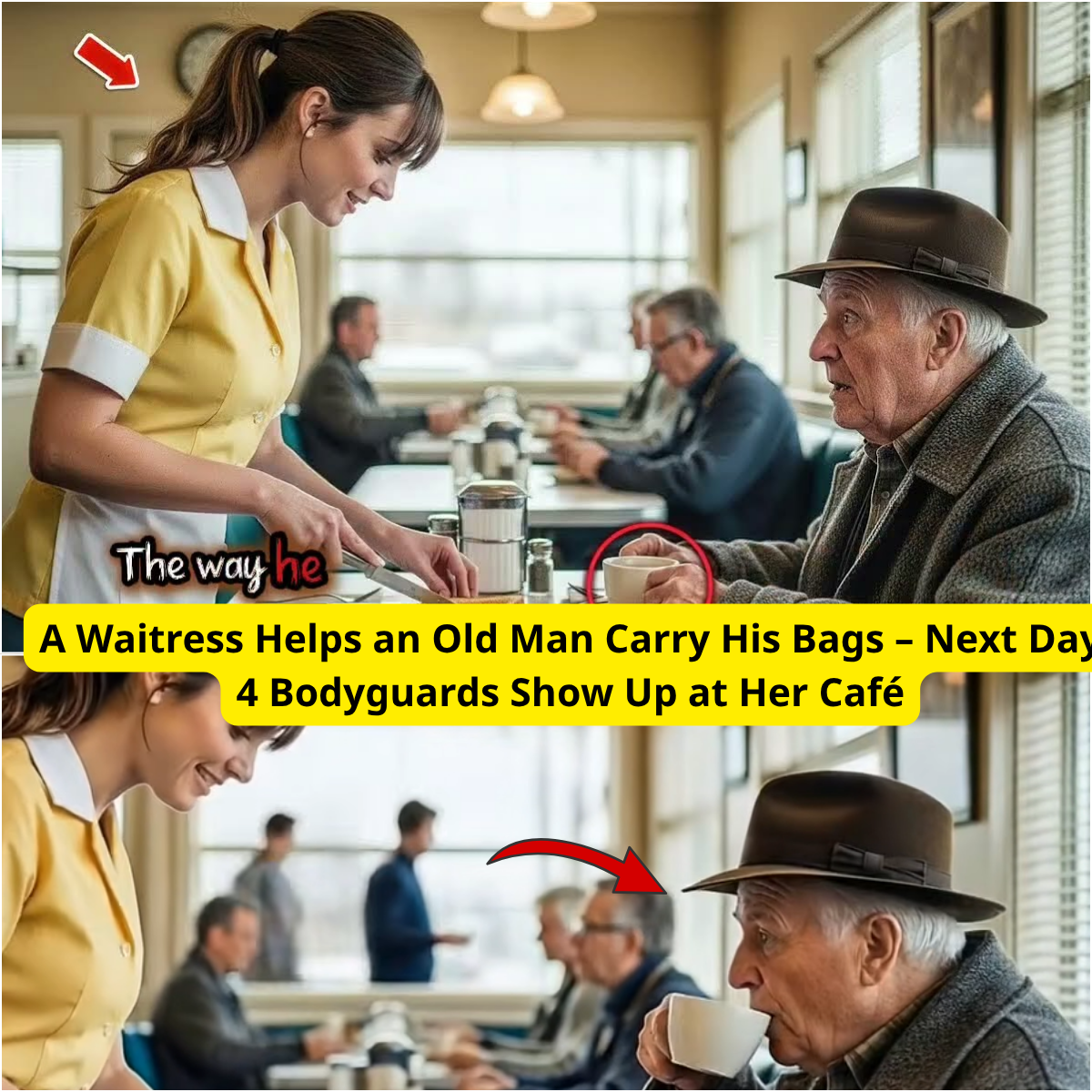
He bypassed the busy counter and navigated toward the back, slipping into the same vinyl booth by the window every single day. From there, he could watch the rain streak across the glass, distorting the headlights of the semi-trucks hurtling down Route 9.
Lena grabbed a ceramic mug and a fresh pot of regular coffee, sliding into the booth across from him with the practiced ease of a seasoned waitress. She poured the dark liquid, watching the steam rise and obscure his wrinkled face for a brief second.
“The usual?” she asked, her pen hovering over her pad.
“Just a cup of black coffee and a single slice of wheat toast, if you please, Lena,” he said, offering a small, polite smile that didn’t quite reach his faded blue eyes.
Lena frowned slightly, tapping the top of her pen against her chin. “Mr. Hail, you’re shrinking right before my eyes. A single piece of toast isn’t fuel for a bird, let alone a man. Let me talk to Cookie. Let’s get you some scrambled eggs, maybe a couple of strips of bacon? On the house if I have to.”
The old man chuckled, a soft, dry sound. He reached out, his hand trembling slightly as his gnarled fingers wrapped around the warm mug. “You need to stop worrying so much about an old man, Lena. Your heart is too big for a place with fluorescent lighting.”
“And you need to eat,” she teased back, sliding out of the booth. “I’ll see what I can do about that toast.”
As she walked away, the smile faded from her face, replaced by a quiet, gnawing worry. Lena was an observer by trade; you had to be if you wanted to survive on tips in a town that economic growth had long since bypassed. And over the last four months, she had noticed things about Mr. Hail that others completely missed.
She noticed the way his breath hitched slightly when she handed him the check. She noticed the agonizingly slow, deliberate way he counted out his currency, sorting through quarters, nickels, and dimes with trembling fingers, ensuring he had exactly the right amount down to the penny, never leaving a tip because he clearly couldn’t afford one. She noticed how he would occasionally stare at the menu for five minutes, looking at the breakfast specials, before quietly closing it and asking for just the toast.
To the other waitresses, he was just a polite, lingering ghost who took up a booth during peak hours and left nothing for the staff. To the owner, he was a low-margin customer.
But to Lena, he was a human being holding onto his dignity by a thread.
Chapter 2: Invisible Grace
A week later, the autumn chill turned into a biting, relentless frost. The diner was packed with construction workers trying to warm up before heading to the job site. The air smelled of burnt grease, maple syrup, and damp denim.
When the bell chimed at 7:10 a.m., Mr. Hail entered, shivering slightly, pulling the collar of his faded brown coat tight against his neck. Lena watched him walk to his booth, his hands shaking noticeably more than usual.
When she brought him his coffee, she didn’t bring a single piece of toast. Instead, she set down a large plate holding two perfectly poached eggs, three thick strips of crispy bacon, and a small mountain of golden hash browns alongside two thick slices of buttered sourdough.
Mr. Hail looked at the plate, then looked up at Lena, a flash of panic crossing his face. “Oh, Lena, dear… there must be a mistake. I didn’t order this. I can’t… I only asked for the toast.”
“Mistake? No way,” Lena said loudly, leaning over the table and speaking in a conspiratorial whisper. “Cookie messed up an order for table four. Made poached instead of fried, and he was just going to throw it in the trash. I told him he was crazy. You’d be doing us a massive favor by eating it, Mr. Hail. Save me the lecture from the manager about food waste.”
The old man stared at the food, then back at Lena. He wasn’t foolish. He knew the diner’s strict policy on mistakes—employees usually had to pay for them or throw them out in front of a supervisor. He looked deep into her eyes, searching for the pity he so fiercely dreaded, but he found none. There was only warmth, a fierce, protective kindness that demanded nothing in return.
“Well,” Mr. Hail said quietly, his voice thick with an emotion he swallowed down. “If it’s to save you a lecture, I suppose I must.”
“Attaboy,” Lena smiled, patting his shoulder before rushing off to refill a row of mugs at the counter.
It became their unspoken ritual. Every few days, a “kitchen error” would magically appear at Mr. Hail’s booth. A side of sausages that was “accidentally dropped in the fryer,” a bowl of hot oatmeal that was “poured by mistake.” When the errors weren’t believable, Lena took matters into her own hands.
She began manipulating the register. When Mr. Hail went to pay his meager three-dollar bill, she would type in a promotional discount, or simply ring it up as a employee-meal deduction, covering the difference out of her own meager tip jar at the end of the shift. On days when he looked particularly fragile, she would look at his handful of coins, smile, and say, “Manager’s special today, Mr. Hail. Every tenth customer eats free. You’re the lucky winner.”
He never argued, never protested. But he watched her. His sharp, perceptive eyes followed her as she rushed across the floor, wiping down tables, soothing angry customers, and treating everyone—from the unhoused man seeking refuge from the cold to the wealthy truckers passing through—with the exact same level of profound, unconditional respect.
One afternoon, as he was leaving, he paused by the register. The diner was empty, save for the hum of the refrigerator. He placed his hand over hers as she handed him his receipt. His skin was dry, papery, and cold, but his grip was surprisingly firm.
“Kindness has a beautiful, circuitous way of coming back to a person, Lena,” he said softly, looking at her with an intensity that made her breath catch.
Lena just offered a modest, self-deprecating smile. “I’m not expecting anything back, Mr. Hail. The world is tough enough as it is. We might as well make it a little softer where we can.”
“I know you don’t,” he whispered, a strange, enigmatic smile touching his lips. “But I am.”
Chapter 3: The Intrusion
Three weeks later, Tuesday arrived with a torrential downpour that turned the morning sky into a bruised, oppressive gray. The rain lashed violently against the glass of the Bluebird Diner. Inside, the atmosphere was dreary. Lena was wiping down the counter, her mind wandering to her mounting past-due electric bill and the radiator in her apartment that had started clanking like a dying engine.
She checked the clock. 7:08 a.m. She automatically grabbed a ceramic mug, setting it by the coffee pot.
At 7:10 a.m. sharp, the brass bell above the door didn’t just chime—it rattled violently as the heavy glass door was flung open with an aggressive, authoritative force.
Lena blinked, turning around.
The diner didn’t just fall quiet; the silence that descended was absolute, heavy, and instantaneous. The low murmur of conversation died mid-sentence. At the grill, Cookie stopped scraping the metal flat-top, his spatula frozen in mid-air. Even the classic rock station playing faintly from the kitchen radio seemed to lose its volume.
Four men stepped into the diner first. They were tall, Broad-shouldered, and dressed in identical, impeccably tailored charcoal-black suits that practically radiated power and corporate authority. They didn’t look like residents of this town; they looked like they had just stepped out of a high-rise boardroom in Manhattan. Their expressions were stone, eyes scanning the diner with predatory efficiency.
Behind them came two massive men wearing earpieces, their hands folded loosely in front of their waists—bodyguards.
The patrons in the booths shrank back, pulling their jackets closer, sensing an immediate, dangerous shift in the atmosphere. Lena’s heart began to hammer against her ribs. Her mind raced through the worst-case scenarios—a mob hit? A federal raid?
Then, the final figure stepped through the door.
Lena’s breath caught in her throat. She gripped the edge of the laminate counter so hard her knuckles turned stark white.
It was Mr. Hail.
But it wasn’t the Mr. Hail who had walked through that door yesterday. The faded, frayed brown coat was gone. In its place, he wore a bespoke, midnight-blue cashmere overcoat that draped perfectly over his shoulders. Beneath it, a crisp white shirt and a silk tie. His gray hair, usually combed flat, seemed to catch the light, possessing a silver brilliance.
More than the clothes, it was his posture. The careful, trembling, hesitant steps were entirely gone. He walked with a straight spine, his head held high, radiating an undeniable, commanding presence that filled every square inch of the dingy diner. He didn’t look tired. He looked monumental.
He didn’t look toward his usual booth. Instead, his eyes locked onto Lena.
“Mr… Mr. Hail?” Lena whispered, her voice cracking in the silence of the room.
The old man smiled. It was the same warm smile she knew, but the fatigue that had always shadowed it was gone, replaced by a profound, unshakeable confidence.
“Good morning, Lena,” he said, his voice echoing clearly through the quiet diner.
The four men in suits immediately moved toward the large family booth near the center of the room. One of them pulled out a leather chair, while another opened a sleek aluminum briefcase, spreading out thick stacks of legal documents across the table.
The first man turned to the old man, bowing his head slightly in an display of deep, submissive respect. “Sir, everything is prepared. The local notary has been secured, and the digital filings are ready for your authorization.”
Lena felt the room spin slightly. “Sir?” she echoed, her voice barely audible. She stepped out from behind the counter, her legs feeling like lead. “What… what is going on? Who are you?”
Chapter 4: The Revelation
Mr. Hail looked at her for a long, poignant moment. The silence stretching between them was heavy with anticipation. The patrons watched, completely spellbound, forks suspended halfway to their mouths.
“My name isn’t just Mr. Hail, Lena,” he said quietly, stepping closer to her. “It is Henry Hail. I am the founder, majority shareholder, and former Chief Executive of Hail Industries.”
A collective, sharp intake of breath rippled through the diner. Even Cookie poked his head out from the kitchen hatch, his eyes wide. Hail Industries was a global aerospace and manufacturing conglomerate worth billions. Their logos were on commercial airplanes, medical equipment, and defense technology worldwide.
Lena blinked rapidly, her mind refusing to connect the corporate titan she had read about in news magazines with the frail man who had counted out nickels for a slice of toast.
“I don’t understand,” Lena whispered, shaking her head. “The coat… the coins… you were starving. You couldn’t afford a full breakfast.”
Henry Hail let out a soft sigh, looking down at his manicured hands before looking back at her. “Three years ago, my wife, Eleanor, passed away. We had built an empire together, but when she died, the empire felt hollow. Suddenly, everyone around me became a vulture. My board of directors, my executives, even people I considered lifelong friends—they all looked at me and saw nothing but dollar signs, stock options, and inheritances. Every smile had an agenda. Every act of kindness came with a receipt.”
He took another step closer, his eyes softening. “I became deeply cynical. I began to believe that genuine human decency was a myth, an extinct virtue replaced entirely by transaction. So, four months ago, I decided to conduct an experiment. I wanted to see something real. I stripped myself of my titles, my luxury, and my name. I bought a dilapidated house three miles from here, put on an old coat, and walked into this diner as a broke, lonely old man.”
“You were testing us?” Lena asked, a sudden prickle of hurt surfacing in her chest.
“I was searching, Lena,” Henry corrected gently. “Searching for real people. For a kindness that didn’t expect a return on investment. And for weeks, I found exactly what I expected to find—apathy. People looked through me as if I were invisible. The manager here tolerated me only as long as my pennies cleared. Except for you.”
Lena’s breath hitched.
“You didn’t see a transaction,” Henry continued, his voice thick with genuine emotion. “You saw a human being who was cold, and you warmed him. You saw a man you thought was hungry, and you fed him out of your own pocket. You protected my dignity when you had absolutely nothing to gain from it, and when your own life was clearly a struggle.”
One of the lawyers stood up, straightening his tie, holding a heavy gold pen and a thick leather folder. “Miss Lena Carter,” he said, his voice booming with formal authority. “Mr. Hail has made a final, irrevocable decision regarding the restructuring of his private estate.”
Lena shook her head, taking a step back, her hands flying to her mouth. “No… no, wait. This is crazy. I didn’t do anything special. I was just doing my job. I just… I liked talking to him.”
“Lena,” Henry interrupted, his voice commanding yet incredibly tender. “You did everything. You gave me back my faith in humanity. You proved to a dying old billionaire that love and charity still exist in a world that feels increasingly cold.”
The lawyer placed the heavy leather folder on the diner counter right in front of her.
Chapter 5: The Right Investment
Lena’s hands trembled violently as she reached out, flipping open the cover of the folder. Her eyes scanned the documents, but the legal jargon blurred together. She saw phrases like Irrevocable Living Trust, Transfer of Equity, and Asset Allocation. Then, her eyes locked onto a number written on the summary page.
It was a figure with too many commas. A number that represented wealth so vast it didn’t even feel real. It looked like a phone number.
“I… I can’t process this,” she whispered, looking up at Henry, tears finally spilling over her eyelashes and tracking down her cheeks. “What is this?”
The lawyer spoke up, his professional demeanor softening into a respectful smile. “Per Mr. Hail’s directive, effective at midnight last night, a total of 15% of the voting shares of Hail Industries has been transferred into a newly established trust under your name. Furthermore, the trust includes an immediate cash liquidity disbursement of twenty-five million dollars, tax-prepaid by the estate.”
The entire diner erupted into a chaotic storm of gasps and murmurs. A woman in a corner booth dropped her coffee mug, the ceramic shattering loudly against the floor, but nobody even looked.
Lena’s knees gave out. She slumped against the counter, her breath coming in short, ragged gasps. “Twenty-five… million? That’s impossible. This is a joke. It has to be a joke.”
“It is very possible, and it is entirely legal,” Henry said, moving forward to rest a firm, reassuring hand on her trembling shoulder.
“Why me?” she sobbed, her voice breaking completely as she looked up at him. “There are people who change the world, people who cure diseases, people who build charities… I’m just a waitress at a highway diner. I just gave you extra toast!”
Henry Hail smiled, a brilliant, tearful smile that illuminated his face.
“Because kindness like yours is the rarest commodity on this planet, Lena,” he said, his voice ringing with absolute certainty. “The world doesn’t need more billionaires, and it doesn’t need more empires. It needs more people who look at a broken, lonely old man and decide that he deserves to eat, simply because he is alive. You gave without expecting a single dime in return. And that is exactly why you are the only person who deserves this.”
The lawyers silently gathered their briefcases, their tasks concluded. The bodyguards stepped back, opening the heavy glass door as the rain outside finally began to taper off, allowing a sliver of bright, golden morning sunlight to pierce through the dissipating clouds.
Henry Hail didn’t immediately turn to leave. He looked at the booth by the window, then back at Lena, who was wiping her face with a paper napkin, laughing through her tears in sheer, overwhelming disbelief.
“Are you really putting all of this money… all of this power… into me?” she asked, her voice trembling.
Henry shook his head gently, his blue eyes clear and full of peace.
“Not in you, Lena,” he whispered, stepping toward the door. “In kindness. And I know it’s going to yield the greatest return this world has ever seen.”
The brass bell chimed one last time as Henry Hail walked out into the morning sun, his posture straight, his heart full. Inside the Bluebird Diner, the silence remained for a long time, but everything had changed forever.