WHO WAS THE DEMON THAT TEMPTED JESUS IN THE DESERT?
WHO WAS THE DEMON THAT TEMPTED JESUS IN THE DESERT?
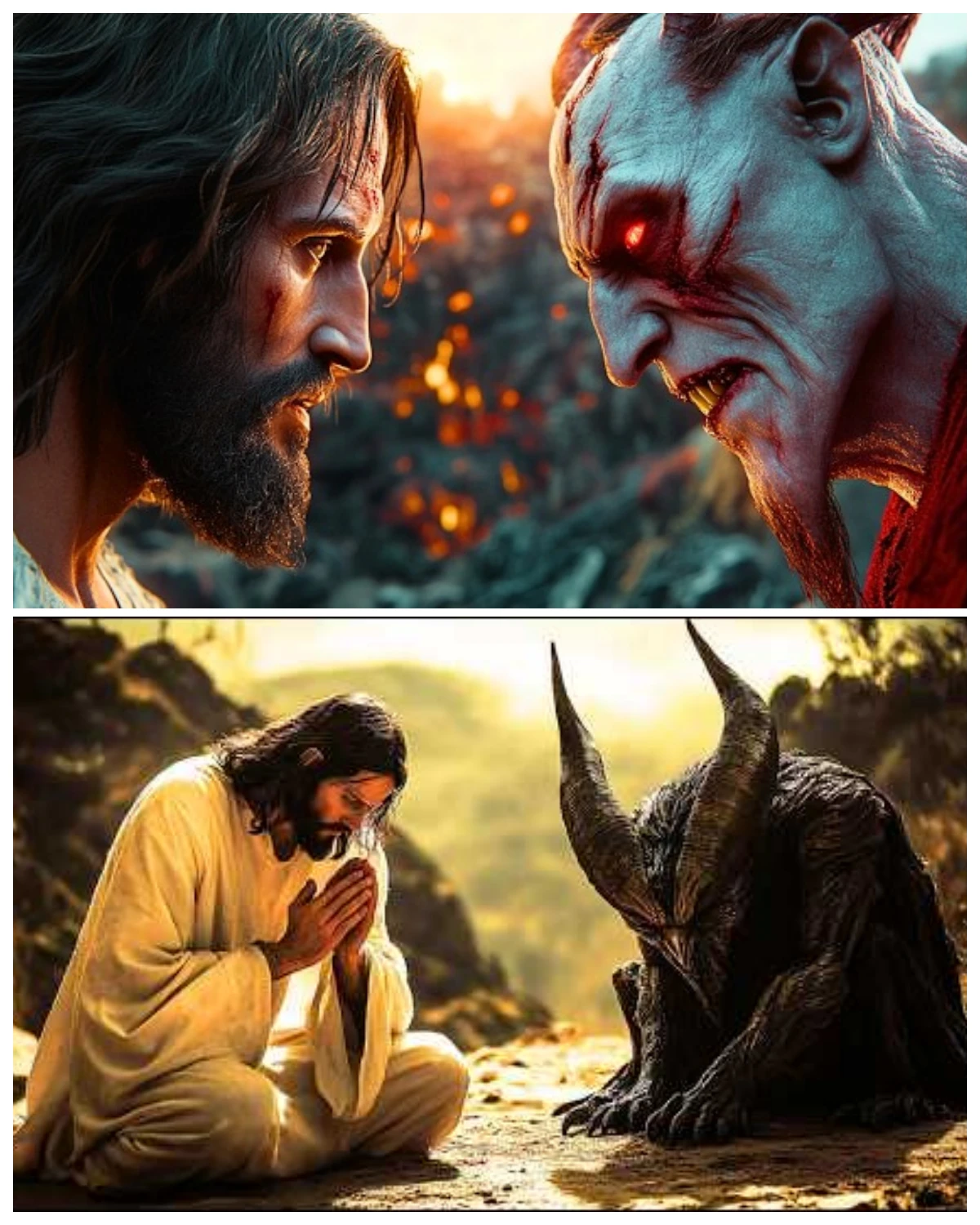
The devil tempted Jesus in the desert.
For 40 days and nights.
The Son of God faced hunger, loneliness, and an unseen confrontation that would define the destiny of humanity.
But who was this person who dared to challenge the Messiah?
Just some random evil spirit, or Lucifer himself, the fallen angel who rebelled against God?
The writing reveals every detail of this clash.
Three temptations, three meticulously planned attacks.
A cunning adversary who knew the scriptures and knew exactly how to twist the truth to his own advantage.
But there was something behind this encounter that few people realize.
If the devil offered the kingdoms of the world, does that mean he possessed them?
If he used God’s own word to try to deceive the Son of God, it means he knew the divine plan.
And above all, this being who tempted Jesus was indeed Lucifer.
The answer is in the Bible.
And what happened in that desert could change everything you think about this story.
The scorching desert sun beat down on the arid land, and thirst quenched the thirst of anyone who dared to cross that vast expanse.
Jesus, the Son of God, now walked alone, guided by the Holy Spirit, into a period of trial that would echo into eternity, without food, without company, without comfort, only himself, the absolute silence of the desert, and the imminent approach of the tempter.
But who was this opponent?
Could it be just some evil spirit, or Lucifer himself, the fallen angel, who defied heaven?
The Bible describes this moment directly.
Then Jesus was led by the Spirit into the wilderness to be tempted by the devil.
After fasting for 40 days and 40 nights, he was hungry.
The Gospel of Matthew, chapter 4, verses 1 and 2.
Here is a profound revelation about the purpose of this event.
Jesus was not led into the desert by chance, nor by a human decision.
But by the very spirit of God.
The same God who guided Israel through the desert for 40 years was now leading his son to a decisive confrontation.
But why did he have to go through that?
In biblical tradition, the desert has always represented a place of trial and transformation.
It was there that Moses received the commandments, that Elijah encountered God in a gentle whisper, that Israel was tested and failed countless times.
Now Jesus would face his own desert, not out of weakness, but to triumph where others had fallen.
He carried with him nothing but the word of God and obedience to the Father.
And that was precisely what would be tested.
The first few days passed, and the hunger began to manifest itself as a deep pain, a growing emptiness that intensified with each passing moment.
The body weakened, thoughts challenged by the overwhelming silence.
The devil, cunning as always, did not appear immediately.
He was waiting for the exact moment, the moment of maximum weakness.
The perfect opportunity to attack.
And when he finally approached, he didn’t come with a brutal attack, but with a subtle voice, laden with venom and disguised as logic.
This moment echoed a much older event .
In the beginning, in the Garden of Eden, the enemy had approached Eve with calculated words, twisting the truth, planting doubt.
This is what God said, Genesis chapter 3, verse 1.
Now the scene would repeat itself, but the stage was different.
If the first man failed in Eden , now in the desert the last Adam was ready to face the adversary.
However, there was one unanswered question .
Who exactly was this tempter?
The scripture calls him the devil, which in Greek means accuser, slanderer.
But could he be Lucifer himself, the cherub who fell because of his pride?
Was there a difference between Satan and Lucifer, or were they just different names for the same being?
That answer was about to be revealed, as the spiritual battle in the desert intensified.
Satan, the devil, or Lucifer, the origin of the enemy.
The tempter was approaching.
He did n’t come with chains, shackles, or frightening shadows, but with words.
His attack was not physical, but mental and spiritual.
Jesus was about to confront the one who had been opposing God’s will from the beginning.
But who exactly was this being?
The scripture calls him the devil, from the Greek diábolos, which means accuser, slanderer.
And from Satan, from the Hebrew chatã, which means adversary.
But many wonder: “Is this devil that appears in the desert the same one we call Lucifer?
Is there a distinction between the titles, or are we talking about the same being?”
The origin of this question lies in passages from the Old Testament that for centuries have been associated with the fall of the enemy.
The book of the prophet Isaiah records: “How you have fallen from heaven, morning star, son of the dawn!”
“How you have been cast down to the earth, you who weakened the nations!”
Isaiah, chapter 14, verse 12.
The expression ” morning star” comes from the Latin Lucifer, meaning light-bearer.
Many scholars argue that the context of this passage speaks of the king of Babylon and his arrogance before God.
However, the language used goes beyond a simple earthly ruler.
It suggests a cosmic fall, an exalted being who tried to elevate himself above the creator himself.
Ezekiel reinforces this view by describing an anointed cherub who was expelled from the divine presence.
“You were the seal of perfection, full of wisdom and perfect in beauty.
You were perfect in your ways from the day you were created, until iniquity was found in you.”
Ezekiel, chapter 28, verses 12 to 15.
These texts, although originally referring to earthly kings, carry a parallel with the fall of an angelic being.
Jesus himself stated: “I saw Satan fall like lightning from heaven.”
Gospel of Luke, Chapter 10, verse 18.
But this leads us to another question.
Is this fallen Lucifer the same Satan who now appears tempting Jesus in the desert?
The answer may lie in the very progression of this being’s rebellion.
Lucifer, the light-bearer, was an exalted being in the heavenly hosts.
But by desiring to usurp God’s throne, he became Satan the adversary.
From then on, his role became that of accuser and deceiver of humanity.
The book of Job gives us a glimpse of this.
“Now there was a day when the sons of God came to present themselves before the Lord, and Satan also came among them.”
Job, chapter 1, verse 6.
Here he appears questioning Job’s faithfulness, acting as a direct opponent of divine plans.
If he was already active in Job’s day, long before the incarnation of Christ, it makes sense that he was the same being who now appeared in the desert.
But why would he care so much about tempting Jesus?
The answer is simple and terrifying.
Since Eden, he knew that a The descendant of the woman would crush her head.
Genesis, chapter 3, verse 15.
He failed to corrupt humanity in the beginning.
So now his last chance was to destroy the Messiah before he fulfilled his mission.
The temptation in the desert was not just a test for Jesus, it was a spiritual war of cosmic dimensions.
The adversary appeared not only to test the resistance of the Son of God, but to try to prevent the redemption of humanity.
If Jesus failed there, the entire promise of salvation would crumble.
And it was with this purpose that he approached.
But his strategy would not be obvious.
He would not come with violence or brute force.
His attack would be subtle, like a serpent hiding in the shadows.
And his first attempt was a direct blow to the most basic need of the human body.
Hunger, the first temptation, power over matter.
The silence of the desert was broken.
The dry air seemed to weigh even more heavily, and the presence of the tempter made itself felt.
There was no sound of footsteps, nor shadows moving in the sand, but something invisible, yet palpable, filled the atmosphere.
It was not a It was not a physical encounter, but a clash between light and darkness, between truth and falsehood.
Jesus, after 40 days and 40 nights of fasting, was at the limit of his human strength.
His muscles ached, his steps were slow, his vision blurred.
Hunger was not just a discomfort, it was a burning pain in his body, corroding his physical resistance, but his soul remained unshaken.
He who had been led by the Spirit into the desert knew that he was not there by chance.
And it was precisely in this moment of weakness that the enemy manifested himself.
The attack did not come with brutality.
Satan did not present himself with shouts, threats, or terrifying visions.
He came with words, coldly calculated words, subtle, disguised, logical, and even feigning concern.
He knew human nature well.
He knew that men easily succumb to despair when their most basic needs are put to the test.
So he launched his first blow.
“If you are the Son of God, tell these stones to become bread.”
Matthew, chapter 4, verse 3.
The proposal seemed harmless, almost reasonable.
After all, what would be the problem with Jesus using his divine power to turn stones into bread?
He was the creator of the universe, the one who had fed Israel with manna in the desert.
Later, he would multiply loaves and fishes to satisfy multitudes.
So why not satisfy his own hunger?
But here was the trap.
The devil’s attack wasn’t just about Jesus’ hunger; it was about his absolute trust in the Father.
Satan wasn’t just suggesting a miracle; he was questioning Christ’s identity and how he would fulfill his mission.
The enemy had used this strategy before.
In Eden, he didn’t tell Eve, “Eat of the fruit,” but he sowed doubt.
“Did God really say so?”
Genesis, chapter 3, verse 1.
He didn’t directly attack the divine command, but planted a seed of questioning.
Now, in the desert, he was doing the same.
He didn’t command Jesus to turn the stones, but “If you are the Son of God?”
This phrase carried a subtle poison.
He didn’t deny that Jesus was the Son of God, but insinuated that if he truly was, then he should prove it.
Here was the real test.
Would Jesus obey the Father or would he yield to the pressure of immediate need?
The temptation was twofold.
First, to attack the Messiah’s identity , then to lead him to act outside the Father’s will.
If Jesus accepted the challenge, he would be demonstrating independence from God.
He would not be performing a miracle to glorify the Father, but to satisfy himself, yielding to a physical impulse and acting on his own.
But Christ did not fall into this trap.
He knew that the real battle was spiritual.
He knew that the desert was not a punishment, but a preparation.
He knew that bread sustained the body, but the word of God sustained the soul.
The soul.
And then he answered: “It is written: ‘Man shall not live by bread alone , but by every word that comes from the mouth of God.'” Deuteronomy, chapter 8, verse 3.
These words were not chosen at random.
Jesus was quoting a crucial moment in the history of Israel.
For 40 years in the desert, God sustained his people with manna, a bread that did not come from human hands, but from heaven.
He taught them to depend entirely on his provision, to trust that he would supply their needs in due time.
But many, in their impatience, murmured against God and fell into disobedience.
Jesus, however, would not make that mistake.
He was not in the desert to challenge God’s will, but to submit to it completely.
He did not need to prove anything to the devil.
His identity as the Son of God did not depend on showy miracles.
The true son obeys his father even when hunger strikes, even when the desert seems endless.
This answer destroyed the devil’s first strategy.
Satan realized that he could not make Jesus doubt the Father or act out of time.
Of God, but he would not give up.
If hunger was not enough to divert the Messiah from the divine plan, perhaps the next temptation needed to be more elaborate.
Now the enemy would use something even more dangerous, the very word of God, but twisted and manipulated to serve deception.
The second temptation, power over the spirit.
The first attack failed.
The tempter saw that Jesus would not yield to hunger, nor to doubt.
The firm and grounded response in the word showed that the Son of God would not make impulsive decisions , nor act outside the Father’s will .
But Satan would not give up so easily.
If Jesus resisted the first blow, then the next would be more cunning, an attack on his trust in God himself.
In an instant, Jesus found himself transported to a new scene.
He was no longer in the scorching heat of the desert, but at the highest point of the temple in Jerusalem.
The holy city stretched before him, its streets bustling, full of the faithful and priests.
The enemy was at his side and this time he would not only launch subtle suggestions.
He would bring the scriptures to the center of the temptation.
If you are the Son of God, throw yourself down from here, for it is written: “He will command his angels concerning you, and they will lift you up in their hands.”
So that you never stumble on a stone.
Matthew’s Gospel, chapter 4, verse 6.
The strategy was more sophisticated than before.
The devil not only challenged Jesus, but now he was using God’s own word to try to persuade him.
The quote came from Psalm 91, one of the best-known texts about divine protection.
But there is something subtly malevolent about this approach.
Satan omits an essential part of the verse, removing the condition that God establishes for his protection.
The complete psalm says: “For he will command his angels concerning you to guard you in all your ways.”
Psalms, chapter 91, verse 11.
But the devil leaves out in all your ways a crucial detail that indicates that divine protection is conditional upon obedience to God’s ways.
The enemy distorts the truth by turning a promise into a test for God.
Jesus immediately understood the trap.
If he jumped, he would be demonstrating reckless faith, demanding a miracle instead of trusting in the Father’s sovereignty.
It was not merely a temptation to prove his identity, but a challenge to manipulate God for his own benefit.
The subtle temptation here was to force God to act according to human desires, instead of humbly submitting to His perfect plan.
Jesus replied firmly, “It is also written: ‘Do not put the Lord your God to the test.'” Deuteronomy, chapter 6, verse 16.
With this statement, Christ exposed the enemy’s fallacy.
True faith doesn’t need spectacular demonstrations to be validated.
God does not need to be put to the test, for he has already proven his faithfulness throughout the entire history of redemption.
Unlike Israel, which tested God in the desert by doubting His provision, Jesus stood firm, refusing to act outside the Father’s will .
Satan realized that this tactic had also failed.
If Jesus would neither succumb to hunger nor manipulate God to prove his power, then the final attack would need to be more direct, more aggressive.
If he would not break his communion with the Father through physical desire or spiritual pride, then perhaps a proposition of power and glory could be the way.
The third temptation, power over kingdoms.
Before we continue, if this content has blessed your life, please like, comment, and share.
Your “amen” in the comments makes all the difference in reaching more people.
Subscribe to the channel, turn on notifications, and check out the playlist.
Special mention in the first comment and at the end of the video.
Continuing, the tempter had failed twice.
Jesus did not succumb to hunger, nor to the desire to manipulate God.
The enemy’s strategy needed to change.
Now he would set aside the subtle insinuations and move on to a tempting offer, a proposal that involved something much greater than simple human desire.
In an instant, the landscape changed again.
Jesus was now standing on a very high mountain, and an impressive sight was unfolding before his eyes .
All the kingdoms of the earth, their riches, their power, their armies, and their thrones were exposed before him.
It was a glorious spectacle, something any ruler on earth would covet.
Then the devil made his last and boldest offer: “I will give it to you if you will fall down and worship me.”
Matthew’s Gospel , chapter 4, verse 9.
This time there was no more deceit in the enemy’s words.
He no longer tried to cast doubt on Jesus’ identity or distort the scriptures.
Now, he was making a direct offer: absolute power over the world, in exchange for a single act of worship.
The proposal had an intriguing detail.
If Satan offered the kingdoms of the world, did that mean he possessed them?
In a sense, yes, the Bible calls him the prince of this world.
Gospel of John, chapter 12, verse 31.
And the God of this age.
Second Corinthians, chapter 4, verse 4.
Since the fall of humanity, he has had dominion over the systems of the world, influencing governments, manipulating nations, and blinding those who reject the truth.
But there was something even deeper about this temptation.
Satan was offering Jesus a shortcut.
The Messiah’s mission was always to reign over all the earth, but the path established by the Father involved suffering, the cross, and humiliation.
Now the devil was proposing an alternative path.
He was saying, in other words, you don’t need the cross.
You can have all of this now, without pain, without sacrifice.
All it takes is an act of worship.
If Jesus had accepted, he would have compromised the entire plan of redemption.
He could have reigned over the earth, but he would have bowed down before the enemy, becoming a ruler subservient to Satan.
The price would be unthinkable.
A kingdom without salvation, an authority without redemption, a government without God’s eternal purpose.
Jesus’ response was the strongest of all.
He not only rejected the offer, but commanded the devil to leave.
Get thee hence , Satan: for it is written, Thou shalt worship the Lord thy God, and him only shalt thou serve.
Deuteronomy, chapter 6, verse 13.
Here the confrontation reached its climax.
With this statement, Jesus reaffirmed that glory and dominion belong to God alone.
There are no shortcuts to divine purpose.
The kingdom of Christ would come, but not by the devil’s concession.
He would come through the path of sacrifice on the cross, through perfect obedience to the Father.
Faced with this answer, the devil had no choice.
He left defeated, but his departure was not permanent.
As the Gospel of Luke records, he separated himself from him for a time.
Gospel of Luke, chapter 4, verse 13.
The enemy would wait for another opportunity, another moment to try to divert the Messiah from his mission.
The temptation had ended, but the battle between the kingdom of darkness and the Son of God was far from over.
The devil had been exposed, his strategy revealed, but he still hadn’t given up.
The battle would continue, and the next major offensive would come from those who were around Jesus.
The desert returned to its silence.
The devil had left, defeated, but not destroyed.
The attack against Jesus had failed, and now angels had come to minister to him, bringing relief after 40 days of hunger and hardship.
But the battle was not over.
The scripture is clear in stating that Satan only departed from him for a time.
Gospel of Luke, chapter 4, verse 13.
This means that their war against the Son of God would continue.
If he couldn’t bring him down through physical desire, pride, or ambition, he would seek other ways to divert him from his mission.
And he didn’t have to wait long.
From the earliest days of Jesus’ ministry, the adversary found loopholes to try to act.
On one of the most significant occasions, when Jesus revealed to the disciples that he would need to suffer, be rejected, and die, Peter immediately objected.
Lord, have mercy on yourself.
That will never happen to you.
Matthew’s Gospel, chapter 16, verse 22.
Jesus’ response was sharp.
He did not rebuke Peter as an individual, but the influence that lay behind his words.
Get behind me, Satan.
You are a stumbling block to me , because you do not understand the things of God, but only the things of men.
Gospel of Matthew, chapter 16, verse 23.
Here we see a pattern.
The same tempter who offered the kingdoms of the world in the desert now manifested himself in the mouth of a beloved disciple, trying to dissuade Jesus from the cross.
The enemy never attacks in an obvious way.
He infiltrates, whispering through those around him, trying to sow doubt and offer seemingly easier paths.
And the strategy didn’t stop there.
Throughout Jesus’ ministry, the devil was working behind the scenes.
He influenced religious leaders, incited crowds, manipulated hearts hardened against the truth, but his greatest move was yet to come.
On the night Jesus was betrayed, the Gospel gives us a chilling detail.
Then Satan entered Judas, surnamed Iscariot, who was one of the twelve.
Gospel of Luke, chapter 22, verse 3.
Here the adversary no longer suggested, no longer whispered.
He seized control of a heart inclined to betrayal and orchestrated the events that would lead to the crucifixion.
The attack that began in the desert was now intensifying in the shadow of the cross.
But there was something the devil didn’t understand.
He believed that Jesus’ death would be his victory.
He thought that by eliminating the Son of God he would thwart the divine plan.
However, it was precisely through the cross that his kingdom began to crumble.
Jesus triumphed in the desert, but his ultimate victory was, and was about to happen, in a much greater confrontation.
The enemy had been exposed, their strategy revealed, and soon their defeat would be sealed forever.
The final defeat of the enemy and the legacy for us.
The confrontation in the desert was just the first clash.
Satan tried to lead Jesus astray, but he failed.
He tried to use people around him to sow doubt, but he was exposed.
So, he had one last card to play.
To destroy the Son of God through the cross.
Judas’ betrayal, the unjust imprisonment, the humiliation, the crown of thorns.
The devil seemed to be winning.
The Son of God was being rejected by the very people he came to save.
While Jesus carried the cross to Golgotha, Satan certainly believed that this time he had triumphed, but he did not realize that he was falling into God’s trap.
God’s plan was never to avoid the cross, but to overcome it.
Jesus was not forced to die.
He gave himself up voluntarily, taking upon himself the sin of humanity.
Something unexpected happened on the cross.
The moment that seemed to be the devil’s victory became his greatest defeat.
As he breathed his last, Jesus declared, “It is finished.
” Gospel of John, chapter 19, verse 30.
These words have echoed throughout eternity.
What was accomplished was finished; the price of sin had been paid; the dominion of death and hell had been broken.
Satan, who had held humanity captive for centuries , now saw his authority crumble before the redemptive work of Christ.
The apostle Paul describes this victory clearly: having disarmed the rulers and authorities, he made a public spectacle of them, triumphing over them by the cross.
Letter to the Colossians, chapter 2, verse 15.
What began in the desert, ended on the cross.
In their first encounter, Satan tried to offer Jesus the kingdoms of the earth.
In the end, it was Jesus who took the keys of death and hell from the devil’s hands.
Revelation chapter 1, verse 18.
The enemy was defeated not by force, but by the perfect sacrifice of the Lamb of God.
But the battle is not over.
The devil is still at work in this world, trying to deceive, divide, and destroy.
He continues to whisper doubts, distort truths, and try to lead Christ’s followers astray from the true path.
However, his defeat is now sealed, his time is running out.
The scripture gives us a glimpse of its ultimate destiny.
And the devil, who deceived them, was thrown into the lake of fire and sulfur, where the beast and the false prophet are, and they will be tormented day and night forever and ever .
Revelation, chapter 20, verse 10.
The story that began in the desert will end on the day Christ returns to establish his eternal kingdom.
Until then, we remain steadfast, knowing that our victory does not come from our own strength, but from the One who has already won for us.
The desert was not the end, it was only the beginning.
In that arid place, without witnesses, without applause, without crowds, the fate of humanity began to be sealed.
The devil tried to bend the Son of God to his will, offering shortcuts, seducing him with power and glory, but Jesus resisted.
He not only overcame temptation, he exposed the enemy’s weakness and demonstrated that true victory lies not in the kingdoms of this world, but in unwavering obedience to the Father.
And that battle did not end there.
To this day, Satan continues to use the same strategies.
He still sows doubt, still twists the truth, still offers empty promises.
He knows he cannot destroy the salvation won by Christ, but he tries to turn hearts away from the path to eternal life.
He whispers that there’s time, that there are other priorities, that one day you can think about it.
But don’t be fooled.
Every choice, every moment, every step matters.
The same Jesus who triumphed in the desert also triumphed on the cross.
And it was because of you.
If you feel you’ve drifted away, if you sense something within you yearns for a return, if the Holy Spirit is touching your heart right now, don’t ignore that calling.
The Savior is waiting with open arms, ready to receive you.
Today could be the day your life changes forever.
Don’t put it off .
If you wish to give your life to Christ, declare it in the comments.
I accept you, Lord Jesus, as my one and only Lord and Savior of my life.
And if you already belong to Him, reaffirm your faith by saying amen, so that this message reaches more lives and brings light to those who need it.
There is no way outside of Christ, there is no victory without Him.
May this truth transform your heart, may the same power that conquered the desert also conquer your life.
Until next time.