What Doctors Found inside Catherine Labouré’s Body Suprised Everyone
The morning light in Paris has a very specific quality.
It filters through the narrow side streets of the seventh arendisment.
It catches the gray stone of old walls and the quiet bustle of a city that never truly stops moving.
But on Rue Dub back, something doesn’t fit the normal rhythm of Paris.
If you walk down the street and turn into a modest gateway at number 140, the atmosphere changes instantly.
The sound of traffic and sirens begins to fade away.
The air feels still and cooler.

It feels heavy with a kind of history that doesn’t need words.
This is the chapel of our Lady of the Miraculous Medal.
To a casual tourist, it might look like just another beautiful building in a city famous for its art.
But to the millions who come here from every corner of the world, it is a sanctuary of profound silence.
They come for different reasons, curiosity, hope, faith, answers.
Yet almost all of them are eventually drawn to a single point in the room.
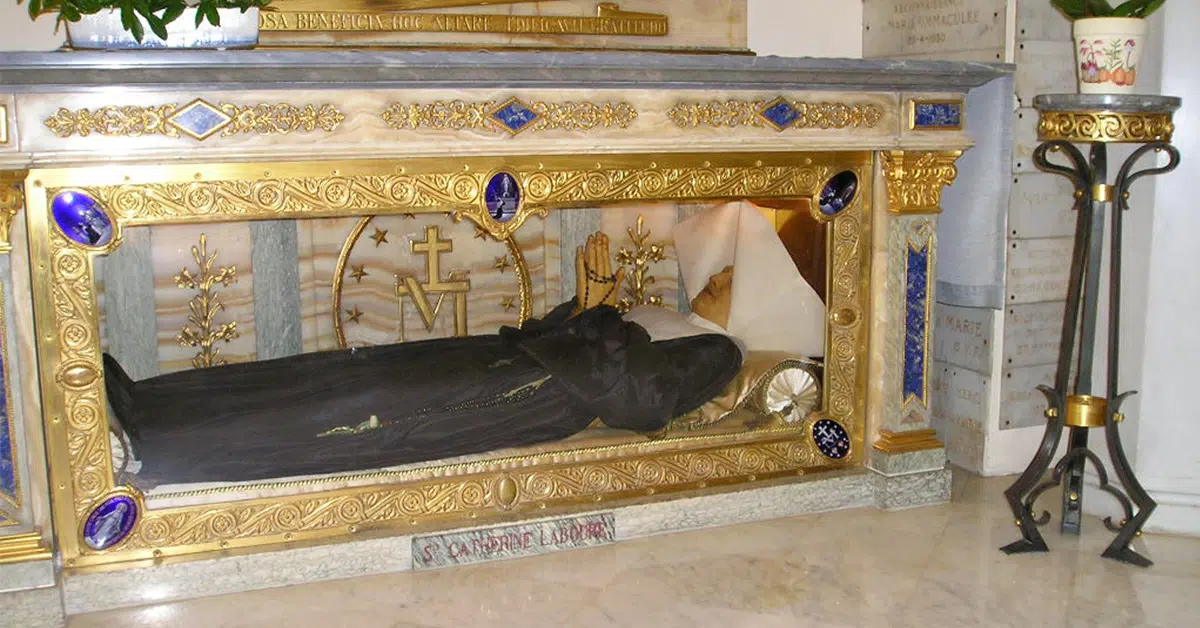
Inside the chapel, to the right of the altar, sits a shrine made of glass.
Inside that shrine lies the body of a woman.
She is dressed in the simple white and blue clothes of a 19th century nurse.
Her hands are folded gently in prayer.
Her face is calm.
She looks as if she simply closed her eyes for a moment and never opened them again.
This is Catherine Laboret.
She has been dead for nearly 150 years.
And yet in 1933 when her grave was opened after 57 years, doctors did not find what nature normally leaves behind.
They did not find a skeleton.
They did not find dust.
According to the official medical records of that day, they found a body that looked almost exactly as it had on the day it was buried.
In our modern world, we understand how biology works.
We know that when a life ends, the body begins a predictable process of returning to the earth.
Moisture leaves the cells.
Chemistry shifts.
Time claims what is left.
It is one of the few certainties of nature.
But the woman in the glass case at rude dub back presents a different story.
Her presence there is not just a religious statement.
It is a physical mystery documented by medical professionals and historians alike.
Her body has become a point of intersection between what we know about science and what we still cannot fully explain.
To truly appreciate the mystery, we have to imagine the scene in the year 1933.
A group of men standing in a dark, damp vault.
Scientists, church officials, workers.
They were there to perform a task that is usually grim and clinical.
They were there to open a grave.
Under normal circumstances, they would expect to find the remnants of a life long gone.
Bones, dust, fragments of rotted cloth.
That is what usually happens after more than 50 years in the ground.
Instead, when the heavy stone was finally rolled back and the lead seals were broken, the witnesses stepped into something that still challenges our understanding of the physical world.
The skin was still present on her face and hands.
The limbs were not stiff or brittle.
In fact, the joints were still flexible.
This was not supposed to happen.
According to every rule of decomposition, the body should have been gone.
How does a body sit in a lead box in the damp soil of Paris for 57 years and remain intact? How does it bypass the natural laws of decay that govern every other living thing on this planet? These are the questions that turn a simple story of a French nun into a cinematic mystery.
One that sits in the space between biological science and faith.
To understand the medical findings that followed that discovery, we have to look past the gold decorations of the chapel.
We have to look past the polished glass of the shrine.
We have to peel back the layers of time.
We have to go back to a time of revolution and to the dusty roads of the French countryside.
We have to go back to a humble farm in a place called Burgundy.
We have to meet a woman who was the very definition of ordinary.
Katherine Laborete was not a woman of high status.
She was not a famous scholar or a powerful leader.
She was a woman who spent 40 years of her life trying to be completely invisible to the world.
She scrubbed floors.
She fed chickens.
She tended to the elderly in the poorest parts of Paris.
She lived and died in such total obscurity that even the people she lived with did not know who she truly was.
She was a woman who claimed to see something she could not explain.
Then she spent the rest of her life refusing to talk about it to anyone.
She did not want the spotlight.
She did not want fame or money.
And yet, decades after her death, her body would become the center of one of the most intense medical and spiritual investigations of the 20th century.
As we begin this journey, we have to set aside our assumptions.
Whether you look at this through the lens of a skeptic or the eyes of a believer, the facts of the opening of the tomb remain the same.
The reports are there.
The medical signatures are on the documents.
The mystery of Katherine Laboret is not just a story told in books.
To understand the mystery that the doctors found in the year 1933, we must first look at the woman herself.
The life of Katherine Laborete was not a life of luxury or comfort.
It was a life built on hard work and physical labor.
She was born in the year 1806 in a small village called Fain less maltiers.
This village is located in a region of France known as Burgundi.
It is a place of rolling hills and big sky.
It is a place where the soil is rich and the people are known for being practical and strong.
Catherine was the ninth child in a family of 11 children.
Her father was named Pierre and he was a very successful farmer.
He was a man of the earth.
He did not care for fancy words or high social status.
He cared about the harvest and the health of his animals.
In those days, being a farmer in France was not easy.
It meant waking up long before the sun came over the hills.
It meant working in the cold and the rain.
Catherine grew up in this environment.
She learned at a very young age that life requires endurance.
She was a child of the soil.
When Catherine was only 9 years old, a great tragedy hit the family.
Her mother died.
This was a devastating blow for a young girl.
In a family as large as hers, everyone had to play a part to keep the home running.
After the funeral, a famous story is told about her.
It is said that Catherine climbed up on a piece of furniture to reach a statue of the Virgin Mary.
She hugged the statue and said that now this would be her mother.
Even as a small child, she seemed to have a very deep and very private inner life.
But on the outside, she remained a quiet and busy farm girl.
But inside her, there was a growing desire for something else.
She felt a calling to serve the poor.
She wanted to join the daughters of charity.
This was an order of nuns who did not stay inside a cloister.
They went out into the streets to help the sick and the hungry.
When she told her father about this, he was very angry.
He did not want to lose his best worker.
He tried to stop her by sending her to Paris.
He hoped the big city would distract her.
He sent her to work in a cafe owned by her brother.
It was a noisy place filled with soldiers and workers.
It was the opposite of the quiet life she wanted.
Catherine did not change her mind.
She did not like the cafe and she did not like the noise.
She stayed focused on her goal.
Eventually, her father realized he could not break her will.
In the year 1830, when she was 24 years old, she finally entered the convent at Rudubac.
She arrived as a simple girl from the country.
She did not have a high education.
She could barely read or write.
The other women in the convent saw her as a kind but very plain person.
They called her a daughter of the fields.
It was during her first year at the convent that the events happened which would change history.
In the middle of the night on July 18th, she said she was woken up by a shining child.
The child led her into the chapel.
Catherine said she saw the Virgin Mary sitting in a chair.
Catherine went over and rested her hands on the knees of the lady.
They talked for a very long time.
It was a moment of incredible peace.
A few months later in November, Catherine had another vision.
This time, she saw a design for a medal.
She saw words written in gold.
She saw a specific image of a woman standing on a globe with light coming from her hands.
She heard a voice telling her that this medal should be made.
The voice said that anyone who wore the medal would be protected and blessed.
Now most people would have wanted to tell everyone about this.
Most people would have wanted the credit for such a big event.
But Catherine was different.
She told her priest about the visions.
And then she did something truly amazing.
She asked him to never tell anyone it was her.
She wanted to remain a secret.
She wanted to go back to her work as if nothing had happened.
For the next 46 years, that is exactly what she did.
The priest arranged for the medals to be made.
Within a few years, millions of people were wearing them.
People were calling it the miraculous medal.
They were talking about the great things that happened to those who wore it.
Everyone wanted to know who the nun was that had the vision.
But Catherine never said a word.
She was sent to work in a hospice for old men in a poor part of Paris called Rui.
For four decades, she lived a life of total service.
She did the hardest jobs.
She worked in the kitchen and the laundry.
She cleaned the rooms of the sick.
She spent her days carrying heavy buckets of water and scrubbing stone floors.
She grew old and her body became tired from the labor.
No one in the hospice knew.
She was the woman who had seen the visions.
The other sisters thought she was just a very hard worker who was a bit too quiet.
She lived through wars and revolutions in Paris.
She saw the city change and grow, but she stayed in her small corner serving the poor.
She was a woman of total humility.
She did not want power or honor.
She wanted to be a servant.
She remained a person of the earth and a person of silence until the very end.
She died on December 31st in the year 1876.
She was 70 years old.
Even on her deathbed, she was calm and quiet.
She had lived a life that was hidden from the world.
She was buried in a simple grave in the vault beneath the chapel at the hospice.
No one expected anything unusual to happen next.
They thought she would rest there forever and her body would slowly turn to dust just like everyone else.
They did not know that the silence she kept in life would be followed by a discovery that would speak to the whole world many years later.
When Catherine Laborete died on the last day of the year 1876, there was no great fanfare.
She had spent her life as a simple sister of the poor to the world outside the walls of the hospice.
She was just another woman who had finished her work within the convent.
She was remembered as a kind and very quiet person who was always busy with her chores.
Because she had kept her secret so well, almost nobody knew that she was the one who had started the movement of the miraculous medal.
The weather in Paris that winter was very cold.
The city was covered in a gray mist.
In those days, the funeral of a daughter of charity was a very humble event.
There was no attempt to preserve her body for the future.
We must remember that in the 19th century the practice of imbalming was not common for ordinary people.
Embalming is the process where chemicals are put into the body to stop it from decaying.
For a woman like Catherine, this would have been seen as unnecessary and much too expensive.
She was buried exactly as she was when she passed away.
The sisters prepared her body for burial with great care, but with great simplicity.
They dressed her in her religious habit.
This included the large white hat known as a cornet and her heavy blue gown.
They placed her in a coffin.
This was not just a simple wooden box.
Because she was being buried in a vault rather than in the open ground, the law required a more secure container.
They used a triple coffin system.
The first was made of wood.
The second was a lining made of lead.
The third was another outer layer of wood.
The use of a lead coffin is a very important detail for the scientists and doctors who would come later.
A lead coffin is meant to be airtight.
It is sealed with heat so that no air can get in and no gases can get out.
This was done to keep the air in the chapel vault clean and safe.
After the coffin was sealed, it was carried down into a tomb beneath the chapel at the Ruly Hospice.
This was the place where she had spent so many years serving the elderly.
For anyone looking at the situation from a scientific point of view, the expectations for her body were very clear.
Nature follows a strict set of rules.
When a person is placed in a grave, the oxygen inside the coffin is used up very quickly.
Even without much air, the tiny organisms that live inside every human body begin to break down the tissues.
This is the natural way that the body returns to the elements of the earth.
In a place like Paris, which has very damp soil, the moisture can often speed up this process.
Under normal conditions, after 50 years in a tomb, a body should be nothing more than a skeleton.
The soft tissues like the skin and the muscles and the organs should have dissolved long ago.
The hair and the bones are usually all that remain.
The clothes often rot away as well, especially if the air is damp.
This is what the sisters expected.
This is what every doctor in France would have expected.
There was no reason to think that Catherine Laboret would be any different from the thousands of other people buried in the vaults of Paris.
The tomb was sealed with a heavy stone slab.
Above the ground, the world began to move faster.
The 19th century ended and the 20th century began.
Automobiles appeared on the streets of Paris where horses used to walk.
Great wars broke out across Europe.
The hospice where Catherine had worked continued to care for the poor.
The memory of the quiet sister who worked in the chicken yard began to fade away into the history books of the convent.
However, the miraculous medal was still being worn by millions of people.
It had become a global phenomenon.
People were reporting amazing stories of healing and help.
As the years went by, the leaders of the church began to investigate the origins of the medal more closely.
They looked into the life of the nun who had received the visions.
They began to realize that Catherine Laboret had lived a life of heroic virtue.
They saw that her humility was almost as miraculous as the visions themselves.
Because of this, they decided to start the official process of making her a saint.
This process is very long and very detailed.
It involves looking at every letter she wrote and every person she knew.
It also involves an event that seems strange to many people today.
It involves the opening of the grave.
The church does this to verify that the person is actually there and to see what has happened to the body over time.
In the early spring of 1933, the decision was made to open the vault at Rui.
It had been 57 years since Catherine was placed in that lead coffin.
Two doctors were hired to be the official observers.
Their names were Dr.
Valentin and Dr.
Dier.
They were professional men of science.
They were not there to look for miracles.
They were there to provide a medical report on what they found.
They arrived at the chapel with their tools and their notebooks.
They were joined by a few church officials and a small group of workers who would do the heavy lifting.
The air in the vault was cold and smelled of damp stone.
They worked in the light of lanterns because there was no electricity in the tomb.
They moved the heavy stone slab and found the coffin exactly where it had been placed in 1876.
The outer wooden box had rotted away over the decades.
This was expected, but the lead inner coffin was still there.
It was covered in a layer of dust and oxidation.
The doctors noted that the seal of the lead seemed to be intact.
There were no obvious holes or cracks.
This meant that for 57 years, the body of Catherine Laboret had been sitting in a dark and silent space with no fresh air and no light.
As the workers prepared to cut through the lead, the atmosphere in the room was very tense.
Everyone expected a grim scene.
They expected to see a pile of bones and the dusty remains of a blue habit.
They were prepared for the smell of decay.
The doctors held their breath as the lead lid was slowly pried open.
But when the light from the lanterns finally hit the inside of the coffin, the men standing there were frozen in shock.
What they saw was something that none of their medical books had prepared them for.
The moment the lead lid was lifted, the air in the small vault seemed to change.
The doctors and the officials leaned in with their lanterns held high.
They expected to see the dark and empty remains of a person who had been dead for over half a century.
Instead, they saw a sight that felt like it belonged in a different world.
There was no smell of rot.
There was no pile of bones.
Resting in the center of the coffin was Catherine Laborete.
According to the written reports from Dr.
Valentin and Dr.
Daidia, the body did not look like it had been buried in 1876.
It looked like it had been buried just a few days earlier.
The first thing the doctors noticed was the skin.
It was still there.
It was not white or pale but had a slightly darkened tone which is common in these cases.
However, it was not bone dry.
When the doctors touched the skin, they found that it was still soft.
It was not like paper or old leather.
It felt like real skin that was still attached to the muscles underneath.
The doctors began a very careful and professional examination of the remains.
They were looking for the signs of natural decay that should have happened 57 years ago.
They looked at her hands.
The fingers were still perfect.
The fingernails were still in place.
One of the most amazing details mentioned in the medical records was the condition of her eyes.
Normally, the eyes are the very first part of the human body to disappear after death.
They are made of very soft tissue and liquid which dissolves almost immediately.
But when the doctors looked at Catherine, they found that medical reports noted that the facial features remained remarkably intact.
They were not bright and clear like a living person, of course, but they were physically there.
The examination continued as the doctors moved her limbs.
In a normal body that has been dead for decades, the joints become very stiff.
or they fall apart completely as the ligaments rot away.
But the doctors recorded that Catherine was still flexible.
They could move her arms and her legs at the joints.
It was as if the body had skipped the process of becoming brittle.
The medical observers noted that even the internal organs seemed to be in their proper places.
They were not just looking at a shell of a person.
They were looking at a body that had stayed together in a way that defied their training.
Everything about her clothing was also in a surprising state.
The white cornet on her head, and the blue cloth of her habit was still recognizable.
They had not been eaten away by mold or dampness.
Even the cross that she wore was still resting on her chest, just as the sisters had placed it there in the winter of 1876.
The doctors wrote down every detail with great care.
They were very clear in their language.
They did not call it a miracle because that was not their job.
They used clinical words.
They used phrases like according to documented reports and medical observers noted.
They stated that the state of preservation was extraordinary.
While the doctors were working, the church officials stood by and watched.
They were there to make sure everything was done with respect and honesty.
They knew that people would ask many questions about this discovery.
They needed to have a record that was honest and simple.
They were not trying to prove a point.
They were trying to document a fact.
The fact was that after nearly 60 years in a tomb, a woman who had never been embombed was still intact.
The witnesses recorded that the body seemed to be in a state of sleep.
This is a word that often comes up in the diaries of those who were present.
They did not see the horror of death.
They saw a quiet presence.
The doctors noted that there were no signs of the body turning into dust.
They checked for signs of insects or larae, which are almost always found in old graves.
They found none.
The lead coffin had done its job of keeping the outside world away, but it could not explain why the inside of the body had not broken itself down.
As the examination drew to a close, the doctors signed their names to the official papers.
They had seen something that challenged their understanding of biology.
They knew that in the world of science, every effect has a cause.
They were left wondering what the cause could be.
Was it the lead coffin? Was it the lack of oxygen? Or was it something that science could not yet measure? They left the vault that day with more questions than answers.
The news of the discovery began to spread quietly through the convent and the church.
The body was carefully lifted from the old lead coffin.
The sisters who were present were moved to tears.
They saw the face of a woman who had served their order with such humility.
They saw the hands that had scrubbed the floors and fed the poor.
Those hands were still there as a silent witness to a life of hard work.
The medical findings were sent to the authorities in Rome.
The reports were read by other doctors and experts.
They all came to the same conclusion.
The condition of Katherine Laborete was a rare and remarkable event.
It was a physical fact that could be seen and touched.
It was a bridge between the hidden life she had lived and the public legacy she was about to leave behind.
The story of the girl from the farm in Burgundy had taken a turn that no one could have predicted.
When a discovery like this is made, it is only natural to look for a logical explanation.
Science is a tool that helps us understand the world through observation and testing.
After the tomb of Katherine Laborete was opened, people began to ask how such a thing could be physically possible.
We have to look at the facts of the burial environment and the biology of the human body to see what might have happened during those 57 years in the dark.
To reach a clear conclusion, we must weigh the medical evidence against the known laws of nature.
The first thing a scientist looks at is the environment of the grave.
Catherine was buried in a triple coffin.
As we mentioned before, the middle layer was made of lead.
This is a very heavy and very soft metal.
When it is soldered shut, it creates a seal that is nearly perfect.
In a lead coffin, the amount of oxygen is very limited.
Most of the bacteria that cause a body to decay need oxygen to survive.
These are called aerobic bacteria.
If the oxygen is used up quickly, those bacteria die out.
This is a well-known factor that can slow down the process of decomposition significantly.
In many cases, a sealed lead coffin can keep a body intact for much longer than a wooden one buried in the dirt.
Another factor is moisture.
If a coffin is not sealed properly, water from the soil can get inside.
Water usually speeds up decay because it brings in new microbes.
However, the reports from 1933 stated that the lead coffin was intact.
This means the body was kept in a very dry and very stable environment.
In some rare cases, a dry and airtight space can lead to a type of natural preservation.
There is also a chemical process called saponification.
This happens when the fats in a human body react with certain minerals in the absence of oxygen.
The result is a substance called adaposa or grave wax.
This wax can cover the body and maintain its shape for a long time.
It can make the skin look white or gray and feel like a hard candle.
However, when we look at the medical reports from Dr.
Valentin and Dr.
died.
They did not describe a body covered in thick grave wax.
They described skin that was still soft and limbs that were still flexible.
This is where the scientific explanation becomes more difficult.
While a lead coffin can preserve a body, it usually results in a body that is very stiff or very fragile.
The fact that Catherine remained flexible is one of the details that most experts find hard to explain using only environmental factors.
It is also important to consider the soil and the temperature.
The vault at Rule was deep underground.
The temperature stayed very cool and very constant all year round.
This acts like a natural refrigerator.
It does not stop decay forever, but it slows it down.
From a skeptical perspective, one might argue that the lack of oxygen combined with the cool temperature and the lead seal simply created a perfect storm of preservation.
They might say that Catherine was just a rare statistical outlier.
Science is full of anomalies where things happen in a way that is unusual but still within the laws of physics.
They would point out that while rare, this is not the only time a body has been found in a state of preservation.
after many years.
From a devotional perspective, people see this as a sign of something beyond nature.
They believe that a body that was used for a holy purpose was given a special grace to remain whole.
They see the physical state of the body as a reflection of the purity of the life she lived.
They find it beautiful that the woman who wanted to be hidden was preserved in a way that made her impossible to ignore.
They see the flexibility of her joints and the preservation of her eyes as signs that go beyond what a lead box can do.
The Catholic Church takes a very balanced and thoughtful approach to this.
It is a common mistake to think that the church uses incorruptibility as proof that someone is a saint.
In reality, the church is very cautious.
The officials know that nature can do strange things.
They know about lead coffins and they know about grave wax.
Because of this, they no longer consider the state of the body as a required miracle for saintthood.
They look at the life of the person instead.
For the church, the real miracle of Katherine Laboret was not her body in 1933, but her life of service.
After the medical examinations were finished, the body of Katherine Laboret was moved from the dark vault at Rule back to her home at Rudubac.
In the year 1947, she was officially named a saint.
This event was celebrated by thousands of people in Paris.
But for Catherine, the fame was something she had spent her whole life avoiding.
Today, if you visit the chapel in Paris, you will see her resting in the glass shrine.
To protect the remains from the light and the air, the face and hands have been covered with a very thin and realistic layer of wax.
This is common in many shrines to ensure that the physical body is treated with the highest level of respect.
Underneath that layer lies the woman who shocked the medical world.
The miraculous medal that she first spoke of is now one of the most common religious objects in the world.
It is found in every country.
It has become a sign of hope for those who feel lost.
Yet, the woman behind it remains a mystery to many.
Catherine Labor did not leave behind a library of books.
She left behind a lifetime of service.
Why do millions of people still flock to this small chapel? Perhaps it is because our modern world is very loud and very fast.
We are constantly told to be noticed.
Catherine shows us that a life of total silence and hidden service can be just as powerful.
She shows us that what we do when no one is watching is what truly defines who we are.
The fascination with her body is a human response to our desire for something that lasts.
We live in a world where everything changes.
Buildings crumble and technology becomes old.
Even our own lives are fleeting.
To find a physical body that appears to have resisted the march of time touches something deep in the human heart.
It makes us wonder if there is a part of us that is also meant to last.
It makes us wonder if there is a reality that is more permanent than the one we see every day.
The medical findings of 1933 are a matter of historical record.
The science of lead coffins provides us with clues, but the sense of wonder remains.
Whether seen as a miracle of nature or a miracle of faith, the state of Katherine Laboray serves as a bridge.
It bridges the gap between the 19th century and our own time.
It bridges the gap between the visible world and the invisible world.
As we end this look at her life and her death, we can find a sense of peace in her story.
She was a farm girl who became a servant of the poor.
She was a woman of the soil who was found to be beyond the reach of the soil.
She did not ask for the glass shrine.
She simply asked to be allowed to serve.
If there is a final lesson to be learned from the mystery of Rudu back, it is this.
We do not need to be famous to be significant.
We do not need to be loud to be heard.
The most authentic way to live is with quiet integrity.
Like the seeds she once planted on her father’s farm, the work of a humble life grows in its own time.
The future arrives and the world moves on, but the truth remains steady.
We walk away from the glass shrine and back into the busy streets of Paris.
We carry with us the image of the woman who chose to be invisible.
We carry the memory of the doctors in the vault and the light of their lanterns.
And perhaps we carry a new understanding that even in a world that is always passing away, there are some things that are meant to stay.
That may be the truest discovery of all.