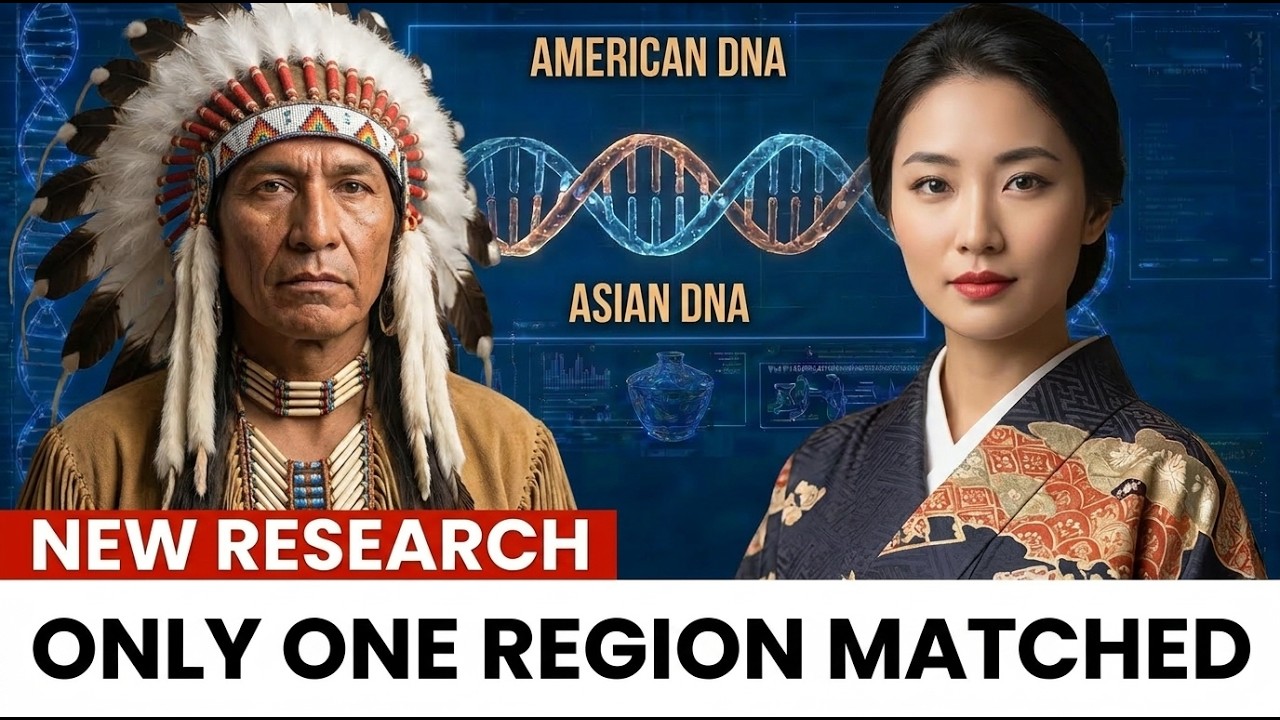
Scientists Compared Native American DNA to Every Asian Group — Only One Region Matched
30,000 years ago, someone walked out of Asia and never came back.
Their descendants became every single Native American alive today.
Scientists have known this for decades.
What they couldn’t figure out until recently was exactly times where times in Asia those people came from.
So they compared Native American DNA to every major Asian population on Earth.
Japanese, Chinese, Korean, Indian, Vietnamese, Mongolian, Tibetan, dozens of groups, thousands of samples, millions of genetic markers, and out of everything they tested, only one region matched closely enough to matter.
One region, and it’s not the one most people would guess.
Here’s the thing about DNA.
It doesn’t lie.
It doesn’t forget.
And it doesn’t care what your history books say.
Every human being walking the planet today carries inside their cells a record of everything their ancestors ever did.
Every migration, every population bottleneck, every time a group of people picked up and moved somewhere new, all of it leaves a fingerprint at the molecular level.
And those fingerprints last for tens of thousands of years.
For most of the 20th century, the story of how people got to the Americas was told through artifacts, arrowheads, campfire ash, scraped bones.
The archaeology pointed toward Asia, specifically toward a land bridge that once connected what is now Siberia to what is now Alaska.
During the last ice age, sea levels dropped so far that a massive stretch of land called Bingia emerged from the Bearing Sea.
Thousands of square miles of tundra exposed and walkable.
And at some point, people walked across it.
But which people from where exactly? That question sat unanswered for a long time because archaeology can only tell you so much.
You can find where people stopped.
You can’t always tell where they started.
Then genetics entered the conversation and everything changed.
The first major genetic clue came from mitochondrial DNA.
The tiny genetic package passed only from mothers to their children, unchanged except for the occasional [music] mutation.
When researchers analyzed the mitochondrial lineages of Native American populations across North, Central, and South America, they found something striking.
Almost all of them fell into just five genetic HLA groups, A, B, C, D, and X.
Five families of maternal lineage covering the enormous genetic diversity of an entire hemisphere.
Four of those five groups turned up in Asia.
Groups A, B, C, and D are all found among various East Asian and Siberian populations.
That confirmed the Asian origin hypothesis.
But group X was strange.
It appeared in small amounts among some Native American groups in North America and then turned up not in East Asia, not in Siberia, but in the Middle East and among some European populations.
For years, this [music] caused enormous confusion and gave a lot of oxygen to some pretty wild alternative theories about early American history.
Theories that were mostly wrong, as it turned out, but we’ll come back to that.
The real breakthrough came when researchers stopped looking at just one type of DNA and started analyzing the entire genome.
Whole genome sequencing.
Reading every single nucleotide in a person’s genetic code gives you an incomparably richer picture.
It’s the difference between reading the title of a book and reading every word on every page.
A landmark study published in 2012 sequenced the genome of an ancient Siberian boy who had died about 24,000 years ago near a place called Malta in the Lake Ball region of southern Siberia.
The Malta boy, as researchers came to call him, belonged to a population that had essentially vanished.
His people are now referred to as ancient North Eurasians, a group genetically distinct from both modern East Asians and modern Western Eurasians.
They were their own thing.
And here’s where it gets remarkable.
When researchers compared the Malta boy genome to populations around the world, they found an unexpected signal.
Native Americans carry a significant portion of ancient North Eurasian ancestry.
Somewhere between 20 and 40% of Native American ancestry traces back to this population people who looked nothing like what we typically imagine when we think of connections between Asia and the Americas.
This meant the story was more complicated than a single migration from East Asia.
It meant that before people crossed into the Americas, there was a mixing event somewhere in Siberia, [music] a meeting between populations that had come from different directions, who then merged into the group that eventually became the ancestors of all Native Americans.
So now researchers had two components to track, an East Asian related component and an ancient North Eurasian component.
and they needed to figure out where specifically in the vast land mass of Asia both components converged.
That’s when the comparison project began in earnest.
Teams of researchers collected genetic samples from populations across the entire Asian continent.
Han Chinese, Tibetans, Mongolians, Koreans, Japanese, Usuzbcks, Kazaks, Berats, Eanks, Yakuts, Eupic.
dozens of different ethnic groups mapped against the genetic profiles of Native American populations from across the Americas.
The results were unambiguous.
When you rank every Asian population by genetic similarity to Native Americans, the groups at the top aren’t from East Asia proper.
They’re not Chinese, not Japanese, not Korean.
The closest living relatives of Native Americans, the population whose DNA overlaps most significantly with indigenous people from Alaska to Patagonia, are found in a specific region of southern Siberia and Central Asia.
The Alt Thai Mountains.
The Alai region sits at the intersection of modern Russia, Kazakhstan, China, and Mongolia.
It’s a remote mountainous area that most people couldn’t find on a map without help.
The indigenous peoples of the Alt Thai groups like the Altans, the shores, and related populations carry a genetic signature that aligns more closely with Native American genomes than any other living Asian population tested.
This makes geographic sense when you think about it.
The Alai region sits at exactly the kind of crossroads where populations from different directions would have met and mixed tens of thousands of years ago.
It’s the place where the East Asian genetic lineage and the ancient North Eurasian lineage would plausibly have come together, producing exactly the genetic combination that appears in Native Americans today.
A 2015 study reinforced this picture dramatically.
Researchers analyzed the genome of a Clovis culture child, one of the earliest, most widespread cultures in the Americas, whose remains had been found in Montana and dated to about 12,600 years ago.
His name given posumously is Anzik 1.
His genome confirmed that he was ancestral to all contemporary Native American groups tested.
And when his genome was compared to populations around the world, the closest living relatives were again populations from the Altai region of Siberia.
Now, let’s go back to Hapla group X, the mysterious maternal lineage that caused so much confusion.
For a while, its presence in both North American indigenous groups and Middle Eastern populations seemed to suggest some kind of ancient transatlantic connection.
Some researchers floated ideas about migrations from Europe [music] or the Middle East.
The internet predictably ran with this and produced some extraordinary theories.
What whole genome sequencing revealed eventually was that HLO group X had been present in ancient North Eurasian populations, people like the Malta Boy.
It has spread westward into Europe and the Middle East as populations moved and mixed over thousands of years.
It had also spread eastward, contributing to the ancestral population that crossed into the Americas.
The Middle Eastern version and the Native American version are distantly related cousins, not evidence of a direct connection.
The mystery wasn’t a mystery anymore.
It was just the normal complexity of ancient human migration.
What this all adds up to is a picture that looks roughly like this.
a population assembled in or near the Alai region carrying a combination of East Asian and ancient North Eurasian ancestry.
At some point, probably between 25,000 and 20,000 [music] years ago, some of these people moved northeast, following game, following opportunity, following whatever drives human beings to walk over the next hill.
They spent thousands of years in Bingia, the land bridge and its surroundings isolated enough that their genetics began to drift in a distinct direction.
Then sometime around 15,000 to 16,000 years ago, possibly earlier, they moved south into Alaska down the coast into the interior of the continent, spreading over thousands of years across two continents that had never known a human footstep.
All of that genetic history, every step of that journey is still readable in the DNA of Native Americans today.
And in the DNA of the people who still live in the Altai Mountains of Southern Siberia, separated by 20,000 years and 12,000 m, they carry traces of the same ancient population in their cells.
There’s something almost incomprehensible about that.
You can sit across from someone from a remote mountain village in Siberia.
And somewhere deep in the molecular architecture of both your bodies, there’s a shared chapter, a shared ancestor, a person who lived and died long before cities, long before writing, long before any of the things we use to define human civilization.
The science here isn’t finished.
New ancient genomes are being sequenced every year.
New populations are being added to the comparison studies.
The resolution of the picture keeps improving, but the core finding holds, and it’s been replicated enough times now to be solid.
When you compare Native American DNA to every Asian group, the Al Thai region of Siberia comes back as the closest match.
Not because scientists expected it, not because it fits a neat narrative, but because that’s what the data shows.
If this kind of story where science goes looking for one answer and finds something stranger and more beautiful than anyone expected, if that interests you, subscribe.
Not because the algorithm needs it, but because there’s a lot more of this kind of thing here, and you’ll want to see it when it comes out.
Drop a comment below, too.
I’m genuinely curious whether this matched what you thought you knew, or whether it rewrote something in your head the way it rewrote things in mine when I first read the research.
That’s the thing about DNA.
It doesn’t care what we thought we knew.