Nefertiti’s DNA COULD rewrite updated Egyptian history
Cairo, December 6, 1912.
The temperature reaches 38 degrees Celsius, and fine dust hangs heavily in the air, settling on skin and grinding between teeth.
In the desert site of Amarna, a German archaeologist named Ludwig Borchardt stands at the bottom of an excavation pit.
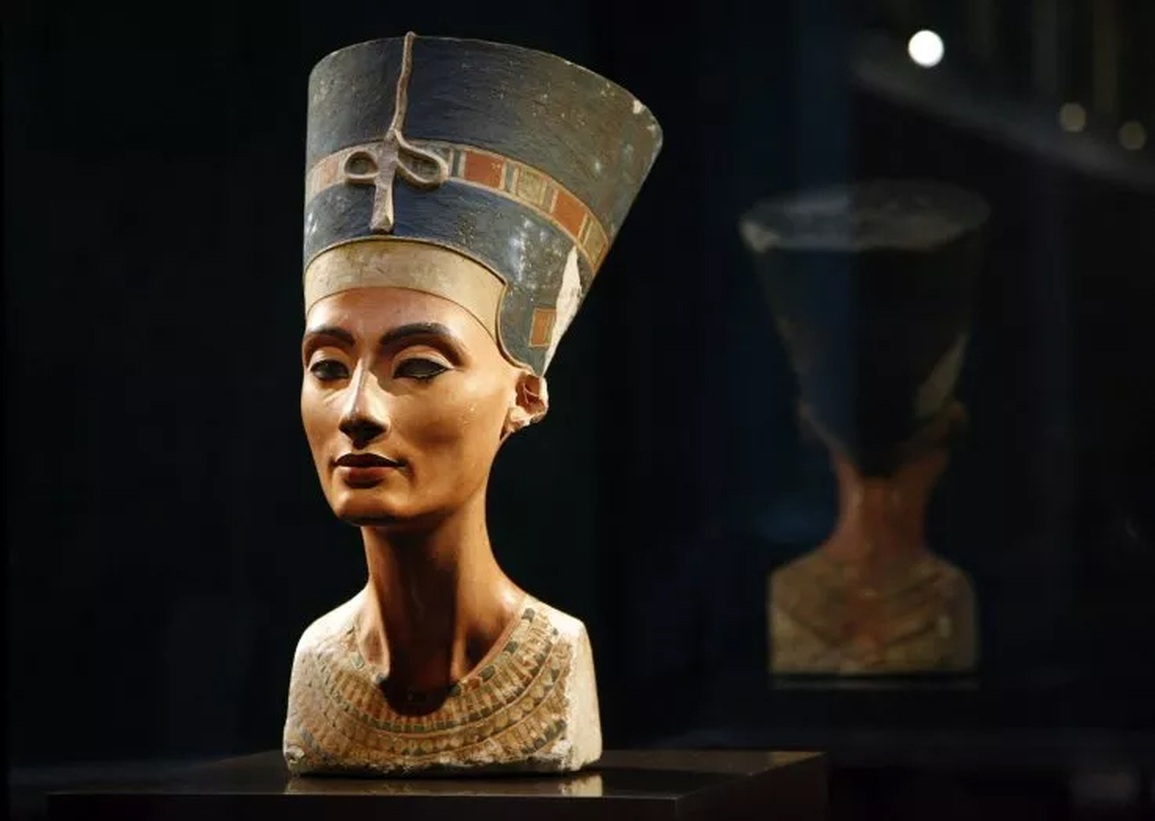
His workers have just uncovered a limestone bust buried beneath the sand for more than three thousand years.
The colors appear astonishingly fresh, as if they had been painted only days before.
One eye is made of crystal, shining with lifelike clarity, while the other socket remains empty.
At that moment, Borchardt writes a short sentence in his diary that would later echo through history.
Description is useless, one must see it.
He understands immediately what he has found.

The face belongs to a woman who lived more than three millennia ago.
Her name is Nefertiti.
Yet the discovery of this iconic image is only the beginning of a much deeper mystery.
In 2010, a team of genetic researchers led by Zahi Hawass conducted DNA analysis on several mummies from the Valley of the Kings.
Among them were the remains of a young man from tomb KV55 and a female mummy known as the Younger Lady from KV35.
The results were published in JAMA.
One conclusion shocked the world of Egyptology.
The parents of Tutankhamun were closely related as brother and sister.
The Younger Lady, believed to be his mother, became the center of intense debate.
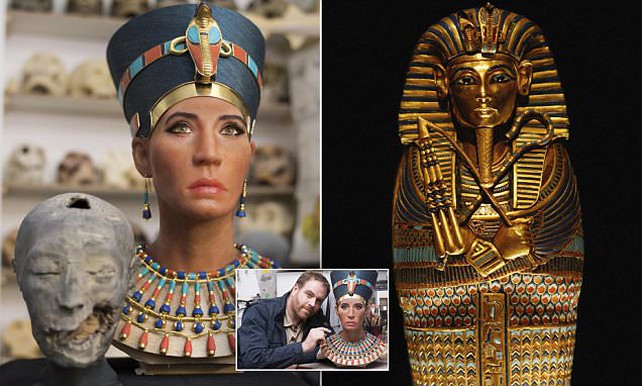
Some scholars suggested she could be the same woman represented in the famous bust.
If that claim were true, it would reshape the entire understanding of Egypt’s Eighteenth Dynasty.
The story grows even more complex when looking back to 1898.
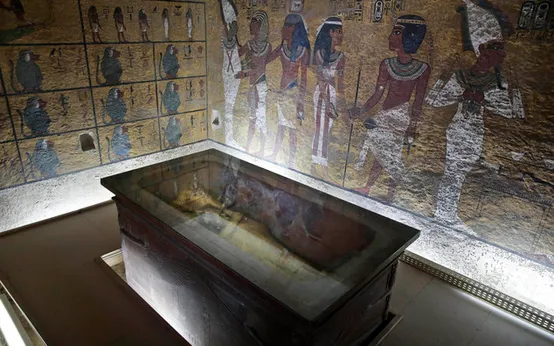
In that year, French archaeologist Victor Loret entered tomb KV35.
Inside, he discovered three unidentified mummies placed without coffins in a side chamber.
One of them was a woman around thirty years old.
Her left arm was positioned across her chest, a pose often associated with royalty.
Her face, however, was severely damaged.
The injuries appeared to have been inflicted long before burial, suggesting deliberate destruction.
Local workers reportedly refused to touch the body, whispering about curses and misfortune.
Loret documented the discovery but could not determine the identity of the woman.
For more than a century, the mummy remained a mystery.
Various scholars proposed different identities.
Arthur Weigall suggested she might be Queen Tiye.
Others believed she could be a lesser known royal figure or even an unnamed consort.
The damage to the face made identification extremely difficult.
Then came the DNA study of 2010.
The genetic material taken from the mummy showed a strong match with Tutankhamun.
The conclusion was unavoidable.
The Younger Lady was his mother.
This revelation raised further questions about royal lineage.
It suggested a pattern of close family unions within the ruling dynasty.
Such practices were not uncommon in ancient Egypt, where royal bloodlines were preserved through intermarriage.
However, the implications for historical interpretation were significant.
If the Younger Lady was indeed Nefertiti, then established genealogies would need to be revised.
Yet many experts remain unconvinced.
Scholars such as Aidan Dodson argue that the evidence is not definitive.
They propose alternative identities, including other royal women whose histories are less documented.
The debate continues without clear resolution.
Meanwhile, the famous bust displayed in Berlin offers no biological clues.
It is a painted limestone sculpture, not a source of DNA.
The real answers lie in the mummies themselves.
The mystery deepens further when examining the historical context of Amarna.
Around 1345 BCE, Pharaoh Akhenaten established a new capital city dedicated to a single deity, the sun disk Aten.
This religious shift marked a dramatic departure from traditional Egyptian beliefs.
The city flourished briefly before being abandoned.
After Akhenaten’s death, his legacy was systematically erased.
Names were removed from monuments, statues were damaged, and records were altered.
This deliberate erasure complicates modern attempts to reconstruct the past.
Another key discovery came from tomb KV55.
Inside was a coffin with its identifying features removed.
The mummy within belonged to a young man.
Early interpretations were inconsistent, but later DNA analysis revealed that he was Tutankhamun’s father.
This finding added another layer to the already complex family tree.
Some researchers believe this individual could be a lesser known figure named Smenkhkare.
Others suggest that Nefertiti herself may have taken on a new identity as a co ruler.
The theory, supported by Nicholas Reeves, proposes that she ruled as a pharaoh under a different name.
If true, it would mean that Nefertiti held power in a role traditionally reserved for men.
Such a scenario is not without precedent.
Earlier rulers like Hatshepsut had adopted male regalia to legitimize their authority.
The damaged face of the Younger Lady may also carry symbolic meaning.
In ancient Egyptian belief, the destruction of the face could prevent the soul from functioning in the afterlife.
This suggests that the damage was intentional, possibly part of a broader effort to erase her legacy.
The motives behind such actions remain unclear.
They may have been driven by political rivalry or religious conflict.
The DNA findings also revealed that both the Younger Lady and the KV55 individual shared the same parents, believed to be Amenhotep III and Queen Tiye.
This indicates that they were siblings, further confirming the pattern of close family unions.
The health consequences of such practices are evident in Tutankhamun himself.
He is believed to have suffered from multiple physical conditions, including bone deformities and a weakened immune system.
Artifacts found in his tomb, including numerous walking sticks, suggest he relied on assistance to move.
His early death at around eighteen years old reflects the biological risks associated with such lineage.
Despite the groundbreaking nature of the 2010 study, controversy soon followed.
Independent researchers questioned the reliability of the methods used.
Concerns were raised about contamination and the challenges of analyzing ancient DNA in a warm climate.
The debate became increasingly intense, and further testing was not immediately conducted.
Subsequent events disrupted research efforts.
Laboratories faced damage, and some samples were reportedly lost.
Requests for independent verification were declined, leaving many questions unanswered.
As a result, the identity of the Younger Lady remains uncertain.
The possibility that she is Nefertiti continues to intrigue scholars and the public alike.
Her story illustrates the fragile nature of historical knowledge.
What is known today is shaped by what has survived.
Artifacts, texts, and remains provide only partial glimpses into the past.
Much has been lost, altered, or destroyed over time.
The image of Nefertiti, preserved in a single bust, has become one of the most recognizable symbols of ancient Egypt.
Yet the reality behind that image may be far more complex and uncertain.
It is a reminder that history is not a fixed narrative but an evolving interpretation.
Each discovery has the potential to challenge established beliefs.
The sands of Egypt still conceal countless secrets.
Some may never be uncovered, while others may one day reshape our understanding entirely.
For now, the story of Nefertiti remains an open question.
It is a tale of beauty, power, and mystery that continues to captivate the world.