May 13 — Our Lady of Fatima: The Mother Who Came from Heaven to Warn a World at War
In 1917, while the Great War devoured an entire generation of young men across Europe, three children, no older than 10, were tending sheep on a hillside >> >> in central Portugal.
A woman dressed in white light appeared above a small evergreen tree. Over the next 6 months, her message would draw crowds, alarm officials, and leave skeptics struggling to explain what they had seen.
The children were poor, barely literate, and too young to understand the weight of what was being asked of them.
And yet the message they carried out of those fields changed the course of Catholic faith in the 20th century and beyond.
This is the story of Our Lady of Fatima, the mother who came from heaven to warn a world at war.
A year before the Virgin Mary ever appeared, something already stirred in the hills around the Hamlet of Aljustrel, near the small town of Fatima, about 70 miles northeast of Lisbon.
It was the spring of 1916, and three shepherd children were watching over their families flocks in the rocky countryside around Fatima.
Lucia dos Santos was 9 years old, the youngest of seven children born to Antonio and Maria Rosa dos Santos, a devout Catholic family of modest means who owned a bit of land and never turned a hungry stranger away from their door.
Her cousins, Francisco and Jacinta Marto, were seven and six, the eighth and ninth children of Manuel and Olimpia Marto, a household where the rosary was recited every evening and work began at dawn.
On that spring day, a strong wind shook the nearby trees despite the calm weather, and a white light approached the children, taking the form of a young man who seemed made entirely of radiance.
He knelt to the ground, bowed low, and told them not to be afraid. He called himself the angel of peace, and taught them a prayer that none of them had ever heard before, >> >> asking pardon for those who did not believe, did not adore, did not hope, and did not love God.
The children repeated his words three times, trembling, and then the figure vanished. That summer, the angel returned, this time identifying himself as the guardian angel of Portugal, urging the children to pray constantly and to offer sacrifices for the sins that offended God.
A third visit came in the autumn, when the angel appeared holding a chalice with a host suspended above it.
Drops of blood falling into the cup. He gave communion to the children, and prostrated himself on the ground, repeating a prayer of reparation.
None of them spoke of these encounters to anyone. Something sacred had settled into their young lives, and they guarded it in silence, not fully understanding what it meant, only sensing that they had been chosen for something far larger than their small world of sheep and stone walls.
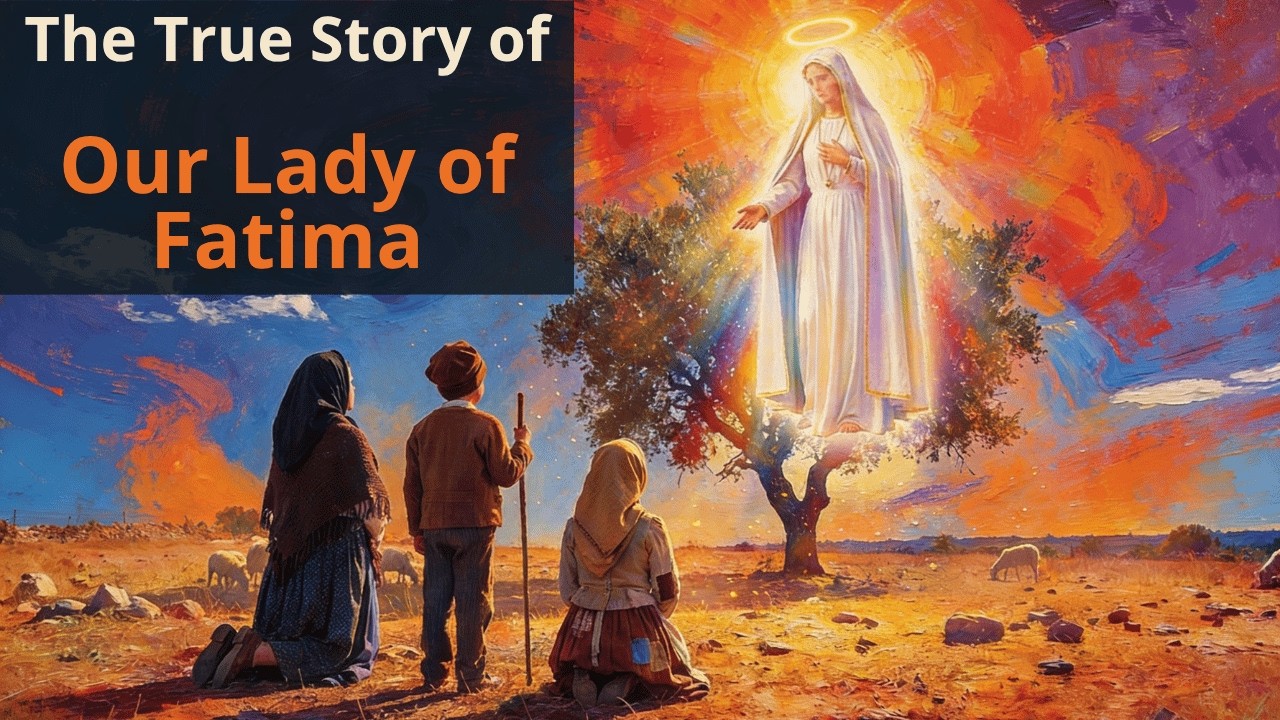
On the afternoon of the 13th of May, 1917, the three children led their flocks to a shallow depression called the Cova da Iria, a small property belonging to Lucia’s parents, about a mile and a half from Fatima.
The Great War was grinding on, and Portugal itself had been in political upheaval since the revolution of 1910 that had overthrown the monarchy and dissolved religious orders across the country.
Pope Benedict XV had made repeated pleas for peace, and just over a week before that May afternoon, he had addressed a direct appeal to the Blessed Mother to intercede for the world.
Two flashes of light, >> >> bright as lightning in a clear sky, stopped the children where they stood.
Above a small home oak tree, a woman appeared, dressed in white and radiating a light so intense that Lucia later described it as brighter than the sun, like a crystal cup filled with sparkling water lit by burning sunlight.
The woman told them she came from heaven and asked them to return to the same place on the 13th of each month for six consecutive months.
She asked whether they would be willing to offer themselves to God and bear all the sufferings he might send them as an act of reparation for the conversion of sinners.
Lucia, speaking for all three, said yes. The lady’s reply was gentle and direct. They would have much to suffer, but the grace of God would comfort them.
She asked them to pray the rosary every day for peace in the world and the end of the war.
Only Lucia could hear the lady’s words clearly. Jacinta heard them faintly and Francisco could see the figure, but heard nothing at all.
That difference would shape how each child carried the message forward. Francisco, unable to hear the lady’s voice, turned inward, spending long hours in silent prayer, saying again and again that he wanted to console God.
Jacinta, deeply moved by everything she witnessed, became consumed with compassion for sinners and a fierce desire to pray for their conversion.
And Lucia, the only one to speak directly with the apparition, became the voice of Fatima, the one tasked with carrying its message to the world long after her cousins were gone.
The children returned on the 13th of June and again on the 13th of July, each time finding the lady waiting for them.
During the June apparition, about 50 people had gathered around the children. The lady told Lucia that God wished to establish devotion to the Immaculate Heart of Mary in the world.
When Lucia asked whether the three of them would go to heaven, the lady replied that she would take Francisco and Jacinta soon, but that Lucia would remain longer because Jesus wanted her to help make the Immaculate Heart known and loved throughout the earth.
On July 13, with a crowd of roughly 5,000 watching, the Lady revealed what came to be known as the Secret of Fatima, given in three parts.
The first was a vision of hell that lasted only an instant, but marked the children for life.
Lucia wrote years later that they saw a sea of fire beneath the earth with souls and demons in human form tumbling through the flames, shrieking in pain and despair.
Their bodies like transparent burning embers, blackened and weightless. The Lady told them that to save souls from that fate, God wished to establish devotion to her Immaculate Heart in the world.
The second part of the secret spoke of a war even worse than the one still raging.
A great sign in the night sky that would precede it, and the spread of grave errors from Russia if her requests for prayer and consecration were not heeded.
The third part, which Lucia wrote down in 1944, but which the church did not reveal until the year 2000, described a symbolic vision of persecution, suffering, and the apparent assassination of a bishop dressed in white, whom the Vatican later connected to the 1981 attempt on the life of Pope John Paul the second.
The children came down from the Cova that July afternoon, changed forever. Jacinta, who had always been lively and talkative, grew quiet and serious, consumed by the horror of what she had seen.
Francisco retreated even deeper into prayer, spending hours alone before the tabernacle, whispering that he wanted to comfort Jesus for all the sins that grieved him.
And Lucia, burdened with a secret she could not fully share, walked the narrow path between childhood and a mission that would last the rest of her very long life.
Word of the apparitions spread quickly, and not everyone was pleased. Portugal’s secular Republican government viewed religious fervor with suspicion, and the district administrator of Ourem, Artur Santos, decided to put an end to the affair.
On August 13, the day of the next scheduled apparition, he arrived at the children’s homes, told their parents he would drive them to the Cova, and instead took them directly to his office.
He interrogated each child separately, threatening to boil them alive in oil if they did not confess that the visions were invented.
At one point, Jacinta was taken out of the room, and Francisco and Lucia were told she had already been thrown into boiling oil.
If they did not recant, the same would happen to them. Francisco and Lucia, still children, refused to lie.
Their answer was simple and unwavering. They could not say what was not true, no matter what was done to them.
The administrator kept all three locked up for 2 days, placing them in a cell alongside other prisoners.
Still, none of them broke. Jacinta wept, not from fear for herself, but because she thought she would die without seeing her mother again, and because they had missed their appointment with the lady.
When the administrator finally released the children on August 16, having failed to extract a single retraction, the apparition had not come on the 13th.
Instead, on August 19, while the children were at a nearby property called Valinhos, the lady appeared once more.
She asked them to continue coming to the Cova, and to keep praying the Rosary, and she promised again that in October she would perform a miracle so that all would believe.
By September, crowds of thousands were gathering on the 13th. The lady repeated her request for the Rosary, and told the children that in October, the Lord himself would come, along with Our Lady of Sorrows and Our Lady of Mount Carmel.
And St. Joseph would appear with the child Jesus to bless the world. >> >> She also noticed that the children had been wearing ropes tied tightly around their waists as penance, which had left marks on their skin.
And she told them gently that God was pleased with their sacrifices, but did not want them to sleep wearing the cords.
Even in the midst of heavenly visions, >> >> there was tenderness, a mother’s care for the suffering of children who had taken on more than their small bodies could bear.
The 13th of October, 1917, dawned dark and rainy. Three days of heavy downpour had turned the fields around the Cova da Iria into a sea of mud.
And yet an estimated 70,000 people had gathered from across Portugal, some on foot, some in carts and automobiles.
Believers and skeptics, side by side. Journalists from major newspapers were present, including Avelino de Almeida from the Lisbon daily O Seculo, a publication with no sympathy for religion.
At noon, the lady appeared to the children one final time. She identified herself. “I am the Lady of the Rosary.”
She asked that a chapel be built at the Cova in her honor. That people continue to pray the Rosary every day, and that they cease offending God because he was already so much offended.
Then she opened her hands and a beam of light shot toward the sun. What happened next was witnessed by thousands gathered in the field, and some accounts even claimed that unusual phenomena were noticed many miles away from the Cova.
The rain stopped abruptly, and the clouds broke apart. The sun appeared as a pale silver disk that people could look at without pain.
It began to spin, throwing off bands of colored light, red, violet, yellow, green, >> >> that painted the faces of the crowd and the muddy ground beneath their feet.
Then the disc seemed to tremble, detach itself from the sky, and plunge in a zigzag toward the earth.
People screamed, fell to their knees, and cried out for mercy, convinced the end of the world had come.
Moments later, the sun returned to its place, and the crowd realized that their clothing, soaked through minutes before, was completely dry.
Almeida’s account in O Seculo the following day described the reactions of the crowd in detail, and the story was picked up by newspapers throughout Portugal and beyond.
The Bishop of Leiria opened an investigation, and on the 13th of October 1930, after 13 years of careful inquiry, he officially declared the apparitions worthy of belief, permitting the cult of Our Lady of Fatima.
The event that believers call the Miracle of the Sun remains one of the most publicly witnessed and widely reported events associated with a Marian apparition, >> >> especially remarkable because the children had announced in advance that a miracle would occur in October so that all might believe.
The lady had told Lucia that she would take Francisco and Jacinta soon, and that prophecy came true with painful swiftness.
In the autumn of 1918, the Spanish flu pandemic swept through Aljustrel, striking nearly the entire Marto family.
Francisco and Jacinta both fell gravely ill. Francisco, quiet and contemplative to the end, remained at home during his final illness, spending his final months in bed, praying and offering his suffering to console the Lord he loved so deeply.
Visitors to his room often remarked that something about the atmosphere felt sacred, like being inside a church.
On the evening of the 3rd of April, 1919, he asked to receive his first Holy Communion.
The following morning, April 4th, he looked toward the door of his room and told his mother he saw a beautiful light.
His father, Manuel Marto, later said simply that Francisco died smiling. Jacinta lingered longer, as the lady had told her she would, suffering with a patience that astonished everyone around her.
A severe infection developed in her chest, and the pain grew severe. She was eventually taken to the Estefania Hospital in Lisbon, where she underwent a painful operation, reportedly with little or no anesthesia, to drain the wound.
A woman named Mother Godinho, who cared for her at an orphanage before the hospital stay, was struck by the child’s wisdom, so far beyond her years.
Jacinta spoke of the need for prayer, for reparation, and for the conversion of sinners with the gravity of someone who had seen things no child should ever see.
On the night of the 20th of February, 1920, alone in her hospital ward, far from her family, Jacinta died.
She was 9 years old. The only person nearby was a night nurse named Aurora Gomes, who later could not recall a single detail of the child’s passing.
Pope John Paul the Second beatified both children on the 13th of May, 2000, the 83rd anniversary of the first apparition.
Pope Francis canonized them on the 13th of May, 2017, making Francisco and Jacinta the youngest non-martyred saints in the history of the Catholic Church.
Lucia remained, just as the lady had said she would. At 14, she was admitted as a boarder at a school run by the Sisters of Saint Dorothy near Porto.
In 1925, while living with the Dorothean Sisters in Pontevedra, Spain, she reported that the Virgin Mary and the child Jesus appeared to her and asked for the devotion of the five first Saturdays.
In 1929, during another vision at Tuy, the lady repeated her request for the consecration of Russia.
Lucia wrote her memoirs in the 1930s and 1940s at the request of the Bishop of Leiria, providing the most detailed accounts of the apparitions, the angels’ visits, and the three secrets.
In 1948, seeking a deeper contemplative life, she left the Dorothean sisters and entered the Carmelite convent of Saint Teresa in Coimbra, Portugal.
Taking the name Sister Maria Lucia of Jesus and of the Immaculate Heart, she remained there in strict enclosure for the rest of her life, dedicating her days to prayer, penance, and the promotion of the Fatima message through her writings.
Over the decades, she became a close confidant of Pope John Paul II, who credited the Virgin of Fatima with saving his life after the assassination attempt of the 13th of May, 1981, a date that fell, as the Pope himself noted, on the anniversary of the first apparition.
Lucia returned to Fatima for the last time in 2000 for the beatification of Francisco and Jacinta.
She died on the 13th of February, 2005, at the age of 97. Her cause for canonization later advanced, and on the 22nd of June, 2023, Pope Francis declared her venerable, >> >> recognizing her heroic virtue.
The little girl who once tended sheep in the fields of Aljustrel had spent nearly nine decades carrying a message that began with a flash of light on a May afternoon and reached every corner of the Catholic world.
The story of Fatima did not end with the last shepherd. A basilica was begun at the Cova da Iria in 1928 and consecrated in 1953 with a tower 65 m high, crowned by a bronze crown and a crystal cross, a vast square surrounds the small chapel of the apparitions, built on the very spot where the Holm oak once stood.
Each year, millions of pilgrims travel to Fatima from every continent. And on the 13th of May and the 13th of October, the shrine fills with candlelight and the quiet murmur of the rosary.
Families come with their children. The sick come seeking healing. Grandparents come to give thanks.
And in the silence between prayers, the same message still echoes across the years. Pray the rosary every day.
Offer sacrifice for sinners, and do not offend the Lord because he is already so much offended.
Fatima reminds us that heaven does not choose its messengers by age, education, or status.
Three children who could barely read carried a message that reached Popes and Presidents, that predicted wars and shaped devotions, that drew tens of thousands into muddy fields to witness something that still defies explanation.
Their story says that prayer is never small, that sacrifice offered in love is never wasted, and that even in the darkest hours of war and suffering, a mother’s voice can still reach through the noise of the world and call her children home.