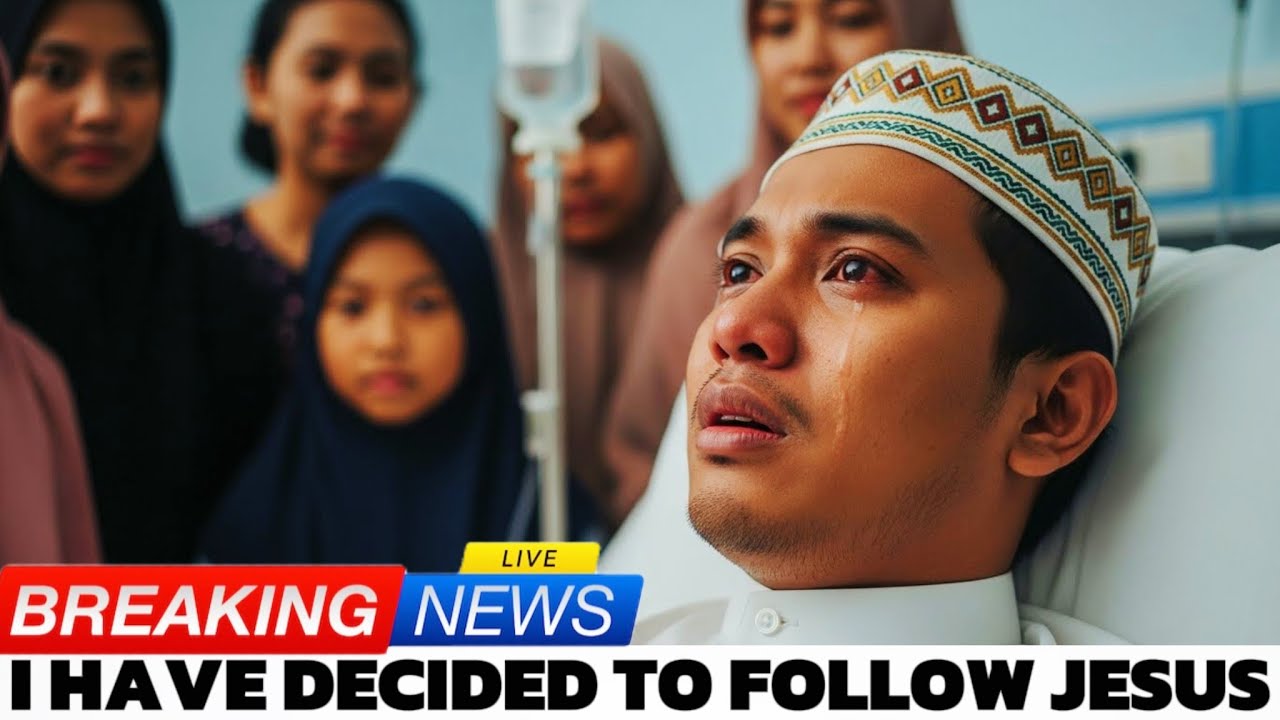
Indonesian IMAM Who Abandoned Islam to Follow Jesus Shares His Mind Blowing Testimony
My story begins in a small town in Java, Indonesia, where the call to prayer echoed five times daily.
I was born into this rhythm into a world where Islam was not just a religion but the very air we breathed.
The foundation upon which everything else was built. My father was a respected man in our community.
Not wealthy but honored. He sold textiles in a small shop near the main mosque and people knew him as a man of integrity.
A man who never missed fajar prayer even when the rains came heavy and the roads turned to mud.
I remember watching him perform wudoo, the ritual washing before each prayer, the way the water ran over his hands, his face, his feet, the deliberate careful movements.
Even as a small child, I understood that this mattered. This was sacred. My mother kept our home and raised us six children with a firm hand and a soft heart.
She taught me my first Arabic words, the opening lines of the Quran before I could even write my own name.
I can still see her in our small kitchen, her hijab slightly as skew as she stirred rice over a charcoal stove, her lips moving in silent decar, the remembrance of Allah.
She prayed for each of us by name every night. I know this because sometimes I would wake and hear her voice in the darkness asking Allah to make her children righteous, to protect us from hellfire, to grant us paradise.
I was the third child, the second son. From early on, I was drawn to the mosque in a way my brothers were not.
They would fidget during the imam’s sermons, counting the minutes until they could run back outside to play football in the dusty lot behind the market.
But I listened. I absorbed. The words of the Quran, even when I did not fully understand their meaning, moved something deep inside me.
The rhythmic Arabic, the stories of prophets, the warnings of judgment, the promises of paradise.
It all felt important, urgent, true. When I was 8 years old, I began attending Madrasa in the afternoons after regular school.
There we sat cross-legged on woven mats, rocking back and forth as we memorized verses from the Quran.
The teacher Ustat Rahman was an old man with a wide beard and kind eyes who carried a thin wooden stick that he never actually used.
He would correct our pronunciation with patience, making us repeat the same verse 20, 30 times until we got it right.
I loved those sessions. While other boys groaned at the repetition, I felt a deep satisfaction in getting each syllable perfect in feeling the sacred words settle into my memory.
By the time I was 12, I had memorized several Jews sections of the Quran.
My parents were proud. My father would bring me to the mosque on Friday and have me recite for the other men after prayers.
I can still remember the feeling standing before those gathered men, their eyes on me, my voice carrying across the prayer hall, the approval in their nods, the honor it brought my family.
But it was not pride that drove me, or at least I did not think so at the time.
It was something else, a hunger, a need to know Allah to please him, to secure my place in paradise and avoid the terrors of the grave and the day of judgment that Rahman described in such vivid detail.
I was terrified of hellfire. The descriptions in the Quran and Hadith, the boiling water, the chains, the tree of Zakum with its bitter fruit, these haunted my childhood dreams.
I would lie awake at night mentally reviewing my prayers, wondering if I had performed them correctly, if Allah was pleased with me or angry.
This fear, this urgency pushed me deeper into religious study. When I was 15, my father arranged for me to study under a respected Islamic scholar in a nearby city.
This meant living home, living in a pasantran, an Islamic boarding school with dozens of other young men who were all seeking to become teachers and leaders of the faith.
Those years were hard. We woke before dawn for faja prayer, attended lessons throughout the day, memorized hadith in the evening, and slept on thin mattresses in crowded rooms where mosquitoes bust and the heat was stifling.
We ate simple food, rice, vegetables, occasionally fish or chicken. We studied Arabic grammar, Quranic exesis, Islamic Jewish prudence, the life of the prophet Muhammad peace be upon him.
We debated fine points of Islamic law. We learned how to lead prayers, how to give sermons, how to counsel the community.
I excelled, not because I was naturally brilliant, but because I worked harder than most.
I would stay up long after the other students had fallen asleep, reading by dim lamp light, copying notes, memorizing.
My teachers noticed they began giving me additional responsibilities, asking me to lead certain prayers to assist in teaching younger students.
By the time I was 19, I was being prepared for a role as an imam.
The day I returned to my hometown as a certified Islamic teacher, my parents wept with joy.
My mother held my face in her hands and praised Allah. My father embraced me, something he really did, and I felt his shoulders shake.
Our community was proud to have produced a young imam. I was given a position at our local mosque and though I was young, people began coming to me with their questions, their problems, their needs for religious guidance.
I married when I was 22. Her name was Sari and she was the daughter of a man who attended our mosque.
The marriage was arranged as was customary, but I grew to care for her deeply.
She was quiet, modest, dutiful. She wore her hijab properly, prayed faithfully, kept our small home clean and welcoming.
We had three children in the first 5 years, two daughters and a son. I named my son Ahmed after the prophet, peace be [music] upon him.
My life fell into a rhythm that felt right, that felt ordained. I would wake before dawn and walk through dark streets to the mosque for faja prayer.
The town was silent at that hour except for the call to prayer echoing from various mosques overlapping in a way that seemed like a conversation between minouetses.
Inside the mosque, I would lead the prayers and afterward men would linger to ask me questions or simply to share tea and conversation.
Mornings, I taught Quran to children. I tried to be gentler than my own teachers had been more encouraging.
I wanted these children to love Islam, not just fear Allah’s punishment. Though I never questioned that the fear was necessary, too.
Allah is both Rahman and Raheem, merciful and compassionate, but he is also Al Jabar, the compeller and Al-Makim, the avenger.
The balance of hope and fear was essential to proper Islamic faith. Afternoons I studied.
There was always more to learn, more hadith to memorize, more scholarly works to read.
I would sit in the small room attached to the mosque that served as my office surrounded by books in Arabic and Indonesian making notes preparing sermons for Friday prayers.
I took this responsibility seriously. The Friday sermon was when I had the attention of the entire community when I could teach, guide, correct errors in practice or belief.
Evenings belong to my family. Sari would prepare dinner while I played with the children.
I taught them their prayers, their Arabic letters. I told them stories of the prophets, Adam and his fall from paradise, Noah and the flood, Abraham’s willingness to sacrifice his son, Moses and Pharaoh, Jonah and the whale.
My daughters would sit on either side of me and Ahmmed would climb on my back and I felt a contentment that I believed was a sign of Allah’s favor.
I had respect. I had purpose. I had certainty. People in our town would greet me with special difference.
Shopkeepers would insist I take fruit or bread without payment. When there were disputes in the community, I was often asked to mediate to provide an Islamic perspective on the solution.
When someone was sick, I would visit and pray over them. When someone died, I would help wash the body and lead the funeral prayers.
I remember one afternoon I was called to the home of an elderly woman who was dying.
Her family had gathered and they [music] asked me to recite Quran for her to help ease her passage from this world to the next.
I sat beside her bed and recited Surah Yasin, the heart of the Quran, which we recite for the dying.
Her breathing was labored. Her eyes were closed, but I saw her lips moving slightly as if she were trying to follow along.
When I finished, she opened her eyes briefly and looked at me, and I saw something there.
Fear perhaps, or hope, or both. Then she closed her eyes again and died within the hour.
I walked home in the fading light that evening thinking about death, about the questioning in the grave that awaits every person, about the day of judgment when every deed will be weighed.
I felt the weight of my responsibility. These people trusted me to guide them. What if I led them wrong?
What if my own understanding was flawed? I pushed the thought away. I had studied.
I knew the Quran, the Hadith, the scholarly consensus. I was doing what Allah required.
But there was something else, something I did not like to acknowledge even to myself.
Beneath the certainty, beneath the confidence, there was a nagging sense of incompleteness. I performed all the required prayers.
I fasted during Ramadan. I gave zakat the required charity. I had performed Hajj, the pilgrimage to Mecca when I was 25 and I wept when I first saw the Cabba.
I did everything that was required and more. Yet I never felt sure that Allah loved me, sure that I would enter paradise, sure that my good deeds outweighed my sins.
Islam taught me that Allah is merciful, but also that he is just and that justice means punishment for sin.
We could never earn paradise through our deeds alone. That was impossible. But we still had to try, had to strive, and even then our fate rested on Allah’s sovereign choice.
He could forgive whom he willed and punish whom he willed. There was comfort in submission to this, in surrendering to Allah’s will.
But there was also a perpetual anxiety. Was I doing enough? Was Allah pleased? Would I be among the successful ones or the losers on the day of judgment?
I never spoke of these doubts. An imam was supposed to project confidence to be a rock for others to lean on.
So I buried the questions and focused on my duties. By the time I was 30 years old, I had been serving as imam for 8 years.
I had gained a reputation not just in our town but in the surrounding area as a knowledgeable teacher, someone who could explain complex matters of Islamic law in ways people could understand.
Other imams would sometimes consult me on difficult questions. I was asked to speak at regional Islamic conferences.
I felt that I was doing important work, that my life had meaning and direction.
My children were growing. My daughters were learning to read the Quran. And Ahmmed, who was six, had already memorized several suras.
He would recite them for visitors and people would smile and predict a great future for him.
Perhaps he would become an imam like his father. Perhaps something even greater. I prayed for him every day.
That Allah would protect him and make him a righteous man. Life was good, difficult sometimes.
We never had much money and there were always worries, always responsibilities. But good. I felt that I was where Allah wanted me to be doing what he wanted me to do.
I knew of course that there were Christians in Indonesia. We had always been aware of them.
Though in our area they were a small minority. Mostly they kept to themselves and we kept to ourselves.
There was not hostility exactly but a careful distance. We knew that they believed strange things that they had corrupted the original message of the prophet Issa Jesus that they committed shik the unforgivable sin of associating partners with Allah by claiming that God had a son.
But in recent years something had changed. We began hearing stories of Muslims converting to Christianity.
Not many, but enough to cause concern. In some areas, entire families were leaving Islam.
The stories troubled our community. How could someone who knew the truth of Islam turn away from it?
It seemed impossible, a kind of madness or deception. The other imams and I discussed this troubling trend.
We concluded that these Muslims who converted must not have had proper Islamic education, must not have truly understood their faith.
They were being deceived by clever missionaries who took advantage of the poor and uneducated offering money or other benefits in exchange for conversion.
This was the only explanation that made sense. At one of our regional meetings, an older Imam stood up and spoke passionately about the need to defend Islam against Christian missionary activity.
He said we needed to study their arguments so we could refute them so we could protect our communities from this spiritual disease.
Several other imams agreed. Someone suggested that those of us who were educated should read the Bible so we would understand what Christians believed and could more effectively argue against it.
I remember sitting in that meeting, listening and feeling something stir inside me, a challenge, a calling.
Yes, I thought this is important. This is needed. I should do this. I should study the Christian scriptures so that I can protect my community.
So that I can help other Muslims understand why Islam is true and Christianity is false.
Looking back now, I can see Allah’s hand. No, I can see God’s hand in that moment, though I did not recognize it then.
I thought I was being zealous for Islam. I thought I was preparing to defend the truth.
I did not realize I was taking the first step on a journey that would cost me everything and give me everything.
I went home that evening and told Sadi about the discussion at the meeting. I told her I was going to obtain a Bible and study it.
She looked worried. She asked if it was dangerous, if reading their book might somehow contaminate my faith.
I laughed at her concern. I was an imam, a trained Islamic scholar. How could their book harm me?
I knew the truth. Reading the Bible would only confirm what I already believed, that Islam was the final and perfect revelation and that Christianity was based on corruption and error.
How confident I was, how certain, how completely unprepared for what was coming. I didn’t know that everything I thought I knew was about to be shaken.
I did not know that within months my life would be shattered and remade. I did not know that the book I was planning to read in order to refute it would instead bring me to my knees, weeping, encountering a love I had never imagined possible.
I thought I was preparing for an intellectual exercise, a defensive strategy. I did not know I was about to meet Jesus.
Getting a Bible in our town was not as simple as walking into a bookstore.
Most stores did not carry them. And even if they did, I would have hesitated to buy one openly.
People would ask questions. They would wonder about my intentions. An imam purchasing a Christian holy book.
It would have caused speculation, perhaps concern. Instead, I traveled to a larger city about 2 hours away by bus.
I told Sari I had meetings with other Islamic scholars which was not entirely untrue.
I did plan to visit a colleague there but my main purpose was to find a Bible in the city’s commercial district.
I found a Christian bookstore tucked between a pharmacy and a phone repair shop. I stood across the street for several minutes watching people go in and out before I finally crossed and entered.
The bookstore was quiet, cool with rows of books in Indonesian and English. A young woman at the counter smiled at me, and I felt suddenly self-conscious in my prayer cap and traditional dress.
She must have known I was Muslim, but she simply asked if she could help me find something.
And I told her I wanted a Bible in Indonesian. She showed me several editions and I chose a simple paperback with no decorations, nothing that would draw attention.
I paid quickly and left, slipping the book into my bag like I was carrying something forbidden.
On the bus ride home, I kept thinking about the book in my back. It felt heavy, significant.
I had handled the Quran my entire life with reverence, with voodoo performed before touching it, with care and respect.
But this book, the angel, as we called it in Islam, I had been taught it was corrupted, changed by human hands, no longer reliable.
Yet, it was also supposedly based on God’s original revelation to Jesus. So, what was I carrying?
Truth mixed with corruption, complete falsehood. I did not know. I decided to keep the Bible in my office at the mosque rather than bring it home.
This seemed more appropriate, somehow more professional. This was a study project, a scholarly exercise.
I would approach it systematically, [music] carefully, looking for the contradictions and errors that I had been told were there.
The first time I opened it, I felt nervous, not afraid exactly, but unsettled. I had read many books in my life, Islamic texts, Arabic grammar, Indonesian literature, but this felt different.
I said a quick prayer for protection before I began. Asking Allah to guard my heart from any deception.
I started with the Gospel of Matthew, the first book in the New Testament. I had a notebook beside me where I plan to write down problems, contradictions, theological errors, anything I could use later when defending Islam against Christian arguments.
The opening genealogy did not interest me much. A list of names tracing Jesus’s lineage back to Abraham.
But when I got to the story of his birth, I slowed down. I knew the Islamic version that Mary was a virgin, that she gave birth to Jesus by Allah’s command, that Jesus was a great prophet.
The Christian version had similarities but also strange additions. Angels appearing to shepherds, wise men following a star, King Herod trying to kill the infant Jesus.
I read about John the Baptist baptizing Jesus in the Jordan River. About Jesus being tempted in the wilderness for 40 days, about him calling disciples, performing miracles, teaching in the synagogues.
Much of this was not unfamiliar. Islam acknowledged Jesus as a miracle worker, a healer, a teacher.
But then I began encountering things that troubled me. Jesus claimed to forgive sins. Not just tell people that Allah had forgiven them, but to forgive sins himself as if he had that authority.
When I read this, I stopped and wrote in my notebook. Only Allah can forgive sins.
I felt I had found my first clear error. But then I kept reading. Jesus healed a paralyzed man.
And the religious leaders accused him of blasphemy for claiming to forgive sins. And Jesus responded by asking which was easier to say your sins are forgiven or to tell the paralyzed man to get up and walk.
Then he healed the man to prove he had authority on earth to forgive sins.
I sat back in my chair thinking this was more complex than I had expected.
Jesus was not just claiming empty authority. He was backing up his claims with power.
Still, I reminded myself the Quran clearly stated that Jesus was just a prophet, not God, not God’s son.
This Christian Bible must be wrong. I continued reading over the next several days late at night after my family had gone to sleep or in the quiet hours of the afternoon when the mosque was empty.
I read about Jesus teaching with authority that amazed the crowds, about him calming storms and walking on water, about him feeding thousands with a few loaves of bread and fish.
About him raising the dead. Some of this aligned with what I knew from Islam.
But there were troubling differences too. The intimacy with which Jesus spoke about God. He called God father not just once but constantly.
This disturbed me deeply. In Islam we would never call Allah our father. He was lord, master, creator, sustainer but not father.
That word implied a closeness, a relationship that seemed inappropriate, almost disrespectful. Yet Jesus spoke of God as father naturally constantly.
And he spoke of himself in ways that seemed to claim equality with God. He said that he and the father were one.
He said that anyone who had seen him had seen the father. He accepted worship from people who bowed before him.
I filled my notebook with objections, with questions, with references to Quranic verses that contradicted what I was reading.
But I also noticed something else happening inside me. I was being drawn in. The stories were compelling.
The teachings were profound. And there was something about Jesus himself. The way he was portrayed, the words attributed to him that I could not easily dismiss.
Then I reached Matthew chapter 5. I had been reading late one night the mosque completely silent around me, a single lamp creating a circle of light on my desk.
I was tired, planning to read just one more chapter before going home. I turned the page to Matthew 5 and I began reading what Christians called the sermon on the mount.
The opening verses were beautiful, poetic. Blessed are the poor in spirit. Blessed are those who mourn.
Blessed are the meek. I found myself nodding. This was good wisdom. Any religious teacher might say such things.
But then Jesus said something that stopped me cold. He said that his followers should be salt and light in the world.
That they should let their light shine before others so that people would see their good deeds and glorify God.
Nothing objectionable in that. But then he said he had not come to abolish the law or the prophets but to fulfill them.
And then and this is where everything began to shift. He said that unless our righteousness surpassed that of the Pharisees and the teachers of the law, we would not enter the kingdom of heaven.
I knew about the Pharisees from my studies. They were known for their strict adherence to religious law, their careful observance of every detail.
And Jesus was saying that was not enough, that something more was required. Then he began explaining what he meant.
He took the law and made it more demanding, not less. He said that murder was wrong, but so was anger.
That adultery was wrong, but so was lust. That we should not break our oaths, but rather we should not swear oaths at all.
Our yes should be yes, and our no should be no. I was underlining passages, writing notes, feeling slightly disturbed but still in control.
And then I reached verse 38. Jesus said, “You have heard that it was said eye for eye and tooth for tooth.”
I knew this law. [music] It was in the Torah and it was also Islamic teaching.
Justice meant proportional punishment. If someone harmed you, you had the right to harm them back equally.
This was fair. This was just this was the basis of legal systems. But then Jesus said, “But I tell you, do not resist an evil person.
If anyone slaps you on the right cheek, turn to them the other cheek also.”
I stopped reading. I read the verse again and again. Turn the other cheek. Do not resist an evil person.
This made no sense. This was weakness. This was allowing evil to triumph. How could this be right?
But Jesus was not finished. He continued, “And if anyone wants to sue you and take your shirt, hand over your coat as well.
If anyone forces you to go one mile, go with them two miles. Give to the one who asks you, and do not turn away from the one who wants to borrow from you.”
My mind was spinning. This was not just radical. This was impossible. This was completely contrary to human nature, to justice, to common sense.
No one could live like this. Society would collapse if everyone behaved this way. The wicked would take advantage of the righteous.
And then I reached verse 43. You have heard that it was said, “Love your neighbor and hate your enemy.
Yes, I thought exactly. This is what I had been taught. We love the believers, our Muslim brothers and sisters.
We help them, we support them, we defend them. And we are commanded to fight against the enemies of Islam, against those who oppose Allah and his messenger.
This was clear in the Quran, in the Hadith, in the entire Islamic tradition. The world was divided into Dar al-Islam, the house of Islam, and Dar al-Hab, the house of war, Muslims and enemies, us and them.
But Jesus said, “But I tell you, love your enemies and pray for those who persecute you, that you may be children of your father in heaven.”
I sat there staring at those words, “Love your enemies. Pray for those who persecute you.
My hands were shaking. I did not understand why, but I felt something cracking inside me.
Some foundation I had built my entire life upon beginning to shift. I had been taught to hate the enemies of Islam.
Not a personal emotional hate perhaps, but a principled opposition. They were wrong. They were misguided.
They were going to hell. And we were commanded to fight them if necessary. The Quran had many verses about fighting the unbelievers.
The prophet Muhammad peace be upon him had fought battles against his enemies. This was part of Islam.
But here was Jesus saying to love them, to pray for them, not just to tolerate them or leave them alone, but to actively love them, to bless them, to do good to them.
Who could do this? Who could live like this? I kept reading but my vision was blurring.
Jesus explained his reasoning. God causes the sun to rise on the evil and the good and sends rain on the righteous and the unrighteous.
If you only love those who love you, what reward is there in that? Even tax collectors do that much.
Even pagans do that much. Then came the verse that broke me. Be perfect therefore as your heavenly father is perfect.
Be perfect as God is perfect. This was the standard. Not just to follow rules, not just to do better than others, but to be perfect, to love perfectly, to forgive perfectly, to reflect God’s character perfectly.
I closed the Bible and put my head in my hands. My heart was pounding.
My throat was tight. And then to my shock, I began to cry. I had not cried like this since I was a child.
Not even at my own father’s funeral had I wept like this. But now the tears came in great gasping sobs that I could not control and did not fully understand because I knew in that moment that I could not do what Jesus was commanding.
I could not love my enemies. I could not be perfect as God is perfect.
No human being could. It was impossible. But Jesus had commanded it anyway. He had set this as the standard.
And then the thought came unbidden [music] terrifying from somewhere deep inside me. Unless he could help us do it.
Unless he could make it possible. Unless he was more than a teacher, more than a prophet, [music] more than a man.
Only God could demand this standard. Only God could live up to it. Only God could enable others to live up to it.
I tried to push the thought away. This was shook. This was blasphemy. This was exactly what I was supposed to be guarding against.
Jesus was a prophet, not God. The Quran was clear. Allah does not have a son.
Jesus did not die on the cross. This is what I had believed my entire life.
What I had taught others, what I was certain was true. But I could not stop crying.
And I could not stop thinking about those words. Love your enemies. Pray for those who persecute you.
Be perfect as your heavenly father is perfect. I stayed in that office for hours that night, long past when I should have gone home.
I read all of Matthew 5, then chapter 6, then chapter 7. Jesus teaching about prayer, about fasting, about not worrying, about judging others, about bearing good fruit, about building your life on solid foundation.
Every page seemed to speak directly to me. Every teaching seemed to expose something in my heart.
I had thought I was righteous because I prayed five times a day, because I fasted during Ramadan, because I followed Islamic law.
But Jesus was showing me that true righteousness was something deeper, something internal, something that transformed not just behavior but the heart itself.
When I finally walked home that night, the sun was beginning to rise. The call to fajul prayer was echoing across the town and I was supposed to be leading it, but I could not go.
Not yet. I walked slowly through the empty streets, my mind churning, my heart in turmoil.
I had opened the Bible to find errors, to find reasons to reject Christianity, to strengthen my Islamic faith.
Instead, I had encountered something, someone who challenged everything I thought I knew. I thought about the elderly woman I had recited Quran over as she died.
The fear I had seen in her eyes. I thought about my own perpetual anxiety about judgment day.
About whether my good deeds would be enough, about whether Allah would show me mercy or punishment.
I thought about the anger I felt toward those who opposed Islam. The satisfaction I felt when I heard about enemies of Islam being defeated.
And then I thought about Jesus saying to love your enemies, to pray for those who persecute you, to be perfect as your father in heaven is perfect.
I wanted to dismiss it. I wanted to find a way to explain it away to fit it into my Islamic understanding to maintain my certainty.
But I could not. Something had shifted. A door had opened and I did not know if I could close it again.
When I reached my house, Sari was awake, worried, she asked where I had been, if everything was all right.
I told her I had been studying late at the mosque, which was true. But I did not tell her what I had been studying.
[music] I did not tell her about the tears. I did not tell her about the question that was now lodged in my heart like a splinter, painful and impossible to ignore.
What if I had been wrong? What if Jesus was not just a prophet? What if he was something more?
I performed my ablutions and prayed fajger alone in our small home going through the motions that I had performed thousands of times before.
But the words felt different now. The prostrations felt hollow. I was speaking Arabic prayers toward Mecca, but my mind was full of Jesus words.
Love your enemies. Be perfect as your father in heaven is perfect. After prayer, I lay down on my mat, exhausted but unable to sleep.
My children would wake soon. The day would begin. I would need to lead prayers at the mosque, teach classes, counsel community members.
I would need to act normal to be the imam everyone expected me to be.
But I knew that something fundamental had changed. I had read the sermon on the mount and I could not unread it.
I had heard Jesus’ words and I could not unhear them. I had set out to defend Islam against Christianity.
Instead, I had encountered a teaching so radical, so demanding, so pure that it could only come from God himself.
And I knew with a certainty that terrified me that I would have to keep reading.
I would have to find out more. I would have to discover who Jesus really was, even if it cost me everything.
The weeks that followed were the most difficult of my life. I continued my duties as imam, leading prayers, teaching children, counseling community members, delivering Friday sermons.
On the outside, everything appeared normal. But inside, I was being torn apart. I could not stop reading the Bible.
Every chance I had, late at night, early in the morning, during the quiet afternoon hours at the mosque, I would open that book and read.
And the more I read, the more my carefully constructed understanding of the world began to crumble.
I read about Jesus healing lepers, giving sight to the blind, casting out demons. I read his parables, the prodigal son, the good Samaritan, the swer and the seed.
I read his confrontations with the religious leaders who cared more about their rules and their positions than [music] about people’s souls.
I read his tenderness towards sinners, toward the broken, toward those whom society rejected. And I saw myself in the religious leaders Jesus criticized.
The Pharisees who knew scripture but whose hearts were far from God. The teachers of the law who placed heavy burdens on others but would not lift a finger to help them.
The ones who loved to be seen praying in public. Who sought honor and recognition.
Who trusted in their own righteousness. Was that me? Had I become so focused on following rules, on maintaining my position, on being respected that I had missed the very heart of what God wanted.
I began comparing what I read in the Bible with what I knew from Islam.
The differences were stark, undeniable. In Islam, I had been taught that humanity’s problem was ignorance.
We needed to know God’s law and follow it. If we did good deeds and avoided major sins, and if Allah chose to show us mercy, we might enter paradise.
But there was always uncertainty. Always the fear that our deeds might not be enough, that Allah in his sovereignty might choose to punish us anyway.
But Jesus taught something completely different. He thought that humanity’s problem was not just ignorance but sin.
A deep corruption of the heart that no amount of good deeds could fix. He taught that we needed not just [music] instruction but transformation, not just law but grace, not just a prophet but a savior.
And he claimed to be that savior. This was what troubled me most. Jesus did not just teach about God.
He made claims about himself that no mere prophet would make. He said he was the bread of life.
That whoever came to him would never be hungry. He said he was the light of the world.
That whoever followed him would not walk in darkness. He said he was the way, the truth, and the life.
And that no one could come to the father except through him. I wrestled with these claims.
In Islam, such statements would be clear shook, blasphemy, the unforgivable sin of claiming to be equal with God.
But Jesus said these things openly, repeatedly, without shame or hesitation. Either he was a deceiver or he was deluded or he was telling the truth.
And I could not believe he was a deceiver or deluded. His teachings were too wise, too profound, too morally pure.
The way he lived, the compassion he showed, the courage he demonstrated, the love he embodied, this was not the behavior of a liar or a madman, which left only one possibility, one that I was terrified to acknowledge.
He was telling the truth. But if Jesus was telling the truth about himself, then Islam was wrong.
The Quran was wrong. Muhammad, peace be upon him, was wrong. And I had built my entire life on a foundation that was false.
I could not accept this. I would not accept this. So I searched for ways to reconcile what I was reading with what I had always believed.
Perhaps the Bible had been corrupted as Islam taught and these claims about Jesus were later additions.
Perhaps Jesus never actually said these things. Perhaps there was some other explanation. But the more I studied, the weaker these arguments seemed.
The New Testament documents were ancient, well attested, consistent across thousands of manuscripts. Scholars, even skeptical scholars, agreed that Jesus made extraordinary claims about himself.
The early Christians believed he was God. Not because of some later corruption, but from the very beginning, from the time of his apostles.
I felt like I was losing my mind. I would lead Friday prayers and preach about the greatness of Islam, about the importance of following Allah’s law, about the need to reject Christian corruption.
And even as I spoke these words, my conscience was screaming at me. You are a hypocrite.
You are lying. You know what you have read. You know what you have felt at home.
Sari began asking if something was wrong. I was distracted, distant, I barely slept. I had no appetite.
She thought perhaps I was sick or worried about some community problem. I reassured her that everything was fine, but I could see the doubt in her eyes.
I had never been a good liar. My children sensed something, too. Ahmmed asked me one evening why I seemed sad.
I forced a smile and told him I was just tired. But he looked at me with those innocent [music] trusting eyes and I had to turn away.
What would happen to him if I lost my faith? What would happen to my family?
This thought tormented me. If I rejected Islam, I would lose everything. My position, my respect, my community, my family.
In Indonesia, apostasy from Islam was not just a religious matter, but a social and sometimes legal one.
I could be killed. Even if I was not killed, I would be shunned, disowned, declared dead by my own relatives.
My wife could divorce me. My children could be taken from me. And for what?
For a belief that seemed insane. For a claim that Jesus of Nazareth, a man who lived and died 2,000 years ago, was actually God in human flesh.
I prayed constantly, but I did not know who I was praying to anymore. Was I praying to Allah, the distant sovereign God of Islam?
Or was I praying to the father that Jesus spoke of the God who loved the world so much that he gave his only son?
Then the dreams began. The first dream came about a month after I had started reading the Bible.
I was standing in a place of deep darkness and I was afraid. I could hear voices all around me, accusing voices, angry voices.
I tried to run but could not move. Then I saw a light in the distance and a figure walking toward me.
The figure was dressed in white and as he came closer, the darkness began to retreat.
I tried to see his face, but I woke up before I could. I told myself it was just stress, just my anxious mind working through my confusion.
But the dream stayed with me all day, vivid and troubling. The second dream came a week later.
Again, I was in darkness, but this time I was not alone. There were other people with me, and we were all lost, all searching for a way out.
Then I heard a voice calling my name. Not my title, Imam, but my given name, the name my mother had called me as a child.
The voice was gentle, but authoritative, familiar, but foreign. I turned toward the voice and saw the figure in white again, closer this time.
He stretched out his hand toward me, as if inviting me to come to him.
I stepped forward, reaching for his hand, and then I woke up. This dream shook me deeply.
In Islam, we believed that dreams could be messages from Allah. But this dream felt different from any I had experienced before.
It felt personal, intimate, real. The third dream was the one that changed everything. I had been reading the Gospel of John, which was even more explicit than the other gospels about Jesus’s divine identity.
John began his gospel by declaring that Jesus was the word, that the word was with God and the word was God, that through him all things were made, and that in him was life and light.
Then John recorded Jesus saying things like before Abraham was I am claiming for himself the divine name that God had revealed to Moses.
Jesus said that he and the father were one. He said that whoever had seen him had seen the father.
I had finished reading and was sitting in the dark office my head in my hands when I suddenly felt overwhelmed by exhaustion.
I lay down on the mat I kept there for prayer [music] and fell into a deep sleep.
In the dream, I was standing in a garden. It was beautiful, more beautiful than any place I had ever seen.
The colors were more vivid. The air was clearer. Everything seemed more real than reality itself.
I knew somehow that this was a holy place. And then he was there, Jesus.
I knew it was him, though I had never seen his face. He was standing a few feet away, looking at me with eyes full of love.
Not judgment, not anger, not disappointment, just love. Pure overwhelming unconditional love. I fell to my knees.
I tried to speak, to ask who he was, to demand proof, to express my doubts.
But I could not form words. I could only weep. And then he spoke. His voice was like nothing I had ever heard.
Gentle as a whisper, but powerful as thunder. He said my name. And then he said words that I will never forget.
Words that are burnt into my soul. I am the way. Come to me and I will give you rest.
I woke up gasping, my face wet with tears. My whole body was trembling. The dream had been so vivid, so real that for a moment I was disoriented, unsure if I was awake or still sleeping.
But I knew what I had experienced. Jesus had appeared to me. He had spoken to me and I could no longer deny the truth that I had been fighting against for weeks.
He was real. He was alive. He was who he claimed to [music] be. And I had to decide what to do about it.
I sat up on that mat in the dark mosque and I knew that my life had reached a breaking point.
I could not continue as I had been pretending everything was fine leading prayers to Allah while my heart was being drawn to Jesus.
I could not serve two masters. I could not stand with one foot in Islam and one foot in Christianity.
[music] I had to choose. But how could I choose? How could I turn away from everything I had known, everything I had been, everything I had built?
How could I betray my parents, my teachers, my community? How could I become an apostate, a traitor to Islam?
The answer came quietly like a whisper in my heart. I could not do it for myself, but I could do it for him, for Jesus.
Because if he was truly God, if he had truly died and risen for me, then nothing else mattered.
Not my reputation, not my comfort, not even my family. He was worth everything. I thought about his words in Matthew’s gospel.
Words I had read and tried to ignore. Whoever loves father or mother more than me is not worthy of me.
And whoever loves son or daughter more than me is not worthy of me. And whoever does not take up his cross and follow me is not worthy of me.
Whoever finds his life will lose it. And whoever loses his life for my sake will find it.
I had thought these were harsh words, unreasonable demands. But now I understood Jesus was not being cruel.
He was simply stating reality. Following him required total surrender, complete commitment, willingness to lose everything.
And I knew what I had to do. I prostrated myself on that mat, not in the ritual Islamic prayer position, but flat on my face.
And I prayed differently than I had ever prayed before. I did not recite memorized Arabic phrases.
I did not follow a prescribed form. I simply spoke from my heart in my own language to the one I now believed was God.
Jesus, if you are real, if you are truly God, I surrender to you. I do not understand everything.
I am afraid. But I believe you are who you said you are. I believe you died for my sins and rose from the dead.
Forgive me. Save me. Make me yours. I give you my life. Whatever that means, whatever it costs.
The moment I finished praying, I felt something that I had never felt in my entire life.
Peace. Not the absence of fear. I was still terrified of what lay ahead. But a deep inexplicable peace beneath the fear.
A sense of being held, being loved, being known and accepted completely. I lay there on that mosque floor in the building where I had served as imam for 8 years and I wept.
But this time they were not tears of confusion or fear. They were tears of relief, of joy, of coming home to a place I had never been before.
I had read the Bible to find errors. Instead, I had found truth. I had set out to refute Christianity.
Instead, I had met Christ and my life would never be the same. I did not know what would happen next.
I did not know how I would tell anyone, how I would leave my position, how I would face the consequences.
All I knew was that I belong to Jesus now. He had called me and I had answered.
The rest was in his hands. I stayed in that mosque until dawn, praying, crying, reading the Bible with new eyes.
Every word seemed to glow with meaning now. Every promise seemed personal, spoken directly to me.
I read Jesus’ words in John’s gospel. I am the good shepherd. I know my sheep and my sheep know me.
I give them eternal life and they shall never perish. No one will snatch them out of my hand.
I had spent my entire life trying to earn paradise through good deeds. Always uncertain, always afraid.
But Jesus was offering me eternal life as a gift based not on my performance but on his sacrifice.
And he promised that once I was his, nothing could take me away from him.
It seemed too good to be true. But I believed it. I had encountered him and I could not deny what I had experienced.
As the sun rose and the call to faj prayer echoed across the town, I knew that I could not lead the prayers that morning.
I could not stand before the community and pretend to be their imam when my heart had left Islam.
It would be a lie and I would not dishonor Jesus by lying. I walked out of the mosque into the dawn light and I felt like a different person.
The world looked the same. The same narrow streets, the same houses, the same mosque minret rising against the pink sky.
But everything had changed. I had changed. I was no longer an imam. I was no longer even a Muslim.
I was a follower of Jesus Christ. And I had no idea what came next.
I went home that morning knowing I couldn’t hide what had happened. The peace I felt was real, but so was the fear.
I stood outside my house for a long time before entering, trying to find the right words, knowing there were no right words for what I had to say.
Sari was preparing breakfast. The children were still sleeping. She looked up when I entered and immediately she knew something was wrong.
I must have looked terrible. I had not slept. My eyes were red from crying.
My clothes were wrinkled from lying on the mosque floor. She asked what had happened.
I sat down at our small table and tried to speak, but the words caught in my throat.
How do you tell your wife that you have abandoned the faith you have shared?
The faith in which you are raising your children, the faith that is the foundation of everything in your lives.
I finally managed to say that I needed to tell her something, something that would be very difficult to hear.
She sat down across from me, her face pale with worry. And then haltingly with many pauses and tears, I told her.
I told her about reading the Bible, about the sermon on the mount, about the dreams, about the encounter with Jesus.
I told her that I had surrendered my life to Christ, that I could no longer be a Muslim, that I believed Jesus was God and Savior.
The silence that followed was crushing. She stared at me as if I had suddenly become a stranger.
Then she began to cry. Not loud so quiet tears that ran down her face as she looked at me with an expression of horror and betrayal.
She asked how I could do this, how I could abandon the truth, how I could throw away everything we had built.
She asked if I had gone mad, if I was possessed by a demon. She begged me to come back to my senses, to ask Allah for forgiveness, to reject these dangerous thoughts before it was too late.
I tried to explain. I tried to share what I had experienced, what I had read, what I now believed.
But she could not hear it. To her, I had committed the worst possible sin.
I had left Islam. I had become an apostate destined for hellfire. And I was taking everything from her.
Her husband’s honor, her family’s reputation, her children’s future. She stood up from the table and said she could not accept this.
She would not accept this. She left the room and I heard her in the bedroom crying and praying.
I sat at the table alone listening to my wife’s grief and I felt my heart breaking, but I also felt that strange peace underneath it all.
I had done what I needed to do. I had told the truth. Whatever happened next was in God’s hands.
I knew I could not continue as imam. That same morning, I went back to the mosque and found the assistant imam who helped me with various duties.
I told him that I was resigning my position for personal reasons. He was confused, concerned, asking if I was sick, if there was a problem in my family.
I gave him vague answers and left quickly before he would press further. Words spread fast in our small town.
By afternoon, people were talking. Why had the imam suddenly resigned? What was wrong? Within days, the rumors began to take shape.
Someone had seen me buying a Bible in the city. Someone else had noticed I had been distracted lately, acting strangely.
The pieces [music] came together and the truth or speculation close to the truth began to circulate.
Then came the confrontation I had been dreading. A group of community leaders came to my house.
Elders, other religious teachers, respected men I had known for years. They did not come with anger at first, but with concern.
They asked me if the rumors were true. Had I been studying Christianity? Was I having doubts about Islam?
I looked at these men, men I had prayed with, learned from, shared meals with, and I told them the truth.
I said, “Yes, I had been reading the Bible. Yes, I had come to believe that Jesus was more than a prophet.
Yes, I could no longer practice Islam because I now followed Christ.” The room went silent.
Then one of the older men spoke, his voice shaking. He said, “I must be confused, that I had been deceived by Satan, that I needed to repent immediately.”
Another man, an imam from a nearby town, was more direct. He said that apostasy was punishable by death in Islamic law, that I was putting myself in grave danger, that I needed to recant my statements right now.
I felt afraid, but I also felt that peace again, that sense of not being alone even in this hostile room.
I spoke calmly. I said I understood their concerns, but I could not deny what I had experienced.
I had met Jesus. I believed he was God. I could not go back. They tried for hours to change my mind.
They quoted the Quran. They cited hadith. They used every argument they knew. They reminded me of my family, my children, my responsibilities.
They warned me of the consequences, social, legal, eternal. But I held firm, not out of stubbornness, but because I knew I could not deny Christ.
He had called me. I had answered. There was no going back. Finally, they left.
But their parting words were ominous. They said I had 3 days to reconsider. After that, they could not protect me.
They would have to inform higher religious authorities and they would make sure everyone in the community knew what I had done.
Those three days were a living nightmare. Sari was devastated, crying constantly, barely speaking to me.
She said she was staying only because of the children, but that if I went through with this, she would have no choice but to leave.
My children were confused, sensing the tension, but not understanding it. Ahmad kept asking what was wrong, why everyone was upset.
I tried to shield them from it all, but that was impossible. People stopped greeting me in the street.
Shops that had always welcomed me now served me coldly or not at all. I received anonymous messages.
Some pleading with me to return to Islam. Others threatening violence. Someone threw a rock through our window at night.
Someone else painted a word on our door that I will not repeat. On the third day, I knew I had to leave our house.
It was not safe anymore. And my presence was endangering my family. I packed a small bag and told Sari I would go stay with a contact I had made, a Christian man in another town who had heard about my situation and offered help.
This was common in Indonesia. I would later learn there was an underground network of Christians who helped Muslim converts providing safe houses, legal assistance, connections to churches.
Sari did not try to stop me. She looked at me with eyes full of pain and said she had never thought I would do this to her, to our children.
I wanted to hold her, to comfort her, to explain that I still loved her deeply, but she turned away and I left.
The Christian man whose name was Buddhy picked me up in his car and drove me to his home several hours away.
He did not ask many questions, just offered me a place to stay and said I was safe there.
His family welcomed me with a kindness that stunned me. They did not know me.
I had been their enemy just weeks ago. An imam who would have opposed their faith, perhaps even preached against them.
Yet they opened their home, fed me, prayed with me. That night, Buddhy asked if I wanted to attend a church service.
I said yes. Nervous about what to expect. The church was small, meeting in someone’s home to avoid attention.
There were maybe 20 people there, mostly young, sitting on mats on the floor. They sang worship songs in Indonesian, simple melodies, but filled with such joy, such love for Jesus.
I found myself crying again, overwhelmed by the reality of what was happening. I was sitting in a Christian worship service.
I was one of them now. After the service, the pastor came to speak with me.
He was a gentleman in his 50s who had also come from a Muslim background years ago.
He understood what I was going through. He told me his story, how he had lost his family, been beaten, spent time in jail, but had never regretted following Jesus.
He said that Christ was worth it all, [music] that the joy of knowing him surpassed every suffering.
Then he asked if I wanted to be baptized. I knew about baptism from my reading of the Bible.
It was the public declaration of faith in Christ. The symbol of death to the old life and resurrection to new life.
I said yes. I wanted to be baptized. I needed to complete this step to fully commit myself to declare openly that I belonged to Jesus.
We arranged for the baptism to happen the following week in a river outside the city away from prying eyes.
On the day of my baptism, I woke early and prayed. I thanked Jesus for calling me, for saving me, for giving me the courage to follow him even when it cost me everything.
I asked him to be with my wife and children, to protect them, to somehow make things right.
At the river, there were about a dozen believers gathered. The pastor waded into the water and called me to follow.
The water was cool, flowing gently around us. He placed his hand on my shoulder and asked me to confess my faith.
I said aloud for everyone to hear. I believe that Jesus Christ is the son of God, that he died for my sins and rose from the dead, and that he is Lord of my life.
Then he baptized me in the name of the father, the son, and the holy spirit.
I went under the water and for a moment everything was silent still. Then I came up gasping and laughing and crying all at once.
The believers on the shore were clapping [music] and praising God and I felt clean, new, born again.
This was the moment I truly became a Christian. Not when I prayed in the mosque, not when I believed in my heart, but when I publicly declared my faith and submitted to baptism.
I had crossed a line that could not be uncrossed, but the cost was only beginning.
In the weeks that followed, the persecution intensified. My family formally disowned me. My brothers put out word that I was dead to them, that my name should not be spoken in their presence.
My wife filed for divorce on the grounds of apostasy. She was granted custody of the children, and I was forbidden from seeing them.
This was the worst pain of all. Losing my children knowing they were being told their father was an apostate, a traitor damned to hell.
I received death threats regularly. Some were vague warnings, others were specific, describing how I would be killed, where my body would be found.
I had to move frequently, staying with different Christian families. Never in one place too long.
I grew a beard differently. Changed my appearance. Learned to keep my head down in public.
There were moments of deep darkness. Nights when I lay awake wondering if I had made the right choice.
If the cost was too high, if I would ever see my children again. I grieved for my old life, for the family I had lost, for the simplicity and security I had once known.
The enemy whispered that I had thrown it all away for a delusion, that I was a fool, that I should go back and recent beg for forgiveness.
But then I would open the Bible and read Jesus’ words again. I would pray and I would feel that peace that surpassed understanding.
I would remember the dream, the voice calling my name, the overwhelming love in Jesus’ eyes, and I would know that I could not go back.
I had tasted and seen that the Lord was good. I had been blind, and now I could see.
How could I return to darkness after experiencing light? The Christian community sustained me during this time.
They fed me when I had no money. They housed me when I had no home.
They prayed with me when I was discouraged. [music] They taught me about grace, about the Father’s love, about the Holy Spirit’s presence.
They showed me what it meant to be part of the body of Christ, to be brothers and sisters, not by blood, but by faith.
I attended Bible studies and worship services whenever it was safe. I devoured scripture, learning about this new faith, this new life.
Everything I read confirmed what I had experienced. The God of the Bible was not distant and inscrable like Allah.
He was father, close and loving, knowable and personal. Jesus was not just a prophet with good teachings.
He was the savior who had died in my place, taking the punishment I deserved, offering me righteousness I could never earn.
And salvation was not uncertain, dependent on Allah’s arbitrary choice. It was secure, guaranteed by Jesus’s finished work on the cross.
I did not have to wonder if I would make it to paradise. I knew I would, not because of anything I had done, but because of what Jesus had done for me.
This was the most revolutionary truth of all. In Islam, I had lived with constant anxiety about judgment day.
But in Christianity, I learned that there was now no condemnation for those who were in Christ Jesus.
The judgment I deserved had fallen on him. I was forgiven fully and forever. I was a child of God, an heir of heaven.
This was not based on my performance, but on his grace. The relief, the joy, the freedom of this truth was indescribable.
I had been carrying a burden my entire life, trying to be good enough, trying to earn God’s favor, never knowing if I had succeeded.
And now that burden was lifted. Jesus had carried it for me. I could rest in his finished work.
One night about 6 months after my conversion, I was staying with a Christian family in a city several hours from my hometown.
After dinner, the father of the household asked if I would share my testimony with their house church the following Sunday.
I agreed, nervous, but also eager to tell others what Jesus had done for me.
That Sunday, I stood before a small group of Indonesian Christians and told my story.
I told them about being an imam, about reading the Bible to refute it, about the sermon on the mount, about the dreams, about the cost of following Jesus.
And as I spoke, I saw tears in many eyes. Several people came to me afterward and said that my story had strengthened their faith, had reminded them of why they believed, had encouraged them to stand firm despite persecution.
And I realized something. My suffering had meaning. God was using my story to encourage others, to reach people who needed to hear that Jesus was worth everything.
The cost was real. The pain was real. But so was the purpose. Nothing I had lost was wasted.
Everything was being redeemed for God’s glory. I also began to meet other former Muslims who had come to Christ.
Each had a similar story. Reading the Bible or the New Testament, being confronted by Jesus teachings, often having dreams or visions, facing severe persecution for their faith.
We formed a support network, meeting secretly, praying for each other, sharing resources and safe houses.
One of these brothers told me something I will never forget. He said that in Islam, we had been taught to fear Allah and to strive to please him through our good deeds.
But in Christianity, we learned that God loved us first while we were still sinners and that his love was the motivation for our obedience.
We did not obey to be loved. We obeyed because we were already loved. This was the heart of the gospel.
The good news that had transformed my life. I was loved unconditionally, sacrificially, eternally loved by God.
Not because I deserved it, but because he chose to love me. And nothing, not persecution, not loss, not even death could separate me from that love.
As I sat in that house church surrounded by brothers and sisters who had become my new family, I thought about the words I had read in the sermon on the mount that first broke me.
Love your enemies. Pray for those who persecute you. Be perfect as your heavenly father is perfect.
And I realized that Jesus was not just commanding the impossible. He was offering to make it possible through his spirit living in me.
I could love those who had rejected me. I could pray for those who threatened me.
I could forgive those who had taken my children and destroyed my reputation. Not because I was strong, but because he was strong in me.
[music] Not because I was righteous, but because he had made me righteous. Not because I was perfect, but because he was perfect and his perfection was credited to me.
This was the miracle of grace. This was what it meant to follow Jesus. And this was why I could say despite everything I had lost that it was worth it because I had found him and he was everything.
5 years have passed since I left Islam and followed [music] Jesus. 5 years of loss and pain, but also 5 years of joy and purpose beyond anything I could have imagined.
I am writing this now from a small apartment in a different city far from my hometown.
I have a new life, a new community, a new calling. But the story of how I got here is one of God’s faithfulness through ongoing trial.
In the first years after my conversion, I lived in hiding, moving between safe houses, dependent on the generosity of believers who risked their own safety to protect me.
I could not work openly, could not use my real name, could not have any contact with my old life.
It was a kind of death, the death of my former identity, my former self.
But Jesus had promised that those who lost their lives for his sake would find them.
And slowly, painfully, I discovered the truth of that promise. The Christian community that embraced me taught me what it meant to live as a follower of Jesus.
They modeled grace, forgiveness, sacrificial love. When I was discouraged, they reminded me of God’s promises.
When I was afraid, they prayed with me and over me. When I doubted, they gently pointed me back to scripture, to the truth of who Jesus was and what he had done.
I spent hours every day reading the Bible, no longer in secret, no longer with trembling hands, afraid of being discovered, but openly, hungrly, joyfully.
The Old Testament came alive in new ways when I read it through the lens of Jesus.
All the promises, all the prophecies, all the sacrificial system, it all pointed to him.
The Passover lamb, the day of atonement, the suffering servant in Isaiah. These were not just historical events or abstract theology.
They were shadows of the reality that came in Christ. I learned about grace. This was perhaps the hardest and most beautiful truth to absorb.
In Islam, everything depended on performance, on works, on trying harder and hoping Allah would be merciful.
But in Christianity, everything depended on Jesus. He had lived the perfect life I could never live.
He had died the death I deserved to die. He had risen to prove his victory over sin and death.
And now by faith in him, his righteousness was counted as mine. I did not have to earn God’s love.
I could not earn it. It was a gift freely given based not on my merit, but on Christ’s finished work.
This truth set me free from the perpetual anxiety that had characterized my entire religious life as a Muslim.
I no longer lay awake at night wondering if I had prayed correctly, if I had done enough good deeds, if Allah would show me mercy on judgment day.
I knew with certainty, with confidence, with peace that I was saved, that I belong to God, that nothing could snatch me from his hand.
This did not mean life became easy. The persecution continued. I received word that some fundamentalist groups had put a price on my head.
I had to be careful about where I went, who I talked to, how I presented myself.
There were times I wanted to give up to disappear somewhere remote where no one knew me and just live a quiet anonymous life.
But God had other plans. About 2 years after my conversion, I began connecting with an organization that ministered to Muslim background believers.
They provided not just safe housing and legal assistance, but also training, disciplehip, and opportunities to serve.
They helped me process my trauma, heal from my losses, and discover how God wanted to use my story.
They asked if I would be willing to share my testimony more publicly, not using my real name or identifiable details, but allowing my story to be told to encourage other seekers and believers.
I agreed and my testimony began to be shared through secure online platforms, through encrypted messaging, through word of mouth in underground church networks.
The response stunned me. I received messages from Muslims who were secretly reading the Bible who were having dreams about Jesus who were wrestling with the same questions I had wrestled with.
Some were imams and Islamic teachers just as I had been. Others were ordinary Muslims who had encountered something in Christianity that Islam could not provide.
They reached out asking for guidance, for prayer, for help understanding what they were experiencing.
I began corresponding with these seekers, sharing my story, answering their questions, pointing them [music] to Jesus.
I was careful, always aware that any communication could be monitored, that I was putting both myself and them at risk, but I felt compelled to do it.
God had pursued me when I was lost. How could I not help others who were searching?
Many of these conversations led nowhere. People would ask questions but ultimately choose to stay in Islam unwilling to pay the cost of following Jesus.
I understood I had almost made the same choice. But some precious few but some took the step of faith.
They prayed to receive Christ. They began reading the Bible. They connected with underground churches.
They were baptized in secret. And each one was a miracle, a victory, a cause for rejoicing in heaven.
I also began to feel a burden to reach back to my own people. Not aggressively, not disrespectfully, but with love and with truth.
I started writing articles about why I left Islam, addressing common questions and objections that Muslims raise about Christianity.
I wrote about the sermon on the mount and why it convinced me that Jesus was more than a prophet.
I wrote about grace versus works, about assurance of salvation, about the love of God revealed in Christ.
These writings were shared carefully within Muslim communities and they stirred conversation. Some responses were hostile, accusing me of apostasy and blasphemy.
But others were curious, thoughtful, even sympathetic. I learned that there were many Muslims who had questions, who sensed something missing in Islam, who were open to hearing about Jesus if approached with respect and love.
This became my mission. Not to attack Islam or to mock Muhammad or to be needlessly provocative, but simply to testify to the truth that had set me free.
To say, “I was an imam. I knew Islam deeply and I found in Jesus something that Islam could never provide.
Not just a prophet with good teachings, but a savior who loved me, died for me, and rose to give me life.
About 3 years after my conversion, I received unexpected news. My eldest daughter, who was then 14, had managed to find me through the Christian underground network.
She sent a message saying she wanted to see me, that she had questions, that she missed me.
My heart nearly stopped when I received that message. I had not seen any of my children since I left.
I had prayed for them every day, begged God to protect them, to somehow reveal himself to them despite everything they were being taught about me.
And now my daughter was reaching out. We arranged to meet in a public place in a neutral city with a trusted Christian brother present for safety.
When I saw her walking toward [music] me, I barely recognized her. She had grown so much.
She was no longer the little girl I remembered, but a young woman. We embraced both of us crying and for a moment the years of separation dissolved.
We talked for hours. She told me how difficult it had been, how her mother and relatives had told her I was crazy, that I had been deceived by Satan, that I was going to hell.
But she also said that she remembered me, remembered how I had loved her, how I had taught her to pray, how I had told her stories of the prophets, and she could not believe that the father she remembered could be evil or insane.
So she had started asking questions and eventually someone had told her the truth that I had not gone crazy that I had converted to Christianity because I believed Jesus was God.
This shocked her but it also made her curious. If her father who had been an imam had found something in Christianity compelling enough to give up everything, maybe there was something to it.
She asked me to tell her why I converted. And there in that cafe with my daughter listening intently, I shared my testimony.
I told her about reading the sermon on the mount, about Jesus’s command to love our enemies, about the dreams, about the [music] encounter with Christ.
I told her about grace, about being loved unconditionally, about having assurance of salvation. She listened without interrupting, her eyes wide.
When I finished, she was quiet for a long time. Then she said something that brought tears to my eyes.
Father, I want to know this Jesus you have met. I cannot fully describe the joy I felt in that moment.
My daughter, my precious daughter, was seeking Jesus. Not because I had pressured her or manipulated her, but because God was drawing her.
I gave her a Bible and some materials to read. I prayed with her before we parted, asking Jesus to reveal himself to her just as he had revealed himself to me.
Over the following months, we stayed in contact secretly. She read the Bible. She asked questions.
She wrestled with doubts and fears. And eventually she made the decision to follow Jesus.
She could not be baptized. It was too dangerous and she was still living with her mother.
But she [music] prayed to receive Christ. And I knew that she was saved, that she was my sister now, not just by blood, but by faith.
This gave me hope for my other children. I continue to pray for them to trust that the same God who reached me and my daughter can reach them too.
Nothing is impossible for him. The organization I work with eventually offered me a position as a counselor and trainer for other Muslim background believers.
They could not pay me much, but they provided a small apartment and enough support to live on.
My work involves meeting with new converts, helping them process their trauma, teaching them about Christianity, connecting them with safe churches and sometimes helping them relocate if their lives are in danger.
It is hard work, emotionally draining, often discouraging. Many of the people I help are broken, having lost everything, family, friends, jobs, homes.
Some struggle with depression. Some have PTSD from violence they have experienced. Some question whether following Jesus was worth the cost.
I understand their struggles because I have lived them and I try to point them to the same truths that sustained me.
That Jesus is worth it, that suffering for his sake is not meaningless, that God wastes nothing, that there is joy even in persecution.
I also help train Christians in how to reach Muslims with the gospel. Many Christians are afraid of Muslims or hostile toward them, seeing them only as threats or enemies.
I try to help them understand that Muslims are people made in God’s image, loved by God for whom Christ died.
Yes, Islam is false. Yes, Muslims need to hear the gospel. But they need to hear it from Christians who actually love them, who respect them as human beings, who are willing to sacrifice and suffer to see them come to faith.
One of the things I emphasize in my training is the power of Christian love.
I tell the story of how I was welcomed by Christians who had every reason to view me as an enemy.
They fed me, housed me, protected me, discipled me. They showed me a love I had never experienced in Islam.
Unconditional, sacrificial, reflecting the love of Christ himself. That love was as powerful as any argument in convincing me that Christianity was true.
I also share about the importance of dreams and visions. In the Muslim world, dreams are taken seriously, seen as potential messages from God.
And Jesus often uses [music] dreams to reach Muslims, appearing to them in ways that bypass all the theological and cultural barriers.
I encourage Christians to pray that Muslims would have dreams of Jesus and I train them in how to respond when a Muslim shares such an experience.
Through this work, I have seen many Muslims come to faith. Each conversion is different, each story unique.
But there are common threads, a deep spiritual hunger that Islam cannot satisfy. An encounter with the person of Jesus through scripture or dreams or the witness of Christians.
A realization that salvation cannot be earned but must be received as a gift. And a willingness to count the cost and follow Christ despite persecution.
These conversions are always costly. Every Muslim who comes to Christ loses something. Family, reputation, safety, sometimes their life.
But every one of them testifies that Jesus is worth it. That knowing him, being loved by him, having peace with God through him is worth any price.
I have also had the privilege of seeing some Christian churches transformed in their approach to Muslims.
Churches that once viewed Muslims with suspicion or hostility have learned to see them with compassion as people who need the gospel.
They have started prayer initiatives, outreach programs and support systems for Muslim background believers. They have become safe places where converts can worship, learn and heal.
This gives me hope. The church in Indonesia is growing. And part of that growth is coming from Muslims who are finding Jesus.
It is not a mass movement, not yet. But it is real and it is accelerating.
More and more Muslims are reading the Bible, having dreams questioning Islam, and taking the risk of following Christ.
As for me, I have found a peace and purpose I never knew as an imam.
Yes, I have lost my old family, my old reputation, my old life. But I have gained a new family in Christ, brothers and sisters from every tribe and tongue.
I have gained a relationship with God that is not based on fear and uncertainty but on love and grace.
I have gained assurance of eternal life. Not because I have earned it but because Jesus has given it to me [music] and I have gained a mission that gives meaning to my suffering.
Every Muslim I help come to faith. Every believer I encourage to stand firm. Every Christian I train to reach Muslims with love.
These are eternal fruits that will last long [music] after I am gone. Do I still miss my family every day?
Do I still grieve what I lost? Often are there nights when I weep for my children and pray desperately for God to save them.
Yes, the cost has been real and the pain has not fully disappeared. But when I read the sermon on the mount now, when I come to those verses about loving enemies and being perfect as our heavenly father is perfect, I do not feel the crushing weight of an impossible standard.
Instead, I feel gratitude because Jesus did not just command the impossible and leave us to struggle.
He lived it perfectly on our behalf and then he gave us his spirit to empower us to follow him.
I am not perfect. I still struggle with anger, with bitterness, with doubt. But I am being transformed slowly, gradually into the image of Christ.
The same Jesus who commanded me to love my enemies gives me the power to actually do it.
The same Jesus who called me to take up my cross and follow him carries that cross with me every day.
This is what I want to say to anyone who hears my story. To Muslims who are seeking, who are questioning, who sense that something is missing in Islam, do not be afraid to read the Bible, especially the New Testament.
Ask Jesus to reveal himself to you. He is real. He is alive and he is calling you.
The cost of following him is high but he is worth it. Worth more than family, more than reputation, more than comfort, more than life itself.
To Christians who take your faith for granted, cherish what you have. You have been given [music] an incredible gift, the knowledge of God’s love in Christ, the assurance of salvation, the indwelling Holy Spirit.
Do not treat it lightly. Do not let it become routine or boring. Remember that there are people all over the world who would give everything to have what you have.
And please reach out to Muslims with love. They are not your enemies. They are lost people whom God loves.
And for whom Christ died. Yes, Islam is false, but Muslims are precious. Pray for them, befriend them.
Share the gospel with them, not arrogantly or aggressively, but humbly and graciously. Be willing to suffer for their sake.
Some of them will respond, and when they do, welcome them, protect them, disciple them.
They will need you. To believers who are suffering for Christ, hold fast. Your suffering is not meaningless.
God sees. God knows. God cares. He is with you in the fire. He is close to the brokenhearted.
He is storing up every tear. And one day, he will wipe every tear away and make all things new.
The glory that awaits us far outweighs any temporary suffering we endure now. I do not know what the future holds for me.
Perhaps one day Indonesia will become more open to religious freedom and I will be able to live without fear.
Perhaps I will see my other children come to faith. Perhaps I will even be reunited with my former wife, though that seems unlikely.
Or perhaps I will die a martr’s death as many Muslim background believers do. Whatever happens, I am at peace because I belong to Jesus.
My life is hidden with Christ in God. And nothing, not persecution, not loss, not even death can separate me from his love.
I was an imam. I was respected, honored, secure in my identity and my faith.
But I was also lost, anxious, uncertain of God’s love, carrying a burden I could never put down.
Now I am a follower of Jesus. I am rejected, hunted, living in constant danger.
But I am also found, loved, certain of my salvation. Free from the burden of trying to earn God’s favor.
I traded everything I had for the one thing that matters. And I would make the same choice a thousand times over because his name is Jesus and he is worth it all.
My name was once called in the mosque for prayer five times a day. Now it is written in the lamb’s book of life and that is worth everything.