Dec.10 — The Miracle Story of Our Lady of Loreto: The Holy House That Flew Across the Sky
How does a small stone house from Nazareth, the very dwelling where the angel Gabriel announced to Mary she would bear the Savior, where the word became flesh, end up in an Italian coastal town hundreds of miles across the Mediterranean Sea with no record of who moved it or how?
What explains the fact that this structure stones match Palestinian limestone not found in Italy?
That it has no foundation but sits directly on the ground. That it appeared overnight in 1294 and has been investigated by popes, scientists, and skeptics for 700 years without definitive natural explanation.
And why do millions of pilgrims still visit this controversial shrine despite modern skepticism? Why is it the origin of the most famous Maran litany in Christianity?
And why did over 50 popes personally honor this house that tradition says angels carried across the sky?
This is the story of Our Lady of Lorettto, the holy house of Nazareth that mysteriously appeared in medieval Italy.
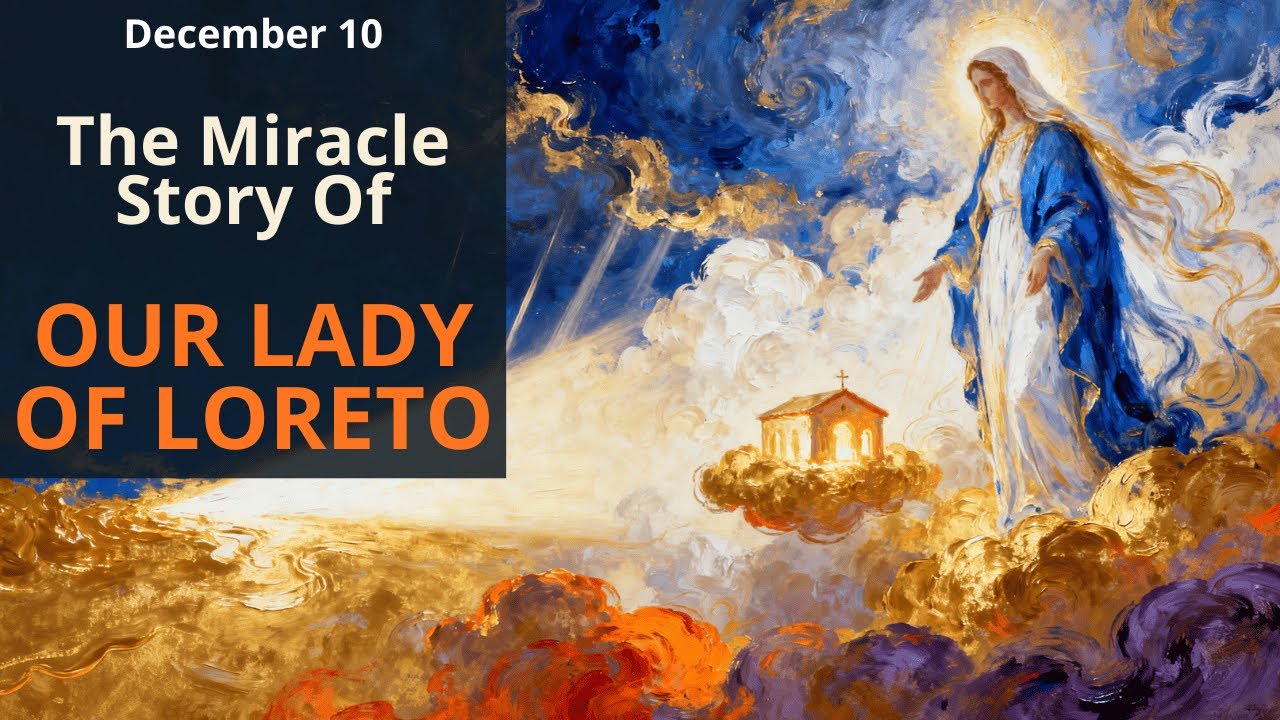
The Marian shrine that has confounded investigators for centuries. The miracle that gave us the litany of Lorettto, proving that sometimes the most controversial devotions are the most enduring.
That mystery does not invalidate faith and that whether angels or crusaders moved it.
In a small town nestled among the hills of Galilee, there stood a house.
It was not remarkable to look at three walls of reddish gay stone, simple and unadorned.
The kind of dwelling where ordinary families lived ordinary lives. But within these walls, something happened that would change the course of human history.
Here, according to ancient tradition, a young woman named Mary heard a voice that no human ear had ever heard.
Here, the angel Gabriel appeared with words that echoed through eternity. Hail, full of grace, the Lord is with you.
The house in Nazareth was where Mary received the announcement that she would bear the son of God.
It was where she spoke her fiat. Let it be done to me according to your word.
And in that moment of humble surrender, the word became flesh. The incarnation began not in a palace or a temple, but in a simple home where a virgin knelt in prayer.
The walls of that house witnessed the most profound mystery of the Christian faith.
God taking on human nature, entering the world through a woman’s yes. From the earliest centuries, Christians venerated this site.
Pilgrims made their way to Nazareth to pray where Mary had prayed, to touch the stones that had sheltered the Holy Family, to breathe the air of that sacred space.
The house became more than architecture. It became a relic of the incarnation itself, a physical connection to the moment when heaven descended to earth.
Emperors and bishops, merchants, and peasants all came to honor the place where salvation’s story began.
When crusaders arrived in the Holy Land, they built a basilica over the site, protecting it from the ravages of time and conflict.
For 200 years, the house remained under Christian guard, a treasure beyond price in the very land where Christ had walked.
But empires rise and fall, and the Latin kingdom of Jerusalem was crumbling. Muslim forces advanced, Christian strongholds fell one by one, and the faithful faced an agonizing question.
What would become of Mary’s house when the last crusaders sailed away? The year was 1291.
Acre, the final Christian fortress, was about to fall. And in Nazareth, something inexplicable was about to happen.
The siege of Acre was brutal. For 6 weeks, the Mammluke army battered the walls of Christendom’s last foothold in the Holy Land.
When the city fell on the 18th of May 1291, the age of the Crusades effectively ended.
Thousands were killed. Survivors fled to ships waiting in the harbor. The dream of a Christian Jerusalem was over.
But on the 10th of May 1291, just 8 days before Acres fall, something strange occurred far to the north.
In her sadow, a small town on the Dalmatian coast of what is now Croatia, local residents awoke to find a structure that had not been there the night before.
Three walls of reddish gray stone with no foundation sitting on the ground as if placed there by invisible hands.
There was no fourth wall, just three sides of what appeared to be part of a house with a simple altar inside and a statue of the Madonna and child.
The local priest, Father Alexander Georgovvich, was as bewildered as his parishioners. Who had built this?
Where had it come from? Why was there no foundation, no sign of construction?
The stones were unfamiliar, a type of limestone no one in Dalmatia recognized. The structures dimensions were peculiar, as if it had been cut from a larger building.
There were no records, no workers, no explanation. According to tradition, an angel appeared to the priest and revealed the truth.
This was the Holy House of Nazareth, the dwelling of the Virgin Mary, transported by angelic hands to save it from destruction in the Holy Land.
The news spread rapidly. Pilgrims began arriving. The local bishop investigated. A delegation was sent to Nazareth itself where they found that the house of the enunciation had indeed vanished from its foundations.
Only the grotto beneath it remained. For 3 years and 7 months, the holy house stood in Tersado.
People came from across the Adriatic to pray within its walls. But on the 10th of December 1294, the house vanished again.
The faithful of Tersado awoke to find nothing but bare ground where the sacred structure had stood.
And on that same night, across the Adriatic Sea, shepherds watching their flocks near the Italian town of Lorettto saw something in the sky.
The shepherds of Laredo would later testify that they had seen a light moving across the night sky, descending toward the laurel grove on the hillside.
When dawn broke on the 10th of December 1294, they found what the people of Tersado had lost.
A small stone structure with no foundation, three walls of foreign stone, a simple altar, and a wooden statue of the Madonna.
The news traveled quickly. Word reached the local bishop who ordered an investigation. Measurements were taken.
The stones were examined. A delegation traveled to Tersado and then to Nazareth, comparing dimensions and materials.
Everything matched. The house that had appeared in Italy was identical to the one that had vanished from Dalatia, which was >> >> identical to the one that had disappeared from the Holy Land.
According to the faithful, angels had carried the house across the Mediterranean. First to Tersado, then after local warfare made that location unsuitable to Italy.
The name Laredo itself came to be associated with the laurel trees where the house appeared, though some scholars would later note that a noble family named D’Angelus or Angelie, meaning of the angels, had transported relics from the Holy Land during this period.
Was the angelic translation a miraculous event or a poetic description of the Angelie family’s rescue mission?
The mystery deepened. The structure had no foundation. It sat directly on the ground as if set down from above.
The stones were Palestinian limestone, impossible to find in the Mare region of Italy.
The dimensions matched exactly with the empty foundations still visible in Nazareth. Inside, archaeological analysis would later reveal graffiti and markings consistent with Eastern Christian practice, not Italian.
Pope Bonafice VIII heard reports of the miraculous arrival. Pilgrims began flooding to Lorettto, seeking healing, offering prayers, touching the stones where Mary had heard the angel’s voice.
The house that had fled the destruction of the Holy Land had found a new home on an Italian hillside.
And whether carried by celestial beings or by faithful crusaders determined to preserve the relic of the incarnation, it had crossed the sea and changed everything.
From the beginning, the church approached Lorettto with careful scrutiny. This was no small claim.
A house transported across the Mediterranean by supernatural means. Pope Clement IIIth ordered a formal investigation in 1531.
Teams examined the stones, interviewed witnesses, compared evidence. They found that the limestone matched samples from Nazareth.
They found no foundation beneath the structure it rested on, an ancient road, as if placed there from above.
They found that the dimensions corresponded precisely to the gap in the foundations at the Nazareth site.
In 1468, Pope Paul II authorized the construction of a magnificent basilica to enshrine the house.
The great architects of the Renaissance were commissioned. Braante, Sansuino, Sanalo. Over a century of work produced one of the most stunning churches in Christrysendom.
With the humble three-walled structure at its heart, more than 50 popes would visit or formally support the shrine.
Saints would pray within its walls. Charles Boromeo, Francis De Sales, Terz of Liu, John the 23rd.
But questions persisted in the 19th and 20th centuries. As archaeological methods improved, scholars proposed alternative explanations.
Some suggested that crusaders, possibly the Angelie family, whose name meant angels, had physically transported the stones by ship to save them from Muslim destruction.
Documents from 1,294 mentioned a dowy given to a nice foro Angelie that included the holy stones carried away from the house of our lady, the virgin mother of God.
Was this evidence of human agency rather than angelic past intervention? The theory had merit.
The dates aligned with the fall of Achre. The Angelie family had means and motive.
Transporting stones by ship, while difficult, was not impossible. Perhaps the angels who carried the house were not celestial beings, but faithful men named Angelie.
Yet the mystery remained. How did a structure with no foundation come to rest so perfectly on a public road?
Why did the house appear suddenly with no record of construction? How did pilgrims in Tursado and Lorettto independently verify that their structure matched the vanished house in Nazareth before any delegation could have made the comparison?
The church wisely refuses to demand either explanation as dogma. What matters is not whether angels or humans transported the stones, but what happened within those walls.
The enunciation, the incarnation, Mary’s. Yes, the Holy House of Lorettto is not venerated because of how it arrived, but because of what it witnessed.
The Basilica that rose around the holy house was designed to inspire awe. Its marble walls, its soaring dome, its Renaissance frescos proclaimed that this was no ordinary church.
At its center, almost inongruously, stood the simple stone structure blackened by centuries of candle smoke, worn by millions of touching hands, humble amid splendor.
The contrast was deliberate. Here was the poverty of Nazareth, enshrined in the glory of Christian art.
Here was Mary’s house, protected by the genius of the world’s greatest architects. It was at Laredo that the famous litany of the blessed virgin Mary, the litany of Laredo, originated.
This prayer with its cascading titles of Mary, mirror of justice, seed of wisdom, mystical rose, tower of David, house of gold.
Ark of the covenant became the most widely used Marian litany in the Catholic Church.
When the faithful pray house of gold, pray for us, they invoke the very house that stands in Lorettto, the dwelling that sheltered the mother of God.
Saints made pilgrimage here. Charles Boromeo walked barefoot to Lorettto, his heart burning with love for Mary.
Francis de Sales celebrated mass within the holy house. Pope John the 23rd before his election prayed here for guidance.
Countless ordinary pilgrims, farmers and kings, soldiers and scholars, the sick seeking healing, and the healthy offering thanks have crossed the threshold of that small stone room.
The shrine’s reputation spread worldwide. Lorettto became one of the most important Maran pilgrimage sites in Christrysendom, rivaling Lordes and Fatima.
Copies of the Holy House were built in other countries. The Walssingham Shrine in England, the Santa Casa Chapel in Prague, each an echo of the original, each drawing pilgrims who could not make the journey to Italy.
And in 1920, Pope Benedict X 15th declared Our Lady of Lorettto the patron saint of aviators.
The choice was not arbitrary. If a house could fly across the sky, then those who flew through the skies might fittingly look to Lorettto for protection.
Pilots and astronauts began carrying medals of the Madonna Dorto. Airports were named for her.
The house that defied gravity became the heavenly guardian of those who defied it every day.
Today, the Holy House of Lorettto continues to draw millions of visitors each year.
They come from every continent, speaking every language, representing every state of life. Some come as skeptics, curious about the strange story of a flying house.
Some come as pilgrims, seeking Mary’s intercession with the same faith that has filled that small room for seven centuries.
Some come simply to see, to touch the stones, to breathe the incense heavy air, to stand where tradition says an angel appeared and a virgin changed the world.
Modern investigations continue. Archaeological studies have confirmed that the stones are indeed Palestinian limestone, that the structure has no foundation, that graffiti on the walls matches Eastern Christian patterns.
Some scholars accept the Angelie family theory as the most probable explanation. Others maintain that the evidence does not fully explain the sudden appearances, the matching dimensions, the lack of construction records.
The church in her wisdom does not require the faithful to believe in angelic transportation.
The miracle of Lorettto is not the flight. It is the incarnation. What matters is not whether the house flew or sailed, but what happened within its walls.
The moment when heaven met earth, when God became man, when a young woman’s yes opened the door to salvation.
And yet the mystery persists. Beautiful and stubborn. A house with no foundation. Stones that do not belong.
Sudden appearances witnessed by shepherds and priests. 700 years of veneration by saints and popes.
The litany of Lorettto prayed around the world. Aviators crossing the sky under Mary’s protection.
Perhaps the mystery is the point. Perhaps God allows some questions to remain unanswered so that faith might have room to grow.
Perhaps the house that flew or was carried or was transported or simply arrived reminds us that the incarnation itself is the true miracle, the mystery that surpasses all understanding.
That God became flesh in a simple house, in a small town, in a young woman’s heart.
A house in Nazareth where an angel appeared and a virgin said yes. Where the word became flesh, where salvation’s story began.
And somehow, whether carried by angels across the Mediterranean sky, or transported stone by stone by faithful crusaders fleeing the Muslim conquest, that house stands today in an Italian town, enshrined in a magnificent basilica, visited by millions who come to pray where Mary prayed.
The Holy House of Lorettto endures as a mystery wrapped in stone, a miracle questioned by skeptics, yet honored by saints and popes for 700 years.
Its walls have heard the prayers of the desperate and the thanksgiving of the healed.
Its threshold has been crossed by sinners seeking mercy and mystics seeking union with God.
Its simple altar has witnessed countless masses, countless tears, countless whispered petitions rising like incense to heaven.
Did the house fly? Perhaps. Does it matter? What matters is that Mary’s house, however it arrived, still echoes with her fiat, still radiates grace, still draws souls to ponder the incarnation.
The stones may be Palestinian or Italian. The transport may have been angelic or human, but the presence is unmistakable.
Something holy dwells there. Something that transforms pilgrims. Something that has endured for seven centuries and shows no sign of fading.
The house that flew across the sky. The mystery that became a shrine. The place where Mary heard the angel and changed everything.
Our Lady of Lorettto, pray for us and for all who seek heaven while walking upon the