A Jewish Man Studied Jesus’ Shroud for 46 Years — One Molecule Broke Him
on findings being published in a new book out today on the Shroud of Turin.
That’s the linen cloth believed to bear Jesus’s imprint as he was being prepared for burial.
And now there’s new research that may disprove the claim of people who said it’s an elaborate fake.
He spent 46 years studying a cloth he was convinced was a medieval fake.
Barry Schwarz, an Orthodox Jewish photographer who had left religion behind as a teenager, joined what would become the most intensive scientific investigation ever conducted on the Shroud of Turin, expecting to disprove it.
Instead, the evidence refused to stay simple.
Images with no known source, blood that shouldn’t, but still remains red.

Results that kept resisting explanation.
Decades later, a single molecule would finally force him to rethink everything he thought he knew.
and what he concluded still divides science today.
The man who said no and then said yes.
Barry Schwarz was not supposed to be the one who ended up defending the Shroud of Turin.
Born in Pittsburgh in 1946 and trained at the prestigious Brooks Institute of Photography in California, he built a reputation as a meticulous commercial and technical photographer who dealt exclusively in verifiable realities, not mysteries of faith.
He had grown up in an Orthodox Jewish household, but by the age of 13, he had walked away from religion entirely, finding no room in his rational worldview for ancient superstitions or divine interventions.
So when a NASA imaging specialist named Don Lynn approached him in 1977 to join the Shroud of Turin research project, Schwarz’s first reaction was not curiosity, but refusal, pointing out that he was Jewish and asking why anyone would want a non-believer involved in investigating a Christian relic.
Lynn’s answer was disarmingly simple.
A Jewish researcher was exactly what the project needed because no one could ever accuse him of bias toward belief, making him the perfect impartial witness for what was about to become the most intensive scientific examination ever conducted on a single artifact.
The Shroud of Turin research project known as STRP was a coalition of 24 American scientists who had secured an unprecedented agreement with the Italian authorities and the Seavoy family, the cloth’s owners, to spend five full days in direct physical contact with the linen.
This was the first time in history that any scientific team had been permitted to perform controlled experiments on it without the interference of church oversight or relic guardians, and the stakes could not have been higher.
Schwarz agreed to participate strictly as the official documenting photographer, and he made his position unmistakably clear from the beginning.
He assumed the shroud was a medieval painting.
He fully expected the examination to prove that beyond any doubt and he was going to record whatever the team found without any emotional or spiritual stake in the outcome.
He was wrong about it being a painting.
And he discovered that within the first 10 minutes, not through any mystical revelation, but through the sheer force of professional training that had taught him exactly how to spot artistic forgery.
He began looking for the properties that every painted surface shares, regardless of who made it or when.
The textured layown of paint, the directional strokes of a brush, and the way pigment sits on top of a fiber rather than bonding within it.
None of those properties were present.
The image was not on the surface of the cloth in any way consistent with any known artistic application of any substance.
Instead, it was inside the fiber at a chemical level, penetrating to a depth so shallow it barely existed at all.
A finding that immediately eliminated painting as an explanation.
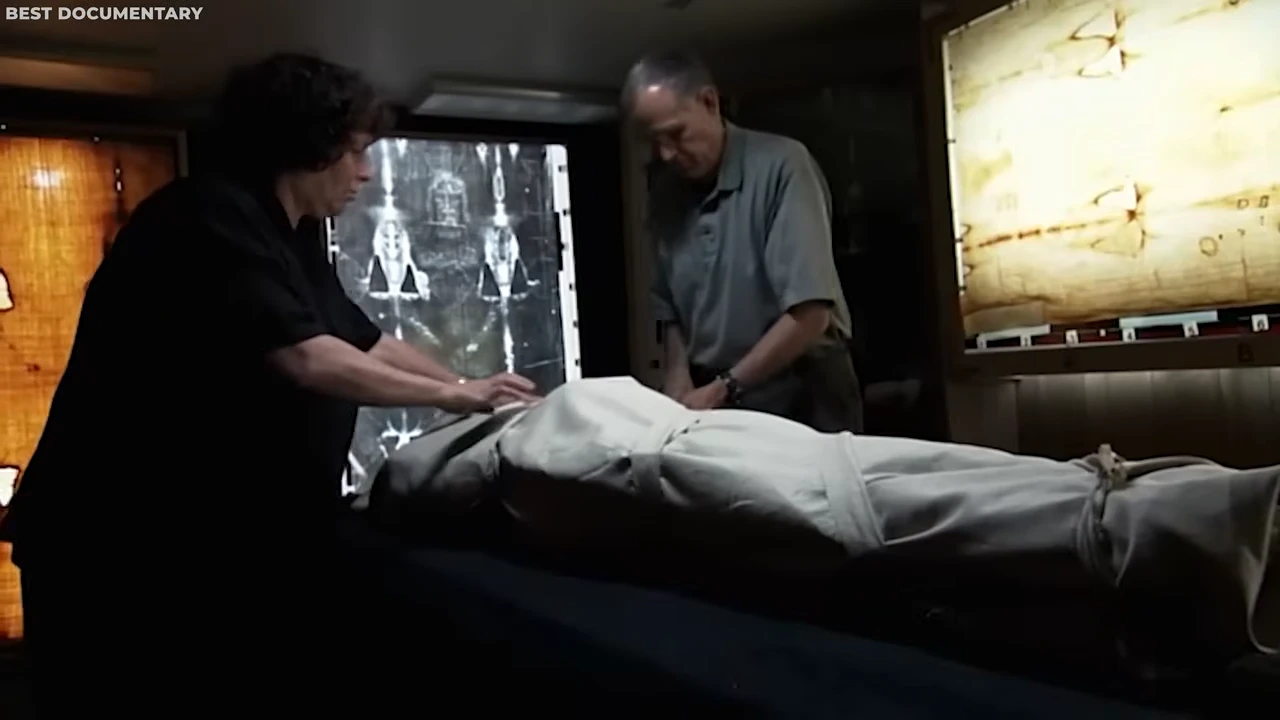
That observation did not eliminate everything else, of course.
And Schwarz would spend the next 18 years trying to find what it did not eliminate, chasing explanations from scorching to photography to natural chemical reactions, only to watch each one collapse under its own weight.
the 120 hours inside a 400-year-old palace.
The examination took place in October 1978 inside the royal palace in Turin.
Fresco covered the ceiling and 400-year-old tapestries hung from the walls.
Every time a bus passed outside, the entire structure vibrated, sending dust drifting down onto the equipment.
It was not a laboratory, but it was the only place the examination could happen.
The shroud was there and the shroud was not going anywhere.
The team had shipped 44 pieces of scientific equipment across the Atlantic on a chartered flight.
They brought X-ray fluoresence machines, ultraviolet fluorescent photography rigs, and multisspectral imaging systems.
They took adhesive tape lifts to collect fibbral samples for later chemical analysis.
The examination ran 24 hours a day for five consecutive days with the team working in rotating shifts.
The cloth measured 14 1/2 ft long by 3 and 1/2 ft wide.
It bore a double image front and back of a man who had been scourged across most of his body surface.
The wounds were not generic depictions, but specific forensic evidence.
The man had been crowned with something that drove puncture wounds across the scalp in a cap-like pattern.
He had been crucified with fasteners through the wrists, not the palms, which is the only way a body can support its weight.
He had been stabbed in the right side with a blade that entered at an upward angle.
The wound pattern required either direct knowledge of first century Roman execution techniques or a body that had actually undergone all of it.
No medieval forger possessed that level of forensic detail.
The image was not a depiction, but a record.
The finding that stopped Schwarz came from a VP8 image analyzer, a device designed for reading X-rays.
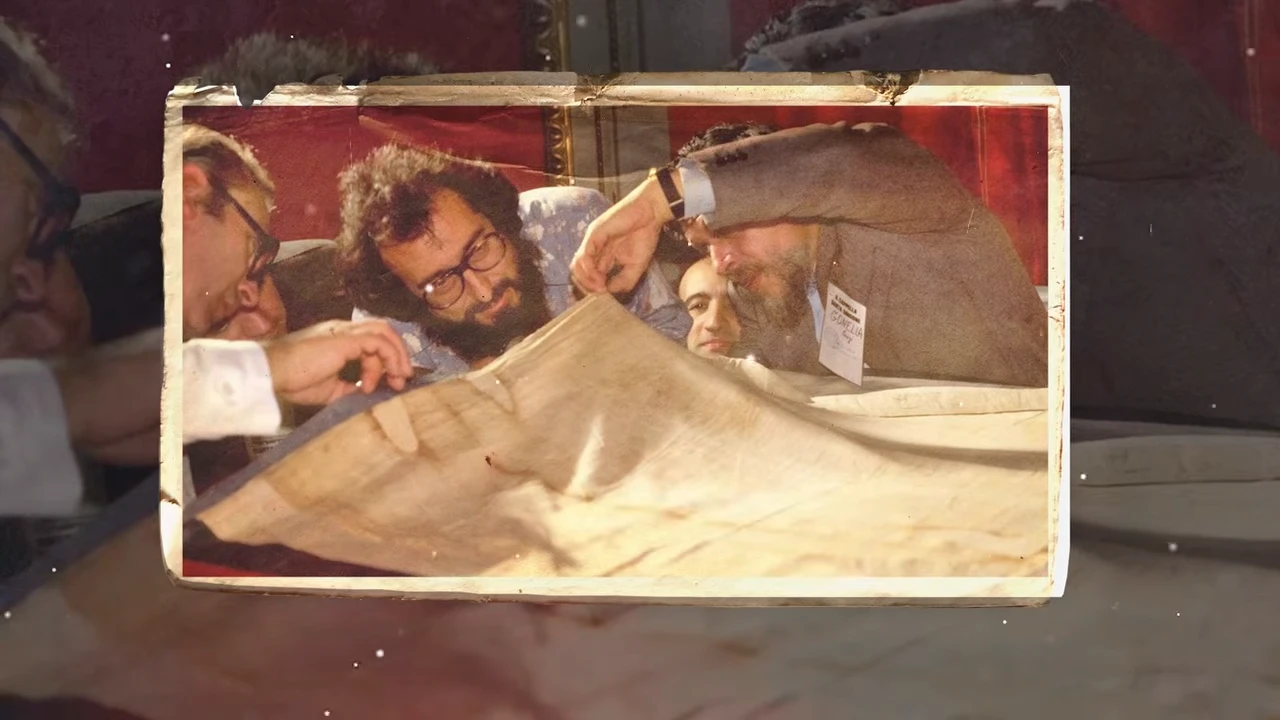
The VP8 converts light and dark values into vertical relief using brightness as a proxy for height.
When applied to any ordinary photograph or painting, the result is spatial distortion with no relation to physical form.
When the STRP team ran the shroud through the VP8, it produced an anatomically accurate three-dimensional relief of a human body.
The image encoded a precise mathematical correlation between brightness and clothto body distance at every point.
No painting encodes that data and no photograph does either.
No known image formation process produces a spatially encoded three-dimensional map from a two-dimensional cloth surface.
The STR team had no explanation for it at the time.
45 years of subsequent research have produced none.
The blood that should not be read.
Schwarz remained a skeptic for 18 years after Turin.
He needed every piece of the puzzle to fit without forcing or special pleading.
One piece did not fit at all, and it sat at the center of the entire object’s claim to authenticity.
The blood on the shroud is red.
Blood oxidizes the moment it leaves the body, turning brown within hours and black within days.
A 2,000-year-old blood stain should be dark and chemically degraded, but the stains on the shroud were clearly red in 1978 and remain red today.
No preservation chemistry or natural aging process known to Schwarz could account for this.
He raised the issue with other researchers over the years and received only vague speculation.
He raised it again in 1995 during a phone call with Dr.
Alan Adler.
Adler was a biochemist at Western Connecticut State University and one of the world’s foremost blood chemistry experts.
He was also Jewish, a detail Schwarz found meaningful because the man who finally answered the question was not a Christian defending a conclusion.
Adler asked whether Schwarz had read his published paper on the st chemical analysis.
Schwarz had not absorbed its significance.
Adler laid it out directly.
The STR tests had detected bilerubin in the blood stains at concentrations far above normal levels.
Bilerubin is produced by the liver as it breaks down hemoglobin under extreme and sustained trauma, prolonged beating, severe dehydration, and cardiovascular shock.
The liver floods the bloodstream with bilerubin at 10 to 20 times normal levels.
Adler found exactly that signature on the shroud.
At high concentrations, Bill Rubin’s yellow orange pigmentation masks the oxidative darkening of hemoglobin.
It preserves the visual redness of blood indefinitely.
Not for centuries, but permanently.
Blood carrying that bilerubin load does not turn black.
It stays red.
No medieval forger could have known to add bilerubin to fake blood.
Billerubin was not isolated or understood until the 20th century.
The chemistry closed Schwarz’s last remaining objection.
He applied the logic of Sherlock Holmes.
Eliminate the impossible and whatever remains, however improbable, is the answer.
Not a painting, not a photograph, not a scorch, not a rubbing.
The image chemistry was confined to the outermost fibbrals by a mechanism no technology has reproduced.
Three-dimensional spatial encoding that no known image process produces.
blood from a crucified man who had suffered extended torture carrying a biochemical signature too specific to have been fabricated.
When the Bill Rubin explanation closed his last open question, Schwarz had only one conclusion available to an honest man.
He accepted it not as an act of faith but as a surrender to the evidence.
The flowers from Jerusalem.
The botanical evidence accumulated around the shroud is the chapter of this story that receives the least public attention and yet deserves the most careful consideration because plants do not lie and pollen does not migrate across continents without human assistance.
It begins with a Swiss criminologist named Max Frey who collected adhesive tape samples from the shroud surface in 1973 and identified pollen grains from plants native to regions as geographically distinct as Palestine, Turkey, and France.
A distribution that immediately suggested the cloth had traveled extensively.
Fry’s methodology was questioned at the time by skeptics who doubted his identification techniques, but the pollen itself was real physical material that could be independently verified.
In 1978, during the STRP examination, he took a second set of 27 samples under more controlled conditions.
In 1979, he collected 46 samples from a companion relic in Spain known as the Sudarium of Oeddo.
And the geographic distribution of what he found on both cloths pointed consistently toward the Near East, specifically the region around Jerusalem rather than medieval Europe where the shroud was supposedly forged.
The story deepened significantly in 1995 when a pair of American researchers Allan and Mary Wanger began identifying faint floral imprints in enhanced photographs of the shroud.
Images so subtle that they had gone unnoticed for decades beneath the more dramatic features of the face and wounds.
They reached out to Avanoam Danin, a professor of botany at the Hebrew University of Jerusalem, who was one of the world’s leading authorities on Neareastern flora and had spent decades building a distribution database of plant species across Israel, organized into grids of 5 km by 5 km.
Danon was a Jewish scientist with no religious investment in the shroud and no motive to find anything other than what the evidence showed.
And he agreed to review the photographs the Wangers sent.
Initially skeptical himself, he found additional floral images in the photographs the Wangers had missed and identified the species using the same forensic methodology he applied to any botanical investigation, comparing the shapes and structures visible on the cloth with his extensive herbarium of pressed plant specimens from across the region.
What Dannon found was a species assemblage that exists in only one place on Earth.
And the specificity of that finding cannot be overstated.
The highest pollen density on the cloth came from Gondilia Tornaphorti, a thistle that blooms exclusively in the Jerusalem region between March and May and that several botonists have independently identified as a strong candidate for the plant used to make the crown of thorns based on its spiny structure and local availability.
A second species, zygopilum dumosum, grows in a narrow geographic band that connects Jerusalem, Hebron, and parts of modern Jordan.
nowhere else in the world and its presence on the cloth is geographically diagnostic.
A third species cystus creticus overlapped with both of the others in its growing range and the co-occurrence of all three confirmed through independent pollen analysis by Israeli pollen specialist Uri Baruk and through floral imaging by Danin points to a single geographic zone the Jerusalem hebron corridor and a single season of the year March or April.
Danin stated this conclusion publicly at the International Botanical Congress in St.
Louis in 1999 before an audience of more than 4,000 scientists from a 100 countries and his presentation was met not with applause but with the stunned silence of professionals who understood the implications.
His conclusion was unambiguous.
The plant material on the shroud could only have been freshly collected from the vicinity of Jerusalem and placed on the cloth in the spring, meaning it could not have come from Europe.
And no medieval forger in France or Italy had access to a fresh Palestinian tumbleeed and a reason to press it against a cloth.
Danon also identified a correspondence between the facial image on the shroud and a sixth century Byzantine icon known as the panto of the monastery of St.
Catherine in the Sinai with facial proportions matching at a level of precision that went far beyond stylistic similarity and into the realm of forensic identification.
The icon predates the shroud’s first documented appearance in Europe by roughly 8 centuries, suggesting that the image on the cloth was known in the Eastern Mediterranean long before any medieval forger could have created it.
Danin spent 14 years on his investigation, publishing his final conclusions through the Missouri Botanical Garden Press in 2010.
And he was not persuaded by faith or by any desire to believe.
He was persuaded by plants, by the immutable geography of species distribution, and by the impossibility of a medieval European forger accidentally creating a floral signature that matched first century Jerusalem.
The carbon dating disaster.
In 1988, the scientific community believed it had settled the shroud question once and for all.
Three independent radiocarbon laboratories in Oxford, Zurich, and Arizona tested a sample from the lower left corner of the cloth.
All three returned dates in the range of 1260 to 1390 AD.
The media announced that the shroud was a medieval forgery.
Most of the world accepted that conclusion and stopped paying attention.
Barry Schwarz did not stop paying attention.
He had 10 years of STR data telling him the carbon dating result was inconsistent with everything else the examination had found.
He was not alone in that assessment.
Raymond Rogers, the head of STR’s chemistry group and a retired fellow of Los Alamos National Laboratory, spent years quietly examining threads from the tested area.
Rogers compared them against threads from the main body of the cloth.
His findings were published in the peer-reviewed journal Thermmochemica Acta in 2005.
The tested threads were chemically different from the rest of the cloth.
They contained cotton fibers not present anywhere else on the shroud.
They showed a surface coating consistent with dye.
They exhibited a weave pattern that did not match the main body.
Rogers concluded that the tested corner was a medieval repair patch.
Invisible reweaving was a documented practice of medieval textile workers who repaired precious damaged cloths.
The 1988 carbon dating had accurately dated the repair and said nothing about the original linen beneath it.
Rogers died shortly after his paper was published.
His widow donated his tape samples to Schwarz, who preserved them in the Stera archive for future research.
In 2025, a comprehensive review in the journal Heritage concluded that the 1988 result is compromised by the sample location problem.
The question of the cloth’s age remains unresolved.
Further testing on fibers from the main body is scientifically necessary.
That peer-reviewed assessment came 37 years after the press conference that told the world the case was closed.
The most recent DNA analysis has added still more complications.
A preprint study from the University of Padua published in March 2026 analyzed dust vacuumed from the cloth in 1978.
It identified human mitochondrial DNA from individuals of diverse ethnic origins.
Significant proportions came from genetic lineages associated with the Indian subcontinent.
One hypothesis is that the linen itself was woven in the ancient Indis Valley.
that would be consistent with documented Roman era textile imports from the region.
A separate 2026 DNA study found halopilic archa in the cloth’s microbiome.
These organisms thrive in high salinity environments such as the Dead Sea region.
Neither finding proves authenticity, but both are deeply inconsistent with a 14th century French origin.
The image that cannot be made.
The deepest problem the shroud presents is not the blood, the pollen, or the failed carbon dating.
It is the image itself.
No one has ever reproduced it.
Not the art community with all its skill, not the scientific community with all its technology.
Every attempt has either produced some of the properties or none of them, but never all of them simultaneously.
The properties are mutually exclusive under every known image formation process.
The image exists only in the topmost fibbrals of the linen threads.
Each thread is composed of roughly 200 individual microfibrals.
The discoloration reaches the outermost two microfibbrals and stops.
It penetrates to a depth of less than 200 nanome thinner than the wavelength of visible light.
Scorch marks from heat penetrate far deeper because heat conducts through fibers.
Paint aderes to the full diameter of a fiber because the liquid wicks into the spaces.
Contact processes of any kind produce deeper penetration because pressure drives material inward.
No known mechanism generates a uniformly superficial color change confined to the outermost layer across a cloth 14 ft long.
In 2011, researchers at the Italian National Agency for New Technologies, Energy, and Sustainable Economic Development used an ultraviolet Excimer laser to attempt replication.
They could approximate the discoloration’s color.
They could not reproduce the depth.
The laser required so much energy to produce the correct surface chemistry that it destroyed the underlying fibers.
The shroud shows intact fibers beneath a superficially discolored surface.
The team concluded that the energy required was incompatible with any sustained directional process.
It was more consistent with a short intense radially uniform burst of energy.
That description has no natural analog in any physical phenomenon currently understood by science.
The 2004 University of Padua discovery of a second faint facial image on the reverse surface compounded this problem.
Both the front and back surfaces carry an image.
The interior of the cloth between those surfaces carries nothing.
A contact transfer process would produce an image that would soak from one surface through the fiber to the other.
The dual surface configuration is physically consistent only with a process in which the energy originated from within or beneath the cloth and acted outward in both directions simultaneously.
That configuration has no known natural explanation in physics or chemistry.
It remains one of the most underdisussed anomalies in the entire Shroud literature.
What a Jewish mother understood.
Schwarz told a particular story at nearly every public lecture in the last decade of his life.
It was not about Billy Rubin or VP8 analyzers.
It was about his mother.
She had a high school education and grew up in a small village in Poland.
She attended one of his lectures and listened carefully to the full presentation of evidence.
They drove home in silence afterward.
He asked what she thought.
She said that of course it was authentic because they would not have kept it for 2,000 years if it were not.
She had understood in 60 seconds what had taken him 18 years of scientific analysis to accept.
Her reasoning was rooted in Jewish law.
Under Halaka, a burial cloth soaked in blood is ritually impure.
The law does not permit its removal from the grave under ordinary circumstances.
Keeping a blood soaked burial shroud above ground, handling it, and displaying it all violate Jewish law.
Such violations require an extraordinary justification.
The justification for overriding the law is that the body was no longer there.
The question Schwarz began receiving after he stated his belief was not about the cloth.
It was about God.
What the shroud dragged him back to was a confrontation with a belief he had not been seeking.
He could not avoid it.
not through any spiritual experience but through evidence.
He did not convert to Christianity.
He remained Jewish.
But he described reconnecting with his own faith as a direct consequence of what 46 years of evidence had forced him to face.
He said at his Tedex talk at the Vatican in 2013 that he had not been in that room for himself.
He had been there for the people who could not be there.
He understood his role as that of a witness.
A witness reports what they saw and the people listening decide what it means.
Schwarz died on June 21st, 2024 at the age of 77.
He had founded the world’s largest Shroud research archive at shroud.
com, which had attracted more than 15 million visitors from over 160 countries.
He had taught future Catholic priests at the pontipical Athenium in Rome.
He had lectured on six continents.
He never claimed the shroud proved the resurrection.
He consistently said it was a pre-resurrection image, a cloth laid over a dead man.
Whatever happened after that was outside the reach of any instrument.
What the science could establish, he believed it had established.
What lay beyond that, he left to the people standing in front of the evidence.
He left them to make up their own minds.
The Sudarium connection.
There is a related relic that rarely enters the discussion of the shroud.
The Sudarium of Oeddo is a small bloodstained cloth kept in the Cathedral of San Salvador in northern Spain.
Historical records place it in Odedo by at least 600 at 31 AD.
Earlier documents trace its movement from Jerusalem before the Persian invasion of 614 AD, passing through Alexandria and Carthage.
Since its arrival in Oeddo, it has remained there for more than 14 centuries.
Its chain of custody is one of the most reliable in relic history.
According to the Gospel of John, the sudarium is the cloth placed over Jesus’s face in the tomb before the body was wrapped in the shroud.
Unlike the shroud, it carries no image, only blood stains.
Those stains have been studied in detail by Spanish forensic researchers.
The pattern is consistent with a bearded man who died in a vertical position.
Blood and pulmonary fluid consistent with crucifixion are present.
The head position inferred from the stains matches the angle of the face on the shroud with remarkable precision.
The overlap pattern suggests the sudarium and shroud came into contact with the same face in sequence.
First, the small cloth caught the blood from the wounds.
Then, the larger cloth wrapped the body.
Max Fry, the Swiss criminologist who sampled the shroud, examined the sudarium in 1979.
He identified 46 pollen samples on the sudarium.
Many species matched on the shroud, including plants native exclusively to the Palestine region.
The overlap is difficult to dismiss as a coincidence.
Two cloths preserved in different countries for over a millennium share matching blood characteristics, stain patterns, and regional pollen signatures.
If one cloth is a medieval forgery, the other must also be a forgery.
That would require creation across centuries and across continents in perfect biological and environmental alignment.
How do two separate relics separated by history and geography end up telling the same story? The only answer is that they both came from the same moment in time.
The final presentation connected to Barry Schwarz took place at the Shroud of Turin International Conference in 2025, nearly a year after his death.
A colleague, Father Andrew Dalton, delivered the tribute.
He recalled a line Schwarz often used when challenged by aggressive skeptics.
When someone insisted they would never be convinced, Schwarz would respond that their belief was not his concern.
It was something they would have to settle for themselves.
It was not a dismissal, but a line between evidence and interpretation.
After 46 years of trying to disprove it, he had run out of honest ways to say no.
And when a skeptic spends a lifetime trying to disprove something and still cannot, the question shifts from belief to something more difficult.
What kind of evidence is capable of outlasting doubt? about itself.
Thanks for watching.
Check out the videos on screen now for more stories like this one.