This Is Exactly How To Talk To The Holy Spirit And Hear Him Speak Back To You
This Is Exactly How To Talk To The Holy Spirit And Hear Him Speak Back To You
The late-afternoon sun poured through the high windows of the downtown Chicago loft, catching the millions of dust motes suspended in the air. Outside, the elevated train rattled along its iron tracks, a rhythmic, grinding roar that bled directly through the brick walls. Inside, Thomas sat at his minimalist white desk, his head buried in his hands. On his laptop screen, an open email from a major publishing house blinked mockingly—a lucrative contract offer that demanded a decision by midnight. On his lap sat a leather-bound journal, its pages filled with frantic, scribbled prayers, all of them completely unanswered.
For fifteen years, Thomas had been a committed believer. He attended services every Sunday, led a weekly small group, and read his devotional before the rest of the city woke up. He talked to God constantly. He muttered prayers while navigating the gridlock on I-90, sent up desperate pleas before high-stakes board meetings, and whispered words of gratitude before dinner. Yet, as he stared at the blinking cursor on his screen, he felt an overwhelming, hollow exhaustion. He was talking into a void. Like millions of believers across the country, Thomas had mastered the art of speaking to heaven, but he had never truly heard a single word spoken back. It wasn’t because heaven was intentionally silent; it was because nobody had ever taught him how to cultivate the silence required to listen.
He closed his eyes, his breathing heavy. “If you’re there,” he whispered into the empty room, “and if you actually care about this, say something. Anything.”
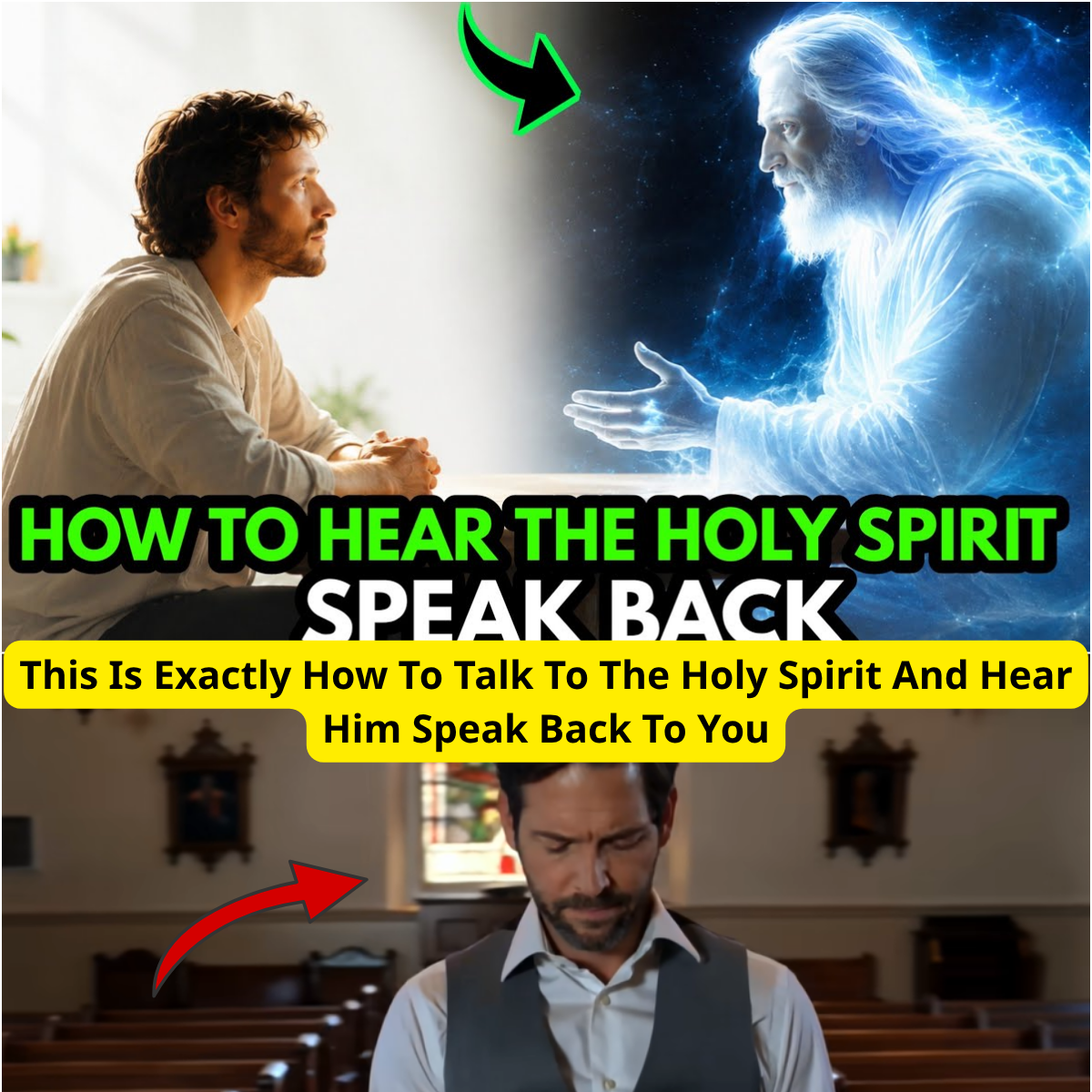
The room remained perfectly still, save for the distant, mocking hum of the refrigerator. Thomas sighed, rubbing his temples. He felt a familiar wave of guilt wash over him. He had always been told that the Holy Spirit was an active guide, a counselor sent to navigate the complexities of human life. But to Thomas, the Spirit was nothing more than an abstract theological concept—a vague, sacred energy that occasionally produced a fleeting emotional warmth during a particularly powerful worship song.
He didn’t realize that this very perception was the exact reason his prayers felt entirely one-sided. You cannot have a meaningful conversation with someone you treat as an impersonal force.
Thomas stood up, abandoning his desk, and walked over to the large bookshelf that lined the eastern wall of the loft. His hand brushed past titles on leadership, productivity, and church growth until it rested on an old, cloth-bound volume given to him by his grandfather years ago. He pulled it from the shelf, causing a small slip of paper to flutter to the hardwood floor.
He knelt and picked it up. It was a faded index card covered in his grandfather’s sharp, steady handwriting. At the top, the words The Anatomy of the Whisper were written in dark ink. Beneath it lay a structured outline of six distinct steps, accompanied by scribbled scripture references.
Thomas sat cross-legged on the floor, the card resting in his palm. His eyes drifted to the first note: Recover the lost understanding of who He is.
Beside the note, his grandfather had penned Ephesians 4:30—Do not grieve the Holy Spirit. Thomas stared at the word grieve. It struck him with the force of an unexpected physical blow. An influence cannot experience grief. A wave of cosmic energy cannot feel sorrow. A sacred mood cannot be wounded. Grief is exclusively the response of a person—a person who loves deeply, who possesses a mind, a distinct will, and profound emotions.
Thomas realized that for his entire Christian life, he had been treating the Spirit of God like a divine vending machine or a spiritual atmospheric pressure gauge. He had reversed the natural relational order that the early church lived by. In the book of Acts, the apostles had confidently written, “It seemed good to the Holy Spirit and to us.” They didn’t make their own plans and then casually ask God to rubber-stamp them with a blessing; they listened first, consulted Him as a living person, and moved second.
A sudden sense of smallness overtook Thomas. The entity he was attempting to contact wasn’t a distant, cosmic entity hiding behind light-years of space. According to the scriptures, this living Person was closer to him than his own breath, completely aware of the specific anxieties knotting his stomach, and infinitely more interested in speaking than Thomas had ever been in listening.
Following the instructions on the faded card, Thomas decided to change his approach entirely. The second step on the card read: Approach Him the way He invites to be approached—with a posture of welcome, not performance.
Thomas leaned his back against the bookshelf, uncrossing his legs. For years, his prayers had been performative, characterized by flowery, theological vocabulary and a subconscious attempt to prove he was worthy of an answer. He looked down at the card, which quoted Luke 11:13: “How much more will your heavenly Father give the Holy Spirit to those who ask him?” The Greek word for ask, his grandfather had noted, implied an intense, raw dependence—a genuine hunger that valued the presence of the Giver far more than the gift itself.
“Holy Spirit,” Thomas said aloud, his voice cracking slightly in the quiet apartment. “I am stopping the performance. I’m not pretending to have it all together, and I’m not going to try to impress you. I am simply acknowledging that you are in this room with me right now. I want to know you.”
As the words left his mouth, a subtle shift occurred within the room. The frantic internal static that had been buzzing in his mind all afternoon—the contract deadlines, the financial projections, the endless mental rehearsals of arguments he might have tomorrow—began to settle. It was as if the emotional chamber of his heart was undergoing a decompression process.
He didn’t offer a list of demands. Instead, he chose to be completely honest about his fear. He admitted his terrifying dread of making the wrong choice regarding the contract, knowing that according to Psalm 139, there wasn’t a single hidden thought on his tongue that the Lord didn’t already know completely. He realized that a hidden heart is functionally incapable of hearing, but an honest heart creates an open doorway.
The third step on the index card addressed the core problem that had haunted Thomas for over a decade: Learn the actual language that He speaks.
Thomas read his grandfather’s notes carefully. The Spirit rarely speaks in audible thunder. He communicates through a gentle, internal knowing that arrives unannounced but carries unmistakable weight. The card broke this language down into four distinct structural channels: the internal witness, the illumination of scripture, sanctified intuition, and divinely arranged confirmation.
As Thomas meditated on these channels, his mind began to race backward through his own history, recontextualizing moments he had previously dismissed as mere coincidence.
He remembered a major business deal three years ago that looked flawless on paper, yet a deep, unshakeable certainty had settled into his gut, warning him to walk away. His logic couldn’t explain it, but he had listened to that quiet internal witness anyway; six months later, the company they were supposed to partner with dissolved overnight amid massive fraud allegations.
He remembered opening his Bible during a season of profound grief and having a single, obscure verse practically stand up off the page, addressing his exact emotional state with surgical precision.
He realized that what he had always casually labeled as “good intuition” or “borrowed wisdom”—thoughts of profound patience or radical generosity that were completely uncharacteristic of his naturally cynical personality—had actually been the voice of the Holy Spirit speaking to his spirit. The Spirit had never been silent; Thomas had simply been completely untrained in His vocabulary.
The fourth step on the card carried a stern, uncompromising title: Master the discipline of sacred stillness.
Beneath it, his grandfather had written a stark contrast: The ancient saints lived in stillness and heard whispers. Modern believers live in noise and strain to hear a shout. Habakkuk 2:20—Let all the earth keep silence before Him.
Thomas looked around his apartment. Even in the relative quiet of his home, the modern world was aggressively loud. His phone sat on the coffee table, its screen lighting up every few minutes with news alerts, social media notifications, and text messages. His mind was a perpetual browser with fifty open tabs, constantly scrolling, constantly digesting content.
He thought of the prophet Elijah on the mountain. God wasn’t in the spectacular wind, the dramatic earthquake, or the raging fire. He came in a still, small voice—a whisper so low that Elijah could only catch it because he had intentionally withdrawn into the isolation of a cave.
Thomas picked up his phone, pressed the power button, and shut it down completely. He walked over to his desk, closed the laptop lid, and walked back to his spot on the floor. He closed his eyes and committed to ten minutes of absolute, unhurried silence.
At first, the silence was agonizing. His brain rebelled against the lack of stimulation, screaming at him to check the time, to review his emails, to do something productive. But Thomas forced his body to remain still. He focused on his breathing, mentally pushing away the urgent demands of his schedule.
Within a few minutes, the internal resistance began to break. In that deep quiet, the silence stopped feeling like an empty void and began to feel like a tangible presence. It was a space where his scrambled anxieties were being systematically rearranged, where the heavy residue of daily stress was being gently carried away. Stillness, Thomas discovered, wasn’t just the acoustic environment required to hear a whisper; it was the operating table where the Spirit performed emotional restoration.
As the silence deepened, a sudden, distinct impression formed in Thomas’s mind. It wasn’t an audible voice, but a sudden, crystalline thought that entered his consciousness from the outside: The contract is a golden cage. Walk away, and feed the sheep.
The thought was so sudden and specific that Thomas opened his eyes, his heart hammering against his ribs. He immediately felt a wave of intense fear. Walking away from the contract meant walking away from financial security. Was this actually God speaking, or was it just his own subconscious fear of commitment? Or worse, was it a psychological delusion?
He turned back to the index card, his eyes scanning for the fifth step: Test what you hear with spiritual precision.
His grandfather had written: Beloved, do not believe every spirit, but test them. Maturity requires filters. The card listed four rigorous, objective filters that every internal impression had to pass through before a believer took action.
+---------------------+---------------------------------------------------------+
| FILTER              | SCRIPTURAL STANDARD & REALITY CHECK                      |
+---------------------+---------------------------------------------------------+
| 1. Scripture        | The Spirit never contradicts the written Word He        |
|                     | inspired. (Is the instruction biblical?)                |
+---------------------+---------------------------------------------------------+
| 2. Peace            | Challenge or stretch may occur, but it will carry an    |
|                     | undercurrent of settled peace, never chaotic urgency.   |
+---------------------+---------------------------------------------------------+
| 3. Christlikeness   | The message must align with Christ's heart—humble,      |
|                     | truthful, and redemptive, never proud or cruel.         |
+---------------------+---------------------------------------------------------+
| 4. Fruit            | Over time, the instruction must produce love, joy,      |
|                     | patience, and self-control, rather than bitterness.     |
+---------------------+---------------------------------------------------------+
Thomas put the impression through the grid. Did walking away from a lucrative corporate contract to focus on his local ministry contradict scripture? No; the Bible was filled with admonitions to prioritize pastoral care over the pursuit of wealth.
What about the emotional quality of the impression? Though the thought of turning down the money frightened his flesh, beneath the surface panic lay a profound, immovable bedrock of absolute peace. It lacked the frantic, chaotic urgency that usually characterized his anxiety-driven decisions.
The phrase feed the sheep was a direct, humble echo of Christ’s words to Peter in the Gospel of John—it was redemptive, outward-focused, and entirely devoid of personal vanity or pride. The impression passed every single filter with perfect precision.
Thomas stood up from the floor, his movements no longer frantic but filled with a deliberate, quiet confidence. He walked over to his desk, opened his laptop, and pulled up the draft email to the publishing house. Without hesitating, he typed a polite, firm refusal, hit send, and closed the lid.
He looked out the window at the Chicago skyline, the evening lights beginning to twinkle across the skyscrapers. He felt an extraordinary lightness in his chest, a sensation he hadn’t experienced since childhood. He realized that he had just initiated the sixth and final step written on his grandfather’s card: Build a life of unbroken fellowship.
The note at the bottom of the card read: Obedience is the volume knob of the Spirit’s voice. Every time you obey, the voice sharpens. Every time you ignore it, the voice dulls. Don’t just visit Him; walk with Him.
Thomas knew that his spiritual life would never be the same after tonight. He understood now that listening to the Holy Spirit wasn’t a specialized method reserved for spiritual giants or ancient mystics; it was an unforced, continuous lifestyle meant for ordinary people. It meant keeping the relational line open while navigating the grocery store aisles, while cleaning the apartment, and while listening to a difficult colleague in a corporate boardroom. It was the art of living in step with an eternal Companion—leaning when He leaned, pausing when He paused, and moving when He moved.
He smiled into the quiet loft, the distant roar of the city no longer feeling like a barrier to heaven. He walked back to the bookshelf, carefully placed the index card back inside the old volume, and slid it into place.
“Speak, Lord,” Thomas whispered, his heart completely at rest. “Your servant is finally listening.”
Are you tired of one-sided prayers that feel like they are bouncing off the ceiling? The Holy Spirit is a living person, closer than your next breath, and He has never stopped speaking to you.
Which of these six steps do you need to practice in your life today? Is it mastering the discipline of stillness, or learning to test the impressions you receive? Let me know your thoughts in the comments below, and let’s start a conversation about walking closely with the Spirit.