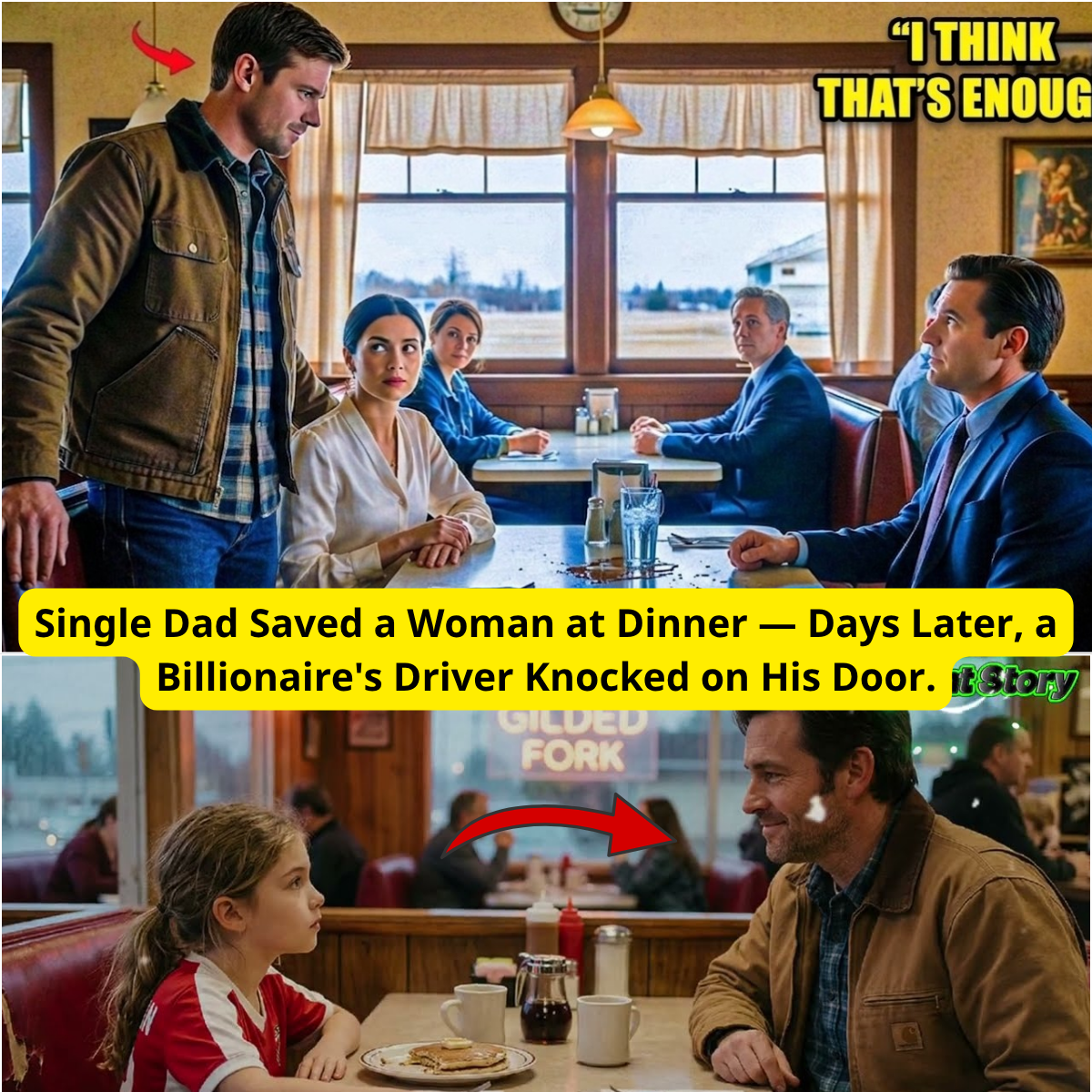
Single Dad Saved a Woman at Dinner — Days Later, a Billionaire’s Driver Knocked on His Door.
Single Dad Saved a Woman at Dinner — Days Later, a Billionaire’s Driver Knocked on His Door.
Act I: The Geometry of Pancakes
The coffee was already cold by the time Marcus Hail noticed the tension radiating from the booth two aisles over.
It was a damp, unremarkable Thursday evening, and Patty’s Diner smelled of burnt onions, cheap maple syrup, and the familiar, reassuring tang of industrial floor cleaner. Marcus hadn’t planned on being here. He had a sink full of dishes at home and a half-graded stack of midterm exams from his automotive class waiting on his desk. But his nine-year-old daughter, Lily, had bypassed his modest dinner pitch with a masterpiece of third-grade negotiation, begging for chocolate-chip pancakes after a bruising soccer practice in the rain.
Marcus, who had spent the last eighteen months merely surviving since the sudden aneurysm that took his wife, Sarah, figured a short stack and scrambled eggs beat another quiet, heavy dinner at the kitchen table.
“Watch the edges, Daddy,” Lily murmured, her small face a picture of intense focus. She was tracking his movements as he used a dull butter knife to cut her pancakes into a perfect grid of triangles. It was a specific ritual—the way Sarah used to do it—and Marcus performed it with the mechanical, careful precision of a man trying to keep a fragile world from tilting off its axis.
He was halfway through the third pancake when the tone of the conversation across the aisle shifted. It wasn’t the volume that caught his attention; it was the frequency.
“I said, you’re embarrassing yourself,” a man’s voice murmured. It was low, controlled, and sharp—the kind of quiet delivery that carries far worse than a shout because it is entirely intentional. “Sit down and stop making a scene.”
Marcus didn’t turn his head. A childhood spent navigating the unpredictable weather of a volatile household had given him a keen radar for social pressure, a sixth sense he’d spent his adult life trying to ignore. Instead, he simply lifted his eyes.
In the booth across the way, a woman in a cream-colored silk blouse sat with her hands folded into a tight, white-knuckled knot on the laminated table. Her dark hair was pulled back into a severe, professional bun, but a few loose strands framed a face pale with a mixture of anger and absolute exhaustion.
Across from her sat a man who looked like he had been dropped into the wrong ZIP code. He wore a navy suit that shouted tailored wool, a clean shave that showed off a sharp jawline, and an expensive silver chronograph that caught the harsh glare of Patty’s fluorescent lights. He had the smooth, practiced smile of a senior partner who was entirely accustomed to dictating the terms of reality.
Beside the woman sat a younger girl—a sister, likely, given the matching curve of her nose—who had frozen completely, her eyes locked onto her untouched plate of chicken tenders.
The man in the suit leaned forward, his elbows resting on the table, invading the woman’s space with a casual, predatory ease. “Everything you have, Elena, I gave you. Don’t you ever forget that.”
Marcus felt a familiar, uncomfortable tightening in his chest. It was the same old instinct Sarah used to tease him about, calling it his “broken radar for broken things.” He told himself to look down. He told himself he had a daughter sitting three feet away, watching him with big, absorbent eyes. He told himself he was a thirty-four-year-old high school shop teacher with grease permanently etched into the lines of his palms—a guy who spent his days explaining the difference between a drum brake and a rotor, with absolutely no business inserting himself into the domestic squabbles of people who bought their clothes in places that didn’t have cash registers.
Then Elena flinched.
It was a tiny thing—barely a two-inch recoil, a subtle tightening of her jaw as if she were bracing for a physical blow that wasn’t coming. But Marcus recognized the movement instantly. He had seen that exact same flinch on his mother’s face thirty years ago, across a different Formica table in a different diner, in a coal town he had spent his entire youth running away from.
He set the butter knife down with a soft clink.
“Daddy?” Lily asked, her fork hovering in the air.
“One second, baby,” Marcus said, his voice level.
He stood up, his large frame unfolding from the vinyl booth. He wasn’t a large man in the theatrical sense—he didn’t have the manufactured muscle of an athlete—but he had the broad, dense shoulders of someone who spent eight hours a day hauling dimensional lumber and wrestling rusted engine blocks into place. He crossed the short distance between the booths in three long strides and stopped right at the perimeter of their table.
The man in the navy suit looked up, his expression transitioning smoothly from malice to the mild, dismissive irritation of a homeowner spotting an ant on the counter.
“Can I help you?” the man asked. His tone managed to imply that Marcus had just tracked wet manure across a pristine carpet.
“I think that’s enough,” Marcus said. He kept his hands loose at his sides, his voice dropped to a quiet, conversational pitch that didn’t carry past their immediate circle. “The lady looks like she’d like some space.”
The man’s eyes narrowed, the practiced smile vanishing instantly. “This is a private conversation, friend. Walk away.”
“Then have it somewhere private,” Marcus replied. He didn’t move an inch. He stood there the way an old cedar fence post stands in a July thunderstorm—unmoving, unthreatening, but completely rooted. “Right now, she looks uncomfortable. So I’m just going to stand right here until that changes.”
Act II: The Anatomy of a Bill
A long, thick silence stretched across the table, heavy enough to drown out the low hum of the kitchen’s pie cooler.
The younger sister looked up for the first time, her eyes wide, glassy with unshed tears, and filled with a sudden, wild mixture of gratitude and terror. Elena herself had gone perfectly rigid. She didn’t look away from Marcus; her gaze searched his face, parsing the scuffs on his flannel shirt and the steady, unblinking green of his eyes with an intensity he couldn’t quite categorize.
The man in the suit let out a short, dry sound that was meant to be a laugh but sounded more like a cough. He realized, with a quick glance around the room, that Marcus wasn’t going to bait himself into a scene. There would be no shouting, no dramatic chest-puffing—just a large, quiet man blocking his exit until he conformed to basic manners.
With deliberate, theatrical slowness, the man reached into his jacket pocket, pulled out a leather billfold, and slipped out a crisp, folded hundred-dollar bill. He dropped it onto the table next to the untouched chicken tenders, then stood up. He was taller than Marcus by a couple of inches, and he made sure to straighten his spine to emphasize the advantage.
“You have absolutely no idea,” the man said, his voice dropping into a dangerous hiss, “what you just stepped into.”
“Probably not,” Marcus agreed, his face entirely blank. “But I know what it looked like from where I was sitting.”
The man held his gaze for one final, icy second, then turned and walked toward the exit. The little brass bell above Patty’s heavy glass door chimed his departure like a sharp piece of punctuation at the end of a long sentence.
Marcus turned his attention to the woman in the blouse. Up close, without the shadow of the man leaning over her, she looked younger than he had first estimated—early thirties, perhaps, with dark, striking eyes that carried the specific, heavy exhaustion of someone who had been the strongest person in every room she’d occupied for a very long time.
“You okay?” Marcus asked softly.
She let out a long, shaky breath, her shoulders dropping three inches as if a physical weight had been lifted off her collarbones. “I will be. Thank you.” She paused, her eyes tracing the grease lines under his fingernails. “You really didn’t have to do that.”
“I know,” Marcus said. He glanced back toward his own booth, where Lily was watching the exchange with the unblinking, absolute absorption of a child recording a permanent memory. “My daughter’s waiting on her triangles. You two going to be all right to get home?”
Elena nodded, a small, genuine movement of her head. “We have a car. Thank you, Mr…?”
“Marcus,” he said, already stepping backward. “Take care.”
He slid back into his vinyl booth, the cold air from the front door still swirling around his ankles. Lily looked at him very seriously, her fork poised over her plate.
“Was that man being mean to that lady?” she asked, her voice carrying that perfect, uncomplicated clarity of a nine-year-old.
“Yeah, baby. He was.”
“Good thing you said something,” Lily said. She picked up a triangle of pancake, dipped it into a pool of syrup, and resumed eating with the calm, total satisfaction of a child whose baseline belief in the universe had just been confirmed by her father. “Mommy always said you can’t just watch.”
Marcus looked down at his black coffee, a small, real smile breaking through the heavy line of his mouth for the first time in months. “Yeah,” he whispered, his chest aching with a sudden, sharp memory of Sarah. “She did say that.”
Act III: The Thick Stock
The truth was, Marcus forgot about the incident by the time he woke up the next morning.
Life as a solo parent didn’t offer the luxury of lingering over old memories. His days were a relentless, crowded assembly line of lesson plans on small-engine repair, soccer carpools, grocery runs where he always forgot the milk, and the deep, silent grief that came at 9:00 PM when he had to tuck in a little girl who still occasionally cried herself to sleep because her mother wasn’t there to smell like vanilla lotion. There simply wasn’t any room left in his brain to wonder about strangers in highway diners.
Four days later, Marcus was out in his gravel driveway, the hood of his 2012 F-150 propped open with a length of two-by-four. He was elbow-deep in the engine bay, grease up to his forearms, trying to replace a stubborn brake line before the rain started.
The heavy, low rumble of a diesel engine caused him to look up. A massive, polished black Lincoln Navigator rolled to a stop at the edge of his grass. The vehicle was spotless, its deep black paint reflecting the modest frame of Marcus’s ranch house like a mirror.
The driver’s door opened, and a man in a crisp gray uniform and polished black shoes stepped out. He didn’t look like a repo man, and he didn’t look like a process server. He walked up the driveway with a quiet, professional deference, holding a small, heavy envelope in his gloved hand.
“Mr. Marcus Hail?” the driver asked.
Marcus wiped his hands on an old red shop rag, his brows furrowed. “That’s me.”
“I was instructed to deliver this to you personally,” the driver said. He handed the envelope over, gave a brief, polite nod, and turned back to the vehicle without another word of explanation. The Navigator purred as it backed out onto the main road, leaving Marcus alone in the gravel.
Marcus tore open the envelope. Inside was a piece of note card made from thick, cream-colored stock—the kind of stationery that feels like fabric and costs more than Marcus’s monthly utility bill. Written across the center in precise, elegant fountain-pen ink were a few simple lines:
Mr. Hail,
You were kind the other night when kindness carried a risk. I would like to repay that debt, if you’ll allow me. No strings, no obligations.
— Elena Voss
Below the signature was a direct phone number.
Marcus stood there for a long time, the red rag limp in his hand, feeling slightly ridiculous in his oil-stained jeans. His initial instinct was to throw it in the kitchen trash. He tried to convince himself it was some kind of mistake, or worse, some bizarre, high-society game whose rules he didn’t understand. But as he looked at the neat, careful loops of the handwriting, he remembered the look of sheer exhaustion in her eyes across that diner aisle.
He went inside, washed the grease off his hands with orange pumice soap, and dialed the number.
Act IV: The View from the Mill
What Marcus didn’t know—what almost nobody in the small, working-class town of Mill Haven, Ohio, knew—was that Elena Voss was the sole heir to the Voss Group.
Her father, Richard Voss, had built the empire from a single, dusty tool-and-die plant in 1987 into a privately held manufacturing juggernaut with holdings across six states. When Richard passed away two years prior, he had left the keys to the kingdom to Elena.
Elena, however, wasn’t her father. She had spent the last twenty-four months quietly, methodically shifting the corporation away from the aggressive, extractive labor practices her father had used to maximize margins, steering it toward local community reinvestment and sustainable manufacturing. It was a massive, dangerous pivot, and it had earned her an army of enemies in her own boardroom.
The man in the navy suit at Patty’s Diner was Preston Caldwell. He had been her father’s chief legal counsel and most trusted adviser for twenty years. For the past twelve months, Preston had been using every lever of psychological pressure, board manipulation, and old-guard loyalty to force Elena into selling the company’s most profitable division to a private equity firm—one he possessed undisclosed financial ties to.
The dinner at Patty’s hadn’t been a date; it had been an ambush. Preston had chosen a public, out-of-town venue specifically to keep her off-balance, calculating that she wouldn’t risk an executive scene. He had spent two hours trying to systematically dismantle her confidence, using her late father’s legacy as a weapon to make her feel small, isolated, and incompetent.
She had been entirely alone in that fight for months. Her legal team was risk-averse, her board of directors was split along generational lines, and her younger sister, Diane, while fiercely loyal, lacked the stomach for the brutal arithmetic of corporate warfare. Elena had been running on absolute empty, her tank dry, on the verge of signing the divestment papers just to make the pressure stop.
And then a high school shop teacher with grease under his fingernails had stood up and reminded her what a fence post looked like.
When Marcus met her for coffee the following morning—not at Patty’s, but at a quiet, independent bakery three towns over—she told him everything with a blunt, refreshing lack of corporate spin.
“I have enough money to buy every diner in this state, Marcus,” she said, her fingers wrapped around a ceramic mug. Her eyes were clear today, the exhaustion replaced by something sharp and re-ignited. “What I’ve been missing for a year is perspective. You did something four days ago that reminded me of a rule my father forgot toward the end of his life.”
“What’s that?” Marcus asked, his flannel sleeves rolled up to his elbows.
“That the right move is usually the simplest one,” she said, looking him dead in the eye. “You just have to be willing to stand your ground until the noise stops.”
She paused, her expression softening as she looked past his shoulder. “Tell me about the little girl. The one with the serious eyes who was watching you.”
Marcus found himself talking about Lily. He talked about Sarah’s illness, the long nights in the hospital, the terrifying reality of trying to teach a nine-year-old girl how to navigate a world without her mother, and the constant, low-grade fear that he wasn’t doing enough to keep her safe. Elena listened the way very few people in Marcus’s life listened anymore—completely, without shifting her weight, without checking her phone, and without already forming her next polite response in her head.
By the time they finished their coffee, nothing miraculous had occurred. No contracts were signed, no checks were exchanged, and no grand cinematic declarations were made. It was just two people from completely different solar systems who had accidentally discovered a shared language: the ordinary, rare courage of being completely honest with another human being.
Act V: The Ripple in the Shop
Three months later, the corporate world in Columbus was rocked by a quiet, devastating earthquake.
Preston Caldwell’s year-long attempt to fracture the Voss Group collapsed within forty-eight hours after a forensic audit—one Elena had quietly commissioned the morning after her breakfast with Marcus—revealed a complex web of shell companies and kickback agreements tied directly to the private equity group. By Friday afternoon, Caldwell had signed a nondisclosure agreement, resigned his seat on the board, and disappeared into a retirement he hadn’t planned for.
The manufacturing division stayed exactly where it belonged.
But the real change didn’t happen in a high-rise office downtown. It happened in the basement wing of Mill Haven High School.
Elena had redirected a significant portion of the Voss Foundation’s annual charitable budget away from the usual high-profile art galas and channel-funding initiatives, targeting it directly toward vocational training programs in underfunded rural school districts—the exact types of trade, wood, and automotive classes that were being systematically stripped from budgets across the state.
On a hot Tuesday morning in late September, Marcus was sorting through a box of worn-out socket wrenches when his department head walked into the shop and dropped a thick manila folder onto his grease-stained workbench.
“You might want to read this, Hail,” the older man said, his face a mixture of disbelief and awe. “It just came in from the superintendent’s office.”
Marcus pulled out the letter. It was from the state board of education, notifying the district that Mill Haven High School had been selected as the primary recipient of an unrestricted five-year vocational grant from the Voss Foundation. The amount was staggering—enough to completely replace their twenty-year-old welding rigs, buy two new hydraulic car lifts, and guarantee the department’s funding until Lily was halfway through high school.
Marcus read the letter twice, his eyes lingering on the small, elegant Voss Group logo embossed at the top of the page. He set the paper down slowly against the wooden workbench, his mind drifting back to a rainy Thursday evening, a little girl who wanted her pancakes cut into triangles, a cold cup of coffee, and the sharp, clean sound of a diner bell ringing as a coward walked out into the dark.
That evening, Marcus and Lily didn’t go to Patty’s. They stayed home and made dinner together—a real dinner, with fresh chicken, actual green vegetables, and a pot of pasta that required constant attention.
“Lily,” Marcus said as he helped her chop zucchini with a child-safe plastic knife. “You remember that lady from the diner a few months back? The one whose table I stood next to?”
“The one with the mean friend?” Lily asked, her brow furrowing as she concentrated on a slice of squash.
“Yeah. That one. Turns out she was able to do something really nice for my school because of that night. She fixed up the whole shop class.” Marcus smiled, watching his daughter stir the sauce. “Sometimes, baby, doing the right thing in one little room sends out ripples that go further than you can see.”
Lily considered this for a very long moment, her spoon held mid-air as she ran the math through her third-grade brain.
“Like when we dropped that silver dollar into the fountain at the mall at Christmas?” she asked, her eyes lighting up with the discovery. “And the water made those big circles all the way to the edge of the stone?”
Marcus let out a laugh—a loud, full, resonant sound that bounced off the kitchen walls and filled the corners of the kitchen. It was the kind of genuine laugh that hadn’t lived in that house since Sarah passed away.
“Yeah, baby,” Marcus said, reaching over to pull her into a quick, one-armed hug. “Exactly like that.”
Outside the kitchen window, the streetlights of Mill Haven clicked on one by one down the quiet block, casting long, steady bars of yellow light across the gravel driveway. The autumn wind was picking up, rattling the screen door slightly, but inside the small house, for the first time in a very long time, the air felt warm, solid, and completely full.