A Quiet Single Dad Met a Heartbroken Billionaire—His Words Changed Her Life Forever…
A Quiet Single Dad Met a Heartbroken Billionaire—His Words Changed Her Life Forever…
Chapter I: The Blue-Collar Sanctuary
The bells above the heavy glass door of the Sunrise Diner didn’t chime so much as rattle, a familiar, metallic greeting that fit the crisp rhythm of an early October morning in Chicago. It was 7:45 a.m. The sun was still low enough to cast long, hard shadows across Elm Street, cutting through the thin autumn fog and striking the grease-filmed windows of the corner booth.
Thomas walked in first, his heavy leather work boots leaving a faint trace of sawdust on the industrial linoleum. He was thirty-six, though the deep lines bracketed around his eyes and the permanent silver threading through his dark hair suggested a man who had lived closer to fifty years of hard winters. He wore a faded flannel shirt, its elbows softened to the thickness of gauze, and a canvas work jacket that smelled permanently of cedar shavings and motor oil. He was a carpenter by trade—the kind who built houses from the framing up, his hands mapping out a blueprint of calluses, scars, and ingrained grit that no amount of industrial soap could ever fully erase.
Behind him, holding tightly to the pocket of Thomas’s canvas jacket, was eight-year-old Danny.
Danny was small for his age, carrying his yellow windbreaker like a security blanket, dragging it slightly against the floor. He had the same wide, dark eyes his mother had possessed before the cancer took her four years earlier. Since that damp November morning when the world emptied out for them, Thomas and Danny had moved through life with a quiet, synchronized caution. They were like two survivors of a high-seas shipwreck who had learned to navigate a lifeboat without needing to speak. They knew each other’s silences perfectly.
“The usual corner, Dad?” Danny asked, his voice muffled by the collar of his shirt.
“You bet, buddy,” Thomas said, guiding the boy into the vinyl booth near the back window.
The Sunrise Diner was their sanctuary. It was a place where nobody asked Thomas why he looked so tired, and nobody asked Danny why he didn’t talk much at school. It was an island of predictable, low-stakes comfort. Thomas ordered a black coffee; Danny ordered a silver-dollar pancake combination, specifically requesting that the kitchen cut the sausages into small circles and leave the butter completely on the side.
While they waited, Danny went to work on his ritual. He reached into the small ceramic caddy at the edge of the table and began extracting the individual sugar packets. One by one, with the intense, geometric focus of a master mason, he lined them up along the faux-wood grain of the laminate table. White packets of refined sugar formed the perimeter; pink packets of saccharin filled the secondary tier; and the blue packets of aspartame sat precisely in the center.
Thomas wrapped both of his massive, rough hands around the thick white ceramic mug the waitress had dropped off. He didn’t drink yet. He just let the rising steam hit his face, allowing the heat to travel up his forearms, loosening the deep ache that came from spending ten hours the day before installing subflooring in a drafty warehouse.
He looked at his son’s small, busy fingers. Love, Thomas had learned, wasn’t a grand speech or a dramatic gesture. It was a series of tedious, repetitive adjustments. It was learning how to cut a grilled cheese sandwich into four identical triangles because a little boy had decided that rectangles were “unsafe.” It was waking up at 5:30 a.m. to make sure the laundry was dry so Danny wouldn’t have to wear a damp sweatshirt to school. It was sitting in a diner booth on a Tuesday morning just to prove to a child that some things in the world stayed exactly where you left them.
Chapter II: The Corporate Fracture
At 8:12 a.m., the bells above the door didn’t just rattle; they practically shrieked as the door was thrown open with an aggressive, hurried force.
Jolie walked in, and the entire room shifted its weight.
She didn’t belong in the Sunrise Diner, and she didn’t belong on Elm Street at eight o’clock on a Tuesday morning. She was thirty-eight, her blonde hair pulled back into a knot so tight it looked painful, wearing a tailored navy wool coat over a silk cream-colored blouse that probably cost more than Thomas made in a week of framing. She carried a leather briefcase like a shield, her heels striking the floor with a sharp, militaristic clack-clack-clack that caused the old men at the counter to lower their newspapers.
Nobody in the diner knew her name, but if they had opened the financial section of the Chicago Tribune over the last five years, they would have seen her face. She was the chief executive of Vane Logistics, a global supply-chain empire her grandfather had founded and her father had nearly lost. Jolie had spent the last twenty years of her life executing a brutal, unyielding expansion, turning the company into a multi-billion-dollar juggernaut. She had sacrificed her twenties to boardrooms, her thirties to red-eye flights, and her personal life to quarterly earnings reports.
She had forgotten what it felt like to look at a horizon without calculating its shipping potential.
For eleven days straight, Jolie had been trapped in a high-stakes corporate acquisition in New York. She had slept perhaps two hours a night, living on espresso and adrenaline. Then, at 10:45 the night before, the trap had sprung.
It hadn’t been a market failure. It had been an execution from the inside. Her chief operating officer—a man she had known since college, a man who had stood as the godfather to her sister’s children—had spent eighteen months quietly diverting intellectual property rights and routing international contracts through a shell company based in Luxembourg. In a single board meeting, he had pulled the rug out from under her. Five hundred million dollars in market capitalization had evaporated before the closing bell, and by midnight, Jolie had realized that the betrayal had been engineered with the cold, surgical precision of an inside job.
She hadn’t wept. She didn’t know how to do that anymore. Instead, she had boarded a private charter back to Chicago at 3:00 a.m., landed in a fog, and told her driver to just drop her off anywhere near the river. She needed to walk. She needed to breathe. But the cold October air had driven her inside, into the first doorway that smelled like burning fat and old coffee.
She took a seat at a small, two-person table near the center aisle, directly across from Thomas and Danny’s booth. She didn’t take off her coat. She sat with her spine perfectly straight, her hands trembling slightly as she set her phone on the table. The screen was dark, but she knew that within three hours, when the markets opened, it would begin to explode with notifications, resignations, and the frantic screams of shareholders.
The waitress, an older woman named Martha who had been working the counter since the Nixon administration, dropped a mug of black coffee in front of her without a word.
Jolie reached for it. Her fingers were stiff, her reflexes numbed by a level of exhaustion that went deep into her marrow. Her hand closed around the handle, but her sleeve caught the edge of the saucer.
The world seemed to slow down for a single, agonizing second. The heavy ceramic mug tipped forward. The dark, scalding liquid didn’t just spill; it erupted in a brown wave across the laminate, rushing over the edge of the table and splashing directly down the front of her cream silk blouse.
The diner went dead quiet. Martha stopped mid-stride with a tray of toast. The old men at the counter turned their heads.
Jolie didn’t move. She didn’t jump back or look for a rag. She just sat there, her arms frozen at her sides, watching the dark stain spread across her chest like an inkblot on a clinical report. She closed her eyes, and for three seconds, Thomas watched her from his booth. He saw her chin tremble—just a tiny, micro-movement that lasted a fraction of a second—before her corporate composure locked back into place like a steel hatch.
She didn’t cry. But Thomas knew that look. He had seen it in the mirror every night for twelve months after the funeral. It was the look of a person who had reached the absolute end of their operational capacity, a person who was currently holding their breath because they knew that if they let it out, their entire skeleton might collapse into the dust.
Chapter III: The Ordinary Bridge
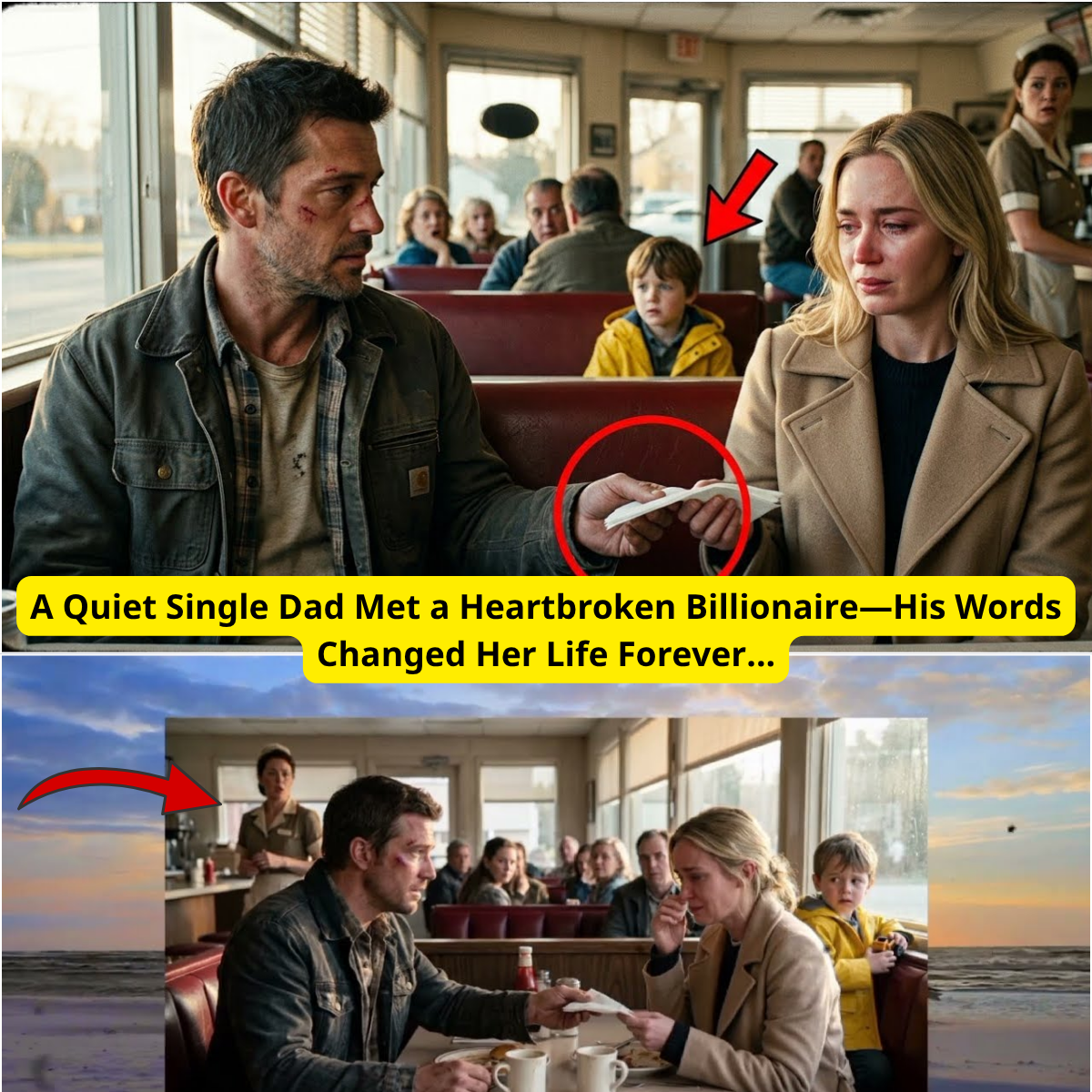
Thomas didn’t think about it. He didn’t calculate the social propriety of approaching a woman who looked like she ran a small country. He simply slid out of the vinyl booth, picked up a fresh, folded brown paper napkin from his own table, and walked across the linoleum.
He didn’t stand over her like an authority figure. He pulled out the chair opposite her and sat down.
He laid the clean paper napkin on the table between them, right at the edge of the coffee puddle, like a surveyor placing a marker on a property line. He didn’t offer to wipe the shirt for her; he didn’t apologize for intruding. He just sat there, his large, rough hands flat on his knees, his sleeve with its small smudge of dried drywall mud resting near her expensive leather bag.
Jolie opened her eyes, her gaze sharp and defensive, ready to dismiss an amateur or a panhandler. But when she looked at Thomas, she found nothing to fight against. There was no pity in his eyes—pity was a currency she despised. There was no recognition, no professional curiosity. There was only the flat, steady presence of a man who knew what a structural failure looked like.
“I must look like an absolute disaster,” Jolie said, her voice tight, clipped, and formal.
“You look like you’ve been carrying something very heavy for a very long time,” Thomas said. His voice was low, carrying the slow, deliberate cadence of the rural Midwest, a sound like gravel shifting under a tire.
Jolie let out a short, sharp breath. It was supposed to be a laugh, but it came out as a ragged gasp of air. She looked down at the paper napkin between them. “Is it that obvious?”
“The coffee didn’t do that to your face,” Thomas said gently, nodding toward her hands, which were still clenched into small, white-knuckled fists. “The coffee just gave you an excuse to look the way you already felt.”
Before Jolie could reply, there was a faint rustle of nylon, and Danny appeared at his father’s side. He was dragging his yellow jacket by one sleeve, his thumb tucked securely into his mouth. He stopped at the edge of the table, his wide eyes taking in Jolie’s stained shirt, her diamond earrings, and the expensive leather briefcase.
“You have coffee on your shirt,” Danny announced with the brutal, unfiltered clarity of an eight-year-old.
“Danny,” Thomas said, his voice dropping into a soft warning.
“What?” Danny asked, looking at his father with complete innocence. “It’s a big spot. It looks like a turtle.”
Jolie looked at the boy, then down at the stain on her chest. For the first time in eleven days, the muscles in her jaw relaxed. A real, unfiltered laugh broke through her throat—a clear, silver sound that surprised her so much she had to press her hand against her mouth to catch it.
“You’re right,” Jolie said, her eyes crinkling at the corners as she looked at Danny. “It does look a bit like a turtle. A very messy one.”
“Can I sit down?” Danny asked, not waiting for an answer as he climbed into the chair beside Thomas, tucking his legs up under himself. He looked at Jolie with that direct, unblinking gaze that only children and animals can manage. “My dad builds things. He can fix mostly anything. Except electronics. He broke the toaster last week.”
“It was an internal fuse, Danny,” Thomas muttered, though there was a distinct smile tugging at the corner of his mouth. “It was beyond repair.”
“He broke it,” Danny repeated to Jolie, nodding sagely.
The tension around the table didn’t just dissipate; it evaporated. For the next forty-five minutes, the billionaire and the carpenter sat in the center aisle of the Sunrise Diner while the morning traffic roared outside on Fifth Avenue. They didn’t talk about logistics, or shell companies, or international fraud. They talked about the cedar shingles Thomas had to install on a roof in Lincoln Park before the rain started on Thursday. They talked about how Danny’s teacher thought he was too quiet, and how Thomas had explained to her that some people just preferred to think before they spoke.
Jolie listened. She didn’t listen the way she did in boardrooms, where every sentence was parsed for leverage or liability. She listened to the sound of Thomas’s voice, the slow, rhythmic description of working with timber, the way wood had a memory and would warp if you didn’t respect its grain. She found herself telling him about her grandfather—not the company he built, but the old garage he used to keep in South Indiana, where he would repair old lawnmowers just to hear the engines turn over.
“I haven’t thought about that garage in fifteen years,” Jolie whispered, her fingers tracing the edge of her cold coffee mug.
“The world gets loud,” Thomas said, leaning back against the wooden slats of the chair. “Especially when you’re the one keeping the lights on. You start thinking that if you stop moving, everything stops behind you.”
“Doesn’t it?” she asked, looking up at him, her eyes suddenly small and vulnerable.
“No,” Thomas said, his voice dropping into that firm, unyielding timber he used when verifying a load-bearing wall. “The world stays right here. My father used to tell me that honest people always feel a betrayal like a death, because to them, a lie isn’t a tactic. It’s a grief. And you have to let grief do its work. It has a job to do, just like any other force. But when it finishes its job, it steps aside. Not all the way out of the room, maybe, but enough that you can get out of bed and pick up your tools again.”
Jolie didn’t answer. She sat in the silence, letting the words settle into the empty spaces that the last twenty-four hours had torn open inside her.
Chapter IV: The Happiest Color
Beside them, Danny had grown tired of the adult conversation. He had slid back down from the chair and returned to his sugar packets, which were now arranged in a complex, circular pattern near the window.
Jolie watched him from across the aisle. Her eyes tracked his small fingers as he adjusted a yellow packet of Splenda, pushing it precisely two millimeters to the left until it sat at the very tip of a long, linear row.
“Danny,” Jolie called out softly, leaning across the back of the chair. “Why do the yellow ones always go at the very end?”
Danny didn’t look up from his work. He gave the packet one final tap with his index finger. “Because yellow is the happiest color,” he said, his tone suggesting he was explaining an obvious law of thermodynamics. “If you put them at the end, then everything has to end happy. That’s the rule.”
Jolie stared at the small yellow rectangle on the laminate table.
+--------------------------------------------+
| [White] [White] [Pink] [Pink] [Blue] [YELLOW] |
+--------------------------------------------+
                ^
                |
       (The Happiest Color)
Something inside her chest—something that had been bound tightly with steel wire since her father’s stroke three years ago—simply let go. It was a physical sensation, a sudden, warm clearing behind her ribs. The five hundred million dollars didn’t matter. The boardroom coup didn’t matter. The betrayal by a man she had trusted was just a broken piece of wood; it didn’t mean the trees had stopped growing.
She stood up slowly, unbuttoning her navy coat. She looked down at the dark, dry turtle-shaped stain on her silk shirt, and for the first time in twenty years, she didn’t care about the appearance of order.
“I need to go,” she said to Thomas. She didn’t reach for her purse. “The lawyers will be waiting at nine.”
Thomas stood up too, his massive frame blocking the light from the front door for a second. “Take care of yourself, Jolie.”
“Thank you for sitting down,” she said. Her voice was quiet, but it had a clear, resonance that hadn’t been there when she walked in. “And thank you for the napkin.”
“Anytime,” Thomas said.
She walked past their booth, stopping for a brief second to look down at Danny. She reached out and lightly tapped the yellow sugar packet at the end of his row. “Keep the rule, Danny. Don’t let anyone change the order.”
Danny looked up, his small face serious, and gave her a single, firm nod. “I won’t.”
Jolie walked out of the Sunrise Diner, the bells rattling behind her one last time. She didn’t wait for her driver. She walked toward the corner of Fifth and Elm, her navy coat open, the cool October wind hitting her stained shirt. The city around her looked different now—the autumn sun was reflecting off the high-rises in long, golden sheets, and the trees along the sidewalk were dropping leaves of brilliant crimson and amber. The world looked like a place that had been built by hand, piece by piece, out of materials that were old and heavy and real.
Chapter V: The Weight of a Morning
Inside the diner, Thomas slid back into his booth across from his son. Martha arrived with a fresh pot of coffee, refilling his mug without being asked.
“That lady left this on the counter,” Martha said, dropping a small, generic white slip of paper next to the sugar caddy.
Thomas picked it up. It wasn’t a business card, and it wasn’t a check. It was just the diner’s guest check receipt. Jolie had paid for her coffee, their breakfast, and the next four tables behind them, leaving a three-hundred-dollar cash tip on the register with a note scribbled on the back in elegant, hurried cursive: For the carpenter’s toolbox. Rebuild something good.
Thomas smiled, folding the paper and sliding it into his flannel pocket next to his tape measure.
“Daddy?” Danny asked, his pancakes finally cooling into a sticky mass of syrup. “Who was that lady with the turtle shirt?”
“Just someone who needed a place to sit for a minute, bud,” Thomas said, taking a slow sip of his coffee.
“Are we going to see her again?”
Thomas looked out the window, watching the pedestrians move along Elm Street, their coats buttoned against the rising wind. Somewhere out there, in one of those tall glass buildings that scraped the sky, a woman was walking into a room full of knives, and she was doing it with a stained shirt and a pocket full of yellow sugar packets.
“Maybe,” Thomas said, reaching across the table to ruffle his son’s messy hair. “Or maybe we just helped her find her tools, and that’s enough for one morning.”
Danny seemed satisfied with that. He picked up his fork, carefully speared a perfect triangle of pancake, and looked at his row of sugar packets one last time before clearing them back into the ceramic caddy. The yellow one went in last, tucked safely under the white ones where nobody could lose it.
Outside, the October light moved across the floorboards of the Sunrise Diner, leaving long, warm stripes of gold across the empty chairs. The morning moved on, regular and loud and indifferent to the fortunes of empires, while in the corner booth, a father and his son sat together in the quiet warmth, waiting for the glue to dry.