We Didn’t Find Aliens. We Found Something MUCH WORSE
We Didn’t Find Aliens. We Found Something MUCH WORSE
The flickering fluorescent light of the basement office at the Christian Heritage Institute hummed a monotonous B-flat. For Dr. David Miller, a professor of New Testament theology and an amateur tech enthusiast, the hum was the only thing keeping him awake at 2:00 a.m.
On his dual monitors, two wildly different worlds collided. On the left screen was a newly declassified PDF from the Pentagon—part of a massive dump of over 200 files released by the government documenting Unidentified Anomalous Phenomena (UAPs). On the right screen was his digital theological library, open to a verse-by-verse breakdown of the Epistle to the Ephesians.
For the past two weeks, David’s phone had been ringing off the hook. Pastors, parishioners, and panicked students from his small Midwestern college kept asking the same question. The government had finally admitted that there were things in our skies it couldn’t explain. More than fifty videos, thermal tracking logs, and official military encounters showed objects that violated every known law of aerodynamics. They stopped dead in midair. They accelerated faster than any aircraft known to man, pulling maneuvers that would liquefy a human pilot, before instantly vanishing.
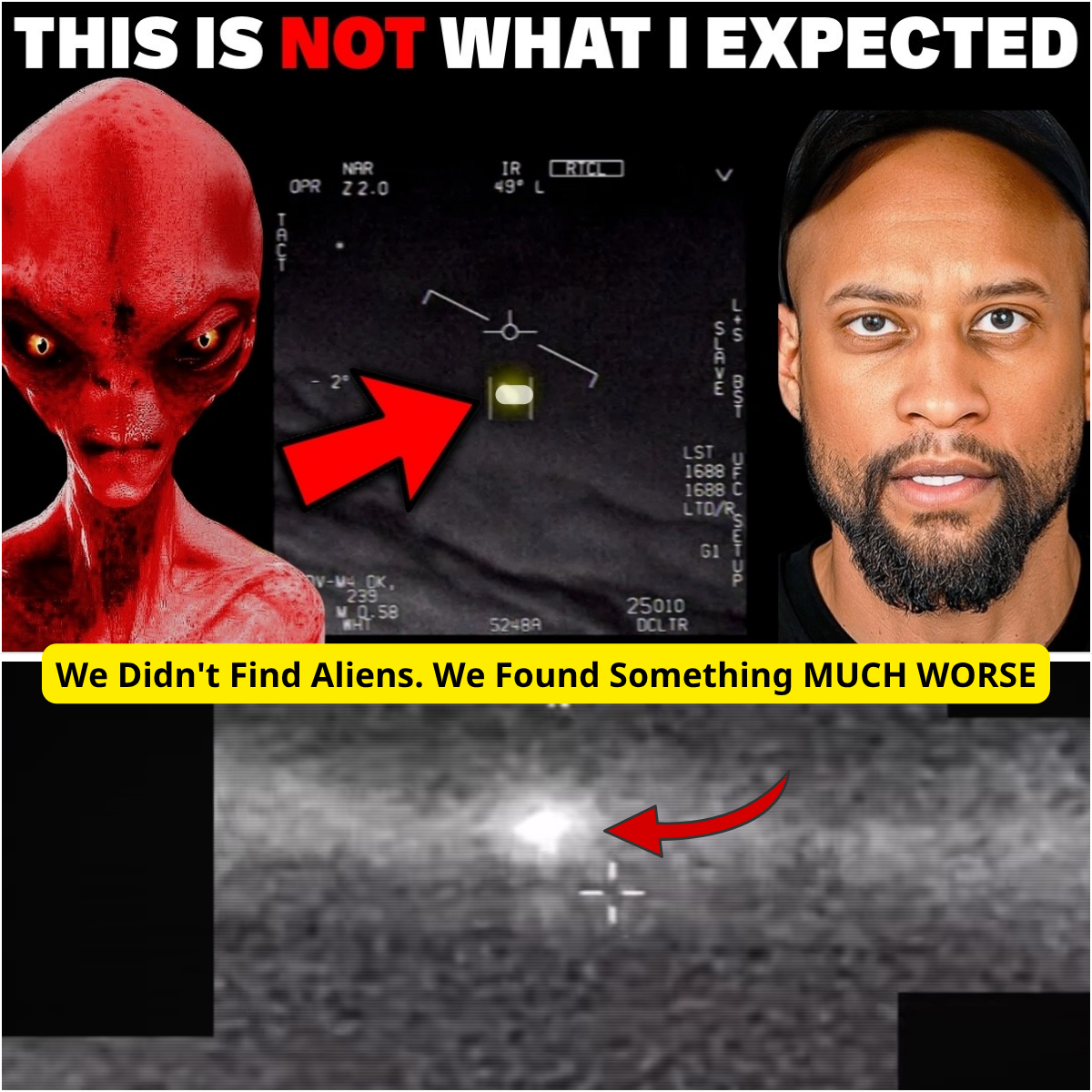
The secular world called them aliens. But in David’s circles, a much more unsettling explanation was spreading like wildfire through podcasts, Sunday school classes, and viral videos.
They’re demons. They’re not from another planet; they’re from another dimension.
This wasn’t just internet fringe talk anymore. David had watched clips of Apollo 16 astronaut Charlie Duke openly speculating that nothing physical could survive a 90-degree turn at 3,000 miles per hour, suggesting a spiritual nature to the phenomena. Even prominent political figures and highly cited Christian intellectuals like astrophysicist Hugh Ross had pointed out that these encounters didn’t seem random; they frequently clustered around individuals heavily involved in the occult or witchcraft.
David leaned forward, rubbing his tired eyes. As a Christian, he felt the pull of the theory. The Bible explicitly warns of deceiving spirits and a real, unseen cosmic war. But as a scholar, something felt terribly off. The pieces of the puzzle were being forced together with a sledgehammer. He needed to find out if this sudden surge of certainty was biblical clarity—or just a collective panic dressed up in theology.
The investigation didn’t truly catch fire for David until he met with his colleague, Dr. Sarah Torres, a data analyst and cultural researcher at the university. They met in the faculty lounge over lukewarm coffee, the gray winter light of a Chicago afternoon pressing against the windows.
“Look at the data, David,” Sarah said, sliding a tablet across the table. It displayed a compiled list of case files from secular and religious UFO researchers alike. “If you want to build a case that these are spiritual entities, the strongest evidence isn’t actually the flight physics. It’s the abduction semantics.”
“The semantics?” David asked, taking a sip of his coffee.
“The patterns of the encounters,” Sarah explained. “For decades, people across entirely different cultures, who have never met, describe the exact same experience. Beings of light. Sudden paralysis in bed. A feeling of intense, suffocating dread. But look at what happens in the cross-denominational case files compiled by researchers like Joe Jordan.”
She tapped a column on the spreadsheet. “Jordan started out as a completely secular UFO investigator. But he kept running into a subset of data that the broader UFO community ignored because it was too inconvenient. Over and over again, individuals claimed that their terrifying abduction experiences came to an abrupt, immediate halt the exact moment they called out the single name of Jesus.”
David studied the data. “Not a general higher power? Not just a prayer for help?”
“No,” Sarah said seriously. “That one specific name. Jordan documented hundreds of these cases. It eventually led him to faith. If these things are flesh-and-blood extraterrestrials from a galaxy millions of light-years away, why on earth would they obey the spiritual authority of a first-century Nazarene?”
David stared at the screen. The evidence felt heavy, almost undeniable. Objects that defied physics, behaved like non-physical projections rather than hardware, targeted people dabbling in spiritual darkness, and fled at the name of Christ.
“It makes a clean narrative,” David muttered, pacing the room. “The modern UFO phenomenon is just the ancient demonic realm putting on a high-tech coat of paint to deceive a technological society.”
“Exactly,” Sarah said. “So why do you look like you just inherited a debt?”
“Because,” David said, turning to face her, “a theological theory can’t just be strong where it wants to be. It has to be consistent where it hurts. And the deeper I go into the text, the more this perfect explanation starts to break down.”
Later that evening, David locked himself back in his study, determined to pressure-test the demon hypothesis using his advanced biblical indexing software. He opened up his digital concordance, a tool he frequently recommended for cross-referencing complex cultural questions through a strictly textual lens.
If these UAPs were biblical demons, their behavior should align with the structural parameters of the supernatural realm laid out in Scripture.
He ran his first deep search: Demon; manifestation; material object.
The software hummed, sorting through thousands of active syntax streams across the Old and New Testaments. David waited, tapping his fingers against the desk. When the results populated, his brow furrowed.
In the biblical narrative, demons work almost entirely through internal mediation. They possess people, or in rare historical judgments, animals. They operate through deception, whispers, psychological torment, and false ideologies. They work from the inside out. They don’t possess inanimate machinery, and they certainly don’t manifest as metallic, radar-reflective disks hovering over high-security military installations.
“Okay,” David muttered to himself, adjusting his search parameters. “What about the alternative? What about the higher-tier spiritual beings? The fallen angels, the Watchers of Genesis 6, or the cosmic principalities?”
He ran a secondary query focusing on the physical manifestations of divine or fallen entities.
The software returned dozens of passages. The results were stark. Whenever a spiritual being crosses the threshold into the material world in Scripture—whether it is a holy angel delivering a message or a fallen entity acting in rebellion—they always manifest as a being. They appear as men, as terrifying figures of light, or as winged creatures.
Never once in the entire biblical canon does a spiritual entity manifest as an inanimate, mechanical object.
David leaned back, staring at the flashing cursor. “If a demon is behind these crafts,” he whispered into the empty room, “there are only two logical options. Either the spirit is driving the object, or the spirit is the object.”
He dug deeper into the creation mechanics of the spiritual realm. If they were driving the crafts, and the crafts were physical, where did the hardware come from? There isn’t a single line of Scripture indicating that fallen angels or demons possess the theological permission or creative capacity to manufacture physical material objects out of nothing. Creation is the sole prerogative of the Creator.
And if they were manifesting as the crafts to deceive us, there was absolutely no biblical precedent for a spiritual being transforming its essence into a floating piece of hardware.
David felt a profound wave of intellectual humility wash over him. To confidently proclaim from a pulpit or a podcast that these military anomalies were definitely biblical demons required granting those entities far more creative power, material flexibility, and technological capability than the Bible ever attributes to them.
He wasn’t reading the demon answer out of the text. He, along with thousands of other well-meaning believers, was reading the demon answer into the text.
The realization hit David with the force of an physical blow. He wasn’t just dealing with a mystery in the sky; he was dealing with a vulnerability in the human heart.
The next morning, David met Sarah at a small diner near the edge of the campus. The smell of frying bacon and cheap maple syrup filled the air as rain streaked down the panoramic glass windows.
“I ran the textual models,” David said, setting his notebook down beside his plate. “The biblical baseline doesn’t support the spacecraft-demon theory. To make it fit, we have to invent an entirely new category of demonology that doesn’t exist in the Bible.”
Sarah watched him, twirling her fork. “So where does that leave us? Are you going to join the skeptics? The people who say it’s all just weather balloons, atmospheric reflections, sensory glitches, or experimental military drones?”
“To be fair,” David said, “a massive percentage of it is exactly that. Even the most serious researchers admit that ninety-five percent of sightings have a perfectly rational, terrestrial explanation. But rushing to the conclusion that it’s all just bad camera tracking is just as much of a mistake as blaming everything on a demon.”
He leaned forward, his voice dropping to a serious whisper. “Don’t you see what we’re doing, Sarah? The demon theory and the glitch theory look like total opposites, but they are the exact same psychological move.”
Sarah paused, looking at him intently. “How so?”
“Both are desperate attempts to achieve immediate certainty,” David said. “Both are mechanisms designed to impose our own control over something that genuinely terrifies us because we don’t understand it. The one answer that human beings hate more than anything else—the one answer that makes our skin crawl—is simply: I don’t know.“
He took a deep breath, looking out the window at the gray Chicago traffic. “We grab for ‘demon’ because it fits into our existing spiritual warfare box. The skeptics grab for ‘glitch’ because it fits into their secular materialistic box. But true intellectual and spiritual maturity means having the courage to look at a mystery, acknowledge the limits of our data, and sit with the discomfort of the unknown.”
Sarah sat quietly for a moment, letting the weight of his words settle over the table. “If we admit we don’t know what’s in the sky, David, how do we protect people from the deception that everyone is so worried about?”
David smiled, a genuine sense of peace finally replacing the exhaustion in his eyes. He opened his small pocket Bible to the first letter of John.
“Look at how Scripture actually tells us to handle deception,” David said, pointing to the text. “In First John, the apostle tells us to test the spirits. But when you look at the historical context, John wasn’t writing about lights in the sky or unidentifiable anomalies over the Sea of Galilee. He was warning the early church about false teachers. He was warning them about real human voices that sounded deeply spiritual, highly authoritative, and incredibly convincing, but were subtly leading people away from the historic reality of Jesus Christ.”
He closed the leather-bound book with a soft thud. “The ultimate test of any spiritual phenomenon isn’t found on a radar screen or an infrared military sensor. The test is a simple, piercing question: Does this thing point you toward the humility and cross of Jesus Christ, or does it point you away from Him?“
The winter semester ended, and the media frenzy surrounding the Pentagon files eventually began to simmer down, replaced by the relentless, fast-moving cycle of political news.
On a quiet Friday evening in the spring of 2026, David stood on the porch of his suburban home. The air was cool and sweet with the scent of wet earth and early blooms. Far above him, the twilight sky was a deep, velvet indigo, turning silver at the horizon where the first stars were beginning to puncture the dark.
A commercial airliner drifted silently across his field of vision, its high-altitude blinking lights tracking a steady, predictable path toward O’Hare International.
David looked up at the vast, unfolding expanse of the universe. He thought about the military pilots who had looked into the dark and seen things that shook their understanding of reality. He thought about the viral videos, the raging debates, and the deep, cultural anxiety of a world that felt like it was spinning out of control.
He didn’t know what those 200 files ultimately represented. They might be highly advanced classified human technology, an unmapped atmospheric anomaly, or something truly beyond our current scientific paradigm. And for the first time in his life, David was completely, beautifully okay with not knowing.
Because as he stood there in the quiet of his yard, he realized that the enemy didn’t need a spaceship to wage a war for the human soul. The real deception wasn’t hovering over a carrier strike group in the Pacific. The real deception was much closer to home—it was the quiet, insidious voice whispering in the dark of a bedroom, telling an ordinary person that they couldn’t trust God’s goodness, that their sins were too heavy to be forgiven, or that they could become the absolute masters of their own destiny.
You don’t need a multi-million-dollar military radar system to identify that voice. You don’t need a Pentagon briefing to unmask it.
David smiled, pulled his jacket tighter against the evening breeze, and stepped back inside his warm house, locking the door behind him. He knew exactly what that voice was, and he knew exactly who had already defeated it.