The FORGOTTEN Marian Apparition You Should Know (Corsica 1899)
The FORGOTTEN Marian Apparition You Should Know (Corsica 1899)
The mountain sun of Corsica did not merely shine; it baked, heavy and merciless, pressing down upon the jagged granite peaks like an invisible anvil. It was June 26, 1899, shortly before four in the afternoon, and the air in the isolated hamlet of Campitello tasted of parched earth and wild rosemary.
Fourteen-year-old Méline Parsy, whom everyone in the village called Lilena, wiped a bead of sweat from her forehead. Her legs were throbbing—a chronic, deep-seated weakness that made every incline on these mountain paths feel like a personal penance. Beside her walked her closest friend, Perpetua Lorenzi, a girl of the same age whose anxious fingers kept beating a nervous rhythm against her apron.
“If we don’t bring back enough wood, my mother will have to delay the bread baking,” Perpetua murmured, her eyes scanning the stony trail. “And I still haven’t memorized the third mystery, Lilena. If the priest tests me before my First Communion, I’ll freeze.”
“You won’t freeze,” Lilena said gently, her voice surprisingly steady for a girl so physically frail. “We will practice as we walk. Repeat after me: Hail Mary, full of grace…“
As the two teenagers trudged upward, their voices rose in a fragile, rhythmic cadence against the vast silence of the scrubland. Perpetua, who could neither read nor write, leaned entirely on Lilena’s memory, absorbing the sacred syllables syllable by syllable.
They reached the Aghja, a massive, ancient flat rock that overlooked a seasonal ravine. Usually, the mountain air here hummed with the dry scratch of cicadas and the distant tinkling of goat bells. But as Lilena stepped toward the clearing, a sudden, heavy stillness dropped over the landscape.
Perpetua stopped mid-sentence. “Lilena… do you hear that?”
The wind had completely vanished. The bugs went silent. The atmospheric pressure seemed to drop, but it wasn’t the suffocating weight of an oncoming thunderstorm. It was an profound, electric quiet.
Then came the music.
It began as a low, crystalline vibration, shifting into a chorus of voices that sounded entirely out of place in the rugged wilderness of Corsica. It wasn’t the traditional, somber polyphonic singing of the island men; it was ethereal, layered, and impossibly beautiful.
Driven by an irresistible pull, the girls approached the edge of the flat rock.
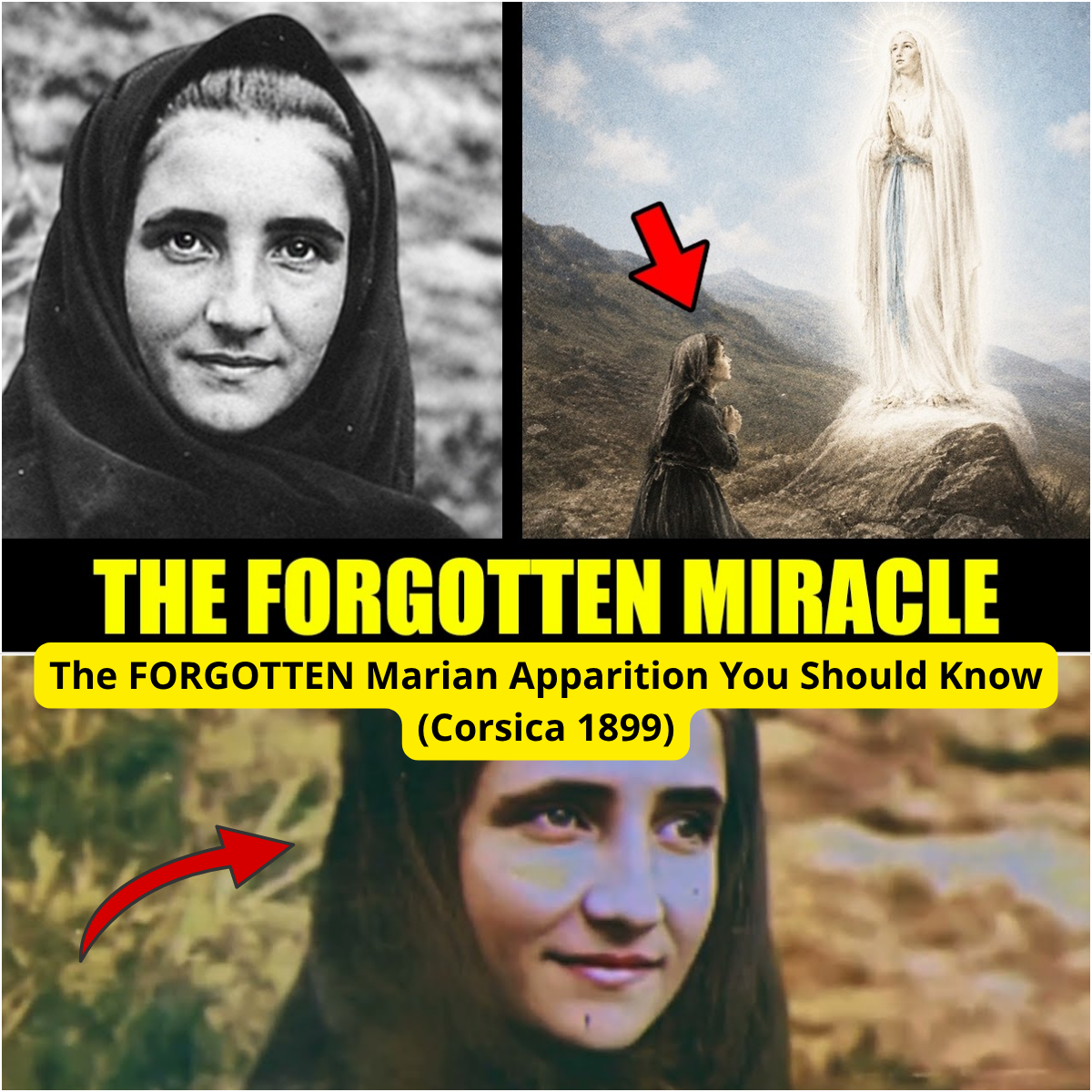
There, standing atop the granite surface, was a woman. She didn’t merely stand; she seemed anchored to a small, brilliant white cloud that hovered just above the stone. Her dress was an unblemished, luminous white, cinched at the waist by a belt the color of a summer sky. A delicate veil cascaded from her head all the way to her bare feet. She radiated a soft, golden warmth—not the blinding glare of the afternoon sun, but an interior illumination that cast no shadows. Her hands were pressed together in quiet devotion, her eyes turned toward the heavens, and above her head, brilliant rays of light converged into the perfect shape of a crown.
Lilena tried to call out to her friend, but her vocal cords refused to work. Instead, a wave of profound, liquid warmth expanded inside her chest. Without a shred of doubt, she knew she was looking at the Queen of Heaven.
Instinctively, Lilena dropped to her knees on the sharp stones. Her hands flew together, and she began to pray the Rosary with an intensity she had never known. Perpetua fell beside her, her earlier anxieties instantly vaporized, her eyes wide as she followed Lilena’s lead.
The entity slowly lowered her gaze. She looked down at the two trembling teenagers and smiled—a look of such infinite tenderness that Lilena felt her breath leave her. The woman raised her right hand, tracing a magnificent, deliberate Sign of the Cross over them. Then, opening her arms toward the sky, she rose slowly into the azure air, dissolving into the light until only the empty mountaintop remained.
The cicadas returned in a sudden roar. The wind swept through the brush once more.
Perpetua was the first to gasp for air, her fingers digging into Lilena’s sleeve. “Who was that? Lilena, who was that?”
“It was her,” Lilena whispered, her face still illuminated by the lingering grace of the encounter. “It was the Virgin Mary.”
As they scrambled to their feet, both girls gasped. When they had walked up the mountain path, the sun had been high and brutal. Now, the sky was painted in deep ribbons of purple and gold, and the long shadows of twilight were sweeping across the valley. Hours had passed in what felt like a matter of minutes. Panic setting in, they grabbed whatever fallen branches they could find and ran down the mountain toward home.
By the time Lilena crossed the threshold of her family’s home, the mountain darkness had fully set in. Her mother, Françoise, was pacing outside, her face etched with panic.
“Where have you been?” Françoise cried, grabbing Lilena’s shoulders. “I’ve been searching the paths for hours!”
Lilena didn’t answer. Slipping past her mother’s embrace, she walked straight into her bedroom, dropped to the floor by her mattress, and buried her face in prayer. Her father, François Parsy, watched from the kitchen table, his brow furrowed. This was a village where life was dictated by harsh necessity and deep ancestral rules; outbursts like this were entirely unwelcome.
At dinner, the tension was thick enough to cut. “Méline,” her father said, using her formal name to signal his gravity. “Account for your time this afternoon.”
Lilena looked up, her young face completely devoid of deceit. With meticulous, quiet detail, she described the music, the cloud, the glowing dress, and the crown of light.
François sat in absolute silence for several long minutes, his calloused hands resting on the wooden table. Campitello was a hard place—plagued by poverty, large families with too many mouths to feed, and ancient blood feuds between clans that lasted for generations. Survival required pragmatism, not fairy tales. Yet, looking into his daughter’s unwavering eyes, he found no traces of a child’s imagination.
“If what you say is true,” François said, his voice dropping to a serious rumble, “then our home has been visited by an immense blessing. But you must be incredibly careful, Lilena. Keep your mouth shut. The village is a dangerous place for rumors.”
But rumors in a Corsican mountain hamlet are like sparks in a dry brushwood forest. Within days, despite Lilena’s compliance, Perpetua’s family had leaked the story. The response from the villagers was a volatile mixture of devout awe and bitter mockery.
By the morning of July 3, the pull of the Aghja became too powerful for Lilena to resist. She approached her godmother, Fevu Casanova—a highly respected widow in the community whose practical demeanor carried immense weight.
“I have to go back to the rock, Godmother,” Lilena pleaded. “Will you walk with me?”
Fevu, seeing the desperate sincerity in the girl’s eyes, nodded. As they made their way through the village alleys, Lilena spotted Perpetua sitting on a stone stoop. “Perpetua! Come with us!”
Perpetua looked down, her eyes red from crying. “I can’t, Lilena. My father heard what people are saying. He swore if I go near that rock again, he’ll beat me. I’m forbidden.”
Undeterred, Lilena and her godmother climbed the mountain path alone, arriving at the clearing around four in the afternoon. They knelt on the parched ground and began the Rosary. On the fourth bead, the universal silence dropped over the mountain once more.
Lilena raised her eyes. The Virgin stood on the cloud again, but this time, her hands held a magnificent rosary. The beads didn’t look like wood or glass; they sparkled like a constellation of tiny, brilliant stars linked by a chain of pure silver. She held it out toward them, as if presenting a weapon of peace to the world.
Beside her, Fevu Casanova let out a ragged sob. When the vision finally ascended and the world returned to life, Lilena turned to her godmother. “Did you see her?”
Fevu was weeping openly, her hands covering her face. “I did not see her face like you did, child… but I saw a brilliant, beautiful white shape. A glowing silhouette standing on that stone. I know someone was there.”
When a respected widow confirms a miracle, the village dynamic fundamentally shifts. The next afternoon, July 4, a small crowd of ten skeptics and seekers followed Lilena up the trail. Among them was Totana, one of Lilena’s childhood confidants. When the silence hit this time, Totana gasped, pointing at the stone. She, too, could see the intricate details of the Virgin’s face, the sky-blue belt, the crown of light. Now, two children were sharing the exact same inexplicable visual telemetry.
As July bled into August, the phenomenon grew too large for the local parish to ignore. Thousands of pilgrims began arriving from neighboring regions, climbing the rocky trails of Campitello. Remarkably, the ancient animosities of the village began to soften. Men who had carried loaded firearms for decades due to cross-generational blood feuds found themselves standing side by side at the Aghja, their heads bowed in common prayer.
However, the local parish priest, Father Jean-Félix Albertini, found himself caught in a severe theological dilemma. He was a man of the Church—educated, cautious, and deeply aware of the strict rules governing supernatural claims. He recalled the severe warnings of St. Paul: Even Satan can disguise himself as an angel of light. The devil can mimic beauty; he can construct a flawless illusion of holiness to lead the faithful into error.
Father Albertini called Lilena into the stone rectory. He handed her a small glass vial, stopped with cork.
“The next time you see this lady, Lilena,” the priest instructed, his eyes searching hers, “you will take this holy water. You will sprinkle it directly toward the vision and say, ‘If you come from God, come closer.’ If this thing is an illusion of the adversary, it will shatter under the authority of Christ’s Church. If it is from Heaven, it will endure. This is your test.”
On July 18, the mountain path was choked with onlookers. Father Albertini walked among them, his watchful eyes fixed on the fourteen-year-old girl. Lilena knelt, holding the small vial in her trembling fingers.
Suddenly, her posture went rigid. Her eyes locked onto the empty space above the flat stone. “She is here,” Lilena whispered.
The massive crowd fell into a dead hush. Lilena carefully pulled the cork from the vial. Looking directly into the center of the brilliant golden light, her voice rang out with unexpected courage: “If you come from God, come closer.”
With a swift flick of her wrist, she cast a drop of the blessed water into the air. The liquid caught the afternoon sun, shimmering like a diamond as it sprayed toward the granite rock.
The entity did not flinch. She did not vanish. Instead, the Virgin Mary stepped forward on her small cloud, her smile widening with a deep, maternal reassurance that seemed to embrace the entire mountain. The holy water had been thrown, and Heaven had remained exactly where it stood. Father Albertini silently crossed himself, his doubts replaced by a profound, trembling awe.
But the true test of Campitello’s faith arrived in August. The summer of 1899 turned into a historic, brutal drought. The mountain streams turned to dust, the crops withered to yellow husks, and livestock began to collapse from dehydration in the rocky pastures. The villagers were growing desperate, staring down the very real prospect of winter starvation.
On August 14, the eve of the Feast of the Assumption, Lilena led a small group to the Aghja to beg for rain. As they concluded their prayers, a man named Bartoli leaned forward, his eyes catching a dark reflection near the base of the holy rock.
“Look here,” he muttered, stepping closer.
Right at the foot of the granite structure, in a dry, narrow fissure where the Virgin’s cloud had hovered, the stone was dark with moisture. Bartoli reached down and touched it. His fingers came away wet.
The surrounding villagers crowded in, muttering in disbelief. There had been no rain for months. The water table was completely depleted. Yet, here was water. Bartoli dropped to his knees and began clearing away the loose gravel with his bare fingers.
The moment his hands cleared the opening, a small, vibrant stream of crystal-clear water burst forth from the solid granite. It ran cold, pure, and completely unbothered by the surrounding heat. Within an hour, half of the village had climbed the trail with clay jars, weeping as they drank from a fountain that had materialized out of a dead rock.
That spring did not stop when the drought broke. It continued to flow the next day, the next year, and through the turn of the century. It would continue to flow continuously for the next 127 years, deep into 2026, a permanent geological impossibility that thousands of pilgrims would visit to fill glass bottles to carry across the globe.
The apparitions continued with astonishing regularity, totaling 34 distinct events over a ten-year span. As the months rolled on, the phenomenon began to produce a series of extraordinary, documented anomalies that Father Albertini meticulously recorded in his daily parish logs—records that would later be preserved in the official archives of the Revue Mariale de Lyon.
One afternoon, a formal religious procession was making its way up the narrow mountain trail when the path was found to be completely blocked by a massive boulder that had dislodged from the upper cliffs. The village men stepped forward, straining against the stone until their muscles tore, but the rock—estimated to weigh nearly 1,000 kilograms—refused to budge an inch.
Amidst the frustration, a ten-year-old boy named Moïse Magnoli walked out from the crowd. He was a small, unassuming child, but as he approached the rock, his eyes rolled back slightly into a state of profound ecstasy. In front of dozens of witnesses, including the parish priest, the child reached down, caught the edge of the one-ton boulder, and flipped it off the path with a casual flick of his wrist, as if he were tossing aside a dried leaf. The moment the path was clear, the boy blinked, returned to his normal state, and walked on, completely unaware of the impossible physics he had just executed.
Then came the Miracle of the Processional Cross. The villagers had constructed a massive cross of oak and iron, standing nearly nine feet tall and weighing over fifty pounds, to lead their marches to the Aghja. During the ecstasies, children as young as ten would volunteer to carry it. But they did not grip the heavy wood with two hands; instead, they would balance the base of the massive cross on the flat, open palm of a single hand, walking up the steep incline without a single stumble.
More incredibly, when the procession would pause for a station of prayer, the child would simply step back, removing their hand entirely. The nine-foot iron-heavy cross would remain perfectly upright, balancing on the rocky path without any structural support, unaffected by the mountain winds. In March 1907, a senior cleric from Lyon arrived to investigate, writing in his official memoir: “I venerate the cross that stays upright alone and without support during the stop… I tried to carry it myself. It weighs at least 25 kilograms. I could barely balance it with both arms.”
The anomalies seemed to ripple through the very nature of Campitello. Children in deep states of ecstasy would clear the brush surrounding the holy rock, tearing out thick, jagged Mediterranean brambles with their bare hands, pulling the thorn-choked roots apart without receiving a single scratch or drop of blood on their skin. Even the surrounding orchard trees caught the grace; several fruit trees near the ravine began to blossom twice in the same calendar year—once in the spring, and once again in the late autumn, with both cycles producing fully formed, sweet fruit.
On the night of August 28, 1899, the ultimate visual confirmation occurred. Lilena stood at the rock alongside three other visionary children: Moïse Magnoli, Ange-Félix, and Jean-Paul. As they entered their collective ecstasy before a massive crowd of adults, the night sky seemed to fracture. Thousands of glowing, star-like spheres of light burst directly out of the granite rock, cascading upward into the darkness like a silent, celestial firework display. The extraordinary event was witnessed and formally signed by both the local mayor and the village postal receiver, providing an indisputable administrative record of the impossible.
Yet, great grace is almost always accompanied by a profound shadow. On February 25, 1900, during the eighteenth apparition, the Virgin Mary looked down at the fifteen-year-old Lilena and whispered a deeply personal secret—a prophecy concerning the future of the world and Lilena’s own life.
“The world will embrace the wonder for a season,” the Lady whispered, her voice tinged with a beautiful sadness. “But human hearts are fickle, Lilena. People will speak cruelly of you. Those who praise you today will call you a liar tomorrow. You will carry a heavy cross for my sake.”
The words proved true within months. As the initial novelty of the miracles faded, the secular newspapers in Bastia and Ajaccio began publishing scathing, cynical articles, accusing the Parsy family of orchestrating a lucrative hoax. Neighbors who had once begged Lilena for intercession began turning their backs when she walked down the street, whispering insults behind her back.
Through it all, Lilena remained completely unshakeable. She never altered a single detail of her testimony. She never commercialized the spring, and she never demanded attention. By 1906, at the age of twenty-one, she decided to fulfill the calling that had burned in her heart since childhood: she left Campitello to enter the Benedictine monastery at Erbalunga, seeking a life of quiet, cloistered prayer.
But human history has a habit of crashing through monastery walls. Within a few months of her entry, the French government enacted the fiercely anti-clerical Combes Laws. Religious orders were forcefully dissolved across France, Catholic institutions were seized, and nuns and monks were driven from their sanctuaries by secular decree. Lilena’s convent was shuttered, and she was forced to strip off her habit and return home to Campitello, her deepest spiritual dream shattered by a political machine she could not control.
She returned to her parents’ small stone house, twenty-one years old, disgraced by the law and mocked by her enemies. Yet, she returned to the Aghja. For three more years, the Virgin continued to meet her in the quiet of the mountains, a secret solace between the Queen of Heaven and a forgotten village girl.
On September 3, 1909, the final encounter took place. It was the thirty-fourth apparition, but the festive, golden light of the early days was gone.
The Virgin Mary materialized not as a crowned queen, but as the Pietà—the tragic, heartbreaking image of a mother cradling the broken, lifeless body of her son. Tears of pure sorrow ran down her radiant cheeks.
She looked at Lilena, her voice carrying the weight of a breaking world. “I ask for penance. Penance and prayer. They have rejected my requests, Lilena. For so long I have asked for a true church to be built upon this stone of grace. Why will they not build it for me?”
With that final, sorrowful plea, the vision ascended for the very last time, leaving the mountain path empty.
The great church the Virgin requested was never built. The diocese, caught in the political turmoil of the era, never issued a formal decree of approval, leaving the records to gather dust in the archives of Lyon. Today, if you climb the rugged trail of Campitello, you will find only a modest stone oratory, a few weather-worn statues, and the relentless, crystalline spring that still bubbles from the granite rock.
Lilena lived out the remainder of her days in quiet, dignified poverty, carrying the Virgin’s secret with her through the decades until she passed away, taking the mystery directly to her grave. She left behind a world that had forgotten her name, but she left the rock forever altered—a place where, for one brilliant decade, the laws of earth bent to the will of Heaven, leaving a wellspring of hope that time could never run dry.