A boy sneaks into a church and is caught in the tabernacle… but the reason moves everyone!
Father Ernesto froze, not out of doubt, but because for a second he couldn’t believe what he was seeing. A boy alone inside the empty church in front of the altar, with the tabernacle open and the Body of Christ in his hands. That was not just wrong, it was unthinkable. The silence of the place seemed to scream, the lights were already low, the pews empty, no witnesses. There was supposed to be no one else there, but there was. And he was stealing the Eucharist.
“Stop.”
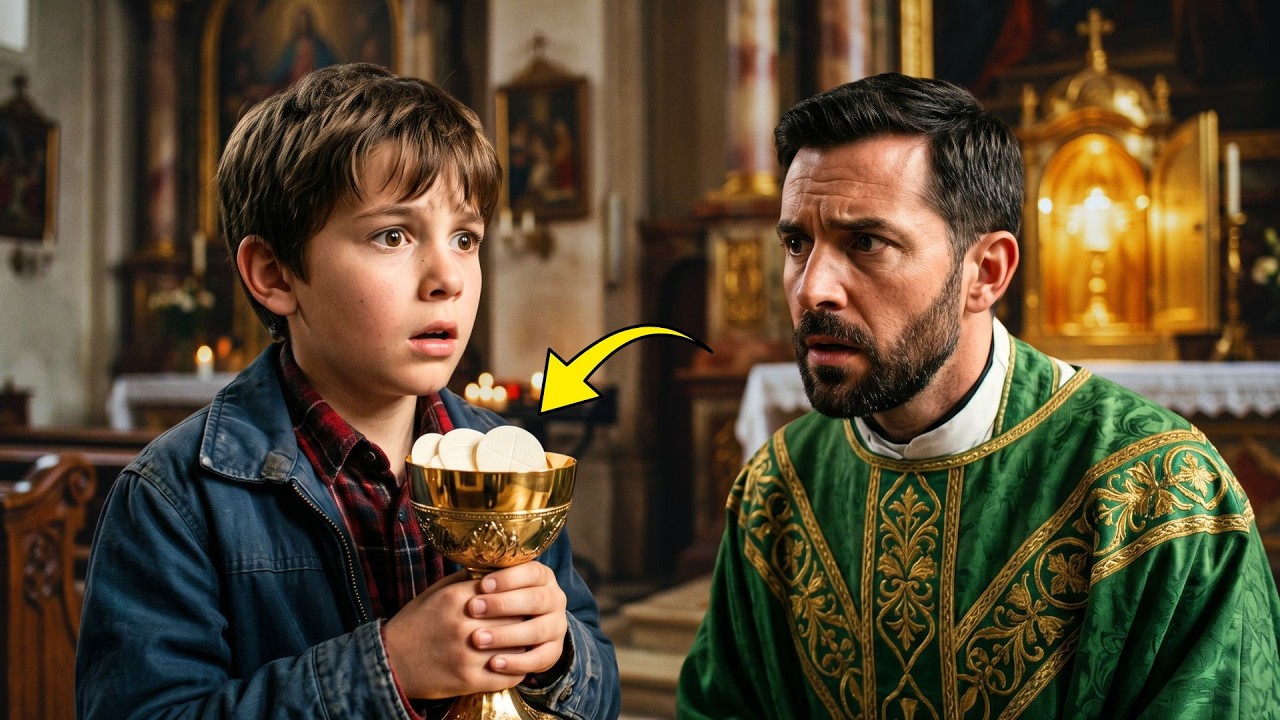
The priest’s voice came out firm, direct, with no room for doubt. The boy froze instantly. His fingers started trembling so hard that the golden chalice almost fell to the floor. Slowly, very slowly, he turned his face and at that moment the whole scene changed, because there was no challenge in his eyes, no evil, no arrogance — there was fear, a fear so deep it seemed it couldn’t fit inside a child. His eyes were full of tears. His chest rose quickly, uncontrollably, like someone who already knew he was lost.
The priest took a step forward.
“What are you doing?”
The question echoed through the empty church. The boy tried to speak, nothing came out. He swallowed hard, looked at the host as if it were more important than any consequence. And then he broke.
“I can’t lose her.”
The sentence came out before any explanation. Broken, desperate.
The priest frowned.
“Lose who?”
The boy raised his eyes and that answer cut through the silence like a blow.
“My grandmother.”
The air seemed to grow heavier. The boy was breathing with difficulty.
“Now she’s dying,” he said almost without voice. “They said she might not make it out of the surgery.”
The tears began to fall uncontrollably.
“And I don’t have any more time.”
The priest stood motionless, observing, waiting.
“I saw a video,” the boy continued, trying to speak quickly, as if afraid of being interrupted. “On my mom’s phone. A friar, his hands were still trembling even more. He said that Jesus is alive in the Eucharist, that it’s His own Body, that He can heal, that He can save.”
The priest took a deep breath.
“And you came here because of that?”
The boy answered immediately. Without hesitation.
“I saw it happen.”
The priest remained silent.
“What do you mean?”
The answer came lower, but even heavier.
“I already took it before.”
The priest’s heart tightened.
“How many times?”
“Two.”
Silence.
“And what happened?”
The boy raised his gaze and this time there was no doubt.
“She got better.”
Those words hung in the air, simple, but impossible to ignore. The boy fell to his knees, the host still trembling in his hand.
“Please,” he begged. “Just one more time.”
The crying was now uncontrollable.
“She’s going to the hospital today. I’m afraid of losing her.”
The priest looked at that unknown child, kneeling, desperate, holding the Body of Christ as if he were holding the last hope that still existed. And in that instant he realized he was not facing a simple mistake, he was facing a faith that didn’t ask for permission and a decision that could change everything.
Hours before that moment in the church, Gabriel was sitting on the cold floor of his grandmother’s room. The place was simple. An old bed against the wall, a noisy fan spinning slowly, a slight smell of medicine in the air, and in the center of it all, Mrs. Helena, lying down, fragile, her eyes almost always closed, her breathing short, irregular. Her body no longer responded as before. She had been like this for months, each day a little worse, each day more distant.
Gabriel stayed there in silence, just looking, not fully understanding what was happening, but feeling everything, feeling that he was losing her. His mother, Monica, did what she could, worked all day, ran with exams, talked to doctors, tried to keep everything together. But there was something she couldn’t hide: fear. The doctors had already said it. The surgery was necessary, urgent, but also extremely risky. And the truth was harsh. Mrs. Helena was not strong enough.
That afternoon, Monica left in a hurry. She needed to sort out more things at the hospital. Gabriel stayed alone with his grandmother. Silence took over the room. He looked at her. She didn’t move, didn’t open her eyes. It was then that he picked up his mother’s phone, with nothing else to do, not knowing how to deal with it, just trying to distract himself. He started scrolling through videos, one after another, random things, until something caught his attention.
A man in simple clothes, a friar speaking calmly but with a different firmness. Gabriel stopped. Something in that way held him. “Many don’t believe,” the friar said, “but Christ is not distant. He is alive.” Gabriel frowned. “Alive in the Eucharist.” The boy didn’t fully understand, but he kept watching. “It is not a symbol, it is not a memory, it is real presence.” The words seemed different from everything he had ever heard. “The Body of Christ has power.” The friar spoke with conviction. “Power to transform, to strengthen, to heal.”
Gabriel remained motionless. “How many people receive it without believing? And how many could see miracles if they had faith?” The word kept echoing in his mind. Miracle. He looked at his grandmother, lying down, weak, almost without strength, and for the first time something different happened inside him — a simple, direct, but powerful idea. If that was true, if Jesus was really there, then He could help.
That same Sunday, Gabriel went to the church alone, without telling anyone. He entered quietly, stayed in the back observing, watching everything, not fully understanding, but paying attention to every detail. And then the moment came. People started to stand up, formed a line that went to the altar, one by one they received something in their hands. The host. Gabriel watched in silence, his heart racing, not knowing exactly what to do, but with a certainty growing inside him. It was there, it was that, it was his only chance.
And on that day, without anyone noticing, Gabriel made a decision that would change everything.
On that first Sunday, Gabriel didn’t have the courage. He watched everything from beginning to end. He saw people standing up, going to the altar, receiving the host with respect, but he stayed still in the back, heart racing, not knowing if he could, if he should, but mainly afraid. When the mass ended, he left with the other people, in silence, without saying anything. But that idea didn’t leave his head. On the contrary, it only grew stronger.
That night, he returned to his grandmother’s room. She was the same, weak, almost motionless. Gabriel sat next to the bed, held her hand and stayed looking, not knowing what to do, but feeling he needed to do something, anything.
The following week, he went back, same time, same place. This time he stayed until the end. He waited, observed. And when the church began to empty, he didn’t leave. He hid, crouching between the pews, his heart beating so hard it seemed someone could hear it. Footsteps leaving, voices fading, doors closing, silence.
When he was sure he was alone, he stood up slowly, afraid but determined, and walked to the altar. Each step seemed wrong, but at the same time necessary. He stopped in front of the tabernacle, took a deep breath, looked around. No one. His hand trembled when he touched it. He opened it. There were the hosts. Gabriel hesitated. For a few seconds he thought about going back, but then he remembered his grandmother, her weak breathing, her body without strength, and those words: “Christ is alive in the Eucharist.” He took one, carefully, as if it were something sacred. And it was. He left the church the same way he entered. In silence. No one saw, no one noticed.
When he got home, he went straight to the room. His grandmother was still lying down, weak. He went to the kitchen, got a piece of bread, carefully placed the host in the middle, as if hiding something precious. He returned to the room, sat beside her.
“Grandma.” His voice came out low. She opened her eyes with difficulty. “Eat a little?”
She didn’t question, just accepted. She brought it to her mouth slowly, swallowed and closed her eyes again. Gabriel stayed there waiting, not knowing what to expect. Minutes passed, nothing happened. He lowered his head, thought maybe it had been silly, but then something changed. It was small, almost imperceptible, but it was real. Her breathing seemed lighter, less heavy, less tired. Gabriel raised his gaze, observed carefully. It wasn’t his imagination. She seemed a little better, very little, but enough, enough to light something inside him. Hope.
The next day, Monica noticed. “She seems a little better,” she said, not understanding. The doctors also noticed. There was a slight response. Nothing conclusive. Nothing guaranteed, but unexpected. Gabriel said nothing. He kept it to himself, but deep down he knew, and that’s why the following Sunday he went back.
This time, without hesitation, without fear, without doubt, he entered the church with a single thought: to take it again, because somehow it was working. And with each small improvement of his grandmother, his faith grew, not as theory, not as teaching, but as something real, something he could see and feel. And now he couldn’t stop anymore.
On that third Sunday, Gabriel was not just determined, he was desperate. His grandmother’s improvement had been real, small, but enough to rekindle hope. But it also brought a new urgency: the surgery. The doctors had already scheduled it. It was that same day. And even with the slight improvement, the risk remained extremely high. Gabriel knew it. He had heard the conversations, the hard words, his mother’s silences, the fear no one wanted to say out loud. And that’s why he ran to the church. He didn’t walk, he ran like someone running out of time.
He entered without drawing attention, heart racing, hands sweating, eyes looking for only one thing: the altar. He already knew what to do, he had done it before. He waited, hid again. The mass ended, the people left, the silence returned and he stood up. Faster this time, more determined, he walked to the tabernacle, opened it, took the chalice. His hands trembled, but not from doubt, from urgency. When he reached for a host, a strong voice cut through the silence like a blow.
Gabriel froze. He didn’t have time to react, didn’t have time to hide. He turned slowly and there was Father Ernesto, standing, watching.
The boy felt the world collapse. Fear came back strong, despair took over. He knew. Now it was over.
“Please,” was the first thing he managed to say before any question, before any explanation. “Please, I need to take it.”
His voice failed. The tears were already streaming down.
The priest approached slowly, looking straight at him.
“Have you done this before?”
It wasn’t a question, it was certainty.
Gabriel lowered his head.
“Yes.”
“How many times?”
“Two.”
The silence weighed between them.
“Do you understand what you’re doing?”
The question came firm, without aggression, but with weight.
Gabriel tried to answer but couldn’t organize the words. He just cried.
“I don’t have any more time.” That was what came out.
The priest took a deep breath.
“Explain.”
And then Gabriel told everything. The grandmother, the illness, the surgery, the video, the faith, the two times, the improvement. Each word came out broken, mixed with crying, with fear, with hope.
When he finished, the silence returned, but this time it was different. The priest no longer saw just a mistake. He saw a child who truly believed.
“Gabriel.” It was the first time he said his name. His voice was now calmer, more human. “What you did is very serious.”
The boy lowered his head.
“I know.”
“This can’t continue like this.”
His heart sank.
“But she needs it.”
“I know.” The priest interrupted. And that made Gabriel raise his surprised gaze.
“I know she needs it.”
The silence became lighter, but still tense.
“You can’t take the Eucharist like this.”
“Then let me just one more time.” The desperation returned. “Please, I’m afraid of losing her.”
The priest closed his eyes for a second, thought, and then made a decision.
“You’re not going to take it.”
Gabriel’s world collapsed, but before he could react:
“I’m going with you.”
The boy froze.
“What?”
“We’re going together.” The priest looked firm. “I myself will take Communion to your grandmother.”
Gabriel’s crying changed. It was no longer just despair, it was relief mixed with something new. Gratitude.
“Let’s go now.”
They left the church in a hurry. Time was running out. Every second mattered. But when they arrived at the house, the door was open and the room empty. Gabriel’s heart raced.
“Mom!” His voice echoed through the house. Silence. Then came the answer.
“She already took your grandmother to the hospital.”
The boy looked at the priest. The fear came back stronger than before.
“We have to go.”
They ran out because now it wasn’t just about faith, it was about getting there in time.
The hospital was silent, a heavy silence, the kind that carries fear. Gabriel ran in, heart pounding, until he found Monica, red eyes, tired face.
“Mom, where’s Grandma? Are they preparing her for surgery?”
He looked at Father Ernesto.
“We’re late.”
“Not yet.” The priest took a step forward. “May I go in?”
Monica hesitated.
“She doesn’t believe.”
The priest answered calmly.
“But he does.”
She looked at her son and nodded. They entered. The room was cold, bright lights, machines around. Mrs. Helena was lying down, weak, but conscious. Gabriel approached, holding her hand.
“Grandma, I did something wrong.” His voice trembled, but it was to help you. The tears fell. “I brought Jesus to you and you got better.”
She looked at him without judgment, only emotion. A tear rolled down.
“I accept.”
The priest approached. He prayed calmly, with respect, and gave her the Eucharist. For the first time, she received Communion.
Minutes later they took her. The door closed and time stopped. One hour, two, four, eight, until the doctor appeared. Serious, tired face.
“The surgery was a success.”
The air changed.
“To be honest, she shouldn’t have made it.”
Silence. No one explained. No one discussed, but Gabriel knew. He said nothing, just stayed there, because deep down the miracle had already happened long before.
Mrs. Helena recovered quickly and soon received discharge. And every day, before going to sleep, she prays with her grandson, thanking God for saving her life. And she also asks for protection and blessing for her grandson.
This was today’s testimony. I hope you liked it. Before leaving, leave your like, subscribe to the channel, turn on notifications and share this testimony with someone close who is in need of hope.
May God always be by your side. Amen.