Coworkers Set Me Up with a Deaf Woman as a Joke — Then I Started Signing Fluently
Coworkers Set Me Up with a Deaf Woman as a Joke — Then I Started Signing Fluently
Chapter I: The Architecture of the In-Crowd
The third floor of Vanguard Marketing in downtown Seattle always smelled of over-roasted espresso beans, expensive dry cleaning, and the faint, copper tang of nervous sweat. It was an open-concept office, a design intended to foster collaboration but which in reality functioned like an architecturalpanopticon. Desks were arranged in sleek, long rows of white laminate, leaving no space for privacy and every opportunity for surveillance.
Ethan Vance had worked as a data analyst at Vanguard for nearly three years, but he still occupied the office geography like a permanent ghost.
At twenty-nine, Ethan was a man of quiet, deliberate movements. He had a lean, unassuming frame, dark hair that he kept trimmed short, and a habit of wearing neutral grey sweaters that made him blend perfectly into the office carpeting. While the rest of the creative and sales teams spent their mornings drinking artisanal cold brew and debating the latest viral ad campaigns with high-yield hand gestures, Ethan sat before three monitors, translating chaotic consumer metrics into neat, predictable spreadsheets. He arrived precisely at 8:00 a.m., took his lunch alone at his desk, and left at 5:00 p.m. without a word.
To the rest of the floor, Ethan wasn’t just quiet; he was a blank space. And in a company that traded exclusively in noise, a blank space was an invitation for a target.
The social ecosystem of Vanguard was dominated by a small, aggressive cluster of account executives led by Jason Miller. Jason was a thirty-four-year-old senior sales manager who wore tailored navy suits, possessed a laugh that could cut through heavy glass partitions, and treated the office like a high school locker room. Jason’s desk was the sun around which the company’s gossip rotated. On any given afternoon, a dozen people would gather around his cubicle, sharing cruel, low-volume observations about the clients, the upper management, and especially the people who didn’t join their Friday happy hours.
Ethan had spent three years successfully navigating the perimeter of this crowd, treating their presence like bad weather—something to be tolerated but never engaged with.
But on a rainy Friday afternoon in late October, the weather came directly to his desk.
The office was winding down early, the air thick with the relaxed, reckless energy that always accompanied the weekend countdown. Ethan was typing out his final weekly data report when a heavy, manicured hand descended onto his shoulder.
“Ethan, my man,” Jason brayed, his voice carrying easily over the partition. He leaned against the edge of Ethan’s desk, a wide, predatory grin stretching across his face. “You’ve been looking a little pale lately, buddy. All work and no play. The team’s been talking, and we decided we can’t let you spend another Friday night staring at data logs.”
Ethan paused his fingers over the mechanical keyboard. He didn’t look up immediately. He took a slow breath, letting his shoulders drop before turning his head to face the sales manager. “I have a lot of reports to finalize, Jason.”
“Forget the reports,” another voice chimed in. It was Chloe, a junior copywriter who belonged to Jason’s inner circle. She stepped into the cubicle space, holding a paper cup of cold brew, an amused, high-frequency smirk dancing at the corners of her mouth. Two other sales associates lingered in the corridor behind her, their eyes darting between each other with a strange, electrical anticipation. “We actually found someone perfect for you, Ethan. A real setup. A blind date.”
Ethan frowned, his gaze shifting from Chloe’s glossy expression back to Jason’s heavy hand on his shoulder. “A blind date?”
“Yeah,” Jason said, slapping Ethan’s shoulder one more time before releasing him. “Her name’s Sophie. She’s a friend of my cousin’s. Incredibly sweet girl, quiet—just your speed, man. We already set it up. Tomorrow night, 7:00 p.m., at the Blue Room Café downtown. All you have to do is show up.”
Something about the specific geometry of their smiles felt entirely wrong. There was a tight, performing quality to Jason’s enthusiasm, and Chloe was holding her breath as if she were trying to contain a joke that hadn’t reached its punchline yet.
Ethan looked at his monitors. He had stopped trying to decipher the complex, cruel social codes of the Vanguard office a long time ago. He knew that if he refused, it would become a three-week narrative about his social anxiety, discussed in low whispers by the coffee machine. If he agreed, he would go to a dinner, spend forty dollars on an awkward conversation, and return to his spreadsheets on Monday with the debt paid.
“Fine,” Ethan said quietly, his voice flat. “The Blue Room Café. 7:00 p.m.”
Jason’s grin widened into something triumphant. “That’s the spirit, buddy! Don’t be late. She’s… well, she’s a unique girl. You’re going to have a lot to talk about.”
As the group walked away, Ethan caught the sound of Chloe’s sharp, stifled giggle escaping into the corridor, followed by a low, guttural murmur from Jason. He ignored it. He cleared his screen, packed his leather laptop bag, and walked out into the cool, gray Seattle drizzle, entirely unaware of the machinery that had just been set in motion.
Chapter II: The Language of Silence
The Blue Room Café was a small, subterranean basement establishment located three blocks off Pioneer Square. It was the kind of place designed for people who wanted to disappear into the architecture—dark mahogany booths, low-wattage Edison bulbs hanging from exposed brick rafters, and a vintage turntable behind the counter spinning a soft, melancholic 1950s Miles Davis record. Outside, the autumn rain had turned into a steady, relentless downpour, drumming a low, metallic rhythm against the thick glass street-level windows.
Ethan arrived at 6:50 p.m. He selected a small wooden table near the back corner, away from the drafts, and ordered a black coffee. He checked his phone twice, his thumbs tracing the edge of the glass screen, a familiar, heavy ball of social dread tightening in his stomach.
At precisely 7:02 p.m., the front door opened, letting in a swirl of cold air and the sound of the street traffic.
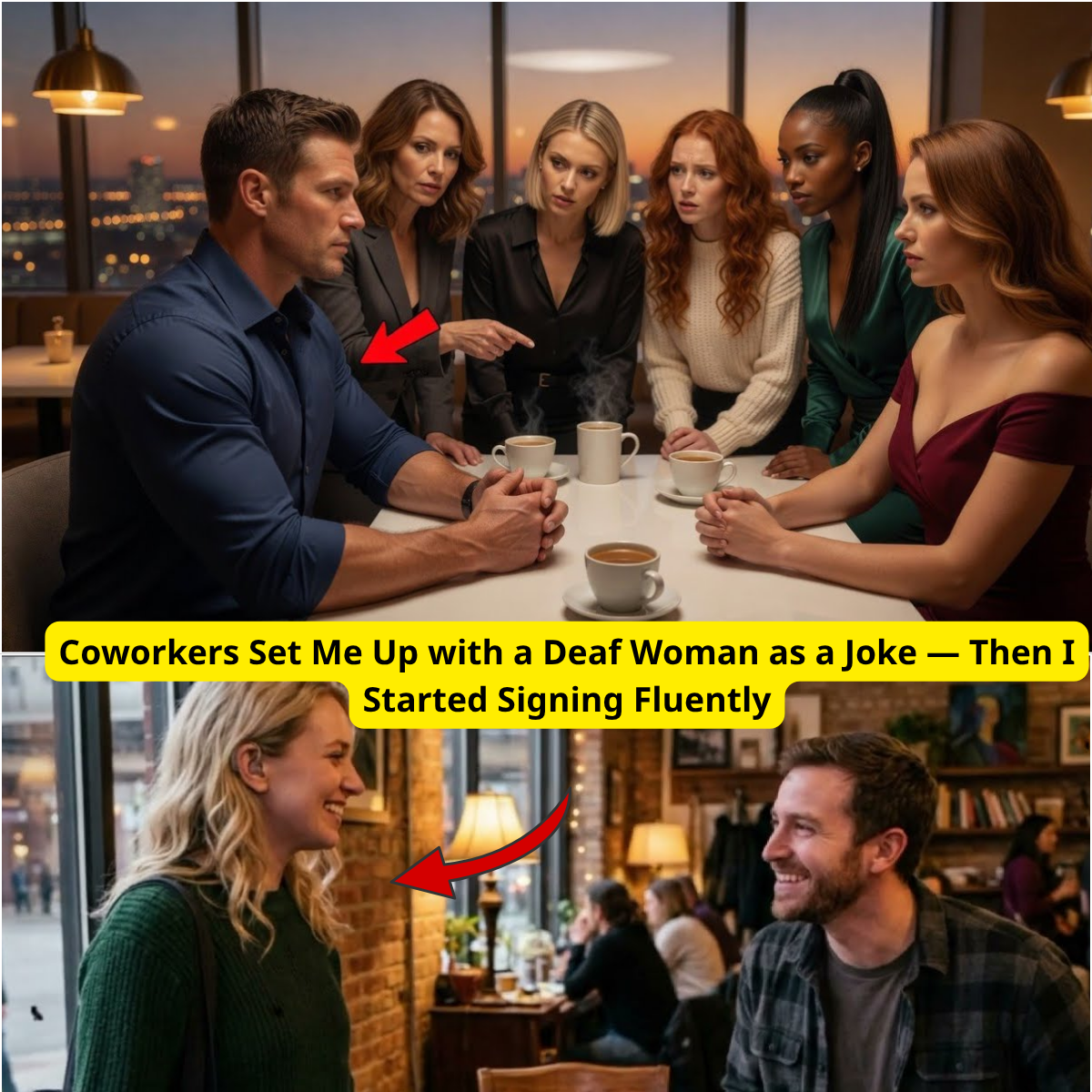
The waitress guided a young woman down the narrow wooden stairs. She wore a dark green trench coat, her shoulder-length brown hair damp from the rain, and carried a small leather purse slung over her arm. She had an attractive, striking face, with a wide, intelligent brow and dark, expressive eyes that scanned the room with a quick, hyper-alert efficiency.
As she approached the table, she took off her coat, and Ethan’s eyes caught a small, flesh-colored plastic device tucked neatly into the contour of her left ear.
A hearing aid.
The young woman sat down across from him, smoothing the fabric of her skirt. She looked at Ethan, her expression polite but guarded, her lips curved into a formal, rehearsed smile. Before Ethan could open his mouth to offer a greeting, she raised her right hand, her fingers moving in a fluid, elegant sequence of shapes before touching her chest and chin.
“Hi, I’m Sophie,” she signed, her movements clear and deliberate.
In that single, crystalline fraction of a second, the entire universe inside Ethan’s head shifted. The puzzle pieces of the previous afternoon fell into place with the sickening, heavy thud of an iron gate closing.
The smirks. The shared looks by the copy machine. Chloe’s muffled laughter in the corridor. Jason’s patronizing enthusiasm.
They hadn’t set him up on a date; they had engineered a social experiment. They thought it would be a spectacular joke to pair the office’s most socially awkward, silent data analyst with a deaf woman, assuming the evening would dissolve into a agonizing, clumsy performance of shouting, miscommunications, and panicked napkin-scribbling. They had created a spectacle for their own amusement, an elaborate piece of office theatre to be reviewed and laughed about over drinks on Monday morning.
What Jason Miller and the rest of the Vanguard team didn’t know—what they had never bothered to discover about the quiet man at the data desk—was that Ethan Vance had been fluent in American Sign Language since he was nine years old.
When Ethan was seven, his younger sister, Lily, had contracted a severe, high-grade strain of bacterial meningitis. She survived the illness, but the high fever had permanently destroyed the delicate hair cells within her cochleae, leaving her profoundly deaf in both ears. Ethan had watched his family plunge into a silent, terrifying world of isolation. He had spent his childhood sitting on the floor of a speech therapy clinic, his small hands copying the shapes his mother and sister made, determined to ensure that Lily would never look across a dinner table and feel like an outsider in her own home. He had lived in two languages for twenty years.
Ethan didn’t flinch. He didn’t clear his throat or look around for a pencil.
He rested his elbows on the dark wood of the table, looked directly into Sophie’s dark eyes, and raised his hands. His fingers moved with the loose, lazy precision of a native speaker, his wrists snapping with a natural, unhurried rhythm.
“Nice to meet you, Sophie. I’m Ethan,” he signed back.
Sophie’s entire posture froze. Her eyes, which had been set in a defensive, expectant line, widened until the whites showed beneath the irises. Her hands hovered over her lap, her fingers twitching slightly as her brain tried to process the translation.
“You know sign language?” she signed quickly, her movements sharp with a sudden, electric surprise.
Ethan smiled—a real, unguarded smile that reached his eyes for the first time in months. He dropped his hands into a more casual, conversational posture.
“A little,” he signed with a modest tilt of his head. “My movements are a bit rusty, but I can keep up.”
As he completed the sign, his eyes naturally drifted past Sophie’s shoulder, toward the large, street-level glass window of the café. Through the dark, rainy pane, illuminated by the yellow glow of a streetlamp, he could see two distinct figures standing under a black umbrella.
It was Jason and Chloe.
They were wrapped in heavy coats, their faces pressed close to the glass, Jason holding his smartphone up to the window with a wide, expectant grin, clearly waiting to capture the first awkward moments of a train wreck to share on the company’s internal messaging channels.
But inside the Blue Room Café, the script had already been burned.
Chapter III: The Conversation of Hands
Sophie kept staring at Ethan for several long seconds, her head tilted to the side as if she were trying to determine if this was an elaborate trick. For a deaf woman in a hearing world, a blind date was usually an exercise in endurance. Most people she met through setups either shouted at her as if volume could fix a broken nerve, spoke with exaggerated, patronizing lip movements, or spent the entire evening looking at their plates because the silence made them sweat.
“You’re actually fluent,” she signed, a small, genuine laugh escaping her throat—a soft, breathy sound that made the Miles Davis record in the background feel distant. “Your syntax… you aren’t doing Signed Exact English. You’re using ASL grammar.”
“I have a good teacher,” Ethan signed back, his hands moving with a relaxed, confident cadence. “My younger sister, Lily. She lost her hearing when we were kids. We spent a lot of time arguing over who got the remote control using these hands.”
The moment he mentioned his sister, the defensive armor that Sophie had worn into the café dissolved entirely. Her shoulders dropped away from her ears, and she leaned forward, resting her chin in her palm, her eyes locking onto his face with a new, intense curiosity.
Outside the window, the figures under the umbrella shifted uncomfortably. Jason lowered his phone by a few inches, his brow furrowing as he watched the two people inside the warm café engaging in a rapid, seamless conversation that looked entirely too natural. There was no shouting. There was no panic. There was only the quick, beautiful dance of fingers under the amber lights.
“Blind dates are usually a horror movie for me,” Sophie signed, her expression turning into a look of dry, systemic amusement. “Last month, an account manager from a tech firm spent the entire dinner talking to the waiter instead of me. He thought if he looked at me, he’d have to figure out how to speak to me. He literally ordered my food for me because he assumed I couldn’t read a menu.”
Ethan shook his head, his hands responding with a sharp, sympathetic snap. “People get terrified when they encounter a language they can’t use as a weapon. They lose their security.”
“That’s an insightful way to put it,” Sophie signed, her eyes bright. “But it doesn’t excuse them from being idiots.”
As the evening unfolded, Ethan found himself completely captivated by the way she communicated. Sophie didn’t just use her fingers; she used her entire face. Her eyebrows indicated grammar—dropping for open-ended questions, rising for yes-or-no queries—and her eyes carried more emotional nuances than any tone of voice Ethan had heard in the Vanguard conference rooms. When she described her work as a graphic designer for a local independent press, her hands moved with a swift, artistic rhythm that seemed to paint the book covers directly onto the air between them.
The tension that Ethan had carried in his chest for three years—the exhausting, daily weight of pretending to care about office politics and competitive metrics—began to evaporate. He wasn’t performing. He wasn’t hiding behind his data spreadsheets. He was entirely, beautifully present.
Around 8:00 p.m., the waitress arrived with the dessert menus. When she asked if they wanted coffee refills, Sophie looked at her, smiled warmly, and spoke aloud in a soft, slightly unaccented voice. “Just a decaf Americano, please. Thank you.”
Ethan’s hands paused for a moment, a look of mild interest crossing his face. Sophie caught it instantly and smirked as the waitress walked away.
“A lot of hearing people think ‘deaf’ means ‘completely silent,’” she signed, her movements teasing. “I lost my hearing when I was four, so I have some speech memory. I use my voice when I know the words are simple enough.”
“I know,” Ethan signed back, his eyes steady. “My sister does the same thing when she wants to annoy our dad. It’s a useful tool.”
They laughed together—a shared, synchronous moment of humor that shattered whatever lingering distance remained between them.
Then, Sophie’s gaze drifted past Ethan’s shoulder, toward the street-level window. Her smile faltered, her hands dropping to the table as her expression hardened into a look of cold, familiar disgust.
Ethan turned his head.
Chapter IV: Breaking the Glass
The rain was coming down harder now, washing across the glass window in thick, distorting sheets. Outside, Jason Miller and Chloe were no longer trying to hide. They were standing directly against the brick molding, their faces illuminated by the neon sign of the café. Jason was holding his phone flat against the glass, laughing openly, pointing his finger at the table while Chloe shook her head, her lips moving in a rapid stream of office gossip. They were treating the window like a television screen, waiting for the punchline of a joke they had authored.
Sophie looked back at Ethan, her signs becoming smaller, tighter, and heavy with a sudden, profound exhaustion.
“They set this up as a joke, didn’t they?” she signed, her eyes dropping to the wooden grain of the table.
Ethan felt a sharp, burning wave of shame rise from his collar to his cheeks. He hated that she had been forced to see them. He hated that the cruel, petty landscape of Vanguard Marketing had followed him into this sanctuary. For a single second, his old survival instinct kicked in—he considered inventing a lie, telling her they were just random drunks from the bar next door to protect her feelings.
But he looked at the honesty in her face, the dignity with which she held herself despite the rain and the idiots outside, and he knew a lie would be an insult.
He let out a long, slow breath and raised his hands. “Yes,” he signed, his movements heavy. “They’re from my office. They think because I don’t join their loud groups, and because you use a different language, that we’re a comedy routine. I didn’t know their real intention when I agreed to come, Sophie. If I had known, I would have never subjected you to this. I’m incredibly sorry.”
Sophie studied him quietly for three long seconds. The disappointment on her face wasn’t born of surprise; it was the deep, weary fatigue of a person who had spent her entire life dealing with the same small, unimaginative cruelties from the hearing world.
“It happens more than you’d think,” she signed slowly, her fingers tracing the edge of her coffee cup. “People treat disability like a social experiment or a test of their own patience. They want to see how the ‘other half’ lives, or they just want a story to tell at brunch.” She looked up, her dark eyes locking onto his grey ones with an intense, testing clarity. “But you’re still here.”
The sentence hung in the air between them, silent but incredibly loud.
You’re still here.
Whatever game Jason Miller had planned didn’t matter anymore. The data logs, the marketing metrics, the promotions, the fear of being an outsider—it all burned away into insignificance. Ethan looked at the man outside the window, the man who held his professional future in his hands, and felt an absolute, liberating lack of fear.
Ethan stood up from his chair.
He didn’t rush. He walked across the small basement floor, stepped onto the lower wooden stair, and stood directly beneath the street-level window. He looked through the rain-streaked glass, his face less than a foot away from Jason Miller’s phone camera.
Jason blinked, his laughter dying in his throat as he saw Ethan approaching. He didn’t lower the phone, assuming Ethan was coming out to apologize or beg them to leave.
Instead, Ethan raised his right hand. He kept his fingers fluid, his palm facing his own chest, and then executed three sharp, clear, and unmistakable signs through the glass—signs that carried the universal force of an impact.
“Get. Lost.”
He followed the phrase with a traditional, old-school military sign for dismissal—a sharp, flat-handed sweep of the wrist that needed no translation in any language on earth.
The laughter outside disappeared instantly. Jason’s face turned an immediate, pale shade of grey under the streetlamp as he realized the absolute, unshakeable confidence in Ethan’s eyes. He realized, with a sudden shock of panic, that the quiet man from the data desk wasn’t a victim; he was an operator who understood exactly what was happening. Chloe grabbed Jason’s arm, her face turning red with embarrassment, and within five seconds, the two executives turned and walked awkwardly away, their black umbrella tilting into the wind as they disappeared into the dark Seattle rain.
Ethan walked back to the table and sat down.
Sophie was staring at him, her lips parted in disbelief. Then, she brought both hands up to her face, her shoulders shaking as a silent, deep laugh took hold of her—a laugh so genuine her eyes crinkled at the edges.
“That was… incredibly satisfying,” she signed, her fingers flying with a joyful, high-speed velocity.
Ethan laughed too, a low, free sound that he hadn’t heard from his own chest in three years. “They’re going to be very quiet on Monday morning.”
Chapter V: The New Metric
The atmosphere at the corner table shifted completely after that. The uncomfortable truth of the office joke was out in the open, leaving no room for performance, no room for pretense, and no reason to navigate the world by anyone else’s rules.
They stayed in the Blue Room Café for another hour and a half. They stopped talking about annoying co-workers and began talking about things that actually carried weight—the specific texture of memory, the way a city looks when the rain stops at midnight, and the silent, beautiful spaces that exist between words. Ethan found himself sharing stories about his childhood with Lily, stories he had never told a single person at Vanguard. Sophie listened with her eyes, her hand occasionally reaching across the wood to tap his wrist when she wanted to emphasize a point.
By the time they finally stood up to leave, the café staff had begun stacking the wooden chairs on top of the empty tables around them, the vintage turntable quiet behind the counter.
They climbed the narrow wooden stairs together and stepped out onto the sidewalk. The storm had passed, leaving the downtown streets clean, dark, and glistening under the yellow neon lights of the city. The air was crisp, smelling of wet asphalt and late autumn.
Sophie stopped near the edge of the awning, wrapping her green trench coat tightly around her shoulders. She looked at Ethan carefully, her dark eyes carrying a soft, reflective light. She raised her hands one final time, her movements slow, deliberate, and gentle.
“You know, Ethan,” she signed, her eyes locked onto his. “This was actually the best date I’ve had in years.”
Ethan smiled, his hands rising to meet her language in the quiet night air.
“Mine, too, Sophie,” he signed back. “Mine, too.”
He didn’t think about the third floor of Vanguard Marketing. He didn’t think about the spreadsheets or the coffee machine or Jason Miller’s Monday morning expression. As he walked her toward the transit station, their hands moving in short, quiet gestures against the backdrop of the city lights, Ethan Vance finally understood something beautiful. Sometimes the world creates a noise specifically to force you into the silence where you belong, with the people who know exactly how to read it.