Magic Johnson HUMILIATES Anthony Edwards For Calling Their Era “Unskilled”
Magic Johnson HUMILIATES Anthony Edwards For Calling Their Era “Unskilled”
In the sun-drenched, high-gloss world of professional basketball, Magic Johnson is the ultimate diplomat. For four decades, the man known as “Earvin” to his inner circle and “Magic” to the world has navigated the treacherous waters of celebrity, business, and sports with a signature, gap-toothed grin that could sell ice to an Alaskan. He is the NBA’s eternal optimist, a figure who transitioned from the hardwood to the boardroom without ever losing the perceived warmth of a man who just hit a game-winning baby hook.
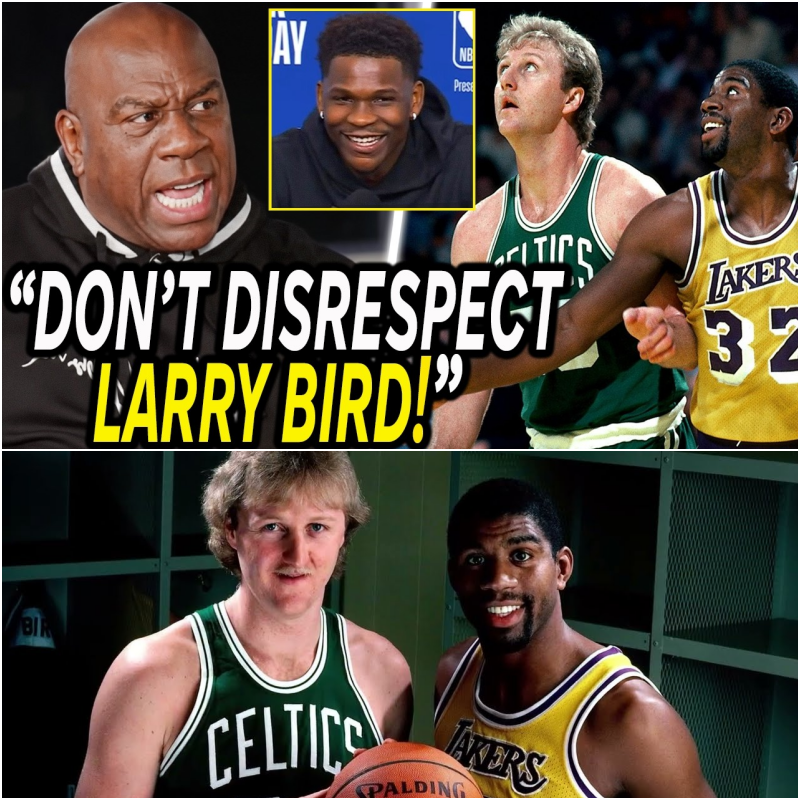
But recently, the smile vanished.
The catalyst for this rare atmospheric shift was not a failed business merger or a Lakers’ losing streak. Instead, it was a comment from Anthony Edwards, the Minnesota Timberwolves’ 23-year-old supernova and the presumptive new face of the league. In an era defined by “Ant-Man’s” gravity-defying dunks and unfiltered trash talk, Edwards threw a stone into the pond of basketball history, claiming that players from the 1980s and 90s—aside from Michael Jordan—were essentially “unskilled” and lacked athleticism.
To the casual observer, it was standard generational banter. To Magic Johnson, it was heresy. Specifically, it was an assault on the legacy of Larry Bird, the man who was once Magic’s greatest enemy and is now his most protected brother-in-arms.
The Weight of the “Unskilled” Label
When Anthony Edwards looked into a camera and suggested that the legends of the past couldn’t handle today’s pace or physical requirements, he wasn’t just expressing an opinion; he was reflecting a growing modern sentiment. In the age of 40-foot three-pointers and advanced “load management,” the grit-and-grind era of the 1980s can look, to a Gen-Z eye, like a slower, more primitive version of the product.
However, Magic Johnson’s reaction, captured on several platforms including Byron Scott’s Fast Break podcast and ESPN’s First Take, revealed a level of “high agitation” that long-time associates like Stephen A. Smith found jarring.
“For him to take that tone… lets me know he was highly agitated,” Smith noted. “Normally, Magic is a lot more diplomatic. He’s a lot more PC.”
The reason for the agitation is simple: Magic Johnson knows what the world seems to have forgotten. He knows that the “stage” Anthony Edwards currently dances upon was built in the rubble of a league that was nearly extinct. Before Magic and Bird arrived in 1979, the NBA Finals were broadcast on tape delay. The league was perceived as too “drug-riddled” and “unrelatable” for mainstream America.
Magic and Bird didn’t just play basketball; they performed an emergency tracheotomy on a dying sport.
Defending the Great White Hope of French Lick
What makes Magic’s defense so poignant is that he isn’t defending his own athleticism. Magic knows he was a 6’9″ anomaly who could run the break like a deer. He’s defending Bird—a man who, by modern standards, possessed a “pedestrian” vertical leap and the foot speed of a standard sedan.
To Edwards, Bird might look like the “unskilled” archetype he’s mocking. But to Magic, Bird is the ultimate rebuttal to the “athleticism-is-everything” argument.
“Larry Bird and I knew what we had to do,” Magic explained, reflecting on their 1979 NCAA Championship clash and their decade-long war in the NBA. Bird was a man who won three consecutive MVPs and three championships through sheer, psychotic competitive fury and a basketball IQ that bordered on the clairvoyant.
By dismissing Bird’s era as “unskilled,” Edwards inadvertently dismissed the very quality that made Bird a god among men: the ability to dominate the most athletic specimens on earth using nothing but his mind and a jumper that never cooled. Magic’s response was a verbal chin-check, a reminder that “youngsters” need to do their homework before they “run up on one of these old heads and get handled.”
The List of Receipts
Magic didn’t just offer rhetoric; he brought the receipts. When the “lack of athleticism” claim was leveled, Johnson rattled off names like a litany of saints: Michael Jordan, Dr. J, Kobe Bryant, Clyde Drexler, David Thompson.
“I can keep going,” Magic warned.
But the most devastating blow Magic landed wasn’t about highlight reels or 40-inch verticals. It was about the jewelry.
“I’ll answer his questions when he wins some championships,” Magic remarked, twisting the knife.
In the high-stakes hierarchy of the NBA, there is a “statute of limitations” on trash talk. To the old guard, if you haven’t held the Larry O’Brien Trophy—the very trophy Bird and Magic passed back and forth for a decade—your opinion on their “skill level” is essentially noise. Edwards is arguably the most exciting player in the league today, a sentiment Magic himself conceded, but excitement doesn’t equal excellence in the ledger of the legends.
The Ferrari vs. The Driver: The Evolution Argument
The debate spilled over into the broader sports media landscape, with former NBA guard Gilbert Arenas offering a counter-perspective on his Gil’s Arena show. Arenas used a luxury car analogy to defend Edwards’ generation.
“My Ferrari is faster than yours,” Arenas argued. “Yours was top in the 80s… but the governor has changed, the wheels have changed, the brakes have changed.”
It’s a seductive argument. Modern sports science, nutrition, and training have undoubtedly produced “faster cars.” Today’s players are faster, stronger, and more specialized. But the pushback from the veteran community, including Kevin Garnett, focuses on the “driver.”
A faster car doesn’t matter if the driver lacks the stomach for a high-speed collision. The 1980s era was defined by a lack of “load management.” Magic recalled stories of his trainer, Gary Vitti, having to literally hide his jersey to keep him from playing through injuries that would sideline a modern player for months.
Magic also revealed a private conversation he had with Michael Jordan in Europe, where the GOAT himself expressed bewilderment at the modern trend of sitting out games. Jordan, who played 82 games in a season nine times, and Bird, who literally broke his back for the Boston Celtics, viewed the game as a sacred obligation. To them, the “athleticism” of today’s players is a gift that is too often pampered, whereas their “unskilled” era was a forge that produced iron men.
A League in Decline?
Magic’s critique went beyond personal pride; he linked the “disrespect” of the past to the current struggles of the league. He pointed to a 40% decline in viewership, suggesting that when the “mentality” shifts from winning at all costs to individual brand-building and highlight-chasing, the audience feels the hollow center.
“When highlights replace legacies,” the sentiment goes, “the game loses its soul.”
The NBA is currently grappling with its identity. It is a league of unprecedented wealth and global reach, yet it finds itself in a defensive crouch against the shadows of its own history. When a young star like Edwards dismisses the pioneers, he risks alienating the very fans who grew up worshipping the “Showtime” Lakers or the “Grit” of the Celtics.
The Bond of the Brotherhood
At the heart of Magic Johnson’s “harshness” is a profound, almost tragic, love for the game. He and Bird didn’t just play; they bled for the league. Bird’s body broke down so completely that he spent his final seasons lying on the floor in front of the bench to keep his back from seizing up. Magic’s career was cut short by an HIV diagnosis that changed the world.
They paid a physical and emotional price that Anthony Edwards, in his youth and exuberance, has yet to contemplate.
Magic Johnson isn’t a “bitter old head.” He is a man guarding the gates of a temple he helped build with his bare hands. He is protecting the legacy of Larry Bird because he knows that if Bird’s greatness is forgotten, the very essence of what makes basketball a test of will—rather than just a test of fast-twitch muscle fibers—is lost.
The message to Anthony Edwards and the new generation is clear: The “Ferrari” might be faster, but the road was paved by men who drove through fire. Until the new generation wins their own wars and raises their own banners, they would be wise to show a little reverence for the architects of their empire.
Magic Johnson is still smiling, most of the time. But let this be a warning to the league’s young stars: If you come for the legends, make sure you’re wearing your ring. Because Magic is always watching, and he never forgets a teammate—especially one who wore Celtic green.