Holy Mother Captured On Camera? The Salta Apparitions
Holy Mother Captured On Camera? The Salta Apparitions
The wind off the Andes didn’t blow into Salta; it dropped like a heavy, silver curtain from the snow-capped ridges of the Lerma Valley, smelling of dry earth, wild tobacco, and the cold, unpeopled spaces of the high puna. It was a landscape that lent itself to silence, a geography where the earth rose up so sharply that the sky felt less like an atmosphere and more like an interrogation.
Inside the quiet, whitewashed parlor of St. Bernard’s Monastery, Sister Maria Clara adjusted her black veil, her fingers moving with the rhythmic economy of a woman who had spent forty years counting the spaces between prayers. Across the dark mahogany table sat Father Thomas Vance.
Thomas was an American priest from the Archdiocese of Chicago, a man whose regular assignments usually involved the structural integration of inner-city parishes and the tedious review of diocesan pension funds. He had been sent to northwestern Argentina as a temporary theological observer, a polite title for an investigator whose job was to ensure that the line between deep faith and mass hysteria remained strictly defined. He was a second-generation American with a pragmatic jaw, eyes the color of winter lake ice, and a mind that treated extraordinary claims with the same disciplined skepticism a building inspector applies to a cracked foundation.
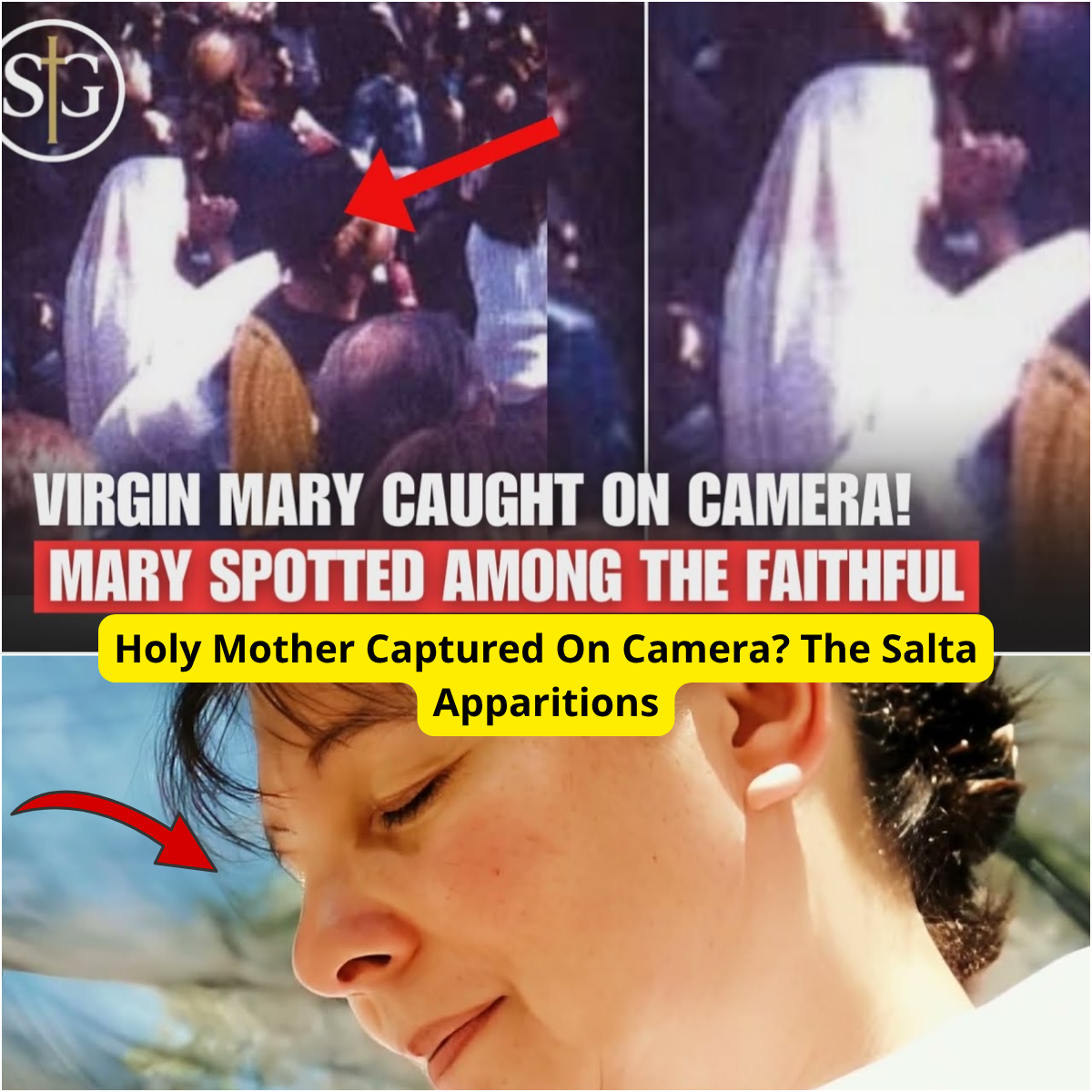
Between them lay a collection of glossy color photographs, their edges slightly curled by the high altitude and the dry air of the convent parlor.
“This is the one from the hill,” Sister Maria Clara said, her voice a low, gravelly whisper that had been tempered by decades of monastic silence. She tapped a photograph taken on a grainy afternoon late in the year. “It was brought to us by one of Maria Livia’s closest companions. A pilgrim took it with a standard automatic camera, aiming blindly into the crowd near the summit of the Cerro. Look closely at the center, Father.”
Thomas pulled a pair of reading glasses from his cassock pocket and leaned into the light of the high window.
The image captured a dense sea of human faces—sweaty, dust-streaked, turned upward toward the ridge line. But in the middle ground, where the scrub oak grew thickest against the red dirt, the sunlight had fractured in an unusual pattern. It wasn’t a classic lens flare; it was a distinct, vertical pillar of soft, opalescent light that seemed to trace the outline of a kneeling figure, wearing a mantle that didn’t match the rough denim and wool of the Argentine peasants around it.
“A light leak through a faulty shutter seal,” Thomas said, his voice retaining the flat, midwestern cadence of a man who spent his youth in a Chicago suburb. “Or a chemical streak from a local processing lab in town. The humidity changes rapidly when you come down from the mountain, Sister. It causes the film emulsion to dry unevenly.”
Sister Maria Clara didn’t look offended. She merely folded her hands inside her wide sleeves, her face remaining as calm and smooth as the stone floor beneath their feet. “Perhaps. But the woman who took it didn’t look at the film chemistry, Father. She looked at the shape and saw the girl she had been looking for her whole life.”
“The Church doesn’t validate film chemistry, Sister,” Thomas replied gently, sliding the photo back into the manila folder. “We validate the fruits. And right now, the fruits look like a division in the diocese.”
The Hidden Decade
The story had begun ten years earlier, in 1990, though the world hadn’t known it then.
Maria Livia Obeid had been married for twenty years—a quiet, unremarkable life of middle-class stability in the suburbs of Salta—when the stillness of her home was shattered by a presence she hadn’t asked for. It didn’t arrive with a thunderclap or a dramatic tearing of the sky. It began as a small, interior voice that gradually grew into a visual manifestation so vivid it made the solid walls of her bedroom look like smoke.
Initially, terrified of her own mind, Maria Livia had told no one but her confessor. For three years, she lived a double life: preparing meals for her husband, managing her household, and then retreating into the small spaces of her home to look upon a visitor who seemed to exist outside the framework of time. Gradually, the secret expanded to her husband and her immediate family, a small circle of protectors who watched her pass into silent, unblinking states that lasted for hours.
During those early years, Maria Livia had sought refuge within the thick, seventeenth-century walls of St. Bernard’s Monastery, befriending the enclosed Carmelite nuns who spent their lives hidden from the world.
“She described her to us in this very room,” Sister Maria Clara murmured, her eyes drifting toward the corner of the parlor where a newly carved wooden statue stood on a stone pedestal. “She told us the visitor had the face of a fourteen-year-old girl—the specific age at which our Lady conceived the Savior. Not a grand queen, Father, but a child from a village, kneeling in the dirt, wearing a mantle and veil of the purest white. Her posture was one of absolute adoration, her hands pressed together before a heart that Maria Livia said was visible through her garments—the Divine Eucharistic Heart.”
Thomas stood up and walked over to the statue. It was beautifully rendered in local cedar, the drapery of the veil carved with remarkable fluidity. But it was the eyes that caught his attention. They were a striking, vibrant aquamarine, a color that didn’t match any standard wood stain or the typical dark hues used in traditional Argentine statuary.
“The painting of the eyes,” Thomas observed, leaning in. “The report says the nuns couldn’t get it right.”
“We tried three times,” Sister Maria Clara said, a faint, rare smile breaking through her solemn expression. “The sisters used every pigment we had in the workshop, but it always came out too blue or too gray. We left the statue unfinished on the table in the old sacristy one evening, intending to sand it down again in the morning. When we unlocked the door at dawn, the eyes were as you see them now. Pristine. The exact shade of ocean water that Maria Livia had described. No sister had entered the room; the key was in my keeping.”
Thomas reached out, his thumb hovering just millimeters from the painted wood, his engineer’s mind searching for the texture of a brush stroke, the small ridges of a human hand. The surface was perfectly smooth, the pigment seeming to exist within the grain itself rather than on top of it.
“A lovely story, Sister,” Thomas said softly, turning back to the table. “But the Archbishop is looking at a different set of facts. Since Maria Livia went public in the year 2000, claiming she was instructed to build a shrine on the Cerro, the hill has become a state within a state.”
The Intercession of Shoulders
The true source of the diocese’s anxiety was not the statue, but the Saturdays on the mountain.
By 2002, the phenomenon had grown beyond the control of the local parish priests. Every weekend, thousands of pilgrims from across South America and the United States traveled up the winding, dusty paths of the Cerro, a rugged hill on the outskirts of Salta. They gathered at the summit, a sea of sunburned faces, to pray the rosary and wait for the lady’s messages to be read aloud.
But the emotional lightning rod of the gathering was the prayer of intercession.
Thomas experienced it himself on a hot, dust-choked afternoon in November. He stood at the edge of the crowd, wearing a plain linen shirt and sunglasses to blend in with the tourists, his notebook tucked into his back pocket.
Maria Livia walked through the tightly packed rows of pilgrims. She didn’t look like a visionary from an old oil painting; she was a mature woman in a simple blouse and skirt, her hair tied back, her face lined with the ordinary fatigue of the northern heat. But as she moved, a profound, heavy silence fell over the ridge.
She walked slowly, her eyes fixed on the people before her. She didn’t preach; she didn’t shout. She simply approached an individual, looked into their face for a silent beat, and then placed both of her hands firmly on their shoulders.
What followed was a scene that made Thomas’s professional skepticism tighten like a knot.
The moment her hands made contact, the pilgrims didn’t merely pray; they collapsed. It wasn’t the violent, thrashing hysteria Thomas had witnessed in some charismatic revivals in the States. It was a gentle, vertical descent—a phenomenon the locals called “slain in the Spirit”—where individuals simply lost the capacity to stand, falling backward into the arms of waiting helpers who laid them out on the red dirt like sleeping children. Their faces were completely serene, their breathing deep and rhythmic.
Thomas watched an elderly man, his hands twisted by decades of farm labor, take the touch. The man’s eyes closed instantly, a look of immense, unburdened peace washing over his features as he slipped to the ground.
“Mass suggestion,” Thomas muttered to himself, his fingers writing rapidly in his notebook. “The altitude, the prolonged chanting, the psychological pressure of expectation. A classic collective emotional release.”
Yet, as he watched Maria Livia move past a young mother weeping over a sick child, her hands resting lightly on the woman’s shoulders, Thomas felt a strange, cold vibration in his own chest. It was the same unsettling feeling he had experienced as a young seminar student when he first realized that some human longings are too vast to be measured by a slide rule.
The Decree of the Archbishop
The reaction from the Church hierarchy was swift, administrative, and unyielding. On April 7, 2003, Monsignor Mario Cargnello, the Archbishop of Salta, issued an official statement that sent a shudder through the community of believers.
Thomas sat in the Archbishop’s private study, surrounded by leather-bound volumes of canon law and the heavy scent of furniture polish. Archbishop Cargnello was a man of intense pastoral responsibility, his face carrying the grim resolution of a shepherd who saw a wolf in every unapproved devotion.
“We cannot allow a parallel magisterium to develop on that hill, Father Vance,” the Archbishop said, his hand coming down firmly on the text of his decree. “I have forbidden the promotion of these recent messages while they remain under formal study by our theological commission. More importantly, I have strictly prohibited the prayer of intercession as it is currently practiced. No layperson in this diocese is authorized to perform the laying on of hands in this manner. It creates confusion about the nature of the priesthood and the sacraments.”
“The messages themselves, Your Excellency?” Thomas asked.
“They are lacking in doctrinal content,” Cargnello said, his eyes narrowing. “They repeat basic truisms about conversion and adoration, which is well and good, but the desire for personal prominence is far too evident. Furthermore, Maria Livia’s team has failed to comply with our requests. We have asked repeatedly for the results of her independent psychological evaluations, and we have received nothing but delays and excuses from her supporters.”
“The Carmelite nuns are standing by her,” Thomas noted.
“The nuns are falling out of line with the pastoral direction of this diocese,” the Archbishop replied coldly. “They are cloistered religious, yet they are acting as a distribution center for an unapproved cult. If this continues, I will be forced to take canonical disciplinary actions against the monastery itself.”
Two years later, in July 2005, the conflict reached a boiling point. Supporters of Maria Livia sent a formal letter to the archdiocese, accompanied by medical documentation, denying that any psychological test results had been hidden and pleading for pastoral understanding. They argued that the fruits of the hill—thousands of confessions, broken families reconciling, a renewed devotion to the Blessed Sacrament—were proof enough of the source.
But the Archbishop remained unmoved. In July 2006, he issued a definitive declaration: there was no proof supporting the supernatural nature of the apparitions. The Church could not endorse the events as true, and the faithful were warned that participation in the gatherings on the Cerro fell entirely outside the pastoral direction of the Catholic Church.
The Progress of the Year
By 2011, the standoff had entered a quieter, more complex phase. The crowds on the mountain had not diminished; if anything, the official warnings had given the Cerro an aura of holy resistance that attracted even more international pilgrims.
On a cool December evening at the end of the pilgrim year, Thomas returned to the hill. To his surprise, he found a temporary altar erected near the summit, and a diocesan priest preparing to celebrate Mass. Archbishop Cargnello had softened his stance slightly, allowing the liturgy to take place so that the pilgrims would not be entirely cut off from the sacramental life of the Church.
Standing near the edge of the altar was Father René Laurentin, the world-renowned French Mariologist, his frail body wrapped in a heavy coat against the mountain wind. Thomas walked over and stood beside the old theologian, watching the thousands of candles flickering in the Argentine twilight.
“A long way from Lourdes, Father,” Thomas said.
Laurentin smiled, his ancient eyes reflecting the sea of small flames. “The geography changes, my young friend, but the human heart remains the same. This mass… it is a sign of progress. It shows that the Church is doing what she has always done best: she is waiting. She is letting the dust settle so she can see the stone beneath.”
“The Archbishop says there is no proof of the supernatural here,” Thomas reminded him.
“The Church is prudent, as she must be,” Laurentin said, his voice nearly lost in the sound of the opening hymn. “Private revelations are like windows in an old house. They are personal experiences; they do not constitute official doctrine, and no believer is required to accept them to save their soul. But look at what the message actually asks for, Thomas. It doesn’t ask for a new dogma. It asks for a return to the Divine Eucharistic Heart of Jesus. It asks for perpetual adoration, for reparation, for the realization that Christ is alive in the sacrament. That is not a dangerous novelty; that is the core of our faith.”
The old priest turned to look at the statue of the young virgin, her aquamarine eyes catching the light of the altar candles. “She asked for prayers for the unity of the West and the East. She asked for preparation for the second coming through a greater understanding of love. She told them that hope is the path that leads to God. Tell me, Father Vance—which part of that message requires a laboratory test to be useful?”
The Mark of Eternity
The next morning, before his flight back to Buenos Aires, Thomas Vance met Maria Livia one final time in a small, non-descript office near the base of the mountain. There were no cameras, no line of fainted pilgrims, no dramatic manifestations. Just a tired woman in her late fifties, pouring black coffee into two plastic cups.
“They want me to be a saint or a fraud, Father,” she said, her voice quiet and entirely lacking in defensive anger. “The journalists want a miracle, and the lawyers want a psychological diagnosis. But I am only a woman who was looking at her garden when the room became too bright.”
Thomas looked at her hands—clean, short-nailed, ordinary. “The Archbishop is worried about obedience, Maria. He is worried about the unity of his diocese.”
“I love the Church,” she said simply, looking him straight in the eye with a clarity that reminded him of the aquamarine paint on the cedar statue. “I do not want to build a kingdom for myself. The Lady told me that every soul that consecrates themselves to his Eucharistic Heart will receive a mark of eternity. She said it is the key that opens the soul for conversion. If the Archbishop tells me to stop speaking, I will go back to my kitchen and pray in silence. The message doesn’t belong to me anyway. It belongs to anyone who looks at the bread on the altar and sees a living heart.”
Thomas didn’t write anything in his notebook. He sat for a long moment, the steam from his coffee rising between them in the cool morning air.
An hour later, as his taxi wound its way down from the high valley toward the airport, Thomas looked out the rear window at the Cerro. The mountain stood high and red against the blue sky, its peaks catching the first full rays of the morning sun.
He knew the theological commission would go on for years, compiling reports, analyzing statements, and debating canonical definitions. He knew the Church would maintain her traditional, necessary prudence, never rushing to declare a miracle where human emotion could explain the light.
But as he looked down at his own hands, he realized he didn’t need the official decree to understand what had happened in the valley. He had seen thousands of broken, exhausted people stand in the dirt of a cold hill, looking for a sign that they were loved, and walking away with a peace that didn’t make sense to the world’s ledger.
He pulled his reading glasses from his pocket and laid them in his briefcase, alongside his notes on film chemistry and mass suggestion. They were good tools, but they were too small for the landscape he was leaving behind. Outside, the great silver wind of the Andes continued to blow across the high grass, indifferent to the decrees of men, carrying the scent of a hidden heart that remained open, silent, and perpetually alive in the high places of the earth.