Atheist Asks TOUGH Questions: EPIC Response! (DEBATE)
The Debate That Defined a Generation: When Tough Questions Met an Epic Response
For decades, the public square has played host to a fierce intellectual battle over the existence of God. While the culture wars often degrade into partisan shouting matches and internet memes, every so often a confrontation occurs that transcends the noise—a moment where two titanic minds clash with such elegance, depth, and intellectual rigor that it permanently alters the landscape of the discussion.
The legendary debate between the late Christopher Hitchens, one of the twentieth century’s most formidable polemicists and a pillar of the “New Atheism” movement, and John Lennox, the brilliant Oxford mathematician and Christian apologist, stands as the gold standard of these encounters.
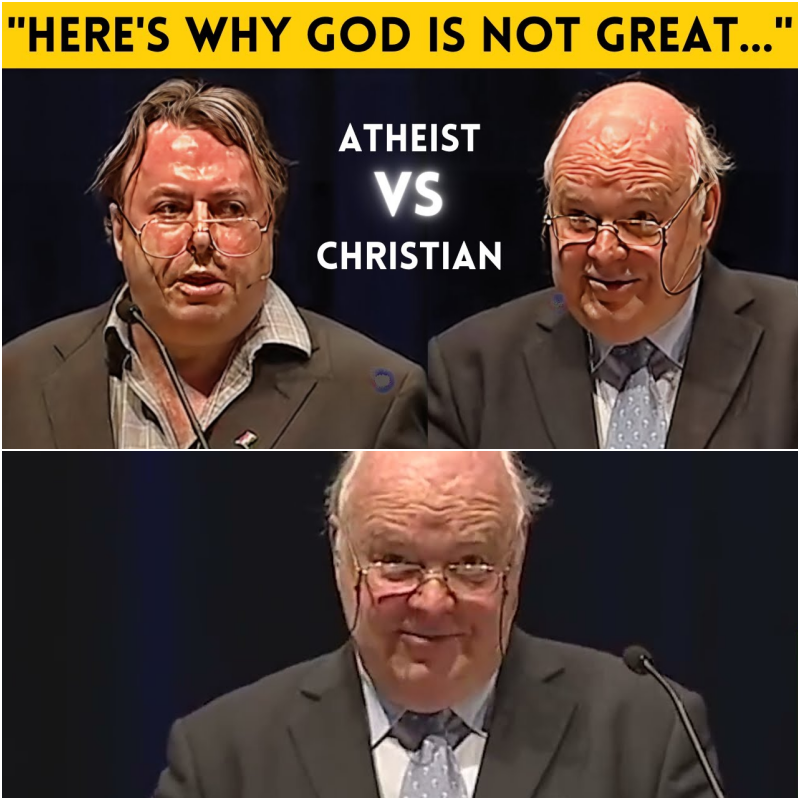
Hitchens came armed with penetrating, deeply uncomfortable questions about the cruelty of nature and history. Lennox responded not with defensive dogmatism, but with a literal masterclass in philosophy, science, and theology.
The core of their exchange offers a timeless exploration of humanity’s oldest riddles: If God exists, why is the world so full of horror? And if science can explain the cosmos, does the divine become obsolete?
The Atheist’s Indictment: A History of Blood and Bungle
Christopher Hitchens was never an opponent who could be brushed aside with Sunday-school platitudes. He possessed a terrifyingly sharp intellect, a mastery of the English language, and a profound, genuine indignation at the suffering of the world. In this historic clash, Hitchens launched what many consider to be his most devastating broadside against theistic belief: the argument from historical and biological horror.
Hitchens’ argument began not with philosophy, but with geology and evolutionary history. He pointed out a staggering statistic: over 99.9% of all species that have ever existed on Earth have gone extinct. If the universe was meticulously designed by a loving creator to foster life, Hitchens argued, then “Heaven has already watched almost a hundred percent of its creation die off—and in very unpleasant, callous circumstances, with folded arms.” To Hitchens, this suggested a designer who was either shockingly incompetent or brutally indifferent.
Moving from paleontology to anthropology, Hitchens narrowed his focus to humanity itself. Drawing on estimates from modern science, including the work of evangelical geneticist Francis Collins, Hitchens noted that Homo sapiens have been walking the earth for at least 100,000 years (with many scientists arguing for a quarter of a million).
“What does it mean if we are divinely supervised and divinely created?” Hitchens asked, his voice dripping with incredulity. It means, he argued, that for the first 98,000 of those years, human beings lived, suffered, and died in utter agony.
Christopher Hitchens' Timeline of Human Suffering:
[ Year 0: Homo Sapiens Emerge ]
      │
      ├── (98,000 Years of Terror)
      │    • 20-30 year life expectancy
      │    • Dying in childbirth / Infant mortality
      │    • Hideous diseases, microbes unknown
      │    • Starvation, tribal warfare, perpetual fear
      │
[ Year 98,000: The "Intervention" ]
      │
      └── (Last 2,000 Years)
           • Sudden divine redemption offered in the Middle East
Hitchens painted a vivid, agonizing portrait of this pre-modern existence. For nearly a hundred millennia, human life expectancy hovered between 20 and 30 years. People died of their teeth rotting out of their skulls. They were consumed by hideous, microscopic diseases they had no way of understanding, let alone curing. They lived in permanent terror of natural disasters—earthquakes, lightning strikes, famines—which they attributed to angry deities. This was to say nothing of the brutal, ceaseless violence between neighboring tribes fighting over women, meat, and subsistence land.
“For the first 98,000 years, Heaven watches this going on with perfect indifference,” Hitchens thundered. Then, a mere two to three thousand years ago, Western religions claim that God suddenly decided to intervene. Hitchens mocked the historical specificity of these interventions with biting sarcasm:
“What would be the best way of intervening to try and redeem this rather bleak picture? What about having somebody tortured to death in an obscure part of the Middle East? That ought to cure it. Or if you’re a Muslim, what about getting an illiterate shepherd to start babbling and saying he’s been shown an archangel?”
To Hitchens, the traditional religious narrative was not just biologically absurd; it was morally bankrupt. It painted a portrait of an “eternal father” who was cruel, capricious, bungling, and callous—a crummy designer who abandoned his children to millennia of torture before offering a bizarre, localized bureaucratic fix.
The Apologist’s Masterclass: Distinguishing Mechanism from Agency
When John Lennox took the microphone, the audience braced for the usual defensive maneuvers. Instead, Lennox delivered an epic, multi-layered response that dismantled the foundation of Hitchens’ worldview while offering a robust defense of Christian theism. Lennox’s approach was brilliant because he did not deny Hitchens’ premises regarding the horrors of the world; instead, he completely reframed what those horrors meant.
Lennox began by making a crucial distinction that stripped Hitchens of one of his favorite rhetorical weapons: the historical atrocities committed in the name of religion. Lennox agreed wholeheartedly with Hitchens’ repudiation of the evils done by the church and religious institutions throughout history. However, he noted that judging the character of God by the failures of his self-professed followers is a fundamental logical error.
“If I fail to distinguish between the genius of Einstein and the abuse of his science to create weapons of mass destruction,” Lennox argued, “I might be tempted to say science is not great and technology poisons everything.”
By the same token, Lennox pointed out, looking at the monstrous, state-enforced atheist regimes of the twentieth century—such as those of Stalin, Mao, and Pol Pot—might tempt someone to say that atheism is not great and has poisoned everything. Rather than playing a game of historical blame-shifting, Lennox insisted that we must evaluate the core truth claims of a worldview, not just the worst behavior of its adherents.
Turning to the scientific critique, Lennox addressed Hitchens’ assertion that modern tools like the telescope and the microscope have rendered God obsolete as an explanation for the universe. Lennox found this view intellectually untenable for a scientist.
Using a vivid analogy, he argued that saying God and science are mutually exclusive explanations for the cosmos is as fundamentally flawed as saying that the laws of internal combustion and Henry Ford are mutually exclusive explanations for the automobile.
“They are complementary explanations,” Lennox insisted. One explains how the machine works; the other explains why it exists in the first place.
Lennox argued that the pioneers of modern science—Galileo, Copernicus, Kepler, and Sir Isaac Newton—were not driven to science despite their faith, but because of it. When Newton discovered the law of gravity, he didn’t conclude that he no longer needed God. Instead, his wonder at the mathematical elegance of the universe increased his admiration for the Creator who had designed it that way.
To suggest that as our scientific instruments grow more powerful, the greatness of God somehow diminishes, is to make the juvenile mistake of confusing the mechanism with the agent. The laws of physics can describe what is there, but they cannot put it there. Lennox quoted the legendary physicist Stephen Hawking, who famously noted that a mathematical model cannot answer the question of why there should be a universe for the model to describe. “Why,” Hawking asked, “does the universe go to all the bother of existing?”
The Fatal Flaw of Atheism: The Incoherence of Mindless Rationality
The apex of Lennox’s masterclass, however, was not his defense of creation, but his aggressive deconstruction of the inner logic of atheism. Lennox turned the tables on Hitchens, arguing that atheism is a self-refuting philosophy that ultimately destroys the very instrument required to argue for it: the human mind.
Hitchens had previously written that if a belief requires “faith,” its likelihood of possessing truth or value is considerably diminished. Lennox pounced on this, pointing out that all scientists are, by definition, people of faith. They must operate on the fundamental, unprovable belief that the universe is rationally intelligible—that the human brain can reliably process and understand the truth of the cosmos. Einstein himself recognized this as a profound mystery that physics could not explain.
If Hitchens’ rule were applied consistently, the “faith” that the universe is intelligible would diminish the value of science itself. Thus, Hitchens’ position was entirely self-defeating.
Furthermore, Lennox challenged the materialist account of human origins. If human life and cognitive faculties are merely the byproduct of mindless, unguided, random evolutionary processes, why should we trust their outputs?
Lennox quoted the secular philosopher John Gray, who observed that if Charles Darwin’s theory of natural selection is purely true, the human mind serves evolutionary success and survival—not objective truth.
“If our brains are just the result of an endless lottery of blind forces,” Lennox argued, “this reduces all rationality to zero. Far from atheism being great, it is irrational, anti-scientific, and utterly incoherent.”
The Question Beneath the Question: Is God Good?
What made this debate resonate so deeply across the cultural landscape was that it quickly bypassed academic pedantry and struck at the raw existential nerve of the human condition. The real question lurking beneath the intellectual debate of “Does God exist?” is almost always a deeper, more emotional one: Is God good? Is he worthy of our trust, or is he a celestial tyrant?
Hitchens looked at the blood, horror, and tragedy of biology and history and saw a cold, chaotic universe devoid of meaning. It is a view that resonates with anyone who has walked through intense personal grief, religious trauma, or chronic illness. The world is objectively full of brokenness, and squaring that reality with a loving God is the ultimate wrestling match of human existence.
Yet, as the post-debate analysis highlights, the alternative offered by atheism provides no refuge. If atheism wins the argument, the suffering of those first 98,000 years of humanity does not disappear; it simply loses all meaning. In a purely materialist universe, those billions of people suffered and died for absolutely nothing, crushed by blind, indifferent forces, leaving humanity to exist without ultimate hope for a tiny moment before being extinguished forever.
Lennox’s closing argument did not attempt to fully untangle the deep philosophical mystery of suffering—noting that even scientists cannot fully define what energy is, let alone the deepest mysteries of theology. Instead, he pointed to the center of the Christian claim: that God did not remain distant, looking down at a suffering world with folded arms.
In the Christian framework, the ultimate manifestation of the greatness of God is found in the incarnation—the claim that the Creator stepped into history, took on human flesh, and willingly absorbed the very horror, violence, and death that Hitchens so rightly lamented.
Ultimately, this legendary confrontation proved that the debate over faith and reason is far from settled. By meeting Hitchens’ toughest, most penetrating historical questions with a sophisticated defense of agency, rationality, and grace, John Lennox demonstrated that belief in God is not a relic of a superstitious past, but a deeply coherent framework that gives voice to our suffering, grounding for our logic, and an enduring hope for the future.