The U.K. Is Truly F*CKED…
The U.K. Is Truly F*CKED…
A distinct linguistic transformation has altered the streetscape of East London, where the iconic red-and-white porcelain signage of Whitechapel Underground Station features the name of the transit stop rendered in standard English block letters, accompanied directly beneath by the loops and curves of the Bengali script. This dual-language marker, located in the historic heart of the British capital’s working-class East End, has become a prominent focal point in a intensifying international debate regarding the scale of Western immigration, the preservation of national identity, and the visible realities of cultural ghettoization. To an increasing number of independent observers and citizen journalists traveling from the United States and across Europe, this single transit sign serves as an unmistakable symbol of a metropolitan landscape changing far beyond traditional recognition, raising fundamental questions about the limits of assimilation in a democratic society.
The Transformation of the East End
To understand the profound nature of the contemporary shift in East London, one must examine the deep historical layers of the area known as Tower Hamlets. For centuries, the East End operated as the gritty, industrious engine room of the British capital. It was a region defined by its proximity to the River Thames and the sprawling commercial docks that fed the global trade of the British Empire. The architecture reflects this utilitarian past: narrow brick terraced houses, imposing Victorian school buildings, and dense tenement blocks designed to house generations of dockworkers, weavers, and laborers.
The neighborhood has long served as a classic gateway for immigrant communities arriving on British shores. In the late 19th and early 20th centuries, the East End became a sanctuary for tens of thousands of Central and Eastern European Jews fleeing persecution. They established synagogues, kosher butcher shops, and vibrant textile businesses along the main thoroughfares, deeply embedding their traditions into the local landscape before gradually dispersing into the broader British middle class.
However, the demographic realignment that began in the post-World War II era, accelerating rapidly through the latter half of the twentieth century, introduced a transformation of an entirely different scale and character. Waves of migration from the Sylhet region of Bangladesh established a new population base in the district. Today, according to recent British census data, residents of Bangladeshi descent comprise the single largest ethnic minority in Tower Hamlets, accounting for over one-third of the total population.
This demographic concentration is heavily reflected in the local religious landscape. The historic churches and industrial structures of Whitechapel have been systematically outpaced by Islamic infrastructure. The most prominent symbol of this shift is the East London Mosque on Whitechapel Road. A massive, state-of-the-art complex featuring towering minarets and an expansive golden dome, it stands as one of the largest and oldest Islamic institutions in the United Kingdom.
Crucially, the mosque is one of a select few in Western Europe granted official municipal permission to broadcast the Adhan—the Islamic call to prayer—via high-powered external loudspeakers mounted on its towers. Five times a day, the melodic Arabic verses resonate across the busy commercial high street, echoing over British red double-decker buses, traditional black cabs, and historic public houses. During peak Friday afternoon prayers, the architectural footprint of the mosque routinely proves insufficient to handle the sheer volume of worshippers, resulting in hundreds of men spilling out onto the public sidewalks and pedestrian crossings, kneeling in unison on prayer rugs laid out over the asphalt.
The Fragmented Public Square
The social and political reality of this demographic concentration becomes starkly apparent when independent journalists and documentarians attempt to navigate the public square. Recent field reporting conducted by independent media outlets has captured a profound sense of cultural isolation within these neighborhoods, revealing communities that function as self-contained enclaves largely detached from the broader cultural life of the host nation.
In numerous recorded interactions on the streets of Whitechapel, journalists attempting to engage local residents in basic conversation have been met with total linguistic barriers. It is entirely common to encounter long-term residents, shopkeepers, and pedestrians who do not speak or understand foundational English, relying exclusively on Bengali or regional dialects to conduct daily commerce and social interaction. This linguistic insulation is actively accommodated by the local state apparatus, which routinely translates official municipal documents, healthcare notifications, and transit signage into secondary languages rather than mandating or incentivizing English proficiency.
Furthermore, the visual markers of the neighborhood have undergone a radical transformation. Traditional British storefronts have been systematically replaced by halal meat markets, Islamic book and clothing emporiums, and money-transfer agencies catering to international remittances. The demographic presence of women in the public square is defined heavily by conservative Islamic dress, ranging from the traditional hijab to the all-enveloping niqab and burqa, which obscure the face entirely. For an outside observer, walking through these sectors evokes the distinct impression of traversing a major municipality in South Asia or the Middle East rather than a historic neighborhood within the capital of the United Kingdom.
This comprehensive cultural shift has extended directly into the halls of local government. The political structure of Tower Hamlets is dominated by the borough’s Bangladeshi and Muslim population, reflecting a voting bloc that operates with high levels of demographic solidarity. The local municipal council is overwhelmingly comprised of individuals of Bangladeshi descent.
The political environment is epitomized by the career of the current Lord Mayor of Tower Hamlets, Lutfur Rahman. A prominent political figure of Bengali origin, Rahman’s tenure has been marred by intense controversy; in 2015, an election court found him guilty of multiple instances of electoral fraud, corrupt practices, and undue spiritual influence over voters, resulting in a formal five-year ban from holding public office. Despite this severe institutional condemnation, upon the expiration of his disqualification period, Rahman was swiftly re-elected to the position of Lord Mayor by his core constituency, demonstrating the deep polarization and insular voting patterns that characterize the borough’s political landscape.
The Rhetoric of Contradiction
The profound tension simmering beneath the surface of these high-density immigrant enclaves frequently erupts when outside media channels attempt to probe the political and religious sentiments of local residents. During recent street interviews conducted outside the East London Mosque, journalists documented a striking rhetorical duality that underscores the broader challenges of integrating conservative religious populations into a liberal Western society.
In one notable exchange captured on camera, a young Muslim resident eagerly approached a documentary crew to offer an impassioned defense of his faith. “Islam is perfect,” the man asserted, adopting the language of modern Western inclusivity. “Respect everyone. Respect every color. We are here to just spread our beautiful religion, spread the peace, and spread the love. That’s it.”
Yet, within the span of the same short conversation, when the topic shifted to native British political figures who openly criticize mass immigration—such as populist organizer Tommy Robinson—the veneer of universal tolerance immediately dissolved into explicit threats of violence. “If I catch you, Tommy Robinson, I’m going to smoke you,” the individual declared repeatedly, utilizing street slang for summary execution. He then looked directly into the lens to issue a broader civilizational warning: “My brothers are going to get beheaded one by one, you dirty dudes. We got Palestine.”
This rapid transition from the vocabulary of peace to the explicit threat of ritual decapitation is viewed by critics as a classic demonstration of the ideological deception that often characterizes radical religious movements operating within Western democracies. To populist commentators and security analysts, the interaction exposes a fundamental reality: the language of tolerance and freedom of speech is frequently utilized by conservative religious enclaves as a tactical shield to protect their presence, even as those same individuals harbor a profound, violent contempt for the foundational laws and figures of the host nation.
The Ambition of Sharia and the Western Dilemma
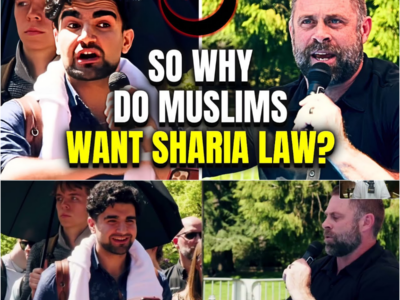
The broader civilizational anxiety regarding the Islamization of Western urban areas is deeply rooted in the long-term geopolitical and legal ambitions of these growing populations. When outside journalists pressed Whitechapel residents on whether their ultimate goal was the implementation of Sharia—traditional Islamic law—within the United Kingdom, the responses revealed an underlying ideological framework that directly challenges Western secularism.
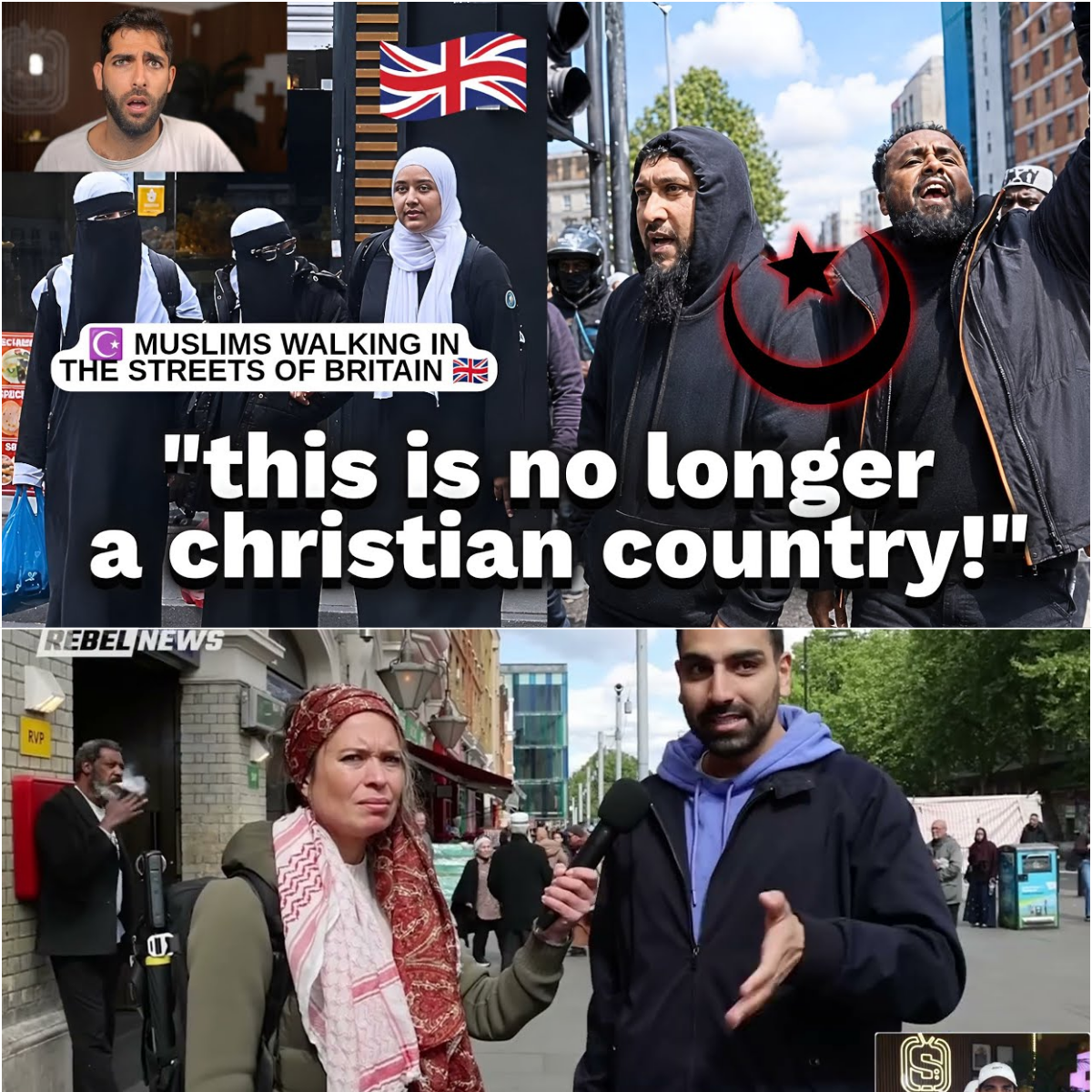
While some respondents attempted to dismiss fears of a demographic takeover by claiming they merely wished to coexist, others openly questioned the historic identity of the host nation. In heated exchanges with journalists, local residents consistently challenged the assertion that the United Kingdom is fundamentally a Christian country, displaying a total detachment from the historical, cultural, and constitutional foundations of the state they now inhabit. When reminded that the official state religion of the UK is the Church of England, that the reigning monarch serves as the Supreme Governor of the Church, and that the national flag features the crosses of patron saints, the arguments were met with open derision or confusion.
The underlying desire for a parallel legal system is consistently validated by extensive demographic research. International polling data, including landmark studies conducted by organizations like the Pew Research Center, reveals a powerful and consistent correlation between large Muslim populations and a desire for the implementation of Sharia law. In comprehensive global surveys of Islamic societies, overwhelming majorities in nations such as Afghanistan, Iraq, Pakistan, and Bangladesh consistently state that Sharia should be the official law of the land.
When hundreds of thousands of individuals migrate from these regions to Western Europe, they do not automatically discard these deeply held legal and spiritual convictions. Instead, as their demographic density increases within specific urban sectors, the demand for parallel judicial frameworks, faith-based municipal policies, and the restriction of speech that criticizes Islam becomes a powerful political force.
This reality has introduced an acute civilizational dilemma for Western democracies. The foundational values of the West—absolute freedom of speech, freedom of assembly, religious tolerance, and pluralism—are being systematically utilized by groups whose explicit, long-term objective is the subversion of those very values in favor of a monolithic religious legal code.
This friction manifests clearly in the community’s attitudes toward modern social issues. While the progressive establishment in London aggressively promotes modern secular concepts of gender equality and LGBTQ rights, festooning public transit networks with rainbow flags, the dominant population in boroughs like Tower Hamlets remains fundamentally opposed to these tenets. When questioned directly, local residents and religious leaders in Whitechapel openly state their total opposition to Western secular morality, confirming that their allegiance belongs strictly to traditional Islamic doctrine, which views such lifestyles as severe moral infractions.
Ghettoization and the Failure of the Melting Pot
The visible reality of contemporary Whitechapel—where towering corporate skyscrapers of London’s financial district, such as the Gherkin and the Walkie-Talkie building, loom directly over streets defined by poverty, linguistic separation, and Islamic governance—stands as a stark monument to the total failure of the progressive multicultural project. For decades, the political and academic elites of the West advanced the theory of the “melting pot,” assuring native populations that mass immigration would inevitably result in a harmonious, integrated society where newcomers would eagerly adopt the values of Western liberalism while enriching the nation with superficial cultural diversity.
Instead, the unrestricted influx of populations from deeply conservative, non-Western regions has resulted in a permanent process of ghettoization. Rather than integrating into the historic fabric of British society, immigrant populations have achieved the critical mass necessary to construct self-sustaining parallel societies. In these enclaves, the native working-class population has been systematically displaced, leaving behind an environment where the laws, language, and customs of historic England have been effectively erased.
This failure of integration has triggered a profound psychological turning point for millions of native citizens across the United Kingdom and the broader Western world. They look upon major sectors of their capital cities and find themselves treated as hostile outsiders within their own homeland, subjected to aggressive harassment and explicit threats of violence if they dare to question the demographic transformation of their neighborhoods.
The mounting tension in communities like Whitechapel indicates that the era of passive compliance is rapidly approaching a conclusion. As the visible contrast between the immense wealth of global financial centers and the cultural decay of surrounding immigrant ghettos becomes impossible to ignore, the public is demanding an immediate and total reassessment of Western border policies. The civilizational question of the twenty-first century is no longer whether mass immigration is economically beneficial, but whether the historic nations of the West possess the political will to preserve their language, their laws, and their foundational identity before the town squares of their ancestors are transformed irrevocably into foreign territory.