Former Devout Muslim’s Christian Testimony Ignites U.S. Debate Over Islam, 9/11, Scripture, and the Internet’s Religious Revolution
Former Devout Muslim’s Christian Testimony Ignites U.S. Debate Over Islam, 9/11, Scripture, and the Internet’s Religious Revolution
New York — A powerful new interview with a former devout Muslim who became a Christian apologist is spreading across American faith media, reopening one of the most sensitive questions in modern religious life: what happens when Muslims raised to defend Islam in the West begin reading the Quran and the Bible side by side for themselves?
The interview is not a shallow anti-Islam rant. It is far more personal — and that is why it is hitting so hard.
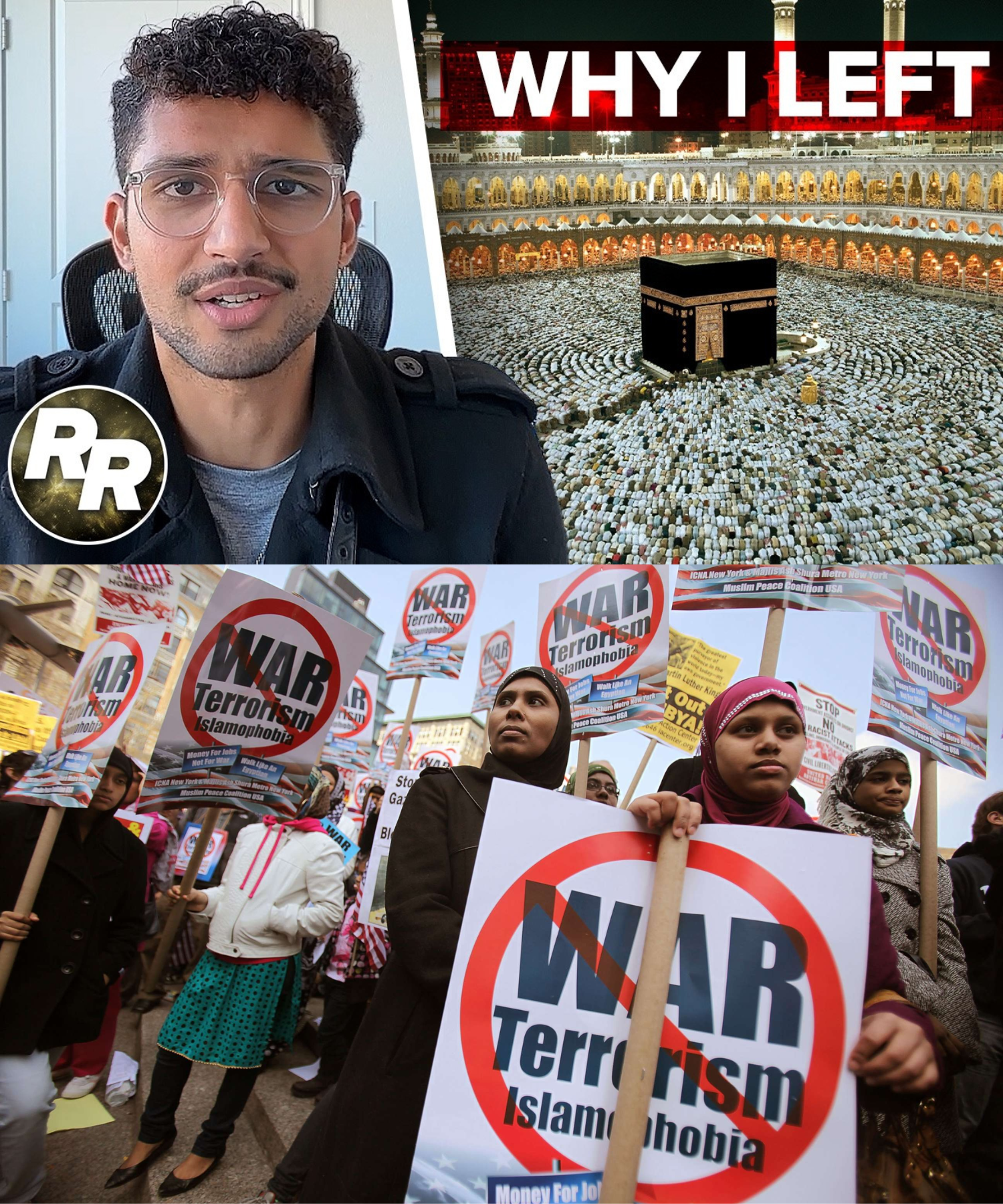
The speaker, identified in the discussion as Shahr Khan, describes growing up in a Muslim family in the United States after 9/11, shaped by both pride and suspicion. His father, he says, saw the attacks from the windows of his Wall Street office. From childhood, Khan was told that defending Islam in America would be part of his identity. He was expected to show Americans that Muslims were not terrorists, not radicals, not outsiders, but successful, charitable, loving people.
That mission made sense to him.
He says the Muslim community around him was strong, disciplined, generous, and tightly connected. Doctors, lawyers, Wall Street professionals, poor worshippers, and wealthy businessmen could stand side by side in the mosque, bowing before God. For a young boy searching for meaning, that humility and order felt powerful.
In his words, Islam was not simply a religion. It was his full identity.
But the same experience that gave him pride also sharpened his separation from America. After 9/11, he says, many families like his felt watched, judged, and treated differently. Instead of weakening Islamic identity, that pressure strengthened it. He describes a world where young Muslims were encouraged to learn the Quran, Hadith, Sharia, apologetics, politics, medicine, law, engineering, and public debate — not only to succeed, but to defend Islam in the West.
For American churches, his warning is direct: Muslims are not passive.
They are often trained from youth to know what they believe, defend it, and challenge Christianity when they encounter it.
That is where the interview turns explosive.
Khan says his childhood view of Christianity was “foul.” He was not taught simply to respect Christianity as another faith. He was taught to see Christians as people who misunderstood Jesus, corrupted doctrine, and needed to be brought into Islam. He says Muslim youth in his circles were trained to analyze Christians carefully, waiting for theological weakness, moral failure, or confusion that could become an opening for dawah — the act of calling others into Islam.
That part of the interview is now drawing intense reaction from Christians online.
Many see it as a wake-up call. They argue that American churches have been naïve, assuming interfaith dialogue means both sides are equally relaxed about truth claims. Khan’s testimony suggests otherwise. In his experience, Muslims often believe Christians are sincerely wrong, and Christians who do not know their own faith are vulnerable.
Yet the interview also contains a serious rebuke to Christians.
Khan criticizes what he calls the “Western social media church” for handling Islam carelessly, mockingly, and without charity. He warns Christians not to “dunk” on Muslims or reduce evangelism to humiliation. Questioning Islam, he says, can be terrifying for Muslims because it can mean questioning family, identity, heaven, community, marriage, and the entire structure of life.
That is one of the most important moments in the discussion.
Khan is not asking Christians to soften doctrine. He is asking them to speak with knowledge and mercy.
He says Muslims who begin to question do not need mockery. They need guidance, Scripture, patient discipleship, and Christians who understand Islam well enough to reconstruct the conversation around Christ rather than merely tearing Islam down.
The theological core of the interview centers on three major claims.
First, Khan argues that Islam’s understanding of God is built around tawhid — absolute oneness. In his telling, this makes Christian claims about God as Father, Son, and Holy Spirit seem not merely confusing to Muslims, but blasphemous. John 3:16, the verse many Christians consider the heart of the Gospel, can sound shocking to Muslim ears because Islam rejects the idea that God has a Son or that blood atonement is necessary for sin.
Second, he argues that Islam rewrites the story of Adam and Eve. In Christian theology, original sin and the need for redemption lead directly toward Christ. In his explanation, Islam removes original sin and blood atonement, replacing salvation through Christ with repentance, obedience, and accumulated good deeds.
Third, he challenges Islamic claims about the Kaaba, Mecca, Abraham, Ishmael, and the direction of prayer. He argues that Islam shifts sacred geography away from Jerusalem and toward Mecca, and that the story of Abraham and Ishmael being connected to the Kaaba does not align with the biblical account. Critics will strongly dispute his framing, but the point of the interview is clear: he believes Islam depends on rewritten versions of older biblical narratives.
That claim becomes even sharper when the discussion turns to archaeology and textual preservation.
The interviewer argues that modern biblical archaeology has repeatedly strengthened confidence in the historical world of the Bible, pointing to inscriptions, ancient artifacts, and the Dead Sea Scrolls. The argument is that accusations of wholesale biblical corruption become harder to sustain when ancient manuscripts show remarkable continuity over centuries.
Khan then adds what he calls one of the strongest tools for Christian engagement with Muslims: comparing prophet stories.
He argues that the Quran repeatedly retells biblical stories in altered forms. He cites examples involving Saul, Gideon, David, Moses, Jacob, Jonah, and Joseph. In his view, these are not minor differences. They show that the Quran is not simply confirming previous revelation, but reshaping it in ways that contradict the older texts.
This is where the interview becomes culturally significant in America.
For centuries, many Muslims did not have easy access to Christian apologetics, biblical scholarship, ancient manuscripts, archaeology channels, or side-by-side scriptural analysis. Now they do. The internet has changed everything. A questioning Muslim in New York, London, Cairo, Lahore, Dubai, Lagos, or Minneapolis can quietly compare arguments that would once have been difficult or dangerous to access.
Khan says that is a blessing.
But it is also a spiritual earthquake.
The internet is doing what closed communities once prevented: giving young Muslims access to opposing views, ex-Muslim testimonies, Christian theology, Bible archaeology, and direct challenges to Islamic truth claims.
That does not mean Islam is collapsing. Far from it. Muslims remain one of the largest and most committed religious communities in the world. Many Muslim scholars would reject Khan’s arguments and respond with their own defenses of Quranic preservation, Islamic theology, and critiques of Christian doctrine.
But the interview shows something real: the old information walls are breaking.
And in America, that matters.
The United States is now home to Muslim communities, ex-Muslim voices, Christian apologists, Jewish scholars, atheist critics, Hindu converts, and interfaith debates all colliding in public. The religious marketplace is not quiet anymore. It is digital, emotional, aggressive, and deeply personal.
Khan’s testimony lands because it refuses to treat religious conversion as a debate trophy. He describes losing identity, trust, community, certainty, and a future that had once been prepared for him. He says leaving Islam cost him emotionally and socially. But he also says the freedom to study, question, evangelize, and follow Christ in America is something he will never take for granted.
That is the deeper American story.
In countries where religious departure can bring violence or severe punishment, this kind of public testimony might be impossible. In the U.S., it becomes a livestream, a podcast, a viral clip, a discipleship course, and a movement.
For Christians, Khan’s message is urgent: learn Islam, love Muslims, know Scripture, and stop treating evangelism like entertainment.
For Muslims, his message is even more direct: do not be afraid to ask which revelation is truly from God.
The battle is no longer hidden.
It is unfolding online, in churches, in mosques, in college dorms, and in private bedrooms where young believers are opening two books side by side and asking the question that can change everything:
What if the story I inherited is not the truth?