DEBATE: Atheist & Christian on Morality (Epic Q&A)
The Moral Pivot: Why a Universe Without God Can’t Quite Explain the Holocaust
In an era defined by deep cultural polarization, most modern debates follow a predictable script: talking points are exchanged, voices are raised, and both sides retreat to their respective ideological trenches. Every so often, however, an intellectual exchange cuts through the noise, stripping away the academic jargon to expose the raw, foundational questions of human existence.
One such exchange recently went viral online under the unassuming headline, “DEBATE: Atheist & Christian on Morality.” What began as a standard Q&A session quickly evolved into a gripping, philosophical chess match. For nearly ten minutes, an unnamed Christian apologist and an atheist questioner named Matthew engaged in a rapid-fire dialectic over a question that has haunted humanity for millennia: If God does not exist, can anything truly be called evil?
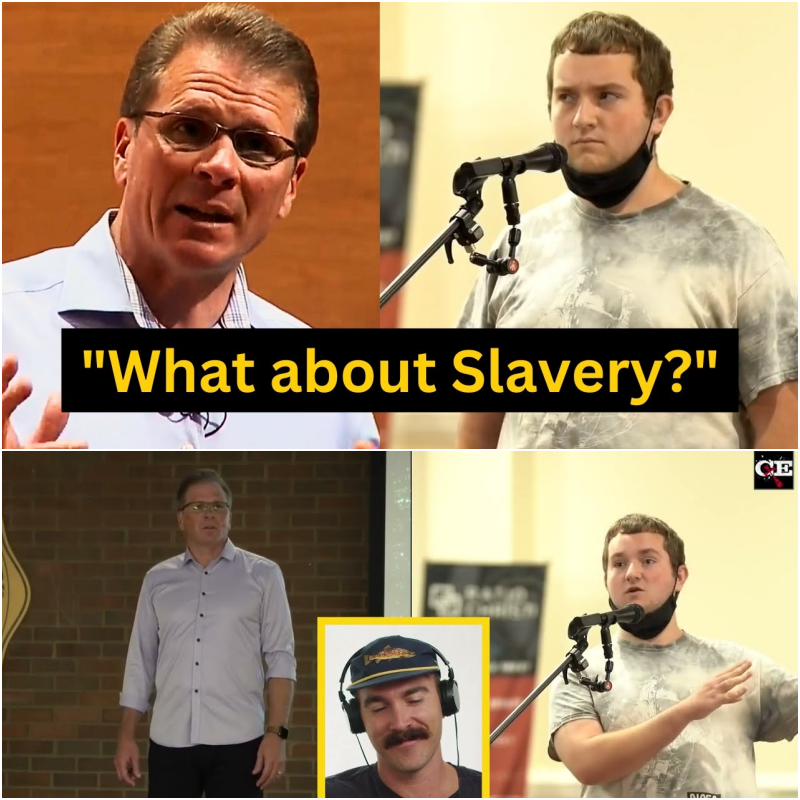
The debate didn’t just rehash stale theological arguments. Instead, it vividly illustrated the profound intellectual crisis facing modern secularism. By pushing the logic of moral relativism to its absolute brink, the interaction illuminated why the concept of “human opinion” routinely collapses under the weight of history’s greatest atrocities.
The Peripheral vs. The Core
The debate kicked off with a familiar objection. Matthew, the atheist interlocutor, asked how morality could possibly be derived from a single divine source when different civilizations, countries, and historical eras have operated under wildly contradictory moral frameworks.
It is a formidable point on the surface. Anthropologists have long documented the vastly different ways human societies handle everything from property rights to sexual ethics. But the Christian speaker countered by drawing upon C.S. Lewis’s seminal 1943 work, The Abolition of Man.
“Although there are differences among the periphery,” the speaker noted, quoting the spirit of Lewis, “all major civilizations have agreed on an essential moral code.”
Lewis called this universal core the Tao—the natural law. While a culture in the ancient Mediterranean might view the rules of warfare differently than a 19th-century European empire, no culture in human history has ever praised a soldier for running away in battle and abandoning his friends. No civilization has built a monument to a man who systematically double-crossed everyone who showed him kindness.
To look at human history and declare that morality is entirely subjective because of regional differences is, as the speaker argued, to mistake sociology for morality. Sociology describes how people do behave; morality dictates how they ought to behave.
The Nazi Paradox
The crux of the entire debate arrived when the conversation shifted from abstract theories to the grim reality of World War II. The speaker threw down an intellectual gauntlet, presenting a chilling thought experiment.
Imagine a counterfactual history where Adolf Hitler’s Nazi regime won World War II. Imagine they conquered the globe, executed their horrific “Final Solution” to completion, and through decades of propaganda and re-education, successfully convinced 100 percent of the surviving global population that the extermination of the Jewish people was a grand, moral good.
The speaker turned to Matthew and asked: “Would that make it a good thing?”
“Of course not,” Matthew replied instinctively. “No, of course not.”
It was a human response, a morally sane response. But as the debate unfolded, it became clear that it was a response Matthew’s worldview could not logically support.
   THE MORAL FORK IN THE ROAD

   [Is Morality Objective or Subjective?]
                |
        +-------+-------+
        |               |
   [Top-Down]      [Bottom-Up]
   Given by God    Evolved by Man
   (Objective)     (Subjective)
If morality is merely a social construct—a set of rules that human beings invent, refine, and agree upon over time to maintain social order—then it is inextricably tied to human consensus. If human consensus shifts entirely toward fascism, then under a purely secular framework, fascism becomes the new moral law.
Matthew attempted to escape this logical trap by shifting the goalposts. He argued that we know the Nazis were evil in the real world because we collectively agree today that mass murder is bad. “It’s a standard of morality that exists because we agree that it exists,” he asserted, invoking the existentialist philosophy of Simone de Beauvoir to argue that values are fluid and human-made.
But the contradiction was already laid bare. The speaker pinned down the logical flaw: You cannot claim that the Nazis would still be wrong in a world where everyone agreed they were right, while simultaneously arguing that right and wrong are determined solely by what everyone agrees upon.
The Sovereignty of “Opinion”
As the pressure of the syllogism mounted, Matthew was forced into an intellectual corner. He was trapped between abandoning his secular premise or embracing a conclusion that revolted his conscience. Ultimately, he chose the premise.
“Ultimately, morality is an opinion,” Matthew admitted.
“All right, then stop right there,” the speaker interjected. “If it’s just an opinion, then the Nazis weren’t really wrong.”
“The Nazis were wrong because we all agree they were wrong,” Matthew doubled down, struggling to bridge the gap. He pointed to historical shifts, noting that for millennia, global societies agreed that slavery was acceptable, whereas modern societies now reject it.
But this defense only deepened the secular dilemma. If the condemnation of slavery or the Holocaust is merely an “opinion” held by the contemporary majority, then the Allied victory in World War II did not vindicate a moral truth—it merely vindicated the stronger army. If the Nazis had won, their “opinion” would have become the global standard, and by the rules of strict moral subjectivism, they would have ceased to be evil.
This is the point where the bottom-up model of morality loses its grip on the human soul. Deep down, human beings do not experience the wrongness of murder, rape, or the torture of an infant as a mere preference. We do not view the statement “the Holocaust was evil” in the same category as “vanilla ice cream is better than chocolate.” We recognize it as an objective fact, operating independently of whether a given society acknowledges it or not.
The Top-Down Necessity
The post-debate analysis in the video cut straight to the underlying philosophical architecture. Morality, the commentator argued, essentially comes down to a binary choice. It is either a “top-down” reality or a “bottom-up” phenomenon.
In the bottom-up model, morality is a byproduct of time, matter, chance, and biological evolution. It is driven by utility—rules we cooked up because they helped our ancestors survive in tribes. While this model can explain why humans developed cooperative behaviors, it completely fails to provide a basis for moral obligation. An evolutionary urge can tell us what we typically do, but it cannot tell us what we ought to do when our self-interest is on the line. If a materialistic universe has no inherent purpose, then there is no objective cosmic difference between a doctor saving a life and a tyrant ending one. Both are simply rearrangements of atoms.
Conversely, the top-down model posits that morality is woven into the very fabric of reality. It is objective because it originates outside of humanity, handed down by a transcendent creator—a moral lawgiver. Under this framework, when God states that murder is wrong, it becomes an unalterable truth, as immutable as $2 + 2 = 4$.
The strength of the Christian speaker’s argument in this viral exchange did not rely on complex theological dogmatism. It relied on a devastatingly simple syllogism that secular philosophy has spent centuries trying to dismantle:
If God does not exist, objective moral values and duties do not exist.
Objective moral values and duties do exist (as evidenced by our universal recognition that certain actions, like the Holocaust, are intrinsically evil regardless of human consensus).
Therefore, God exists.
The Modern Resistance
Toward the end of the clip, Matthew attempted a final, pragmatic pivot. Even if an objective moral standard exists from a God, he argued, it remains functionally useless to us because human beings cannot agree on how to interpret it. He cited internal religious debates, such as differing interpretations of Biblical passages regarding homosexuality, to argue that we are still left wandering in a fog of human disagreement.
But this final objection, while practically complex, misses the philosophical point. A disagreement over how to read a map does not mean the destination doesn’t exist. The fact that human beings argue passionately over what is truly right and wrong actually proves the existence of an objective standard; we do not debate the rules of a game that we don’t believe has any real rules.
The viral debate concluded on a lighthearted note, with the speaker offering Matthew a book and Matthew promising, “Scout’s honor,” to read it. Yet, the gravity of the exchange lingered long after the screen faded to black.
By refusing to let the secular position hide behind comfortable euphemisms, the dialogue exposed the steep intellectual rent that a purely materialistic worldview demands. If you want a universe without a creator, you must accept a universe where the horrors of Auschwitz were not objectively wrong, but merely unfashionable. It is a price that very few human beings, when looking at the reality of evil, are genuinely willing to pay.