White Cop Pulls Over Black Driver—Freezes at the Five Words: “I’m Your New Police Chief”
White Cop Pulls Over Black Driver—Freezes at the Five Words: “I’m Your New Police Chief”
The high-intensity blue and red strobes of Cruiser 412 sliced through the violet dusk of Thompson Heights, painting the manicured lawns and brick driveways in a rhythmic, jarring neon. Officer James Brennan sat behind the wheel, his eyes narrowed, his left wrist resting casually over the top of the steering wheel. He had fifteen years on the force—fifteen years without a single formal reprimand on his jacket—and that tenure had gifted him what he considered a flawless internal radar. He knew who belonged on these quiet, affluent streets, and more importantly, he knew who didn’t.
A block ahead, a sleek, charcoal-gray Mercedes SUV had failed to come to a complete, three-second algorithmic stop at the intersection of Elm and Coventry. It was a rolling stop. Infinitesimal, really. The kind of minor infraction Brennan ignored dozens of times a week when the driver was a panicked soccer mom or a wealthy local doctor rushing home to a cold dinner.
But as the SUV turned under the amber glow of a streetlamp, Brennan caught a glimpse of the driver. A Black man. Well-dressed, posture perfectly straight, looking entirely too relaxed behind the wheel of a eighty-thousand-dollar machine.
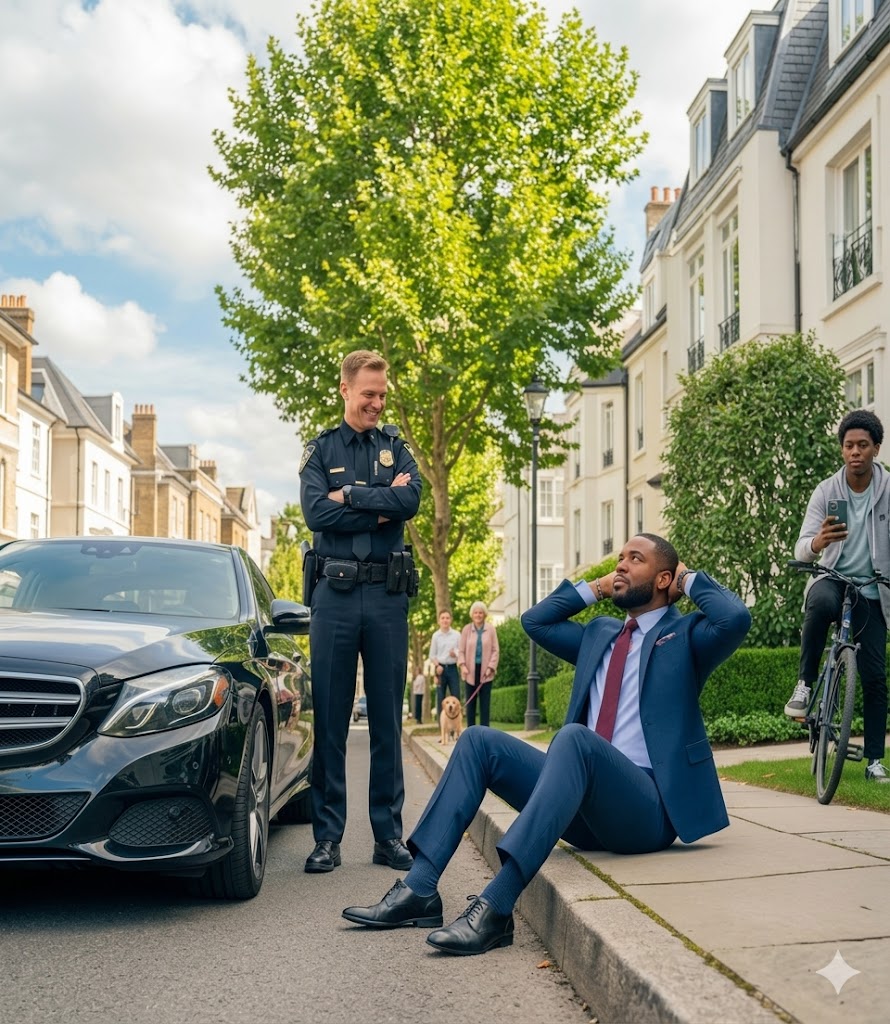
In Brennan’s mind, a familiar taxonomy began to assemble itself. This was Thompson Heights—an exclusive enclave where the median income hovered in the mid-six-figures. A late-model luxury vehicle driven by a minority male at dusk didn’t match the neighborhood’s typical resident profile. In his mind, it wasn’t prejudice; it was proactive policing. It was “intuition.”
Brennan flipped the toggle switch. The siren gave a sharp, aggressive yelp, and the overhead lights erupted.
“Cruiser 412, initiating traffic stop at Coventry and 4th,” Brennan muttered into his shoulder mic. “Out-of-state tags. One occupant.”
In the passenger seat, his junior partner, Officer Marcus Miller, shifted uncomfortably. “Looks like a minor rolling stop, Jim. You really want to reel him in for that?”
“Complacency kills, Marcus,” Brennan said, his voice carrying the flat, unassailable weight of a veteran. “Let’s see what we’re dealing with here.”
The Mercedes pulled over immediately, parked perfectly parallel to the curb, and clicked its hazard lights on. Brennan unbuckled, his hand instinctively dropping to rest on the butt of his service weapon as he stepped out into the crisp evening air. He walked with a heavy, deliberate stride, his flashlight beam slicing through the rear window of the SUV, sweeping across the pristine leather interior before pinning the driver’s face in a blinding circle of white light.
“Good evening, officer,” the driver said. His voice was remarkably calm, devoid of the immediate defensiveness or nervous tremor Brennan usually encountered. He didn’t look down, didn’t reach for the glove box. He kept his hands precisely at ten and two on the steering wheel.
“License and registration,” Brennan barked, keeping his flashlight aimed directly at the man’s eyes to disrupt his vision. “You know why I pulled you over tonight?”
“I imagine you’re going to tell me,” the man replied smoothly. He didn’t make a sudden move. Instead, he slowly indicated with his eyes toward the center console. “My identification is in my breast pocket. I am going to reach for it now.”
“Just hold it right there,” Brennan said, his tone hardening. The man’s sheer composure was aggravating him. It felt like defiance. It felt like someone who thought they were above the standard protocol. “Step out of the vehicle, please.”
“Officer, is that entirely necessary for a failure to come to a complete stop at a vacant intersection?”
“I’m not going to ask you again, sir. Step out of the vehicle. Now.”
From across the street, a pair of affluent residents walking a golden retriever paused, watching the scene unfold. Officer Miller stepped out of the cruiser, standing by the passenger side door, his hand hovering near his belt, his eyes darting between Brennan and the wealthy homes lining the street. The optics were heavy, stark, and entirely familiar: a white officer commanding a well-dressed Black man onto the asphalt of a neighborhood that rarely saw its own residents subjected to such scrutiny.
The driver sighed—a soft, almost disappointed sound—and opened the door. He stepped out. He was tall, wearing a tailored charcoal suit jacket and a crisp white shirt. He didn’t argue. He moved with a disciplined, deliberate grace.
“Turn around, face the vehicle, and place your hands on the hood,” Brennan ordered.
The man complied. He leaned forward, pressing his palms against the cool, metallic surface of his own car. Brennan stepped in close, executing a firm, aggressive pat-down. He felt the solid weight of a wallet, a set of keys, and the distinct outline of a heavy, metal object in the man’s interior breast pocket.
Brennan’s adrenaline surged. He grabbed the man’s right wrist, pinning it slightly. “What’s in the jacket?”
“My credentials, Officer Brennan,” the man said softly, reading the name tag pinned to the officer’s chest without turning his head.
Brennan reached inside the jacket, pulling out a heavy, leather-bound badge wallet. He flipped it open under the beam of his flashlight, expecting to find a private security credential, or perhaps a falsified ID.
Instead, the gold shield of the municipal police department gleamed back at him. Beneath it, engraved in pristine, unyielding block letters, were the words: CHIEF OF POLICE.
Brennan’s breath caught in his throat. His fingers went entirely numb. The flashlight beam wavered, dancing erratically across the leather wallet. He stared at the identification card nestled next to the shield. Edward Madison. Chief of Police. Thompson Heights PD.
The five words he had heard a hundred times in departmental rumors over the last month, the announcement of a high-profile hire brought in all the way from a legendary career in Atlanta to clean up their suburban department, finally coalesced into a terrifying reality.
I’m your new police chief.
The silence that fell over the boulevard was absolute, punctured only by the distant, rhythmic crackle of the cruiser’s radio.
Chief Edward Madison slowly turned around, his wrists free. He didn’t look angry. He didn’t yell. His expression was a mask of profound, academic detachment. He looked at Brennan not as a furious boss, but as a scientist examining a flawed specimen under a microscope.
“You can return my shield, Officer Brennan,” Chief Madison said, his voice barely louder than a whisper, yet carrying the absolute force of law.
Brennan’s hand trembled slightly as he handed the leather wallet back. “Chief… I—I apologize, sir. I didn’t recognize… there’s been a rash of vehicle thefts in the area, and with the out-of-state tags—”
“My tags are temporary transport plates from the municipal pool, officer,” Madison corrected him calmly, smoothing the lapels of his suit jacket. “And my rolling stop was a minor infraction that warranted, at best, a polite warning. Instead, within ninety seconds, you removed a compliant citizen from his vehicle, subjected him to a physical search, and assumed a posture of maximum hostility.”
Brennan swallowed hard, his throat dry as sandpaper. “Sir, I was just exercising officer safety protocols. In this neighborhood—”
“We will discuss what you consider ‘safety’ and what you consider ‘this neighborhood’ in due time,” Chief Madison interrupted. He looked past Brennan to Officer Miller, who stood completely paralyzed by the cruiser. Madison gave Miller a brief, acknowledging nod, then turned his gaze back to Brennan. “Get back in your car, officer. Finish your shift. We will speak very soon.”
Without waiting for a reply, Chief Madison stepped back into his Mercedes, closed the door with a solid, expensive thud, and drove away into the deepening twilight.
The next morning, Chief Madison sat in the expansive, mahogany-paneled office of the Chief of Police. The morning sun streamed through the blinds, casting long shadows across a desk that was meticulously organized. There were no stacks of chaotic paperwork, only a laptop, a notebook, and a single, steaming cup of black coffee.
He picked up his desk phone and dialed an internal extension. “Officer Jensen? This is Chief Madison. Please step into my office.”
A few minutes later, Officer Sarah Jensen entered. She was an eight-year veteran, known within the department as a highly competent, quiet officer who kept her head down and refused to participate in the locker-room bravado that dominated the shifts.
“Sir,” Jensen said, standing at attention.
“Have a seat, Sarah,” Madison said, gesturing to the leather chair across from him. He leaned back. “I’ve spent the last forty-eight hours reviewing the department’s internal climate. I don’t want the official, sanitized version from the captains. I want the ground truth. Tell me about the culture here regarding traffic enforcement.”
Jensen hesitated, her eyes darting to the closed door. Madison smiled reassuringly. “This room is a safe space for professional candor, officer. Your career will only be helped by honesty.”
Jensen took a breath. “Sir, to be frank, there’s an unwritten rule. We call it ‘boundary policing.’ Officers like Jim Brennan… they view Thompson Heights as a fortress. Anyone who doesn’t look like they belong here gets treated as a hostile actor until proven otherwise. Citation metrics are heavily weighted toward the south side of town, but the pretextual stops happen right here, keeping the ‘outsiders’ uneasy.”
Madison nodded, writing a single word in his notebook: Pretextual.
“Thank you, Officer Jensen. That confirms what my own field study revealed last night,” Madison said. “I’m going to need allies in the coming months. People who care about the ethics of authority. Keep doing your job the right way. Your work hasn’t gone unnoticed.”
Once Jensen left, Madison contacted the city manager’s office. He didn’t file a formal complaint against Brennan—not yet. Instead, he requested the complete dashcam and audio footage from Cruiser 412’s shift the previous night. He framed it as an “observational baseline study” for his upcoming strategic plan.
Over the next three days, Chief Madison didn’t call Brennan into his office. He let the veteran officer stew in his own anxiety. Instead, Madison spent his time out in the community. He walked the neighborhoods of the south side, visited community centers, and sat down for coffee with Ms. Clara Washington, a local civil rights advocate who had filed three separate complaints over the past two years regarding racially biased traffic stops—complaints that had been systematically buried by the previous administration.
“They listen to us, Chief Madison,” Ms. Washington told him, rocking back on her front porch chair. “They nod their heads, they write it down, and then nothing changes. The same officers are back on the street the next day, doing the same things.”
“The era of nodding and doing nothing is over, Ms. Washington,” Madison told her, his voice resonant with quiet resolve. “I am collecting data. And data, unlike promises, cannot be easily ignored.”
Meanwhile, in the breakroom of the station, Officer James Brennan was trying desperately to maintain his composure. He poured himself a cup of stale coffee, laughing just a little too loudly at a joke made by another veteran officer.
“I’m telling you, this new guy from Atlanta is going to try to bring all that big-city corporate nonsense here,” one of the shift sergeants grumbled, leaning against the vending machine. “De-escalation seminars, community outreach barbecues. It paralyzes the guys on the street. You can’t police a city if you’re constantly worried about hurting someone’s feelings.”
“Exactly,” Brennan chimed in, trying to mask the knot of dread tight in his stomach. “It’s all optics. A guy like Madison, he’s a politician in a uniform. Once he realizes we’re the ones keeping the crime rates low in this town, he’ll back off and let us do our jobs. You can’t run a department from a spreadsheet.”
But Brennan’s bravado was a hollow shield. Every time the shadow of the Chief passed the hallway windows, Brennan’s chest tightened. He waited for the hammer to fall, for the internal affairs notice, for the suspension. But it didn’t come.
Instead, on Thursday morning, a department-wide mandate dropped: All personnel are required to attend the 0800 briefing in the main auditorium. Full dress uniform.
When the officers assembled, the room was thick with murmured speculation. At exactly 0800, Chief Edward Madison walked onto the stage. He didn’t wear the civilian suit he had worn during the traffic stop. He wore the crisp, dark navy formal uniform of the Chief of Police, five gold stars gleaming on his collar, his silver hair neatly trimmed. He radiated a quiet, unassailable authority that instantly silenced the room.
He didn’t mention the traffic stop. He didn’t name Brennan. Instead, he turned on a massive projector screen behind him.
“Good morning,” Madison said, his voice echoing clearly through the acoustics of the hall. “We are entering a new chapter for the Thompson Heights Police Department. Today, we transition from a philosophy of dominance to a philosophy of service.”
He clicked a remote. A series of charts and graphs appeared on the screen.
“Over the past week, I have personally analyzed our department’s performance metrics,” Madison continued, his tone clinical and precise. “Our data shows an unacceptable statistical disparity. Sixty-eight percent of our pretextual traffic stops—stops made for minor infractions like a cracked windshield, an expired registration by a single day, or a rolling stop—occur on the borders of our highest-income neighborhoods. Yet, eighty-two percent of those stopped are non-residents, predominantly minorities.”
Brennan felt a cold sweat break out across the back of his neck. He stared down at his polished boots, refusing to look up.
“This is not effective policing. This is biased policing, and it ends today,” Madison announced. His voice hardened, ringing like iron. “Effective immediately, the following directives are law within this department: First, body-worn cameras will remain active for the entirety of all public interactions. Failure to activate or unexplained gaps in footage will result in immediate administrative suspension. Second, traffic enforcement will pivot exclusively to public safety hazards—speeding in school zones, reckless driving, DUI. Pretextual stops used as a dragnet based on demographic assumptions are strictly banned. Third, our metric for promotion will no longer be the quantity of citations you issue, but the quality of community engagement and the reduction of complaints in your assigned sectors.”
A restless shift ran through the older officers in the room. A few scoffed under their breath. Madison paused, his sharp eyes sweeping across the rows of seats until they landed squarely on Brennan.
“Some of you may believe that this is a passing administrative trend,” Madison said, his eyes locking onto Brennan’s with terrifying intensity. “Some of you may think you can wait me out, or that your decades of service insulate you from accountability. Let me be unequivocally clear: adapt, comply, or find another profession. The culture of unchecked discretion is over.”
The formal administrative reckoning for Officer James Brennan arrived two days later. He was summoned not to a crowded disciplinary board, but to Chief Madison’s office. Sitting at the table alongside the Chief was the City Manager and the Director of Human Resources.
Laid out on the table were four thick folders.
“Officer Brennan,” Chief Madison began, gesturing to the folders. “When I look at your fifteen-year history, I see an officer who is highly capable. You have zero firearm discharges, excellent physical fitness marks, and a high rate of stolen vehicle recoveries. But when I look deeper into the secondary data—the data this department used to ignore—I see a systemic pattern.”
Madison opened the first folder. It contained a printed transcript of the audio from Brennan’s stop of Madison, alongside three historical complaints from citizens that had been classified as “unfounded” by the previous administration.
“Three different citizens, all minority individuals, stopped by you within a two-mile radius of Thompson Heights over the last eighteen months,” Madison said, sliding the papers forward. “In all three cases, the dashcam footage shows the same pattern of behavior. High aggression, immediate ordering out of the vehicle, and an assumption of criminal intent without reasonable suspicion. Your stop of me wasn’t an isolated incident, James. It was your standard operating procedure.”
Brennan cleared his throat, his defensiveness flaring up despite his terror. “Chief, with all due respect, those stops occurred in high-property-value areas where we’ve had a surge in burglaries. I was using my discretion to protect the residents—”
“Your discretion is broken, officer,” Madison interrupted, his voice dropping an octave, heavy with disappointment. “You have conflated a person’s racial and socioeconomic profile with a criminal profile. You have weaponized the authority granted to you by the state to make law-abiding people feel like intruders in their own city.”
The City Manager spoke up. “Based on the Chief’s recommendation and the review of these historical files, James, the city is within its rights to terminate your employment for a documented pattern of discriminatory practices.”
Brennan felt the room spin. Fifteen years. His pension, his identity, his livelihood—all of it balancing on the edge of a knife. The arrogance that had sustained him for a decade dissolved, replaced by a raw, hollow panic. He looked at Madison, expecting to see the smug satisfaction of a trap snapping shut.
But Madison’s face held no malice. It held only an intense, demanding gravity.
“I don’t believe in disposable human beings, Officer Brennan,” Madison said calmly. “And I don’t believe that simply firing one officer fixes a systemic cultural rot. True leadership requires providing a pathway to redemption. If I terminate you, you will simply take your fifteen years of experience, your biases, and your resentment to a neighboring county, and the cycle will continue.”
Madison leaned forward, resting his forearms on the desk. “Here is your alternative. You are suspended without pay for thirty days. Your field training officer status is permanently revoked. When you return, you will be placed on monitored administrative duty for six months. You will undergo intensive, one-on-one implicit bias training, conducted by an external academic institution. And finally, you will spend twenty hours a week participating in our new Community Restorative Engagement program, working directly within the neighborhoods you have spent fifteen years over-policing. If you refuse, or if you show a single instance of resistance, your termination will be finalized. Do you understand these terms?”
Brennan swallowed the lump of pride in his throat. He looked at the folders on the desk, then at the gold stars on Madison’s collar. The realization hit him with absolute clarity: the rules of the game had changed forever.
“I understand, Chief,” Brennan whispered, his voice cracking slightly. “I accept the terms.”
The transformation of the Thompson Heights Police Department did not happen overnight. It was a grinding, deliberate process of institutional engineering. In the first three months, four veteran officers who refused to adapt chose to take early retirement or transferred to other departments. Chief Madison welcomed their departures, replacing them with a diverse group of young recruits recruited from universities and community programs, individuals trained from day one under the new ethical frameworks.
Statistical markers began to shift with dramatic velocity. By the sixth month of Madison’s tenure, complaints regarding biased enforcement dropped by forty-two percent. Traffic citations became evenly distributed across the city’s geography, focusing tightly on actual safety hazards. The community advisory boards, which had once been nothing more than symbolic PR exercises, were granted genuine oversight power, reviewing random samplings of body camera footage each month alongside internal affairs investigators.
But the most profound shift was witnessed not in the spreadsheets, but in the human terrain.
On a bright, clear Saturday afternoon in late October, the department hosted its inaugural Community Safety Fair at the Oak Grove Recreation Center—a vibrant park located on the city’s historically underserved south side. The event was designed to break down the walls of mutual suspicion, featuring bicycle safety courses, car seat installations, and open forums where residents could speak directly with the officers assigned to their beats.
Standing near the main pavilion, Chief Madison stood with his hands folded behind his back, watching the crowd. He wore his summer uniform, looking relaxed but inherently authoritative.
A few yards away, a group of local teenagers were gathered around a parked cruiser, laughing as they tried out the vehicle’s public announcement microphone. Standing right beside them, patiently explaining the computer layout inside the cabin, was Officer James Brennan.
Brennan looked different. The hard, cynical edge that had defined his posture for fifteen years had softened. He wasn’t wearing his tactical vest; he wore a soft polo shirt with the department emblem. He was listening—genuinely listening—as a young Black teenager asked him a question about how the radar gun worked. Brennan smiled, handed the device to the boy, and showed him how to calibrate the lens.
Later in the afternoon, Ms. Clara Washington walked up to the pavilion, holding a plate of barbecue. She stopped next to Chief Madison, her eyes following his gaze over to Brennan.
“I never thought I’d see the day,” Ms. Washington said softly, taking a sip of lemonade. “That man pulled my grandson over twice last year for absolutely nothing. Made him sit on the curb like a dog. I wanted his badge, Chief. I wanted him ruined.”
“I know,” Madison replied, keeping his eyes on the scene. “Retribution feels good in the short term, Clara. It satisfies our anger. But it doesn’t heal the neighborhood. It doesn’t create safety.”
“He’s been coming to the youth center every Tuesday,” she noted, her voice carrying a reluctant, hard-won respect. “The first few weeks, he looked like he wanted to crawl under a rock. He didn’t know how to talk to people without a badge and a gun to back him up. But he kept showing up. He listened. He helped fix up the gym floor. He’s starting to see these kids as people.”
“The system taught him to see them as threats,” Madison said. “We had to rebuild the system to teach him otherwise. Human behavior adapts to the metrics we incentivize. If we reward dominance, we get tyrants. If we reward empathy, we get public servants.”
Brennan caught Chief Madison’s eye from across the lawn. The veteran officer paused, gave his chief a respectful, crisp nod—a nod acknowledging a leader who had chosen to rebuild him rather than destroy him—and then turned back to the community he was finally learning to serve.
Chief Madison returned the nod, a quiet sense of accomplishment settling over him as the evening sun dipped below the horizon, casting a warm, golden light across a community finally beginning to mend.