When Jordan Peterson Realized There Must be a God
Beyond the Biology: The Moment Jordan Peterson Faced the Limits of the Natural World
For years, the intellectual phenomenon that is Jordan B. Peterson operated like a master mechanic of the human psyche. Armed with an encyclopedic knowledge of evolutionary biology, clinical psychology, and Jungian archetypes, the Canadian professor built a global following by treating the grand narratives of human history as highly sophisticated survival tools. Religion, in his early lectures, was rarely presented as literal divine revelation. Instead, it was an ancient, beautifully calibrated software package—a biological adaptation honed over millennia to keep the human animal from tearing itself apart.
But a singular, pivotal encounter with the prominent American Christian philosopher William Lane Craig exposed the limits of that worldview. It was a moment where the machinery of naturalism ground to a halt, forcing Peterson to confront a haunting possibility: that morality is not something humanity invented to survive, but something we discovered that was already there.
The Clash of Two Intellectual Titans
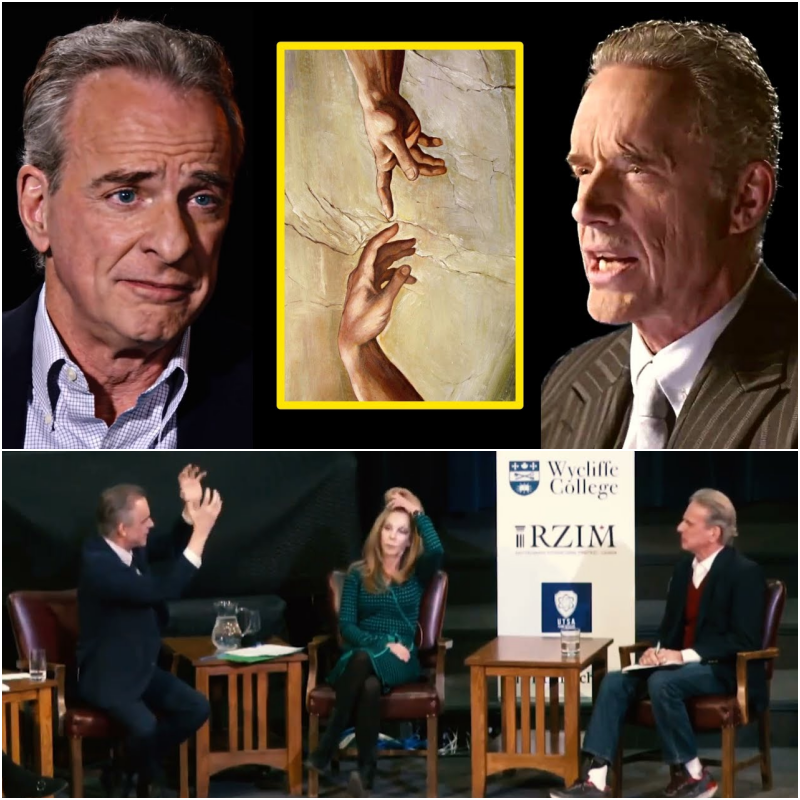
The exchange took place during a high-profile panel discussion, a meeting of minds that promised a clash between Peterson’s grounded, evolutionary pragmatism and Craig’s rigorous, unapologetic classical theism.
For much of the evening, Peterson did what he does best. He argued that human morality—our deep-seated understanding of good and evil—could be traced back to our biological substrate. We are an intensely imitative species, Peterson noted. Unlike most animals, humans learn how to navigate the world by watching, copying, and emulating models of behavior. Over millions of years, our cognitive and emotional structures evolved to recognize certain behaviors as beneficial and others as destructive.
To Peterson, the concept of the “Transcendent Good” or even the image of God was simply the ultimate abstraction of this process. We looked at local, concrete examples of admirable people, stripped away their flaws, and synthesized an idealized, perfect archetype. Religious conceptions, he argued, emerged organically from this underlying biological machinery.
Then, William Lane Craig stepped in.
Craig, known for his formidable debate skills and laser-like focus on logical consistency, did not dismiss Peterson’s evolutionary observations. Instead, he pinned them to the wall. He praised Peterson for his fierce defense of objective moral values—the idea that some things are unquestionably good and others are unquestionably evil. But then Craig delivered the philosophical pivot.
“The naturalist is trapped in the lower story,” Craig argued, his voice measured but firm. Objective moral values and duties, he explained, are not physical entities. They cannot be weighed, measured, or described by the laws of physics or chemistry. If morality is merely a biological byproduct—a tool cooked up by evolution to help homo sapiens pass on their genes—then it isn’t actually objective. It is a subjective evolutionary trick.
To truly claim that morality is objective, Craig pushed, one must move through naturalism and beyond it. You must find a transcendent ground for these values. They must be rooted in a moral law Giver. Otherwise, the entire framework of objective right and wrong collapses into cosmic insignificance.
The Cracks in the Naturalist Armor
What happened next was not the typical defensive posturing of a public intellectual. Instead, the audience witnessed something exceedingly rare in modern public discourse: genuine, vulnerable intellectual capitulation.
Peterson paused. He admitted that he had tried, with all his intellectual might, to work out his theories within a strictly naturalistic framework. He did so because the scientific method is incredibly powerful, and because the scientific literature is filled with evidence that our moral instincts have deep evolutionary roots.
But then came the confession that signaled a massive shift in Peterson’s trajectory.
“One thing I have learned from attempting to reduce religious preconceptions to their biological substrate,” Peterson admitted, “is that there’s always something left over that you haven’t explained.”
He didn’t dismiss this leftover element as a minor variable or a temporary gap in current scientific knowledge. “It’s not something trivial,” Peterson emphasized, his tone shifting to one of profound reverence. “Because every time I look into what’s left over, it turns out to be unutterably deep. I get rid of some more of it, and the rest becomes unutterably deep.”
In that moment, the genetic fallacy—the logical error of assuming that explaining how something originated explains away its true nature—was laid bare. Just because we can track the evolutionary path of how humans came to recognize the good, it does not mean the good is merely a figment of our biology.
The Insufficiency of Science
For an American audience raised on the cultural warfare between rigid biblical literalism and aggressive, New Atheist scientism, Peterson’s realization offers a profound middle path. It highlights a growing exhaustion with the idea that science can answer every question of human existence.
For decades, secular thinkers have promised that if we just map the brain well enough, or sequence enough DNA, we will finally understand the mechanics of human happiness and societal harmony. But Peterson’s breakthrough cuts to the heart of why that promise has felt so empty to so many.
When you reduce love to a chemical cocktail of oxytocin and dopamine, or heroism to a calculated move for genetic preservation, you do not explain the phenomenon—you explain it away. You leave the human soul cold, staring into a materialist void where nothing matters beyond survival.
Peterson realized that when you peel back the layers of human psychology, you do not find a bottom to the well. You find a doorway to something else. The entire process of evolution, he suggested, seemed to be shaping itself around something pre-existing—something akin to Platonic ideas or a Transcendent Good. Biology wasn’t creating morality; biology was slowly, painstakingly adapting itself to perceive a spiritual reality that was already there.
A Shift in the Cultural Zeitgeist
This pivotal conversation with William Lane Craig was not an isolated incident; it was the catalyst for a broader, highly visible transformation in Peterson’s public thought. In the years following that exchange, the secular psychologist who used to speak of God purely as a psychological archetype began to speak of the divine with a trembling sense of literal reality.
He began to question the very nature of what secular society calls “truth.” Is the highest truth merely objective, material fact? Or is there a deeper truth—a truth that is acted out, a truth that dictates how we ought to live?
For a culture deeply starved of meaning, watching a fiercely independent intellectual stumble upon the necessity of God not through blind faith, but through the sheer exhaustion of trying to explain Him away, is electrifying. It validates an intuition that millions of people hold but struggle to articulate: that the universe is not a cold, accidental machine, and that our hunger for justice, beauty, and love is a response to a real, transcendent signal.
Peterson’s journey, sparked by Craig’s philosophical challenge, marks a broader shift in the West. The smug certainty of the New Atheism movement of the 2000s has given way to a profound cultural hangover. People have found that liberation from traditional religious frameworks did not bring enlightenment; it brought an epidemic of nihilism, anxiety, and tribalism.
The Road to Damascus is Long
To be clear, this moment was not a sudden, dramatic altar call. Peterson did not walk away from that stage a fully orthodox, card-carrying Christian. He remains a man wrestling with the immense weight of belief, often stating in subsequent interviews that he lives “as if God exists,” terrified of the moral responsibility that comes with full affirmation.
But what that exchange with William Lane Craig achieved was the permanent breaking of the naturalist spell. It forced Peterson to acknowledge that he could no longer hide behind the safety of clinical jargon or evolutionary theory to explain the miracles of human conscience and self-sacrifice.
By forcing him to confront the “unutterably deep” remainder left over by science, Craig helped clear the intellectual roadblocks blocking Peterson’s path toward theism. It proved that the biological substrate is not the foundation of the house; it is merely the basement. Above it stands a grand, transcendent architecture of objective moral reality—one that requires a Builder.
For an intellectual heavyweight who built his career on explaining the “why” behind human behavior, realizing that the ultimate “why” lies outside the physical world was a terrifying, humbling, and utterly pivotal moment. It is a moment that continues to reverberate through his work, signaling to a skeptical world that sometimes, the deeper you dig into the earth, the more impossible it becomes to ignore the heavens.