Atheist Asks TOUGH Questions: EPIC Response! (Q&A)
Atheist Asks TOUGH Questions: EPIC Response!
COLLEGE STATION, Texas — It is a scene that has played out on university campuses for generations, yet it never fails to draw a crowd. Under the bright lights of a packed auditorium, a young man steps up to the microphone during a question-and-answer session. He is polite, articulate, and carrying a philosophical paradox that has vexed theologians and thinkers since the dawn of antiquity.
The speaker at the podium is Frank Turek, a well-known Christian apologist, author, and debater accustomed to high-stakes intellectual sparring. But the student, introducing himself as Carter, does not lob a soft ball. Instead, he goes straight for the jugular of Christian foundational theology.
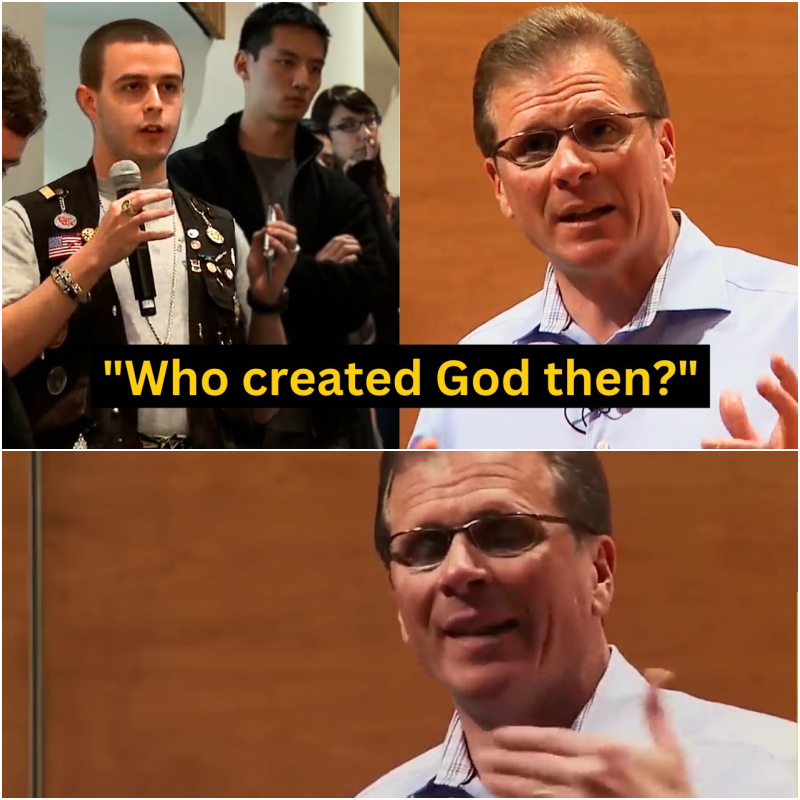
“As I understood, you’ve argued that a painting or a creation implies a painter or a designer,” Carter begins, his voice steady. “But I must ask: who designed God? And if no one designed God—if God is timeless, spaceless, and immaterial, and he existed eternally in an uncaused fashion—then why can’t nature exist in the exact same way? Why can’t our uncaused origins be as marvelous and precise as God, but be natural causes?”
The room goes quiet. It is a formidable challenge, targeting the very core of the cosmological argument. The exchange that follows offers a fascinating glimpse into the modern battle for the secular mind, showcasing a rare mix of scientific taxonomy, philosophical gymnastics, and an unexpected pivot into the deeply personal territory of human free will and the nature of hell.
The “SURGE” of Cosmic Origins
Turek does not flinch. In fact, he beams. “Good question,” he responds. “Excellent question, Carter.”
Turek concedes that Carter has correctly framed the ultimate binary of existence: either the universe itself is the uncaused first cause, or something outside and beyond the universe is. The disagreement, Turek argues, is not a matter of philosophical preference, but of empirical evidence.
To map out why the universe cannot be the eternal, uncaused entity Carter suggests, Turek deploys one of his signature pedagogical tools—the acronym SURGE. It is a five-pronged scientific defense designed to show that the cosmos had a definitive, absolute beginning, ruling out its own past eternity.
S – The Second Law of Thermodynamics
The universe, Turek points out, is systematically running out of usable energy. If the cosmos had existed from an infinite past, it would have suffered “heat death” an eternity ago. The fact that the universe still possesses active, burning energy implies it had a starting point—someone or something, metaphorically speaking, had to wind the clock up.
U – The Expanding Universe
Discovered by Edwin Hubble in 1929, the physical expansion of the universe means that if you mathematically reverse the cosmic timeline, the entire fabric of space-time collapses back into a single point. This singularity represents a state of infinite density—effectively nothingness before the explosion of creation.
R – Radiation Afterglow
In 1965, Arno Penzias and Robert Wilson accidentally discovered the Cosmic Microwave Background radiation. This remnant heat, lingering across the cosmos, serves as the definitive “smoking gun” of the Big Bang, confirming a sudden, cataclysmic beginning.
G – Great Galaxy Seeds
Satellite data later revealed microscopic temperature variations within that radiation afterglow. These “seeds” allowed matter to clump together, forming the vast galaxies we observe today, demonstrating an extraordinary level of precision at the birth of the universe.
E – Einstein’s Theory of General Relativity
Albert Einstein’s equations showed that space, time, and matter are co-relative—they are interdependent and must have come into existence together. Space-time did not exist prior to the Big Bang; it was created at the Big Bang.
“The evidence points to the fact that the universe is not the uncaused first cause,” Turek concludes. “So there must be something beyond the universe that is. And that thing must be spaceless, timeless, and immaterial. If you are timeless, do you have a beginning? No. Therefore, God did not have a first cause.”
Redefining the “Other Dimension”
What makes the interaction truly compelling is Carter’s response. Eschewing the typical internet-debate posture of stubborn defiance, the student displays a striking level of intellectual humility.
“I do not have the training or expertise to refute arch science,” Carter admits openly. “And in fact, I accept your conclusion that the Big Bang had a beginning and space, time, and matter came into existence from a point of origin.”
However, Carter quickly pivots to a sharper, more nuanced philosophical line of defense. Accepting a cosmic beginning does not mean accepting the God of Abraham. “We do not know that this point of origin is God,” Carter argues. “Calling it God is to make a false assumption. Another reason for the existence of everything might simply be that other dimensions had the power, marvelousness, and complexity to create a situation where the Big Bang could be brought into existence… without an intelligent designer having a hand.”
Turek smiles, seizing on what he views as a semantic concession rather than a refutation.
“Carter, what you just described there is what we would call God,” Turek counters. “God is in another dimension that has the ability to bring these dimensions into existence. So if you want to call it another dimension, you can call it that—but that’s exactly what we mean by God.”
The Ultimatum of Free Will and Hell
The debate quickly shifts gears from the cold calculations of astrophysics to the fraught, emotionally charged landscape of theology. If this uncaused first cause is merely an “other-dimensional force,” Carter asks, why the complex scaffolding of religion? Why is there theology? Why must humans worship this entity?
“You don’t have to worship God,” Turek replies, pointing to Aristotle and Plato, who deduced the logical necessity of an “unmoved mover” but never built an apparatus of worship around it. “God loves you enough to give you free will. You can love him or reject him; that’s up to you.”
But Carter steps forward with the classic counter-dilemma of modern secularism: the perceived coercion of salvation.
“You do have the free will to accept or reject God,” Carter observes. “But the obvious conclusion is that the rejection of God will lead to eternal damnation in hell. So, in reality, we do not really have the choice… We must ultimately accept God, assuming we choose to avoid perdition.”
Turek pauses, acknowledging the weight of the objection. To answer it, he strips away the medieval imagery of fire and brimstone, redefining hell through the lens of relational volition.
He shares a story from a previous debate at the University of Michigan with an atheist attorney, Eddie Tabash. Tabash had asked Turek a deeply personal question about his own mother, a Holocaust survivor who lived a tragic life and ultimately rejected the Christian gospel. Is she in hell right now? Tabash had demanded.
“Eddie, I don’t know where your mother is,” Turek recalls telling him. “But if she didn’t [accept God], then God will not force her into his presence against her will. God is too loving for that.”
To illustrate this to Carter and the university audience, Turek uses a domestic analogy. He asks the women in the room if they have ever been relentlessly pursued by a man they had no interest in dating. When a suitor refuses to accept “I just want to be friends” and tries to force a relationship, it ceases to be romance; it becomes coercion.
“Love, by definition, must be freely given,” Turek argues. “If he truly loves you, what would he do? He would leave you alone. That’s exactly what God does. He keeps sending us cards, letters, and flowers while we’re here. And if we keep rejecting him, he gives us up to our own desires. That is ultimately what hell is: separation from God. You are free in hell… but you are confined to hell. Hell is a quarantine of evil.”
Moving Beyond the Microscope
As the dust settles on the formal exchange, the broader implications of the debate linger. Critics of Turek’s approach often note that moving from a cosmological “first cause” to a personal Savior requires a massive leap of faith.
Commentators analyzing the interaction note that arguments like SURGE are merely “square one”—a cognitive stepping stone. The cold abstractions of science can prove a beginning, but they cannot prove a personality.
The transition from a distant, Aristotelian “unmoved mover” to a deity worthy of worship requires switching epistemological tracks. The Christian defense relies on a cumulative case that moves from cosmology to history—specifically, the life, death, and reported resurrection of Jesus of Nazareth.
For believers, this is where the argument shifts from a laboratory experiment to a personal relationship. Just as one cannot prove a spouse’s love merely by putting their brain chemistry under a microscope, apologists argue that God cannot be fully known strictly through the lens of empirical science. The Christian narrative holds that the “other dimension” Carter spoke of actually entered human history in the form of a person named Emmanuel—meaning “God with us.”
Ultimately, the standing-room-only crowd at the university auditorium left with two starkly different worldviews to ponder. For the secular skeptics, the question remains whether the mysteries of our cosmic origins can eventually be explained by a deeper, yet undiscovered layer of natural physics and higher dimensions. For the believers, the debate was an elegant confirmation that the universe cries out for a Creator who respects human autonomy so deeply that He allows them the tragic freedom to say no.









