Most Disturbing Deaths Scientists Still Can’t Explain
Most Disturbing Deaths Scientists Still Can’t Explain
Late on the frozen night of January 16, 2008, a photocopier representative named Michael Anthony was driving home along a pitch-black, two-lane road in Devon, England, when the air inside his car suddenly turned hostile, his hands went completely numb, and a pair of massive, animalistic paws covered in coarse hair materialized out of thin air to wrench his steering wheel toward a fatal ditch.
Part I: The Grip on the Wheel
The Cold Road from Postbridge
For Michael Anthony, the highway was a second home. As a traveling representative for one of the largest photocopier corporations in Great Britain, his entire career was defined by the steady hum of tires on asphalt and the slow accumulation of hundreds of miles a week. Driving at odd hours through unfamiliar, winding country lanes was simply the price of doing business.
On this particular night, his spirits were exceptionally high. He had just concluded a highly lucrative meeting in Postbridge, a tiny, historic village nestled deep within the rugged expanse of Dartmoor. A client setting up a new enterprise had agreed to lease several high-end copiers, and the contract was secure. With his work finished and the professional pressure lifted, Michael settled into the long, late-night drive back to Bristol, where his wife and two young daughters were asleep.
It was a clear, beautiful winter night. Above the open, treeless landscape of the moors, the sky was a brilliant canopy of stars. Michael looked forward to the solitary drive as a chance to unwind, knowing that within a few hours he would be safely back in his own home.
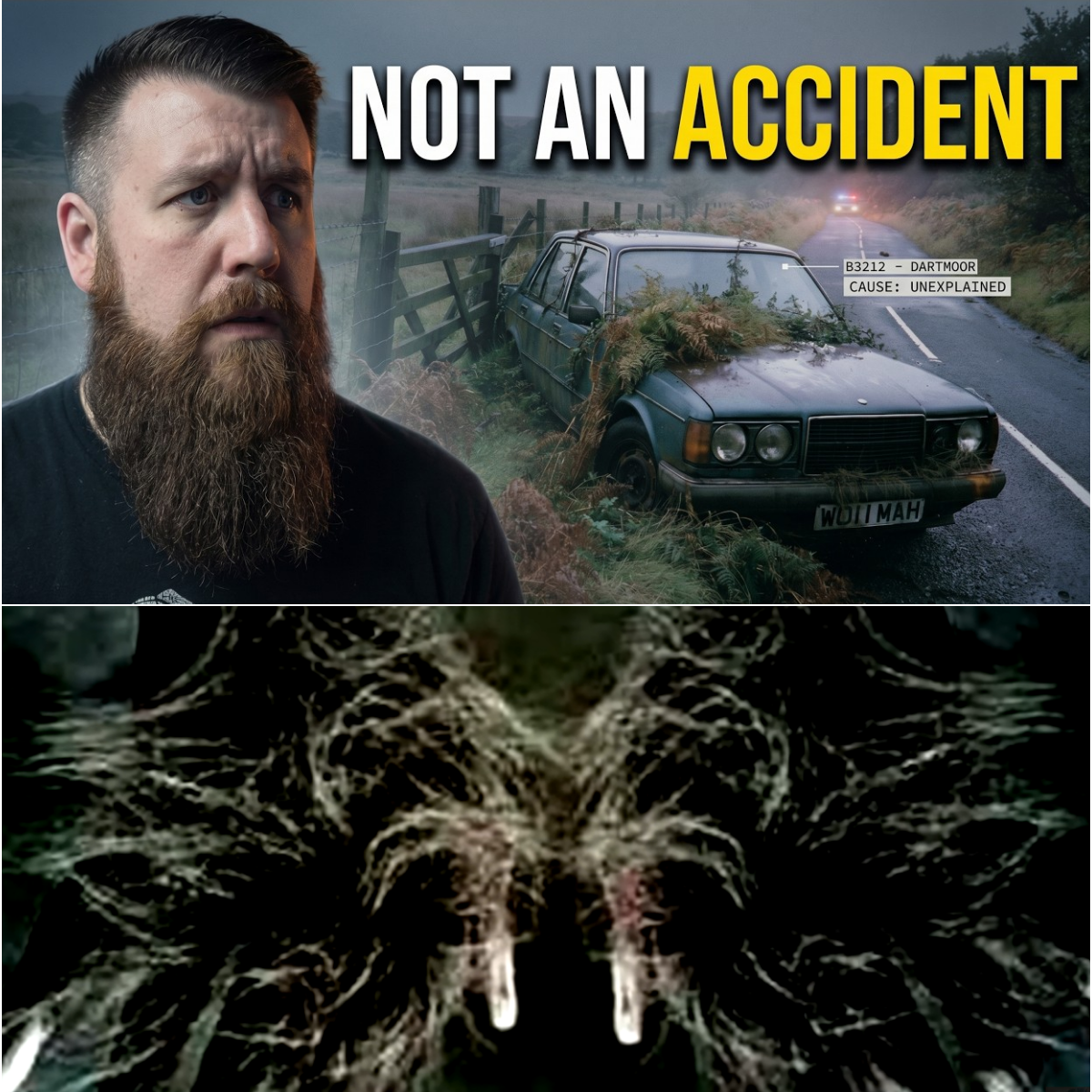
But as the lights of Postbridge faded from his rearview mirror, the peaceful atmosphere shattered.
[Chronology of Michael Anthony's Encounter - Jan 16, 2008]

  10:45 PM: Leaves Postbridge ──> 10:50 PM: Sudden Visceral Dread ──> 10:53 PM: Somatic Numbness ──> 10:55 PM: Materialization & Struggle
It began with a bizarre physical reaction. His skin grew suddenly cold—not the superficial chill of a faulty car heater or a cracked window, but a deep, clammy, internal dampness that seemed to seep outward from his very bones. It was a primitive somatic response, a biological alarm system triggering before his conscious brain could comprehend why.
An overwhelming weight of absolute dread settled into his chest. It was a pure, gut-level conviction that he was in immediate danger, despite the empty, peaceful road ahead.
The Materialization
Michael gripped the steering wheel tighter, desperately trying to rationalize the sensation as mere exhaustion. He had been working grueling hours, it was nearing 11:00 PM, and the vast, black emptiness of Dartmoor was notorious for playing tricks on a tired driver’s mind. Just get to the motorway, he told himself. Get home, get some rest, and this will pass.
Then, the air inside the cabin physically changed. It grew heavy, oppressive, and thick with an unmistakable aura of pure malice. The sensation of being utterly alone vanished; the space became crowded with a hostile presence that felt actively malevolent.
Suddenly, a profound numbness struck both of his hands simultaneously. Michael stared down in disbelief as the sensation drained completely from his fingers and palms, leaving them white and unfeeling. His immediate thought was one of medical terror: I am thirty-six years old, I am having a stroke, and I am going to die alone on this moor.
But it was not a stroke.
As he fought to maintain control of the vehicle with his deadened hands, a pair of massive, grotesque hands materialized directly over his own.
   [ Anatomy of the Apparition ]

   Human Attributes:  Distinct knuckles, fingers, and opposable grip.
   Animal Attributes: Enormous scale, muscular build, and a thick coating of coarse, dark hair.
   Anatomical Void:   Completely severed at the wrist—no arms, no shoulders, no body.
These were not the hands of a human being. They were massive, muscular paws covered in a dense coating of coarse, dark hair, looking more like the appendages of a wild beast than a man. Horrifyingly, they were entirely self-contained. There were no arms attached to them, no shoulders, and no body. They simply existed as a pair of disembodied, powerful hands, clamped down with agonizing force over Michael’s fingers on the steering wheel.
Before a single scream could escape his throat, the hairy hands violently wrenched the wheel to the left, forcing the car off the asphalt and targeting the dark, rocky ditch at the side of the road.
Instinct overrode his paralysis. Michael threw his entire body weight against the steering wheel, fighting the invisible musculature of the entity. With a desperate heave, he managed to straighten the car just before it left the road.
Immediately, the hands jerked the wheel again, harder this time. The car fish-tailed wildly on the narrow lane as Michael fought a life-or-death tug-of-war against a disembodied nightmare. Three times the entity tried to force him into a catastrophic crash, and three times Michael held the line, his muscles straining against a terrifyingly physical force.
       [ The Three-Phase Assault & Extinction ]

   Assault 1: Sudden Leftward Wrench ───> Straightened by Driver Instinct
   Assault 2: High-Velocity Jerk     ───> Countered by Driver Bodyweight
   Assault 3: Final Violent Swerve   ───> Resisted; Triggered Flash & Sulfur Void
Then, as abruptly as they had appeared, the hands vanished. Their departure was marked by a blinding burst of white light that illuminated the entire interior of the car like a high-powered camera flash going off inches from his eyes.
Instantly, the cabin was saturated with a sickening, overpowering stench—a sharp, chemical aroma of rotten eggs and burning brimstone that left him gagging on the verge of vomiting.
Michael did not slow down. He did not pull over to check the tires or process the trauma. He slammed his foot onto the accelerator and raced away from the moors, not letting up until he reached the bright, mundane safety of a 24-hour service station on the M5 motorway. Shaking, sweating, and profoundly traumatized, he sat in the fluorescent light of the gas station, entirely unaware that he had just become the latest chapter in a century-old haunting.
Part II: The Ghostly Record of the B3212
The Hound’s Landscape
To understand the nightmare that overtook Michael Anthony, one must understand the unique, atmospheric isolation of Dartmoor. Situated in the southwest of England, Dartmoor is a vast, ancient landscape of windswept heather, deep bogs, and eerie granite summits known as tors. It is an isolated terrain where weather patterns shift with terrifying speed, dropping dense, blinding walls of fog over the landscape in a matter of minutes.
+--------------------------------------------------------------------------+
|                     THE LITERARY AND MYSTICAL MOOR                       |
+--------------------------+-----------------------+-----------------------+
| Year / Era               | Cultural Marker       | Supernatural Link     |
+--------------------------+-----------------------+-----------------------+
| 1902                     | Conan Doyle's Novel   | Hound of the Basker.  |
| 1910–1920                | Early B3212 Reports   | Handlebar Tugging     |
| 1921                     | The Helby Fatality    | Mechanical vs Ghostly |
+--------------------------+-----------------------+-----------------------+
This bleak wilderness has long held an iconic place in the British supernatural consciousness. Its brooding atmosphere directly inspired Sir Arthur Conan Doyle to pen his masterpiece, The Hound of the Baskervilles, in 1902. But while Doyle’s demonic hound was a work of fiction, the stretch of road Michael was traveling—the B3212, which cuts directly through the heart of the moor between Postbridge and Two Bridges—held a real-world reputation that was far more terrifying to locals.
The phenomena began around 1910, an era when transportation across the moors was transitioning from horse-drawn carts to early motor vehicles and bicycles. Cyclists traveling this specific stretch of the B3212 began returning to nearby villages with broken bones and shaken nerves. They reported that while riding along flat, straight sections of the road, their handlebars would be suddenly and violently snatched out of their grip by an invisible, muscular force, sending them crashing into the turf.
           [ Evolution of Target Vehicles on the B3212 ]

   1910s: Bicycles & Pony Carts ───> Handlebars yanked, reins pulled sideways
   1920s: Motorbikes & Tour Buses ──> Open steering mechanisms seized
   2000s: Modern Enclosed Cars   ───> Complete cabin penetration & physical combat
Drivers of traditional pony carts spoke of their horses being suddenly spooked as the leather reins were jerked to one side by an unseen entity. As early motorcars and transport coaches became more common, motorists began echoing the exact same complaint: an unnatural, violent lurch of the steering wheel, as if a hitchhiker from hell had reached out from the dark and grabbed the controls.
For a decade, these stories were confined to the warm, fire-lit interiors of local pubs—tales told over pints of ale to warn tourists about the dangers of driving too fast on Devon’s narrow, lopsided country lanes. Most people assumed it was a mixture of bad driving, fatigue, and the naturally treacherous nature of the terrain.
Then came the summer of 1921, and the legend of the B3212 claimed its first life.
Part III: The Summer of Blood
The Tragedy of Dr. Helby
Just off the lonely corridor of the B3212 sits HM Prison Dartmoor, a grim, imposing stone fortress originally constructed in 1809 to house prisoners of the Napoleonic Wars. In June of 1921, the prison’s medical officer was a respected physician named Dr. Ehlby.
On a clear summer afternoon, Dr. Helby was riding his heavy vintage motorcycle along the road, heading toward the prison quarters. Packed into the attached wicker sidecar were his two young daughters. The family was enjoying a scenic ride through the moorland when, without warning, the motorcycle began to pitch and weave violently across the road.
      [ The 1921 Helby Accident Profile ]

      Vehicle:       Vintage Motorcycle with Wicker Sidecar
      Location:      B3212 near Princetown
      Somatic Action: Doctor shouts to daughters to jump clear; they survive with minor abrasions.
      Fatal Impact:  Doctor thrown headfirst into the turf; suffers a fatal fractured skull.
Recognizing that the machine was completely out of his control, Dr. Helby screamed at his daughters to jump clear of the sidecar. The young girls leaped into the soft heather at the edge of the road, escaping with minor bumps and scrapes.
But their father was not so fortunate. The motorcycle violently turned over, launching Dr. Helby headfirst onto the hard road. He died instantly from a fractured skull.
An official inquest was quickly convened to investigate the death of a high-ranking government employee. The coroner inspected the wreckage and noted that the wheel spokes and the main axle had shattered, listing the official cause of the crash as a catastrophic mechanical failure. It was a tragic, explainable accident of early motoring—or so the authorities desperately hoped.
The Cherabang and the Captain
Only a few weeks after Dr. Helby was laid to rest, a cherabang—a large, open-topped charabanc bus loaded with holiday tourists—was traveling down the exact same stretch of the B3212. Without warning, the heavy bus swerved sharply across the oncoming lane and rammed into a steep earthen bank on the opposite side of the road.
In an era long before seatbelts, the sudden impact launched several passengers into the air, leaving multiple tourists seriously injured.
When investigators interviewed the driver, expecting him to confess to looking away or losing his brakes, they were met with a statement that defied logic. The driver, pale and visibly trembling, insisted that he had been driving well under the speed limit when an invisible force seized the steering mechanism.
He described looking down and seeing a large, grotesque pair of hairy hands clamp onto the steering wheel, physically overpowering him and steering the bus into the dirt. Because the man was in a clear state of medical shock, his testimony was quietly dismissed by the transport company.
[ The August 1921 Media Flashpoint ]

  Military Captain Crashes Motorcycle ──> Refuses Initial Press Inquiries ──> Confesses to "Hairy Hands" ──> London Press Makes It National News
But on August 26, 1921, the phenomenon struck someone whose credibility could not be easily brushed aside: a highly decorated Captain in the British Army.
The Captain, an exceptionally experienced motorcycle rider, was traveling the B3212 when his bike was violently forced off the road, throwing him into the turf. He survived the crash by a matter of inches. When local reporters tracked him down in the hospital, the officer was highly reluctant to speak, fearing the damage a supernatural claim would do to his military career.
Eventually, under intense pressure from the press, the Captain issued a formal, chilling statement:
“I was riding along at a moderate speed when I felt a sudden coldness, and then a pair of large, muscular, hairy hands clamped directly over mine on the handlebars. I wrestled with all my strength to keep the bike straight, but the physical power of those hands was completely overwhelming. They intentionally steered me into the ditch.”
The Captain’s testimony changed everything. Over night, the “Hairy Hands of Dartmoor” transformed from a local folktale into front-page news across the entire United Kingdom. Major newspapers in London sent investigative journalists to Devon, and the small country road became the center of a national scientific debate.
Part IV: The Camber and the Caravan
The Skeptical Fix
With the reputation of Devon’s tourism industry at stake, government officials and engineers stepped in to provide a rational explanation for the escalating body count on the B3212.
The supernatural was off the table. Instead, a popular theory emerged suggesting that vast deposits of magnetic iron ore buried deep beneath the moorland were creating localized electromagnetic anomalies. It was theorized that these underground magnetic fields were violently pulling on the heavy iron steering linkages of early automobiles and motorcycles, creating the physical sensation of an external hand grabbing the wheel.
       [ The Engineering Solution vs. Supernatural Reality ]

   Skeptical Theory: Dangerous road camber pulls vehicles at high speeds.
   The Fix:           Civil crews level the asphalt and re-align the curves (1921–1922).
   The Failure:      1924 Caravan incident occurs 0.5 miles AWAY from the road surface.
Civil engineers were dispatched to survey the asphalt. While they found no magnetic anomalies, they discovered a severe flaw in the construction of the road itself: the camber—the lateral slope of the road surface—was dangerously steep and lopsided at several points. If an inexperienced driver hit these uneven curves at high speed, the physics of the road would naturally yank the steering wheel violently to one side.
The local council immediately authorized extensive roadworks. The lopsided sections were leveled, the asphalt was resurfaced, and the dangerous camber was permanently corrected. The press declared the mystery solved, the road was deemed safe, and the public expected the ghost of the B3212 to fade into history.
The Window at Powder Mills
The engineering theory was completely dismantled just three years later, in the summer of 1924.
An Englishwoman and her husband were vacationing in Dartmoor, staying in a small caravan (a vintage towed camper) parked near the historic stone ruins of the Powder Mills—an abandoned nineteenth-century industrial site located more than half a mile away from the actual asphalt of the B3212.
Late one night, while her husband slept soundly beside her, the woman was jolted awake by a sudden, intense wave of primal terror. There had been no noise, no nightmare, and no external disruption; it was simply a sudden, icy sensation that her life was in imminent danger.
[ Spatial Mapping of the 1924 Powder Mills Incident ]

  |─────────────────────── 0.5 Miles of Open Moorland ───────────────────────|
  [B3212 Roadway: Level & Fixed]                                             [Powder Mills: Caravan Window]
                                                                              * Single Hairy Hand scales the glass
                                                                              * Targets a small open ventilation gap
Her bunk faced a small glass window that had been cracked open a few inches to allow for ventilation. As she lay paralyzed in her bed, trying to steady her breathing, she noticed a movement outside the glass in the moonlight.
To her horror, she watched a single, gigantic hand, covered in thick, dark hair across the back and knuckles, scaling the exterior wall of the caravan. It was moving with an unnatural, arachnid agility, crawling upward toward the open gap at the top of the window.
Realizing that no physical weapon would save her from an entity that defied nature, the woman instinctively made the sign of the cross and began to whisper a frantic prayer. Miraculously, the hairy hand paused on the glass, recoiled as if burned, and slowly slid down out of sight into the black heather.
The encounter shook the investigative community to its core. The road had been fixed, the camber was flat, and yet the entity had materialized half a mile into the wilderness to terrorize a stationary target. The problem was not the engineering of the road; the problem was the land itself.
Part V: The Unbroken Pattern
The Bridge and the Windshield
As the decades rolled on, the B3212 continued to collect encounters, establishing an eerie, repetitive pattern of somatic coldness, sudden loss of control, and fractured skulls.
[ Historical Timeline of Verified B3212 Encounters ]

  1947: Young Exeter couple crashes at Cherry Brook Bridge (Boyfriend suffers fatal fractured skull).
  1960s: Florence Warwick sees dual hands pressed flat against her stationary windshield.
  1961: Princetown motorcyclist reports rough, hairy hands clamping over his controls.
  2008: Michael Anthony encounters hands accompanied by a flash of light and sulfur.
In September of 1947, a young couple from Exeter was riding home from Princetown on a motorcycle with an attached sidecar. As they neared the historic stone arches of the Cherry Brook Bridge, the motorcycle did something completely unnatural: instead of slowing down for the approach, the engine began to rev and accelerate on its own, while the handlebars began to wobble uncontrollably.
The young woman was launched clear into the soft grass, surviving the impact. But her boyfriend remained trapped on the runaway machine, crashing at high speed into the stone parapet of the bridge. He died instantly of a fractured skull—the exact same fatal injury that had claimed Dr. Helby twenty-six years earlier.
Sometime in the early 1960s, a twenty-eight-year-old woman named Florence Warwick was driving the road at dusk when her car’s engine began to sputter and stall. She pulled over to the shoulder of the dark road, retrieved a travel guidebook from her glovebox to check her map coordinates, and tried to calm her nerves.
Without warning, an icy chill filled the car. Florence looked up from her book and gasped in horror. Pressed flat against the exterior of her windshield, directly in front of her face, were two massive, hairy hands.
   [ The Florence Warwick Window Matrix ]

   [ Windshield Glass ] ──> Two Massive Hairy Hands Pressed Flat
        ▲
        │ Inches away
        ▼
   [ Driver Face ]     ──> Paralyzed by Somatic Chill & Vocal Inability
Paralyzed by fear, she watched as the disembodied hands began to slowly crawl across the glass, their thick fingers leaving no marks on the moisture of the windshield. After what felt like an eternity of silent terror, Florence managed to let out a piercing shriek. The instant her voice cut the air, the hands vanished. Her car engine, which had been dead seconds before, instantly roared to life, and she fled the moor without stopping.
Years later, a respected Fleet Street journalist named Rufus Endle revealed to paranormal researcher Michael Williams that he too had been forced to fight a pair of phantom hands for control of his steering wheel near Postbridge. Because of his position as a high-profile, credible news reporter, Endle was so terrified of professional ridicule that he made Williams sign a binding agreement: his account could not be published until long after he had died.
Part VI: The Ghost in the Gunpowder
The Blacksmith of Powder Mills
What is the origin of the disembodied paws of Devon? Unlike most famous British hauntings, the standard lore surrounding the B3212 rarely includes an official backstory. There is no tragic jilted lover, no executed highwayman, and no ancient curse tied to the standard retellings. However, old-time residents of the moors point to a tragic industrial accident that occurred during the nineteenth century.
In the early 1800s, the Dartmoor Powder Mills operated as a major industrial facility, manufacturing volatile blasting gunpowder for the region’s massive granite quarries. Due to the extreme danger of an accidental explosion, the facility operated under an ironclad set of safety rules.
The floors of the mixing houses were constructed entirely of smooth, spark-proof granite, and every worker was strictly required to change into rope-soled canvas shoes before entering the processing area.
                  ┌────────────────────────────────────────┐
                  │ The Powder Mills Fire-Spark Dynamic    │
                  └───────────────────┬────────────────────┘
                                      │
         ┌────────────────────────────┴────────────────────────────┐
         │                                                         │
         ▼                                                         ▼
   Standard Attire                                           Safety Protocol
Hobnail Boots (Steel Studs)                               Rope-Soled Shoes Only
         │                                                         │
         ▼                                                         ▼
[ Granite Floor Contact ] ───> Fatal Spark ───> Gunpowder Explosion ───> Total Disintegration
Standard working boots of the era were held together with steel studs known as hobnails. If a worker walked onto the hard granite floors wearing hobnail boots, the friction between steel and stone could throw off a single micro-spark—and near loose gunpowder, a single spark meant total destruction.
According to local lore, there was a worker at the mills who also served as the village blacksmith. He was an incredibly large, muscular man, widely respected for his strength, and known throughout the community for being exceptionally hairy.
One summer night, after spending a long evening drinking heavily at a local pub, the blacksmith walked back to the mills late at night to retrieve his personal tools. In his highly intoxicated state, he forgot to change his footwear.
The moment his steel-studded boots struck the granite floor of the mixing room, a spark ignited the residual powder. The subsequent explosion tore through the valley, leveling the stone building. When the smoke cleared, the blacksmith’s body had been completely vaporized—save for his massive, muscular hands, which were allegedly blown clean into the moor.
               ┌─────────────────────────────────┐
               │    The Blacksmith Mythos vs.    │
               │   The Forensic Sulfur Reality   │
               └────────────────┬────────────────┘
                                │
         ┌──────────────────────┴──────────────────────┐
         │                                             │
         ▼                                             ▼
     The Folk Myth                                 The Physical Clue
"The severed hands of a dead                  "The sudden flash of light, the somatic
blacksmith wander the road,                   numbness, and the heavy stench of sulfur
seeking their destroyed body."                point to an elemental, demonic entity."
Local legend claims that these severed hands have spent the last two centuries roaming the perimeter of the ruins, taking out their eternal, agonizing fury on anyone driving through their territory.
Historical records do show that the Powder Mills were plagued by real fatalities; a worker named Roger Northcote was killed in an explosion there in 1857, and another worker was burned to death in 1851, leaving behind a widow and five children.
The Sulfur Verdict
While the story of the drunken blacksmith offers a neat, poetic explanation for a local haunting, it fails to account for the specific, terrifying details reported by modern witnesses like Michael Anthony.
When the hands vanished from Michael’s steering wheel in 2008, they did not simply float away into the night or display human grief. Their departure was accompanied by a blinding, electrostatic burst of white light and an immediate, suffocating wave of rotten-egg sulfur gas—the classic, historical hallmark of a demonic or elemental manifestation.
The B3212 remains open to this day, a narrow ribbon of asphalt cutting through an ancient, dark landscape. The camber has been leveled, the signage is modern, and the vehicles are equipped with computerized steering and advanced safety systems. But as the fog rolls over the tors and the night turns cold, drivers still cross that lonely stretch between Postbridge and Two Bridges with their eyes fixed straight ahead, praying that they don’t feel a sudden chill—and that no secondary pair of hands reaches out from the dark to take the wheel.